Moving an Indian Business Operation to Dubai: What to Prepare and What It Costs

Topic Summary
Why Indian Founders Are Structuring Dubai Operations Now
Indian founders are moving operations to Dubai for proximity to global markets, streamlined licensing, and trade benefits under the India-UAE CEPA (Comprehensive Economic Partnership Agreement). Lower setup friction, English-language systems, and access to free zone structures make Dubai a practical base alongside an existing Indian entity.
What Is Moving an Indian Business Operation to Dubai and Why It Matters
What Is Moving an Indian Business Operation to Dubai and Why It Matters
Choosing a Structure: Free Zone Company for Indian Founders
A dubai free zone indian founder typically sets up under a free zone company because it allows full foreign ownership, simplified licensing, and visa sponsorship tied to the license. Free zone setup suits founders who trade internationally rather than sell directly within the UAE mainland market.
Understanding Tax Rules Before Moving an Indian Business Operation to Dubai
Federal Decree-Law No. 47 of 2022 sets UAE corporate tax at 9% above AED 375,000 profit, administered by the Federal Tax Authority (FTA). Indian founders must also address Income Tax Department obligations on Indian-sourced income and confirm which jurisdiction taxes their global earnings before relocating.
Steps to Prepare Your Documents and Company Records
Preparing documents for business setup in dubai from india involves passport copies, board resolutions, bank reference letters, and ICP-linked residency paperwork. GDRFA (General Directorate of Residency and Foreigners Affairs) handles entry permits while Emirates ID registration follows medical fitness and biometrics once the visa stage begins.
What It Costs to Relocate or Duplicate Your Operation
Costs for moving an indian business operation to dubai include license fees, visa packages, office space, and bank account setup. Founders remitting funds from India must work within RBI LRS limits, currently USD 250,000 per financial year per individual, when transferring capital for share subscription.
Common Mistakes Indian Founders Make When Relocating
Common mistakes when moving an indian business operation to dubai include skipping name checks, underestimating RBI remittance rules, and mismatched activity descriptions between Indian and UAE company records. These errors delay licensing and residency approval by weeks in many cases.
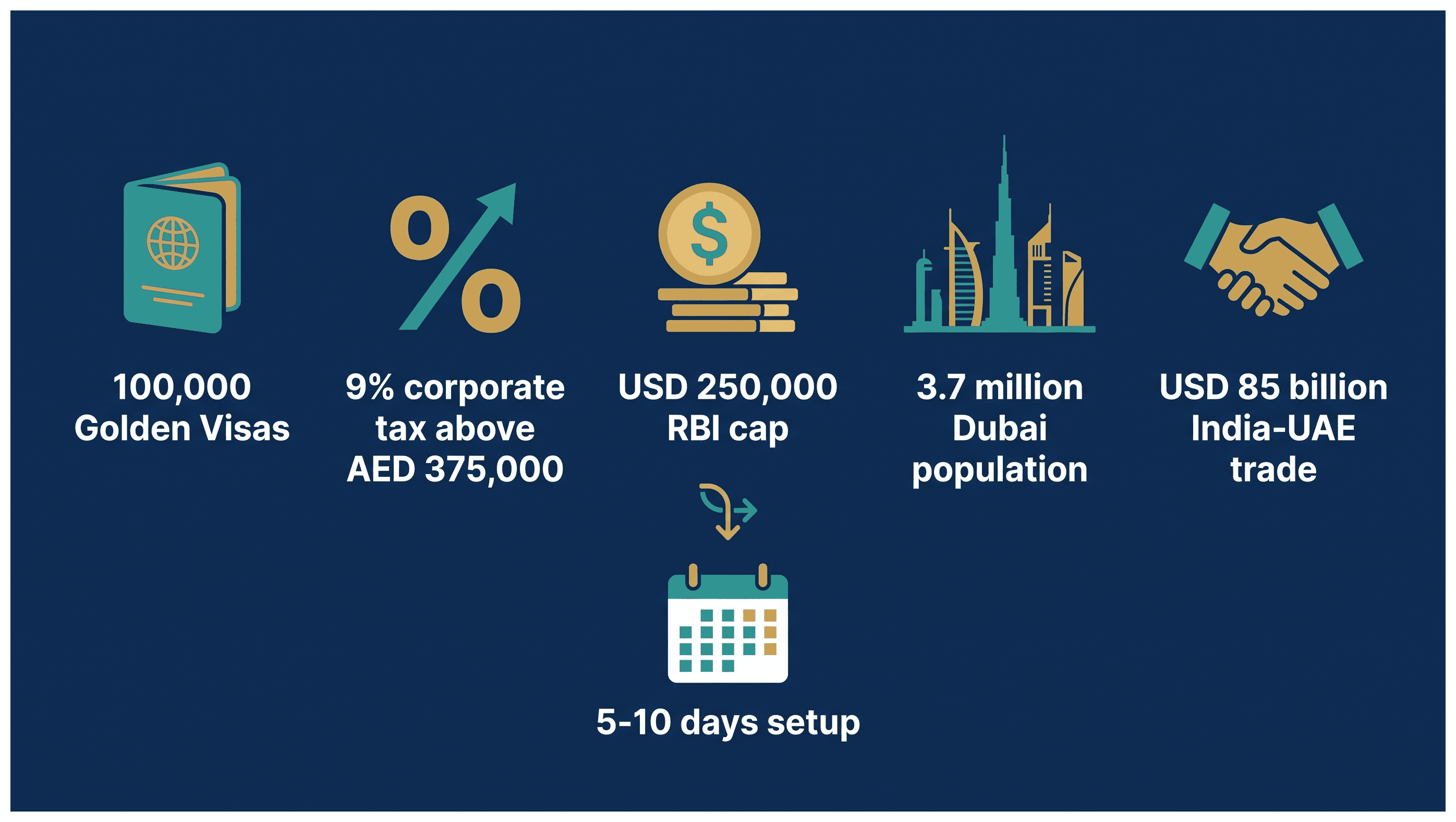
In 2026, over 100,000 Golden Visas have been issued across the UAE, and a growing share now goes to Indian founders relocating or duplicating operations (ICP, 2026). Roughly 9% corporate tax applies above AED 375,000 profit under Federal Decree-Law No. 47 of 2022. USD 250,000 is the yearly RBI remittance cap per person. Dubai's population passed 3.7 million in 2024 (Dubai Statistics Center, 2024). Trade between India and the UAE crossed USD 85 billion in FY2023-24. Setup timelines for a free zone license often run 5 to 10 working days. That's the backdrop for anyone weighing moving an indian business operation to dubai this year.
Why Indian Founders Are Structuring Dubai Operations Now
Indian founders are moving operations to Dubai for proximity to global markets, streamlined licensing, and trade benefits under the India-UAE CEPA (Comprehensive Economic Partnership Agreement). Lower setup friction, English-language systems, and access to free zone structures make Dubai a practical base alongside an existing Indian entity.
Trade Advantages Under the India-UAE CEPA
The CEPA, in force since 2022, cuts tariffs on a wide range of qualifying goods traded between the two countries. That means a Mumbai textile exporter opening a Dubai trading entity can re-export to Africa and Europe with lower duty friction and faster paperwork. Invoicing across borders gets simpler too, since UAE trade documentation aligns closely with what Indian customs already expects. For exporters chasing new markets, that's a real edge over setting up somewhere without a comparable trade deal.
Running Two Entities Side by Side
Plenty of founders don't shut down their Indian company at all. A Bengaluru SaaS founder might keep the dev team in India while billing global clients through the Dubai entity. This works because the two companies serve different functions: one handles domestic delivery, the other handles international invoicing and banking. Coordinating directorships across both takes some planning, but it's a common structure among founders moving to Dubai from India.
What Is Moving an Indian Business Operation to Dubai and Why It Matters
Moving an indian business operation to dubai means relocating, duplicating, or extending an Indian company's activity into a UAE free zone entity. It covers licensing, visa sponsorship, banking, and compliance with both Indian and UAE authorities, allowing founders to trade internationally under a UAE trade license (u.ae, 2025).
Relocation vs Duplication
Full relocation winds down Indian operations.
Duplication keeps both entities running.
Your choice hinges on client base and residency goals.
Some founders test duplication first, then relocate later.
Who This Path Suits
Exporters and traders reaching new regions.
Consultants billing international clients directly.
Tech and e-commerce founders selling globally.
Service providers wanting a UAE banking presence.
Is moving your business to Dubai worth it for Indian founders?
It's worth it if you trade internationally, want easier banking, or need a UAE address for clients. It's less useful if your business is purely domestic Indian retail with no cross-border ambition.
Choosing a Structure: Free Zone Company for Indian Founders
A dubai free zone indian founder typically sets up under a free zone company because it allows full foreign ownership, simplified licensing, and visa sponsorship tied to the license. Free zone setup suits founders who trade internationally rather than sell directly within the UAE mainland market.
Matching License Type to Activity
You'll need to pick between trading, professional, or ICT (information and communication technology) license categories before anything else moves forward. A Delhi-based consultant offering advisory work would go for a professional license, not a trading one. The activity you choose also determines your visa quota, so confirm it before you reserve a name. Get this wrong and you'll be amending documents later, which costs time and sometimes money.
Reserving Your Trade Name
Check name availability before drafting any incorporation documents. Restricted or trademarked terms get rejected, and that delays everything downstream. Reserving early through a tool like a business name availability check locks in your branding while you finish the rest of the paperwork. Free zone setup, generally speaking, offers full foreign ownership and a quicker path than mainland routes, which suit direct UAE retail trade instead.
Understanding Tax Rules Before Moving an Indian Business Operation to Dubai
Federal Decree-Law No. 47 of 2022 sets UAE corporate tax at 9% above AED 375,000 profit, administered by the Federal Tax Authority (FTA). Indian founders must also address Income Tax Department obligations on Indian-sourced income and confirm which jurisdiction taxes their global earnings before relocating.
Corporate Tax Basics Under the FTA
Profit above AED 375,000 gets taxed at 9% (FTA, 2025). Registration with the FTA has strict timelines, and missing them brings penalties. Free zone companies can qualify for preferential treatment on certain income, but that depends on meeting specific substance and activity conditions set by the FTA (Ministry of Finance, 2025).
Staying Compliant With the Income Tax Department
If you're still an Indian tax resident, the Income Tax Department expects you to declare foreign income. This is where a chartered accountant earns their fee, since double taxation issues crop up fast if residency status isn't clarified early. Get this sorted before you start moving money, not after.
Steps to Prepare Your Documents and Company Records
Preparing documents for business setup in dubai from india involves passport copies, board resolutions, bank reference letters, and ICP-linked residency paperwork. GDRFA (General Directorate of Residency and Foreigners Affairs) handles entry permits while Emirates ID registration follows medical fitness and biometrics once the visa stage begins.
Key Facts: Setting Up a Dubai Entity as an Indian Founder
Feature | Requirement | Detail |
|---|---|---|
Corporate tax | 9% above AED 375,000 profit | Administered by the FTA under Federal Decree-Law No. 47 of 2022 |
RBI remittance limit | USD 250,000 per person per year | Applies under the Liberalised Remittance Scheme (LRS) |
Residency stages | Entry permit, medical test, Emirates ID | GDRFA handles stamping; ICP oversees status change |
License categories | Trading, professional, ICT, and more | Choice affects visa quota and permitted activity |
CEPA benefit | Reduced tariffs on qualifying trade | Speeds up cross-border invoicing and export flows |
Step 1: Gather Corporate and Personal Documents
Passport copies and photographs for each shareholder.
Board resolution authorising the Dubai entity.
Attested Indian company documents if duplicating.
Bank reference letter for shareholder verification.
Step 2: Apply Through ICP and GDRFA
ICP processes entry permits and status change.
GDRFA manages residency stamping in Dubai.
These timelines run alongside license issuance.
Step 3: Complete Emirates ID and Medical Checks
Book your biometric appointment early.
Complete the medical fitness test.
Collect the Emirates ID to finish residency.
For founders who'd rather not chase every form themselves, business support services at Dubai South Business Hub Free Zone handle much of this paperwork, and UAE residency services cover the visa side end to end.
What It Costs to Relocate or Duplicate Your Operation
Costs for moving an indian business operation to dubai include license fees, visa packages, office space, and bank account setup. Founders remitting funds from India must work within RBI LRS limits, currently USD 250,000 per financial year per individual, when transferring capital for share subscription.
License and Visa Package Costs
License fees vary by activity tier, and most packages bundle a set number of visas with the license itself. Budget for renewal in year two, since some authorities front-load discounts into the first-year price. Use a cost calculator before committing so you're not surprised by renewal pricing later.
Moving Capital Under RBI LRS
The Liberalised Remittance Scheme caps outward transfers at USD 250,000 per person per year (Central Bank of the UAE, 2025). A Pune founder might split remittance across family members to fund share capital without breaching this limit. Banks will ask for source-of-funds documentation, so gather that early. Timing your transfer with share subscription deadlines avoids last-minute banking delays.
Common Mistakes Indian Founders Make When Relocating
Common mistakes when moving an indian business operation to dubai include skipping name checks, underestimating RBI remittance rules, and mismatched activity descriptions between Indian and UAE company records. These errors delay licensing and residency approval by weeks in many cases.
Document Mismatches Between Jurisdictions
Small spelling differences in a company name between Indian and UAE records cause real headaches at the banking stage. Activity descriptions that don't align between the two entities raise questions during license review. Missing attestations on Indian documents are one of the most common holdups we see.
Underestimating Compliance Timelines
Don't assume your visa and license issue on the same day, because they usually don't. Renewal cycles need budgeting from day one, not month eleven. And FTA registration deadlines have real penalties attached if you ignore them.
Moving an indian business operation to dubai comes down to picking the right structure, lining up documents early, and budgeting realistically for licensing, visas, and remittance limits. Get the CEPA trade angle, the tax mechanics, and the RBI remittance rules sorted before you sign anything, and the rest of the process moves a lot faster.
Reach out to Business Support to prepare your file, or use the Cost Calculator to price out setting up or buying a license.
References
Frequently Asked Questions