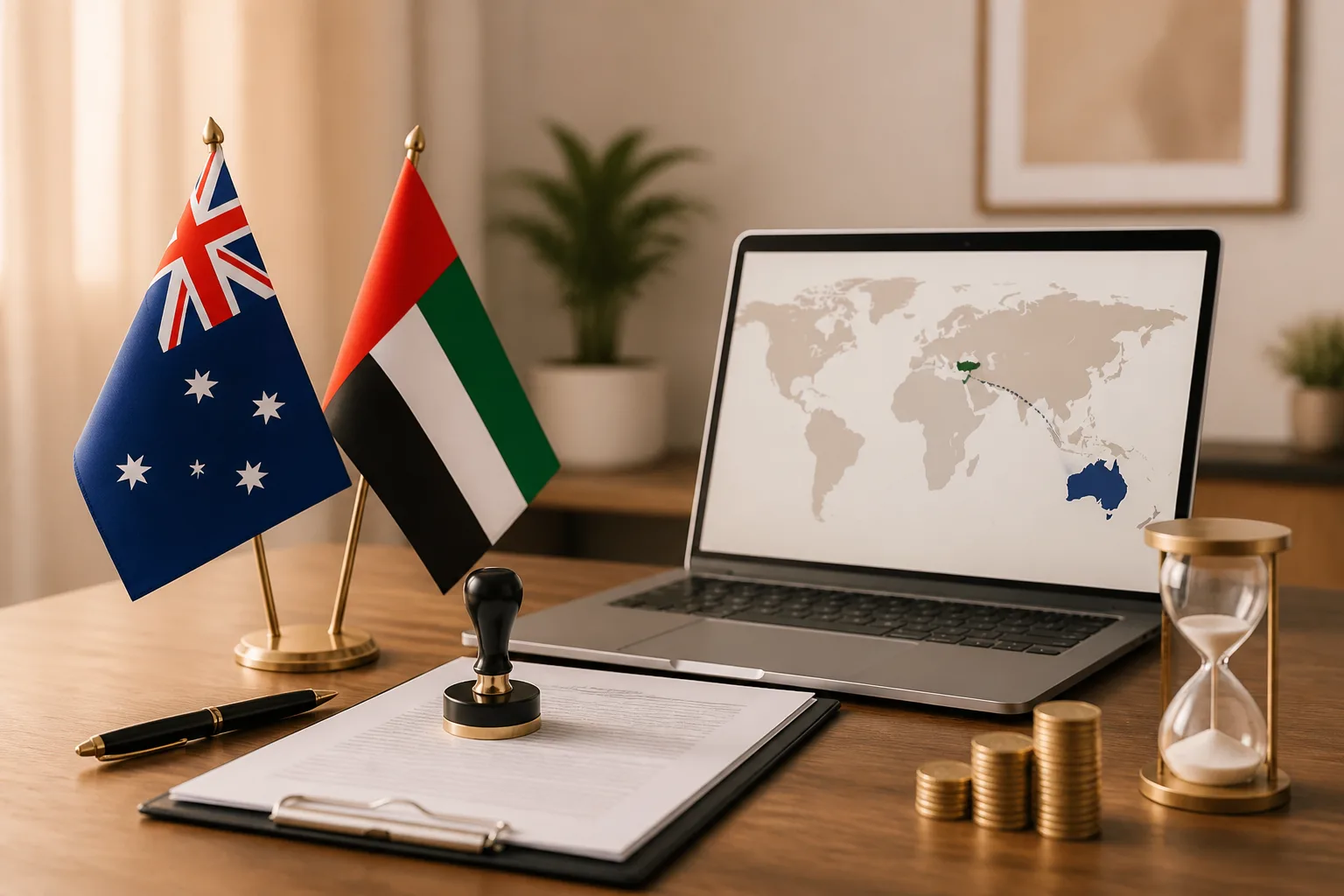
Open a Company in Dubai from Australia: Cost and Timeline
Topic Summary
Australian founders can open a Dubai free zone company with 0% personal income tax and 100% foreign ownership in four to eight weeks.
The UAE ranked 16th globally on the World Bank's Ease of Doing Business Index before the index was discontinued in 2021, and independent assessments since then consistently place it among the world's most business-friendly jurisdictions (World Bank, 2021). For Australian founders, the numbers are hard to ignore: 0% personal income tax, 100% foreign ownership in free zones, and a corporate tax rate of 9% on profit above AED 375,000 under Federal Decree-Law No. 47 of 2022. Year-one setup costs run from AED 15,000 to AED 35,000. The full process, from first document to Emirates ID in hand, takes four to eight weeks. And critically, the Australian Taxation Office (ATO) does not automatically release you from Australian tax obligations the moment you incorporate offshore.
This article walks you through exactly what it costs to open a company in Dubai from Australia, how long the process takes, what changes on tax at home and in the UAE, and the precise sequence of steps from license application to Emirates ID collected, so you can make a fully informed decision before committing a dollar.
What Is a Dubai Free Zone Company and Why It Suits Australian Founders
A Dubai free zone company is a legal entity licensed within a designated UAE economic zone, granting 100% foreign ownership, 0% personal income tax, and the right to repatriate all profits. For Australian founders looking to open a company in Dubai from Australia, it offers a credible international base with full ownership control and no requirement for a local partner, a structural advantage that mainland company formation does not provide without additional conditions.
The Core Structure: License, Visa, and Entity
Three elements form the foundation of any Dubai free zone company. Understanding how they connect saves you from costly surprises later.
License: Issued by the free zone authority, the trade license defines your permitted business activities. At Dubai South Business Hub Free Zone, it is the document that gives your entity legal standing. Explore the full list of business activities in Dubai to confirm your activity is covered before applying.
Visa: The license directly opens up residency visa eligibility. The founder and any staff they sponsor can apply for UAE investor or employment visas once the license and Establishment Card are in hand.
Entity: Your free zone company can operate globally and invoice international clients in any currency. Direct selling into the UAE mainland is restricted but can be addressed through a local distributor arrangement, a practical solution most founders manage without structural complexity.
An Australian e-commerce founder licensing a general trading activity at Dubai South Business Hub can invoice international clients, hold USD accounts, and sponsor their own two-year investor visa, all under a single license structure. Dubai South Business Hub's location adjacent to Al Maktoum International Airport and Expo City makes it particularly well-positioned for Australian trade routes into the Gulf and South Asia.
Key Facts at a Glance: Dubai South Business Hub Free Zone
Key Facts at a Glance: Dubai South Business Hub Free Zone
Feature | Detail |
|---|---|
Foreign ownership | 100%, no local partner required |
Personal income tax | 0%, a structural feature of UAE law, not a temporary concession |
Corporate tax | 9% on taxable profit above AED 375,000 (Federal Decree-Law No. 47 of 2022); 0% below threshold |
Typical year-one license cost | AED 15,000–35,000 inclusive of Establishment Card and one investor visa |
Visa eligibility | 2–6 investor/employee visas depending on package |
Setup timeline | 4–8 weeks from document submission to Emirates ID |
Corporate tax authority | Federal Tax Authority (FTA), registration via EmaraTax portal (tax.gov.ae) |
Worth flagging: the 0% personal income tax is not a free zone concession that expires or gets reviewed. It is embedded in UAE federal law. Corporate tax, however, is real and enforced by the Federal Tax Authority (FTA). Never describe the UAE as entirely tax-free, that framing creates compliance risk.
Australia vs. UAE: Tax and Ownership Environment Comparison
Feature | Australia | UAE (Dubai Free Zone) |
|---|---|---|
Personal income tax rate | Up to 45% + 2% Medicare levy (47% effective top rate) | 0%, no personal income tax under UAE federal law |
Corporate / company tax rate | 25% (small business base rate) or 30% (standard rate) | 0% below AED 375,000; 9% above (Federal Decree-Law No. 47 of 2022) |
Capital gains tax | Taxed at marginal income tax rate (50% discount for assets held 12+ months) | No personal CGT; exit CGT event may apply on departure from Australia |
VAT / GST | 10% GST on most goods and services | 5% VAT on UAE-based supplies; exports of services typically zero-rated |
Foreign ownership of business | Generally permitted; FIRB review applies above certain thresholds | 100% foreign ownership in free zones, no local partner required |
Dividend withholding tax | Up to 30% on unfranked dividends paid to non-residents | 0%, no dividend withholding tax in UAE |
Worldwide income basis | Yes, Australian tax residents assessed on worldwide income | Territorial basis for qualifying free zone income; UAE does not tax foreign-source income of residents |
Australia vs. UAE: What Actually Changes on Tax
Moving your business to Dubai does not automatically end your Australian tax obligations. The Australian Taxation Office (ATO) applies a residency test to determine ongoing liability, and an exit capital gains tax event may be triggered on departure. UAE corporate tax is 0% below AED 375,000 and 9% above, administered by the Federal Tax Authority (FTA). Getting this wrong has six-figure consequences, so read this section carefully before you move a dollar.
The ATO Residency Test and What It Means for You
The ATO uses a four-factor residency test, covering the resides test, domicile test, 183-day rule, and superannuation test, to determine whether a departing Australian remains a tax resident. Simply incorporating in Dubai does not sever Australian tax residency. You need physical relocation and a demonstrable, genuine intention to live in the UAE.
Until the ATO accepts you as a non-resident, your worldwide income remains assessable in Australia. That includes income earned through your UAE company if the ATO deems you still resident. The exit CGT (capital gains tax) event is triggered on the date you cease to be an Australian resident, crystallising a deemed disposal of certain assets at market value, this can be a significant cost even before you earn your first UAE dirham.
An Australian consultant who registers a Dubai company but spends 200 days a year in Sydney may still be assessed as an Australian tax resident by the ATO, meaning UAE income remains fully in scope for Australian tax.
Important: Get independent Australian tax advice before you depart. The exit CGT event alone can have six-figure consequences. This article is not tax advice.
UAE Corporate Tax Under Federal Decree-Law No. 47 of 2022
Federal Decree-Law No. 47 of 2022 introduced a 9% corporate tax rate on taxable profit exceeding AED 375,000, effective for financial years starting on or after 1 June 2023. Qualifying free zone entities, those meeting substance and income conditions set by the FTA, may be eligible for a 0% rate on qualifying income, but this is subject to conditions, not automatic.
The FTA requires corporate tax registration regardless of whether tax is actually payable. Registration is completed through the EmaraTax portal at tax.gov.ae. Missing the registration deadline carries penalties.
A software consultancy generating AED 500,000 in annual profit at Dubai South Business Hub would owe 9% on the AED 125,000 above the threshold, approximately AED 11,250, under Federal Decree-Law No. 47 of 2022, assuming no qualifying free zone relief applies. That is materially lower than Australia's 25–30% company tax rate, but it is not zero. Plan accordingly.
For detailed guidance on banking and taxation in the UAE, Dubai South Business Hub's Beyond Hub service provides structured support for founders navigating both FTA registration and corporate banking setup.
Step-by-Step Guide to Open a Company in Dubai from Australia
To open a company in Dubai from Australia, you choose a free zone and business activity, reserve your trade name, submit incorporation documents, pay license fees, receive your Establishment Card, apply for an Entry Permit via the Identity and Citizenship Authority (ICP), complete a medical fitness test, and collect your Emirates ID, typically in four to eight weeks. Here is the exact sequence.
Step 1: Choose Your Activity and Check Your Trade Name
Your business activity is not just a label, it determines your license type, visa quota, and what you are legally permitted to do. Trading, professional services, ICT, and education all carry different conditions. An Australian digital marketing agency, for example, would select a professional services activity rather than a trading activity. The distinction affects visa allocation and permissible operations in ways that are costly to fix post-incorporation.
Before submitting any application, use the company name availability check to confirm your preferred trade name is not already registered. UAE naming rules prohibit offensive terms, references to political or religious bodies, and names that are identical or confusingly similar to existing registrations. Activity selection is binding at incorporation; amendments are possible later but carry additional fees.
Step 2: Submit Incorporation Documents and Pay License Fees
Required documents for company formation in Dubai from Australia typically include:
Passport copies for all shareholders and directors
A business plan or activity description
Your proposed trade name (confirmed available)
A completed application form from the free zone authority
Documents originating in Australia may need attestation by the Australian Department of Foreign Affairs and Trade (DFAT) and then legalisation at the UAE Embassy in Canberra before submission. Budget one to two weeks for this step if your documents are not already certified.
Once approved, you receive the trade license and the Establishment Card. The Establishment Card is the free zone authority's official record of your company, without it, you cannot sponsor visas. A sole founder setting up a consultancy at Dubai South Business Hub typically receives the Establishment Card within five to seven working days of license approval. Use the Dubai free zone company setup cost calculator to model your total outlay before committing.
Step 3: Apply for Your Entry Permit and Complete Medical Fitness
The Entry Permit is applied for through the Identity and Citizenship Authority (ICP) at icp.gov.ae. It allows you to enter the UAE specifically to complete residency processing. If you are already in the UAE on a visit visa, status adjustment is possible without departing. If you are outside the UAE, the Entry Permit is issued first and activated on arrival.
The General Directorate of Residency and Foreigners Affairs (GDRFA) at gdrfad.gov.ae processes the residency visa stamp once the Entry Permit is activated and medical fitness is confirmed. Medical fitness testing is conducted at a Dubai Health Authority (DHA)-approved centre, the test includes blood screening and a chest X-ray and is typically completed within one working day (DHA, 2026).
An Australian founder flying to Dubai after license approval presents their Entry Permit on arrival, completes the DHA medical test within 48 hours, and proceeds directly to Emirates ID biometrics, all in a single coordinated trip.
Step 4: Collect Your Emirates ID and Open a Bank Account
The Emirates ID is issued by the ICP and is the mandatory national identity document for all UAE residents. You need it to open a bank account, sign a tenancy contract, and access government services. Biometrics, fingerprints and a photograph, are submitted at an ICP-approved typing centre. The physical card is typically ready within five to ten working days.
With the Emirates ID and trade license in hand, you can approach UAE banks to open a corporate account. Banks typically request company documents, proof of address, and a business plan. For guidance on opening a UAE bank account and structuring your taxation approach, Dubai South Business Hub's Beyond Hub service provides tailored support.
A Queensland-based founder who completes all steps remotely then visits Dubai for a single two-week trip can realistically collect their Emirates ID, open a corporate bank account, and return to Australia, all within that window. That is the efficiency most founders aim for when they open a company in Dubai from Australia.
Cost of Opening a Company in Dubai from Australia: Full Breakdown
The total cost to open a company in Dubai from Australia typically ranges from AED 15,000 to AED 35,000 for the first year, covering the free zone trade license, Establishment Card, investor visa, medical fitness, Emirates ID, and document attestation. Exact figures depend on activity type, visa quota, and office package chosen.
License and Government Fee Components
The trade license fee is the largest single cost. Professional activities typically attract lower fees than multi-activity trading licenses. Key fee line items include:
Trade license fee: Varies by activity category and package
Establishment Card: Separate annual government fee paid to the free zone authority
Activity-specific approvals: For example, DHA approval for healthcare activities carries additional fees set by the relevant regulator
Registered address package: Included in most free zone packages; flexi-desk and dedicated office options carry different price points
A single-activity professional services license at Dubai South Business Hub with one investor visa typically lands in the AED 17,000–22,000 range for year one, inclusive of all government fees. Use the business setup cost in Dubai calculator to get a precise figure for your activity and visa configuration.
Residency Visa and Emirates ID Fees
The investor visa package covers several distinct government fees:
Entry Permit application (ICP)
Status change or visa stamping (GDRFA)
Medical fitness test at a DHA-approved centre
Emirates ID application (ICP)
Each additional visa sponsored by the company, for employees or family members, carries its own set of these fees. A founder sponsoring themselves plus one employee should budget an additional AED 6,000–9,000 on top of the base license cost for the second visa package.
Australian founders should also budget for DFAT attestation and UAE Embassy legalisation on Australian-origin documents, typically AUD 200–500 depending on document volume. The business support services at Dubai South Business Hub cover PRO services, document attestation, and government transactions on a bundled basis, which simplifies this for founders managing the process from Australia.
Timeline: How Long Does It Take to Open a Company in Dubai from Australia
From first document submission to Emirates ID in hand, most Australian founders complete the Dubai company formation process in four to eight weeks. License approval takes five to ten working days; the investor visa and Emirates ID add a further two to four weeks, depending on ICP and GDRFA processing queues.
Remote vs. In-Person: What You Can Do from Australia
The license application, trade name reservation, and document submission can all be completed remotely. You do not need to be physically present in Dubai to receive the trade license and Establishment Card. The Entry Permit application through the ICP can also be initiated remotely.
Biometrics for the Emirates ID, however, must be submitted in person at an ICP-approved centre in the UAE. Founders who prefer a single trip can coordinate the DHA medical fitness test, GDRFA visa stamping, and ICP biometrics within one two-week visit. Document attestation in Australia (DFAT plus UAE Embassy) adds approximately one to two weeks to the pre-submission timeline if documents are not already certified.
A Melbourne-based founder submitted all documents remotely in week one, received the trade license in week two, flew to Dubai in week three, and had the Emirates ID collected by week five, total elapsed time: 35 days. That is a realistic best-case outcome when documents are prepared correctly from the start. For UAE residency visa services including Entry Permit coordination and Emirates ID biometrics support, Dubai South Business Hub's Beyond Hub team manages the sequencing on your behalf.
Practical Considerations Before You Begin
Confirm your preferred trade name is available before paying any fees, name conflicts are the most common cause of application delays
Have your passport validity checked: UAE authorities typically require at least six months remaining validity
Start DFAT attestation early, this step runs in parallel with your free zone application and should not be left until after approval
Corporate bank account opening adds two to four weeks after Emirates ID is received, depending on the bank's KYC process
ATO exit planning should be initiated before you submit your free zone application, not after your license is issued
Which Business Activities Work Best for Australian Founders in Dubai
Australian founders most commonly license professional services, ICT and technology, trading, and education activities in Dubai. The activity choice determines visa quota, permissible operations, and whether additional regulatory approvals are needed. Selecting the right activity at incorporation avoids costly amendments later.
Professional Services and Consultancy
Management consulting, marketing, HR, legal advisory (non-litigious), and financial advisory activities sit under professional services, among the most popular choices for Australian founders setting up a Dubai company. A
World Bank (worldbank.org)
tax.gov.ae (tax.gov.ae)
icp.gov.ae (icp.gov.ae)
gdrfad.gov.ae (gdrfad.gov.ae)
DHA (dha.gov.ae)
Frequently Asked Questions