Running a UK and a Dubai Company Side by Side: Company Options, Cost and Timing

Topic Summary
Company Structuring Options for Dual UK-Dubai Ownership
Company Structuring Options for Dual UK-Dubai Ownership
Tax Rules Both Founders and Companies Must Follow
Tax Rules Both Founders and Companies Must Follow
Steps to Set Up and License a Dubai Company
Setting up a Dubai company involves choosing a free zone activity, reserving a trade name, applying through ICP for immigration approval, completing GDRFA entry formalities, and finalising an Emirates ID once the license is issued. Most founders complete this in 4 to 6 weeks.
Cost Breakdown for a UK Founder Running Two Companies
A Dubai South free zone license package for a British founder generally runs from AED 12,500 to AED 18,200, covering the license, one visa allocation and registration. UK founders also keep Companies House and HMRC filing costs running in parallel.
Common Mistakes British Founders Make Running Both Companies
The most frequent errors involve miscounting SRT test days, missing FTA corporate tax registration deadlines, and confusing UK and UAE banking documentation. Founders who plan both compliance calendars together avoid most of these delays.
Running a UK and a Dubai company side by side means keeping your existing HMRC-registered entity active while forming a separate Dubai free zone company for regional trade, contracts or residency. Federal Decree-Law No. 47 of 2022 governs the UAE side, while HMRC rules still apply to your UK entity. Over 100,000 Golden Visas have been issued across the UAE, and a growing share go to British founders doing exactly this (u.ae, 2025).
Two Legal Entities, Two Compliance Systems
Your UK company remains under Companies House and HMRC, full stop. It doesn't disappear or get "replaced" once you form a Dubai entity. The Dubai company sits under Federal Decree-Law No. 47 of 2022, the corporate tax law, plus separate free zone regulations. There's no automatic legal link between the two: they're independent entities with independent liabilities.
Take a London consultancy owner opening a branch through Dubai South free zone to serve Gulf clients. She keeps her UK firm trading exactly as before, invoices UK clients from London, and invoices GCC clients from Dubai. Two sets of books, two regulators, one founder.
Why British Founders Choose This Route
Access to UAE and wider Gulf clients without relocating fully
Residency visa tied directly to the Dubai license
Retained UK banking relationships and credit history
Ability to test the market before committing further
Free zone licensing suits founders keeping a UK base, since it allows 100% foreign ownership without needing a local mainland sponsor arrangement. That's the appeal for most people running a UK and a Dubai company side by side: you don't give up equity to a local partner just to trade in the region.
Company Structuring Options for Dual UK-Dubai Ownership
British founders typically choose between a standalone Dubai free zone company, a branch of the UK company, or a holding structure connecting both. Each option affects liability, tax treatment and how profits move between the two jurisdictions.
Standalone Free Zone Company
Independent legal entity, unconnected on paper to the UK business
Simplest route for founders starting fresh UAE-only activity
Full ownership stays with the founder, no local sponsor required
A Manchester-based e-commerce founder launching a new UAE retail brand might pick this route rather than tying it to her existing UK company at all.
Branch of the UK Parent
A branch extends your UK company legally into the UAE rather than creating a fresh entity. It's useful when you already have contracts under your UK brand and want continuity of name and reputation. This path requires your parent company documents (certificate of incorporation, memorandum of association) attested and translated before ICP will process the application.
Holding Structure Across Both Countries
A holding structure separates ownership from operations, placing a parent entity above both the UK and Dubai trading companies. It suits investors running multiple ventures who want centralised control. The trade-off is more complex accounting: you'll need consolidated reporting across two currencies and two tax regimes, so budget for a specialist accountant on each side.
Tax Rules Both Founders and Companies Must Follow
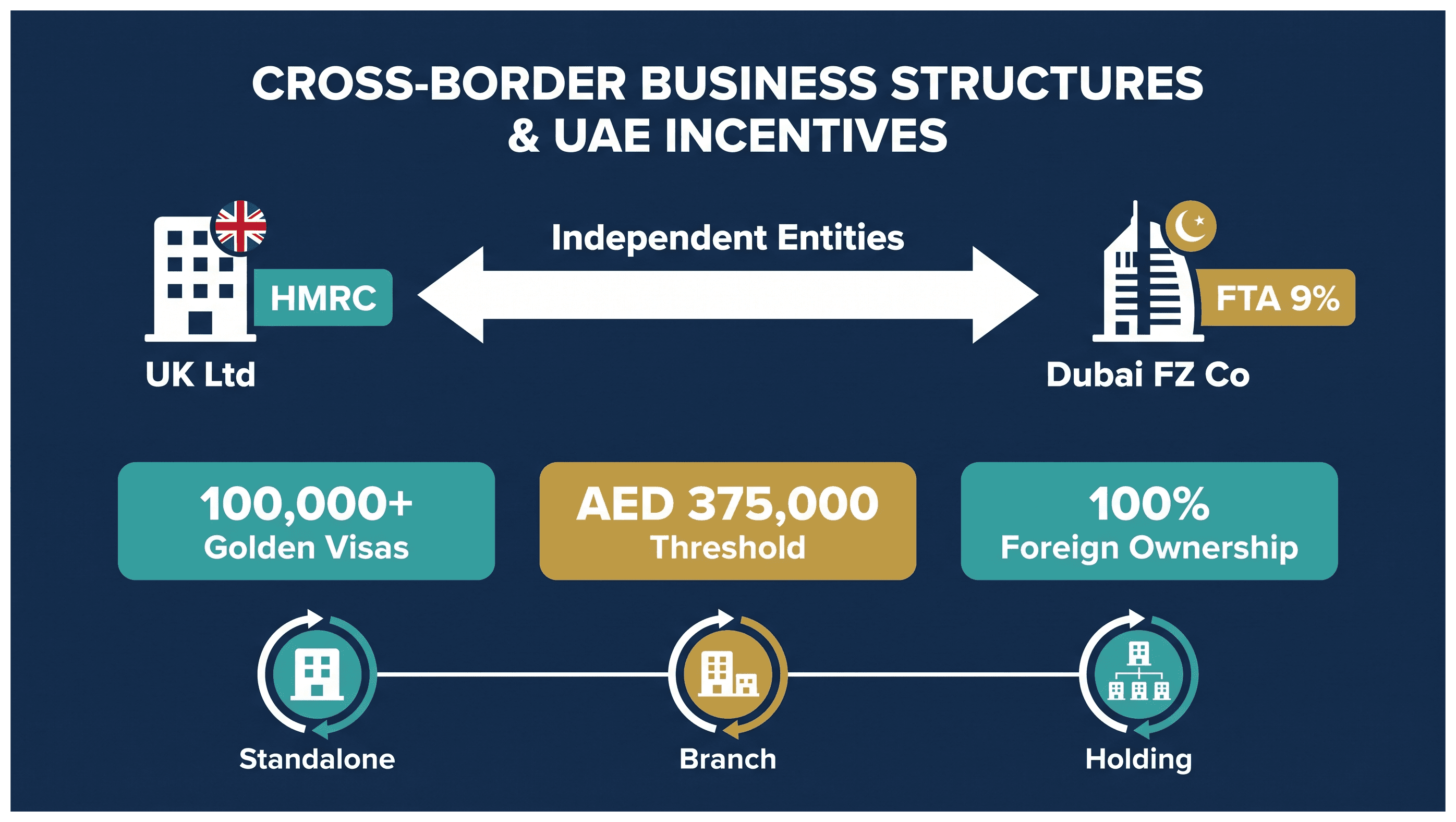
The Federal Tax Authority (FTA) oversees UAE corporate tax under Federal Decree-Law No. 47 of 2022, charging 9% above AED 375,000 net profit. Meanwhile, HMRC applies the Statutory Residence Test (SRT test) to determine UK tax residency, so founders splitting time between countries must track days carefully to avoid double taxation.
UAE Corporate Tax Basics
9% rate applies above AED 375,000 in net profit
FTA registration is mandatory for your Dubai entity, regardless of profit level
VAT at 5% applies on most taxable supplies within the UAE
Staying Compliant With HMRC
The SRT test determines whether HMRC treats you as UK tax resident based on day-counting and ties to the UK (family, property, work). Get this wrong and you could face tax on the same income in both countries. A founder spending under 91 days in the UK annually, with no UK home available and limited UK work days, typically sits outside SRT residency thresholds. Check the Federal Tax Authority guidance and consult a cross-border accountant before assuming either country's rules apply automatically. Dubai South's banking and taxation support can help align your bookkeeping across both jurisdictions.
Is it worth running two tax residencies at once?
Not automatically. It depends on where your income originates and how many days you actually spend in each country. Get professional SRT and FTA advice before assuming dual structuring saves tax.
Steps to Set Up and License a Dubai Company
Setting up a Dubai company involves choosing a free zone activity, reserving a trade name, applying through ICP for immigration approval, completing GDRFA entry formalities, and finalising an Emirates ID once the license is issued. Most founders complete this in 4 to 6 weeks.
Step 1: Choose Your Activity and Reserve a Name
Match your intended activity to the free zone's approved list
Reserve your trade name using Dubai South's name check tool before applying
Confirm activity code aligns with ISIC classification standards used by UAE authorities
Step 2: Submit ICP and GDRFA Applications
The Federal Authority for Identity, Citizenship, Customs and Port Security (ICP) handles the establishment card and entry permit
The General Directorate of Residency and Foreign Affairs (GDRFA) manages residency stamping once you're physically in the UAE
Processing typically runs 5 to 10 working days per stage
Step 3: Complete Emirates ID and Medical Formalities
A biometric appointment follows your entry permit approval
Your Emirates ID card is usually issued within a few working days after biometrics
Medical fitness testing is required before residency visa stamping
UK Company vs Dubai Free Zone Company: Key Facts
Feature | UK Company | Dubai Free Zone Company |
|---|---|---|
Regulator | Companies House and HMRC | Free zone authority and the FTA |
Tax rate | 19% to 25% corporation tax | 9% above AED 375,000 net profit |
Ownership | 100% foreign ownership standard | 100% foreign ownership, no local sponsor |
Residency link | No visa tied to company formation | Residency visa tied directly to license |
Setup timing | Same-day online incorporation | 4 to 6 weeks including visa formalities |
Cost Breakdown for a UK Founder Running Two Companies
A Dubai South free zone license package for a British founder generally runs from AED 12,500 to AED 18,200, covering the license, one visa allocation and registration. UK founders also keep Companies House and HMRC filing costs running in parallel.
Dubai-Side Costs
License package fees from AED 12,500 to AED 18,200 depending on activity
Visa allocation costs per employee, on top of the base package
Optional office or flexi-desk add-ons for a physical UAE presence
Use the Dubai South cost calculator to model your exact package before you commit.
UK-Side Costs Still Running
Companies House annual confirmation statement fee
HMRC corporation tax filings and Companies House accounts
Accountancy fees for dual bookkeeping across both currencies
Common Mistakes British Founders Make Running Both Companies
The most frequent errors involve miscounting SRT test days, missing FTA corporate tax registration deadlines, and confusing UK and UAE banking documentation. Founders who plan both compliance calendars together avoid most of these delays.
Residency Day-Counting Errors
Founders often misread SRT test thresholds, assuming a simple "90 day rule" when the actual test weighs ties like family, accommodation and work days too. Failing to log travel dates consistently is the single biggest cause of an unexpected HMRC residency claim. Keep a dated travel log from day one, not retrospectively.
Missed FTA Registration Deadlines
Late corporate tax registration with the FTA carries administrative penalties, even if your Dubai company owes zero tax that year. Founders also frequently misunderstand free zone qualifying income rules, assuming all free zone profit stays outside the 9% rate when only qualifying activities do.
Banking Document Mismatches
UAE banks routinely request proof of your UK company's trading history before opening a corporate account for the Dubai entity. Share value documentation delays at ICP are another common snag when the UK parent's paperwork isn't properly attested. Sort this early, since bank account approval can take longer than the license itself.
Running a UK and a Dubai company side by side is a workable structure once you understand the licensing route, FTA and HMRC obligations, and realistic costs involved. Founders who plan compliance calendars for both countries together, rather than treating Dubai as an afterthought, save themselves weeks of avoidable admin.
Follow up with our Business Support team or use the Cost Calculator to set up or buy your license.
References
Frequently Asked Questions