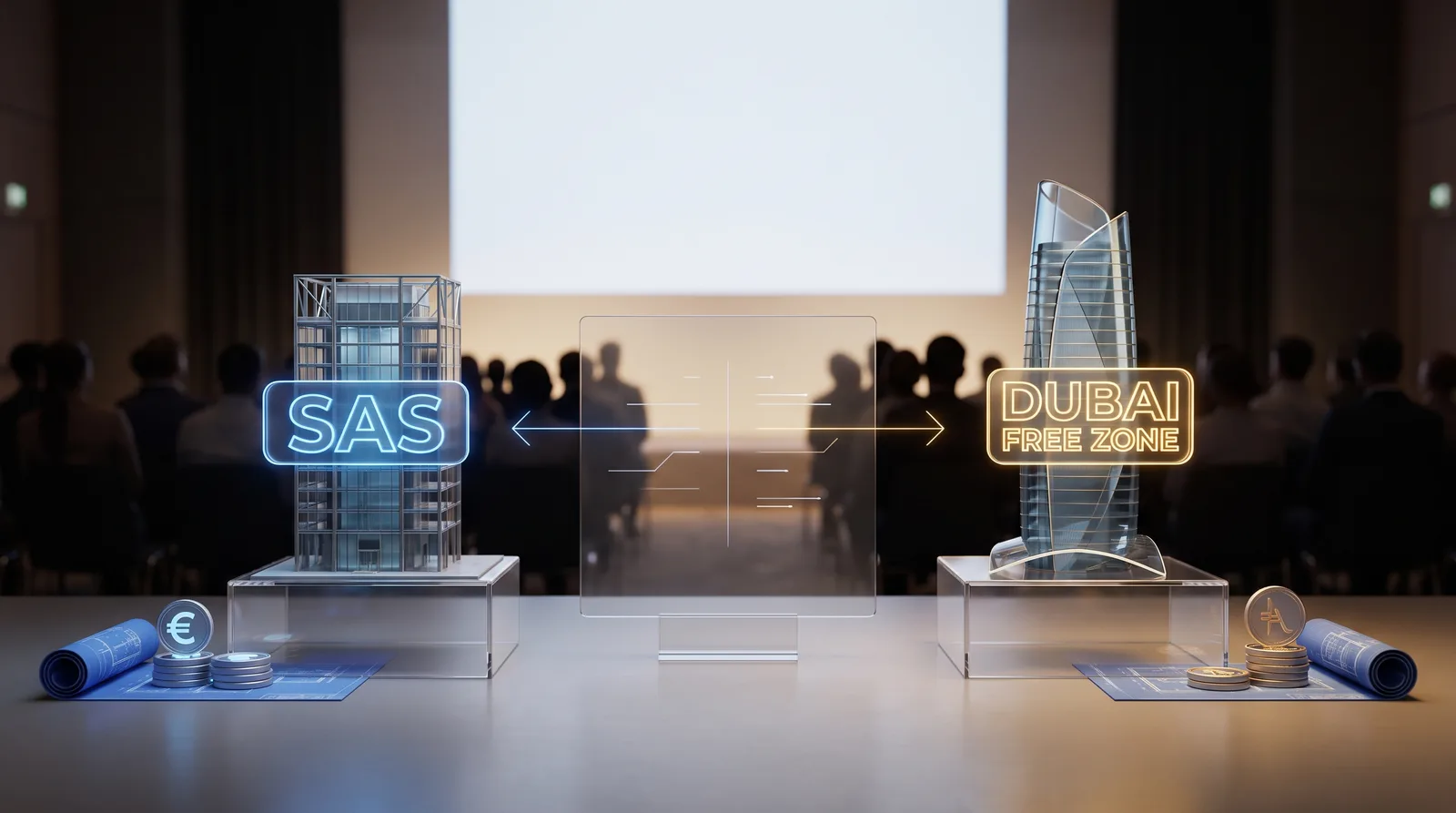
SAS or Dubai Free Zone Company: Structure and Cost Compared
Topic Summary
What Is a SAS and What Is a Dubai Free Zone Company
A SAS (Société par Actions Simplifiée) is a flexible French corporate structure subject to French corporate tax and social charges. A Dubai free zone company is a UAE legal entity incorporated inside a designated free zone, offering 100% foreign ownership, no personal income tax, and a low corporate tax rate under Federal Decree-Law No. 47 of 2022. For French founders weighing the SAS vs Dubai free zone company question, the structural differences are significant from day one.
Ownership and Control: SAS vs Dubai Free Zone Company
A SAS allows flexible shareholder arrangements under French law but does not remove French regulatory and tax obligations. A Dubai free zone company guarantees 100% foreign ownership with no local partner requirement, giving French founders complete control over equity, profits, and governance from outside the EU. This is a core distinction in the french company vs Dubai debate.
Tax Obligations: SAS vs Dubai Free Zone Company
A SAS pays French corporate tax at 25% plus dividend taxes managed by the DGFiP. A Dubai free zone company is subject to UAE corporate tax under Federal Decree-Law No. 47 of 2022, capped at 9% on non-qualifying income, with 0% personal income tax and no French tax on UAE-sourced profits once the founder is a genuine UAE resident. The SAS vs Dubai free zone company tax gap is substantial for high-earning founders.
Setup and Running Costs: SAS vs Dubai Free Zone Company Compared
Incorporating a SAS in France costs €200–€500 in registration fees with minimal annual compliance costs, but ongoing tax and social charges are significant. A Dubai free zone company at DSBH starts from AED 12,000 per year for the trade license; total first-year costs including visa and Emirates ID typically range from AED 15,000 to AED 25,000. For a dubai company for french founders, the cost picture looks very different once you factor in recurring French obligations.
How to Set Up a Dubai Free Zone Company as a French Founder
French founders can incorporate a Dubai free zone company at DSBH in three core steps: choose your business activities and trade name, submit your application and obtain your license, then apply for your investor visa and Emirates ID through the GDRFA and ICP. The full process typically takes 10 to 15 business days. DSBH handles end-to-end support, including visa coordination, which is a clear differentiator from the DIY French SAS registration process.
In 2026, France's top marginal income tax rate sits at 45% (Statista, 2024). Add social contributions and effective rates on founder income can climb past 60% [1]. The UAE levies 0% personal income tax [2]. Its corporate rate under Federal Decree-Law No. 47 of 2022 is capped at 9% [3]. A Dubai free zone trade license at Dubai South Business Hub Free Zone (DSBH) starts from AED 12,000 per year [4]. The full setup, including investor visa and Emirates ID, typically completes in 10 to 15 business days [5]. This article breaks down the SAS vs Dubai free zone company decision across ownership rules, tax treatment, and real setup costs, so French founders can choose the structure that actually fits their business.
What Is a SAS and What Is a Dubai Free Zone Company
A SAS (Société par Actions Simplifiée) is a flexible French corporate structure subject to French corporate tax and social charges. A Dubai free zone company is a UAE legal entity incorporated inside a designated free zone, offering 100% foreign ownership, no personal income tax, and a low corporate tax rate under Federal Decree-Law No. 47 of 2022. For French founders weighing the SAS vs Dubai free zone company question, the structural differences are significant from day one.
The SAS Structure at a Glance
The SAS is governed by Articles L227-1 et seq. of the French Commercial Code. It's the most popular corporate form for French startups and SMEs because it allows flexible governance, custom articles of association, and shareholders that can be individuals or other legal entities. Minimum share capital is technically €1, though banks often require substantially more before opening a business account.
Profits distributed to founders are subject to French corporate tax at the standard 25% rate. Small companies with taxable profit below €42,500 qualify for a reduced 15% rate. Dividends then attract the PFU (prélèvement forfaitaire unique) flat tax of 30% (12.8% income tax plus 17.2% social levies), unless the founder elects the progressive income tax scale. A Paris-based tech consultant earning €200,000 through a SAS would typically face a combined tax and social charge burden exceeding 55% on distributed income. The Direction Générale des Finances Publiques (DGFiP) administers all French tax obligations, including CIT, VAT, and social contributions.
The Dubai Free Zone Company Structure at a Glance
A free zone company, typically structured as an FZ-LLC or FZCO, is incorporated within a UAE-designated free zone and regulated by that zone's own authority. No local sponsor or Emirati partner is required. The Federal Tax Authority (FTA) oversees UAE corporate tax. Under Federal Decree-Law No. 47 of 2022, qualifying free zone entities pay 0% on qualifying income and 9% on non-qualifying income above AED 375,000 (FTA, 2023). The UAE levies 0% personal income tax on founders' salaries and dividends (u.ae).
A French e-commerce founder incorporating at DSBH retains full ownership with no local partner and accesses a 0% personal income tax environment from day one. For the dubai free zone vs SAS comparison, this structural difference in tax treatment is where most founders start.
Ownership and Control: SAS vs Dubai Free Zone Company
A SAS allows flexible shareholder arrangements under French law but does not remove French regulatory and tax obligations. A Dubai free zone company guarantees 100% foreign ownership with no local partner requirement, giving French founders complete control over equity, profits, and governance from outside the EU. This is a core distinction in the french company vs Dubai debate.
Shareholder Flexibility in a SAS
A SAS can have one or more shareholders (a sole-shareholder SAS is called a SASU). Governance is largely defined by the articles of association, which gives founders real flexibility. Foreign nationals can hold shares in a SAS without restriction. The catch: the entity remains French-resident and fully subject to French law, French tax treaties, and DGFiP reporting requirements regardless of where the shareholders live.
The DGFiP applies exit tax provisions on unrealised capital gains when founders transfer their fiscal residency abroad, triggered above an €800,000 threshold under current French fiscal rules. A French founder relocating to Dubai while keeping an active SAS may still trigger French tax residency obligations if the SAS continues to be managed from France. That's a practical risk worth flagging before you book flights.
Full Ownership Rights in a Dubai Free Zone Company
UAE Federal Law No. 26 of 2020 (as amended) and individual free zone regulations guarantee 100% foreign ownership with no Emirati sponsor needed (u.ae). Founders set their own shareholder agreements, board structures, and profit distribution rules within the free zone authority's framework.
A DSBH free zone company can be owned entirely by one French national or split between a group of French co-founders with no mandatory local equity stake. Two French co-founders splitting a DSBH free zone company 50/50 face no third-party ownership requirement and can distribute profits freely between their UAE and French accounts. Profits can be repatriated to France or retained in the UAE without UAE-imposed capital controls. DSBH's ownership rules are set by the Dubai South free zone authority, not mainland UAE commercial law, which keeps the structure clean and straightforward for international founders. You can review the full range of business activities in Dubai available under a DSBH license before committing to your structure.
Tax Obligations: SAS vs Dubai Free Zone Company
A SAS pays French corporate tax at 25% plus dividend taxes managed by the DGFiP. A Dubai free zone company is subject to UAE corporate tax under Federal Decree-Law No. 47 of 2022, capped at 9% on non-qualifying income, with 0% personal income tax and no French tax on UAE-sourced profits once the founder is a genuine UAE resident. The SAS vs Dubai free zone company tax gap is substantial for high-earning founders.
French Tax Burden on SAS Founders
SAS profits face the standard 25% corporate income tax rate. The key rates to know:
French CIT: 25% standard rate (15% for profits below €42,500)
PFU dividend flat tax: 30% (12.8% income tax + 17.2% social levies)
Social charges on founder salary: 40-50% on top of gross remuneration
Top marginal income tax rate: 45%
A SAS distributing €150,000 in dividends to a sole founder would generate approximately €45,000 in French tax under the PFU, before any wealth or solidarity contributions. Founders who are also salaried managers (président assimilé salarié) pay social contributions on their remuneration separately. The DGFiP administers annual CIT declarations, VAT returns, and payroll social contributions, and non-compliance carries interest and penalties. The compliance burden alone is a recurring cost that many founders underestimate.
UAE Tax Treatment of a Dubai Free Zone Company
Federal Decree-Law No. 47 of 2022 introduced UAE corporate tax, with the FTA as the competent authority. Qualifying free zone persons pay 0% on qualifying income (typically from transactions with other free zone entities and certain international transactions) and 9% on non-qualifying income above AED 375,000. Qualifying free zone status depends on meeting substance requirements; DSBH guides founders through this process.
The UAE levies 0% personal income tax. Founders draw salaries or dividends without personal tax liability in the UAE. French founders who establish genuine UAE tax residency (183 or more days per year, with their centre of vital interests in the UAE) cease to be French tax residents and stop paying French income tax on UAE-sourced income, subject to the France-UAE double tax treaty. A French digital consultant who relocates to Dubai, incorporates at DSBH, and spends 183 or more days in the UAE can legitimately exit the French income tax system on their UAE business income. If you want to understand the full relocation picture, DSBH's moving to Dubai from France guide covers the process in detail.
SAS vs Dubai Free Zone Company: Key Facts for French Founders
Feature | SAS (France) | DSBH Free Zone Company (UAE) |
|---|---|---|
Incorporation cost | €200–€500 in registration and publication fees | From AED 12,000/year (license + registered address) |
Annual license / compliance cost | €1,500–€5,000/year (expert-comptable) + CCI + CFE | No mandatory accountant below AED 375,000 threshold |
Corporate tax rate | 25% standard (15% below €42,500) | 0% on qualifying income; 9% above AED 375,000 |
Personal income tax | Up to 45% + 30% PFU on dividends | 0% personal income tax |
Foreign ownership | Allowed, but entity stays French-resident | 100% foreign ownership guaranteed, no local sponsor |
Setup time | 1–4 weeks via online platform or notary | 10–15 business days (license + visa + Emirates ID) |
Residency visa eligibility | No visa benefit; founder remains subject to French residency rules | Investor visa tied to company license; Emirates ID issued by ICP |
Setup and Running Costs: SAS vs Dubai Free Zone Company Compared
Incorporating a SAS in France costs €200–€500 in registration fees with minimal annual compliance costs, but ongoing tax and social charges are significant. A Dubai free zone company at DSBH starts from AED 12,000 per year for the trade license; total first-year costs including visa and Emirates ID typically range from AED 15,000 to AED 25,000. For a dubai company for french founders, the cost picture looks very different once you factor in recurring French obligations.
What It Costs to Run a SAS in France
Incorporation: €200–€500 in registration and publication fees via a notary or online platform
Annual statutory accounts: chartered accountant (expert-comptable) fees of €1,500–€5,000/year depending on complexity
Annual CCI (Chamber of Commerce) contribution and CFE (Cotisation Foncière des Entreprises) business tax from year one
Social contributions on founder remuneration: approximately 45–50% of gross salary
A solo SAS founder drawing a €60,000 annual salary would pay approximately €28,000–€30,000 in employer and employee social charges before income tax. That's the recurring cost that makes the SAS vs Dubai free zone company comparison so striking for active founders.
What It Costs to Set Up and Run a DSBH Free Zone Company
DSBH trade license from AED 12,000/year, covering the license, registered address, and free zone ecosystem access
Investor visa package tied to the company license; the General Directorate of Residency and Foreigners Affairs (GDRFA) processes the residency visa (GDRFA, 2025)
The Identity, Citizenship, Customs and Ports Authority (ICP) issues the Emirates ID, mandatory for banking, telecoms, and daily life
No mandatory local accountant for entities below the AED 375,000 VAT registration threshold
A French founder setting up a consulting company at DSBH can be fully licensed with an investor visa and Emirates ID within 10–15 business days, at a total first-year cost well below the equivalent French social charge burden. Use the Dubai free zone company setup cost calculator at DSBH to model your exact first-year outlay before committing.
How to Set Up a Dubai Free Zone Company as a French Founder
French founders can incorporate a Dubai free zone company at DSBH in three core steps: choose your business activities and trade name, submit your application and obtain your license, then apply for your investor visa and Emirates ID through the GDRFA and ICP. The full process typically takes 10 to 15 business days. DSBH handles end-to-end support, including visa coordination, which is a clear differentiator from the DIY French SAS registration process.
Step 1: Choose Your Business Activities and Trade Name
Your activity selection defines what you can legally do under your license, so it's worth getting right before you pay any government fees. DSBH offers a wide range of licensed activities, from consulting and trading to ICT and professional services. Browse the full list of business activities in Dubai on the DSBH platform to confirm your category and any activity-specific approvals needed.
Run a trade name availability check before submission. Your company name must comply with UAE naming conventions (no offensive terms, no references to religions or political bodies). A French marketing agency founder, for example, would select 'Advertising and Marketing Services' as a primary activity and use the company name availability check tool to confirm their preferred name before paying any fees.
Step 2: Submit Your Application and Obtain Your License
Submit your application to DSBH with passport copies, a business plan summary if required for your activity, and the signed application form. DSBH issues the trade license and the Memorandum of Association (MOA) is drafted and signed at this stage. Most straightforward consulting and services licenses are approved and issued within 3–5 business days of a complete application submission.
Once the license is issued, you can open a UAE corporate bank account. Emirates ID is required by most banks, so the visa step follows directly.
Step 3: Apply for Your Investor Visa and Emirates ID
With your trade license in hand, apply for an investor visa. The GDRFA processes and stamps the residency visa into your passport. The ICP then issues your Emirates ID, which serves as your primary UAE identification document for banking, government services, and daily life. The total residency process from license issuance to Emirates ID in hand typically runs 10 to 15 business days (GDRFA, 2025).
French founders should simultaneously begin registering their change of fiscal residency with the DGFiP if they intend to exit the French tax system. A French founder who lands in Dubai with a complete DSBH application can realistically hold both a trade license and an Emirates ID within two working weeks.
Can I run a Dubai free zone company without relocating to Dubai?
You can incorporate a DSBH free zone company without living in Dubai, but the tax benefits depend on genuine UAE residency. Operating a Dubai free zone company without establishing real UAE presence (183 or more days per year) creates tax risks under the France-UAE double tax treaty. The structure works best for founders who actually relocate.
References
Frequently Asked Questions