South African Exporters Using Dubai as a Gulf Base: Setup Cost, Route and Timeline
Topic Summary
What Is South African Exporters Using Dubai as a Gulf Base and Why It Matters
South African exporters using Dubai as a Gulf base means registering a free zone trading company that re-exports goods through Jebel Ali port and Al Maktoum airport, using Dubai's customs zone and logistics network to reach Gulf, African and Asian buyers faster than shipping directly from South Africa.
Choosing The Right License And Trading Activity
Choosing The Right License And Trading Activity
Understanding Tax And Customs Rules For Your Trading License
The Federal Tax Authority (FTA) oversees VAT and customs compliance, while corporate tax under Federal Decree-Law No. 47 of 2022 applies at 9% above AED 375,000 profit. Free zone re-export activity can qualify for customs duty suspension when goods pass through bonded zones without entering local circulation.
Steps To Set Up Your Trading Company And Logistics Route
Setting up follows six steps: choose a trading activity, reserve a name, submit license application, secure office or warehouse space, register with customs, and arrange freight through Jebel Ali or Al Maktoum. Most founders complete licensing within two to four weeks.
Setting Up Residency Once Your Company Is Licensed
Once licensed, founders apply for an entry permit through ICP (Federal Authority for Identity, Citizenship, Customs and Port Security), complete medical testing and status change via GDRFA (General Directorate of Residency and Foreigners Affairs), then receive an Emirates ID. This residency ties directly to the company license and typically takes seven to ten working days after entry.
Managing Exchange Control And Reporting Back Home
South African founders must clear South African Reserve Bank (SARB) exchange control before transferring capital abroad and declare offshore business interests to the South African Revenue Service (SARS) annually. Keeping clean transfer records and SARS-compliant disclosures prevents penalties while funding the Dubai entity legally.
Key Costs And Timeline For South African Exporters Using Dubai As A Gulf Base
Typical costs cover license fees, warehouse or office rent, customs registration and residency processing, with most setups completing within three to five weeks. Budgeting for freight and bonded storage separately keeps re-export margins predictable for South African exporters using Dubai as a Gulf base.
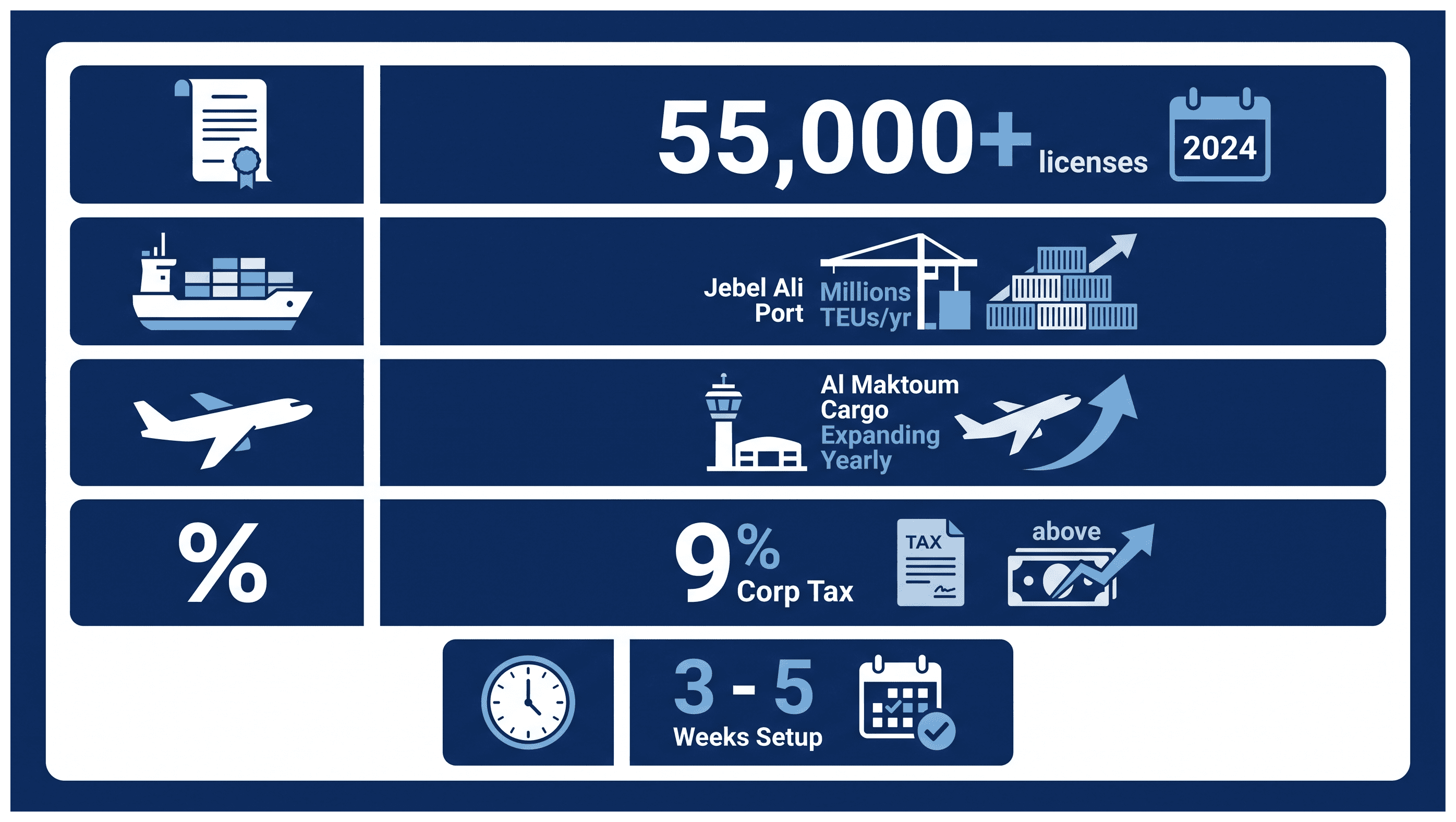
In 2024, over 55,000 new commercial licenses were issued in Dubai (Dubai Chamber of Commerce, 2024) [1]. South African trading firms are using this growth to reach Gulf, African and Asian markets faster. Jebel Ali port handles millions of TEUs a year (DP World, 2024) [2]. Al Maktoum airport keeps expanding cargo capacity yearly. Corporate tax sits at 9% above AED 375,000 profit under Federal Decree-Law No. 47 of 2022 [3]. South African exporters using Dubai as a Gulf base can complete licensing in three to five weeks. That's the route this guide walks through, activity codes, customs, warehousing and residency included.
What Is South African Exporters Using Dubai as a Gulf Base and Why It Matters
South African exporters using Dubai as a Gulf base means registering a free zone trading company that re-exports goods through Jebel Ali port and Al Maktoum airport, using Dubai's customs zone and logistics network to reach Gulf, African and Asian buyers faster than shipping directly from South Africa.
Why Founders Choose A Gulf Trading Hub
Dubai sits almost equidistant between African, European and Asian ports, which shortens transshipment routes considerably. A Durban-based furniture exporter, for instance, can consolidate container loads in a Dubai bonded warehouse before selling onward to Saudi buyers, cutting handling costs per unit. Over 55,000 new commercial licenses were issued in a prior year (Dubai Chamber of Commerce, 2024), reflecting how many founders are treating Dubai as a regional distribution point rather than an end market. The freight lanes here are already dense with weekly sailings and daily air cargo slots, so you're plugging into infrastructure that already works.
How This Differs From Selling Direct From South Africa
Transit times to Riyadh or Muscat drop from weeks to days once cargo sits in Dubai.
You can invoice in AED, USD or ZAR depending on buyer preference.
Warehousing near port infrastructure means faster reloading, not just storage.
Buyers across the Gulf often prefer a Dubai-based counterparty for contract familiarity.
Founders relocating from Johannesburg or Cape Town often start by reading the Moving to Dubai from South Africa guide before picking a license structure.
Choosing The Right License And Trading Activity
A general trading or specific commodity license lets South African exporters legally re-export goods through Dubai. The activity list must match what's physically stored or trans-shipped, since customs and free zone authorities check declared activities against actual cargo movements.
Matching Activity Codes To Your Goods
Picking the correct activity code matters more than founders expect. A Cape Town wine exporter, say, would select a beverage-specific trading activity rather than a broad general trading license, because customs inspectors cross-check invoices against declared codes. Mismatches trigger delays and, sometimes, penalties. Reviewing the full business activities list before applying saves you from costly amendments later.
Free Zone Structure Basics For South African Founders
Free zone companies allow 100% foreign ownership without a local partner.
Office licenses suit consultancy-style trading; warehouse licenses suit physical goods.
Activity amendments require a fresh application, not a simple update.
Renewals happen annually, tied to your original license date.
Understanding Tax And Customs Rules For Your Trading License
The Federal Tax Authority (FTA) oversees VAT and customs compliance, while corporate tax under Federal Decree-Law No. 47 of 2022 applies at 9% above AED 375,000 profit. Free zone re-export activity can qualify for customs duty suspension when goods pass through bonded zones without entering local circulation.
Corporate Tax And VAT Basics
Here's the practical bit: profit under AED 375,000 stays untaxed, and anything above that gets taxed at 9% (Federal Decree-Law No. 47 of 2022) [3]. VAT on re-exported goods often doesn't apply if the goods never enter local circulation, but you still need clean invoicing. The FTA expects detailed record-keeping, including shipping manifests and customs declarations, for at least five years.
Key Facts for South African Exporters Setting Up a Dubai Trading Base
Feature | Requirement | Detail |
|---|---|---|
License type | Match declared goods to avoid customs disputes | |
Corporate tax | 9% above AED 375,000 profit | Set under Federal Decree-Law No. 47 of 2022 |
Setup timeline | 3-5 weeks typical | License plus warehouse fit-out combined |
Residency | ICP entry permit, GDRFA status change, Emirates ID | 7-10 working days after arrival |
Exchange control | SARB clearance before capital transfer | Single Discretionary Allowance limits apply |
Logistics | Warehousing near Al Maktoum and Jebel Ali | Shared or dedicated space depending on volume |
Customs Duty Suspension On Re-Export Cargo
Bonded warehouses hold goods without triggering import duty.
Documentation must show onward shipment intent clearly.
Filings go through the Dubai Trade portal [4].
Goods transiting through Jebel Ali bonded zone to Oman, for example, skip local duty entirely.
Steps To Set Up Your Trading Company And Logistics Route
Setting up follows six steps: choose a trading activity, reserve a name, submit license application, secure office or warehouse space, register with customs, and arrange freight through Jebel Ali or Al Maktoum. Most founders complete licensing within two to four weeks.
Step 1: Select Activity And Reserve Company Name
Confirm your activity code matches physical goods.
Reserve your name early; approvals take days.
Check name availability before submitting documents.
Step 2: Submit License Application And Documents
Submit passport copies and shareholder documents.
Include a short business plan outlining trade routes.
Approval usually lands within five to seven business days.
Step 3: Arrange Warehousing Near Al Maktoum And Jebel Ali
Shared warehouse space suits smaller pallet volumes.
Dedicated units suit high-frequency shippers.
A textile exporter, for example, might lease shared space for pallet consolidation before scaling up.
Step 4: Register For Customs And Freight Accounts
Register your customs code before first shipment.
Onboard a freight forwarder familiar with Gulf routes.
Confirm booking slots at Jebel Ali or Al Maktoum early.
How long does it take to license a trading company in Dubai from South Africa?
Most South African founders complete licensing within two to four weeks. Warehouse setup adds another one to two weeks. First shipments typically go out within five weeks of starting the process.
Setting Up Residency Once Your Company Is Licensed
Once licensed, founders apply for an entry permit through ICP (Federal Authority for Identity, Citizenship, Customs and Port Security), complete medical testing and status change via GDRFA (General Directorate of Residency and Foreigners Affairs), then receive an Emirates ID. This residency ties directly to the company license and typically takes seven to ten working days after entry.
ICP Entry Permit And GDRFA Status Change
The entry permit from ICP arrives once your license is issued. From there, GDRFA handles the in-country status change, including medical fitness testing and biometric capture for your Emirates ID. Most founders finish this stage within ten working days of landing.
Linking Residency To Your Trading License
Visa quota depends on your office or warehouse size.
Renewals align with your license renewal cycle each year.
Dependents' visas follow once your own status is confirmed.
Founders who want help managing paperwork often use business support services to handle GDRFA and ICP filings.
Managing Exchange Control And Reporting Back Home
South African founders must clear South African Reserve Bank (SARB) exchange control before transferring capital abroad and declare offshore business interests to the South African Revenue Service (SARS) annually. Keeping clean transfer records and SARS-compliant disclosures prevents penalties while funding the Dubai entity legally.
SARB Approval Before Transferring Capital
The Single Discretionary Allowance covers smaller transfers without extra approval, but larger capital injections require a Foreign Investment Application through your authorised dealer bank. Skipping this step risks frozen transfers later, which nobody wants mid-shipment.
SARS Disclosure Obligations
Declare foreign business interests annually on your tax return.
Keep invoices consistent across both South African and UAE books.
Retain SARB approval letters alongside SARS filings for audits.
Key Costs And Timeline For South African Exporters Using Dubai As A Gulf Base
Typical costs cover license fees, warehouse or office rent, customs registration and residency processing, with most setups completing within three to five weeks. Budgeting for freight and bonded storage separately keeps re-export margins predictable for South African exporters using Dubai as a Gulf base.
Budgeting For License, Warehouse And Visa Costs
Separate your one-time setup fees (license issuance, name reservation, customs registration) from recurring costs like rent and visa renewals. Running your numbers through a cost calculator before committing gives you a realistic budget rather than a guess.
Realistic Timeline From Application To First Shipment
License approval: five to seven business days.
Warehouse fit-out: one to two weeks.
First outbound shipment: scheduled within five weeks total.
South African exporters using Dubai as a Gulf base gain a faster, more connected route to regional buyers once the license, activity, customs and residency pieces are aligned correctly. Getting each step right the first time avoids weeks of rework and keeps your trading margins intact.
Explore Business Activities or run the Cost Calculator to set up or buy a license that fits your trading model.
References
Frequently Asked Questions