Starting a Dubai Trading Company From India: Setup Cost, Route and Timeline

Topic Summary
What Is Starting a Dubai Trading Company From India and Why It Matters
Starting a Dubai trading company from India means registering a free zone entity that buys, sells or re-exports goods through UAE ports, using a trade license, customs code and warehousing near Jebel Ali or Al Maktoum, without becoming an Indian tax resident abroad.
Choosing Your License, Activity and Legal Route
Choosing Your License, Activity and Legal Route
Customs, Warehousing and Logistics Near Al Maktoum and Jebel Ali
A Dubai trading company needs a customs code, bonded or non-bonded warehousing near Jebel Ali port or Al Maktoum airport, and a clear import-export flow registered through the relevant customs portal to move goods efficiently between India, the UAE and re-export markets.
Step-by-Step Timeline From India to a Working Trade License
Starting a Dubai trading company from India typically follows six steps: choosing an activity, reserving a name, submitting documents, paying setup fees, receiving the license, and applying for residency visas, completed in roughly two to four weeks depending on document readiness.
Visa and Residency Steps After Company Formation
After the trade license is issued, founders apply for an entry permit through ICP, complete a medical test, register biometrics for an Emirates ID, and get the residency visa stamped by GDRFA , usually within one to two weeks of license issuance.
Money Matters: Funding, Taxes and Remittance Rules
Indian founders funding a Dubai trading company must work within the RBI Liberalised Remittance Scheme (LRS) limits, report foreign assets to the Income Tax Department, register for corporate tax under Federal Decree-Law No. 47 of 2022, and can use India-UAE CEPA tariff benefits on qualifying goods.
Setup Cost Breakdown for a Dubai Trading License
Setup cost for starting a dubai trading company from india covers the license fee, visa allocation, warehousing or flexi-desk space, and customs registration, with total first-year cost varying by activity count, number of visas and warehouse size chosen.
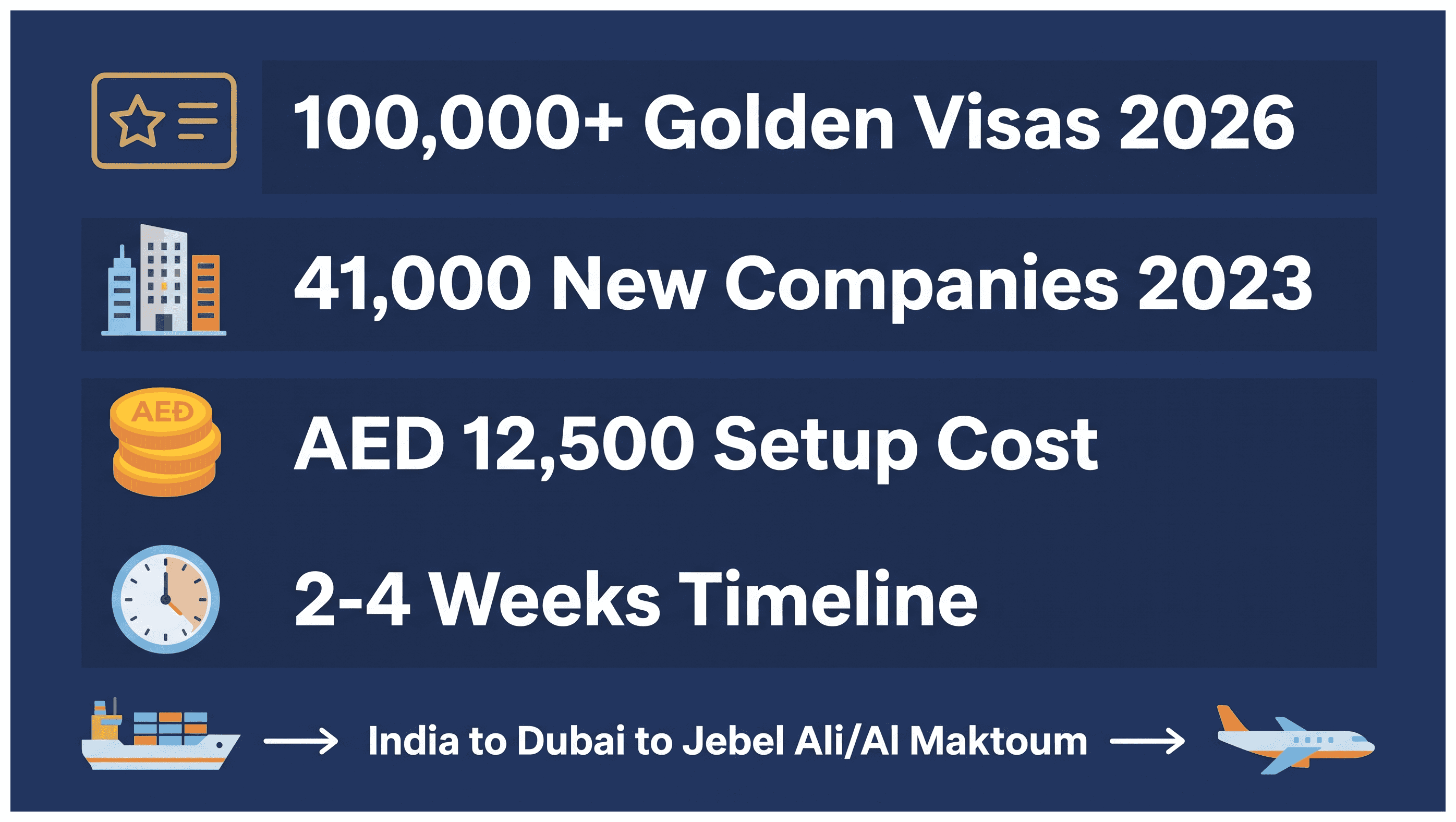
In 2026, over 100,000 Golden Visas have been issued to investors and entrepreneurs across the UAE [1], and a growing share of new company owners behind that number are Indian traders building re-export businesses near Jebel Ali and Al Maktoum. If you're weighing starting a dubai trading company from india, you're joining a well-worn path. Dubai Chamber of Commerce recorded 41,000 new member companies in 2023 [2], many with Indian shareholders on the paperwork. Setup costs typically start around AED 12,500 for a basic trade license as of 2026, and the whole process, from name reservation to visa stamping, can run two to four weeks. This guide covers the free zone route, the activity codes you'll actually need, and the customs steps most blogs skip entirely.
What Is Starting a Dubai Trading Company From India and Why It Matters
Starting a Dubai trading company from India means registering a free zone entity that buys, sells or re-exports goods through UAE ports, using a trade license, customs code and warehousing near Jebel Ali or Al Maktoum, without becoming an Indian tax resident abroad.
How Trading Companies Differ From Service Businesses
A trading company moves physical goods, not advice or consulting hours. That means customs codes, HS classifications, and a warehousing plan sit at the centre of your operation, not an afterthought.
Take an Indian textile exporter re-selling fabric rolls to buyers across East Africa through a Dubai warehouse. She needs a bonded storage arrangement, an import declaration for each container from Mumbai, and a re-export certificate before goods leave UAE soil. None of that applies to someone running a marketing consultancy.
Why Indian Founders Choose the Re-Export Route
Jebel Ali seaport and Al Maktoum airport sit within 20 minutes of most free zone offices.
The India-UAE CEPA (Comprehensive Economic Partnership Agreement) cuts tariffs on many Indian-origin goods entering the UAE.
Dubai's business day overlaps with both Mumbai mornings and African afternoons, useful for live negotiations.
Re-export status often avoids UAE import duty entirely when goods pass through bonded zones.
Choosing Your License, Activity and Legal Route
Indian founders setting up a trading company pick a free zone trade license, select specific goods activities such as general trading or commodity trading, and register a legal structure like an FZCO (Free Zone Company), all under Federal Decree-Law No. 47 of 2022 for corporate tax purposes.
Trade License Activity Options
General trading covers multiple product categories under one license.
Single-product licenses cost less but restrict you to one HS chapter.
You can add activities later as volumes grow, without re-registering the company.
A Chennai-based auto parts trader, for instance, picked a specific vehicle-parts trading activity instead of general trading, saving on the broader license fee.
Browse the full business activities list before you commit, since matching the code to your actual goods avoids customs delays later. If trading specifically interests you, the trading business license page breaks down the sub-categories.
Legal Structure and Shareholding
Most Indian founders register an FZCO rather than a branch, since an FZCO gives 100% foreign ownership with no local sponsor required. That's been standard free zone policy for years and it removes a common worry from first-time founders.
Naming follows straightforward rules: no religious references, no duplicate names, and the activity must match what's on your license. Documentation is light: passport copy, a passport-size photo, and a signed application form (Source: Ministry of Economy, 2025).
Customs, Warehousing and Logistics Near Al Maktoum and Jebel Ali
A Dubai trading company needs a customs code, bonded or non-bonded warehousing near Jebel Ali port or Al Maktoum airport, and a clear import-export flow registered through the relevant customs portal to move goods efficiently between India, the UAE and re-export markets.
Registering a Customs Code
Once your trade license is issued, you link it to a customs profile through Dubai Trade, the online portal that handles import-export declarations for Dubai Customs. Bonded warehousing lets you store goods duty-free until they're re-exported, which matters if your India-to-Africa flow never technically enters the local UAE market.
Choosing Warehousing Near the Ports
Jebel Ali seaport suits bulk sea freight, containers from Nhava Sheva or Mundra.
Al Maktoum airport suits time-sensitive air cargo, perishables or high-value electronics.
Larger warehouses cost more monthly but cut per-unit delivery time to buyers.
A spice trader storing bulk shipments near Jebel Ali before onward shipment to East Africa avoids double handling, since containers move straight from ship to bonded storage to the next vessel.
Key Facts: Dubai Trading Company Setup From India
Feature | Requirement | Detail |
|---|---|---|
License type and activity | Free zone trade license | General trading or single-product code, matched to actual goods |
Customs code registration | Linked to license via Dubai Trade portal | Enables import-export declarations and bonded storage |
Warehousing location | Near Jebel Ali or Al Maktoum | Sea freight vs air cargo depending on goods type |
Visa and Emirates ID steps | ICP entry permit, then Emirates ID biometrics | Completed within 1-2 weeks post-license |
Typical setup timeline | 2-4 weeks total | Depends on document readiness and warehouse choice |
Step-by-Step Timeline From India to a Working Trade License
Starting a Dubai trading company from India typically follows six steps: choosing an activity, reserving a name, submitting documents, paying setup fees, receiving the license, and applying for residency visas, completed in roughly two to four weeks depending on document readiness.
Step 1: Select Activity and Structure
Confirm your trading activity code against actual goods.
Decide between an FZCO and a branch structure.
Run numbers through the cost calculator before applying.
Step 2: Submit Documents and Reserve Name
Passport copy and passport-size photo for each shareholder.
Trade name reservation, checked against existing records.
Draft MOA (Memorandum of Association) signed digitally.
Step 3: Pay Fees and Receive License
Setup fee payment, usually processed within 24 to 48 hours.
License issuance follows within days of payment clearing.
Bank account groundwork can start once the license is in hand.
Step 4: Apply for Residency and Emirates ID
Entry permit issued through ICP (Federal Authority for Identity, Citizenship, Customs and Port Security).
Medical test and Emirates ID biometrics booked next.
Visa stamped in passport by GDRFA (General Directorate of Residency and Foreigners Affairs).
Visa and Residency Steps After Company Formation
After the trade license is issued, founders apply for an entry permit through ICP, complete a medical test, register biometrics for an Emirates ID, and get the residency visa stamped by GDRFA, usually within one to two weeks of license issuance.
How long does UAE residency take after a Dubai company license?
Most founders get their entry permit within days, complete the medical test soon after, and receive the Emirates ID within one to two weeks total. GDRFA handles final visa stamping.
Entry Permit and Status Change
If you're already in the UAE on a visit visa, ICP handles a status change instead of a fresh entry permit, which shaves a few days off the timeline. Founders starting from India apply for the entry permit first, then travel once it's approved.
Emirates ID and Visa Stamping
Booking your biometric appointment early avoids queue delays at typing centres. Once GDRFA stamps the visa in your passport, you can sponsor dependents, a step many founders handle in the same visit. Dubai South's business support services can coordinate this paperwork if you'd rather not chase appointments yourself.
Money Matters: Funding, Taxes and Remittance Rules
Indian founders funding a Dubai trading company must work within the RBI Liberalised Remittance Scheme (LRS) limits, report foreign assets to the Income Tax Department, register for corporate tax under Federal Decree-Law No. 47 of 2022, and can use India-UAE CEPA tariff benefits on qualifying goods.
Remitting Capital Under RBI LRS
The RBI LRS caps individual annual remittances at USD 250,000. Banks will ask for a Form A2 and PAN details before releasing funds, so plan your remittance timing around license and warehouse deposit deadlines rather than scrambling at the last minute.
Tax Reporting Back Home
Any foreign company shareholding must be disclosed to India's Income Tax Department under the Schedule FA reporting requirement. On the UAE side, corporate tax registration falls under Federal Decree-Law No. 47 of 2022, administered by the FTA (Federal Tax Authority). CEPA duty benefits apply on qualifying Indian-origin goods, cutting import costs on many trading categories (Source: FTA, 2025).
Setup Cost Breakdown for a Dubai Trading License
Setup cost for starting a dubai trading company from india covers the license fee, visa allocation, warehousing or flexi-desk space, and customs registration, with total first-year cost varying by activity count, number of visas and warehouse size chosen.
Fixed Costs vs Variable Costs
License and registration fees stay fixed regardless of trade volume.
Visa cost scales per shareholder or staff member added.
Warehouse rent scales with cargo volume and storage duration.
Estimating Your Total With a Calculator
Comparing activity bundles before you apply saves you from paying twice for an amendment later. Add warehousing costs once you know your monthly container volume, and budget separately for renewal years, since license fees typically stay flat but warehousing rates can shift with demand. The cost calculator gives a realistic first-year figure in minutes.
Starting a Dubai trading company from India comes down to picking the right activity, registering customs and warehousing near Jebel Ali or Al Maktoum, and staying compliant with both UAE tax law and Indian remittance rules. Get those three right, and the rest, banking, visas, renewals, tends to fall into place on schedule. If you're moving your whole household as part of this, the moving to Dubai from India guide covers the relocation side in more depth.
Ready to move forward? Browse Business Activities to confirm your trading code, then run your numbers through the Cost Calculator to set up or buy a license today.
References
Frequently Asked Questions