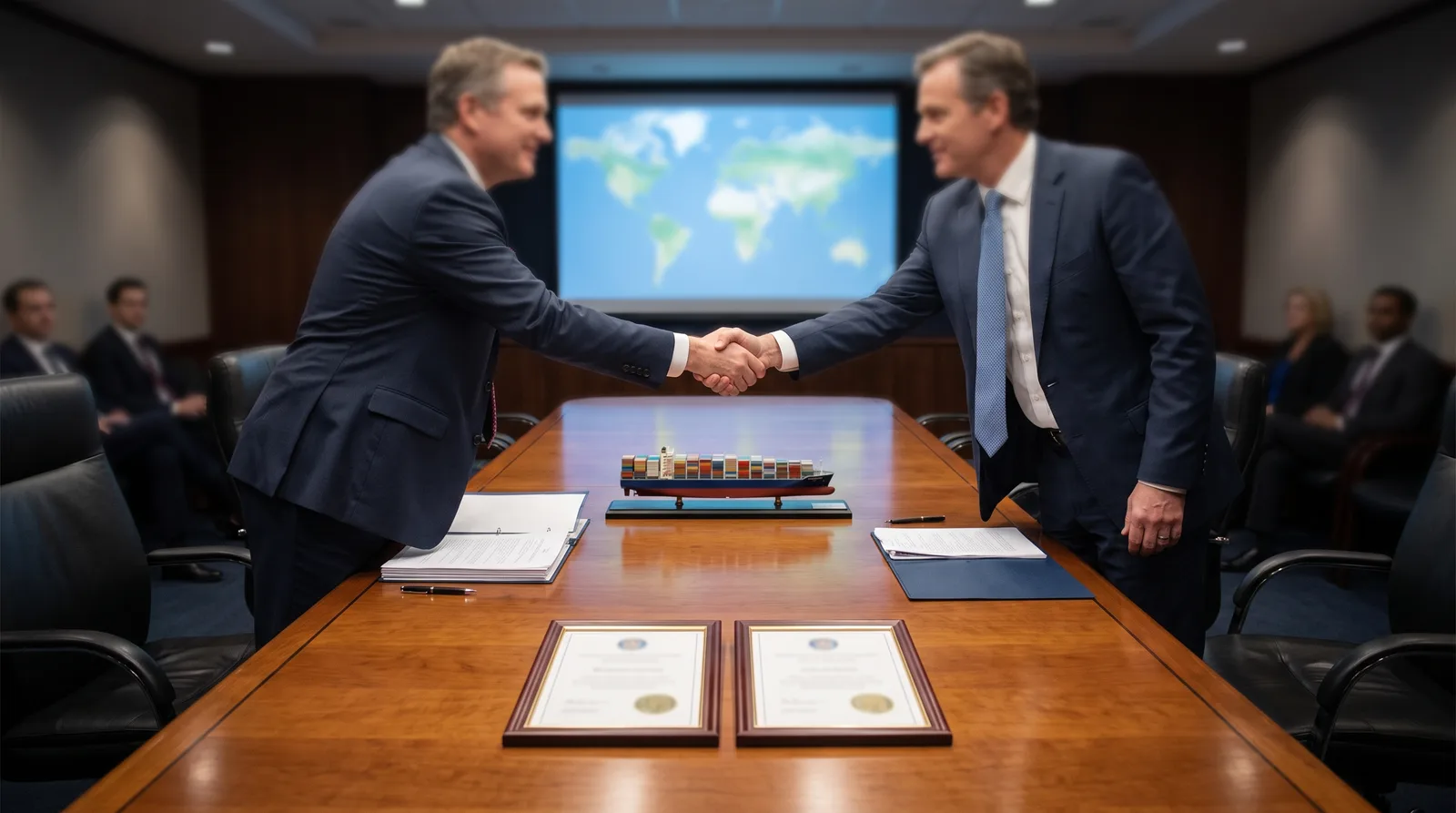
Trade Between France and the UAE: License and Routes
Topic Summary
What Is Trade Between France and the UAE and Why the Tax Position Matters
Trade between France and the UAE covers the two-way flow of goods and services across one of Europe's most active Gulf corridors. French exporters benefit from zero personal income tax and 0% corporate tax on qualifying free zone income in the UAE under Federal Decree-Law No. 47 of 2022 (FDL 47), while managing French tax obligations through the Direction Générale des Finances Publiques (DGFiP).
How to Structure Your Trade Route Through a DSBH License
French founders can structure their UAE trade route through a free zone trade license at Dubai South Business Hub Free Zone (DSBH). The license covers import, export, and re-export activities, places the company inside a customs-bonded ecosystem near Al Maktoum International Airport, and starts from AED 12,500 with setup in three to seven working days.
Step-by-Step Guide to Registering Your France–UAE Trade Company at DSBH
To register a France–UAE trade company at Dubai South Business Hub Free Zone, choose your license activity, submit incorporation documents, obtain your trade license, apply for residency through the GDRFA, complete your Emirates ID biometrics via the ICP, and open a UAE corporate bank account . The full process runs three to seven working days.
Customs, Logistics, and the France–UAE Freight Flow
Goods moving between France and the UAE enter through Jebel Ali Port or Al Maktoum International Airport and are cleared through UAE Customs under standard GCC tariff rules. Free zone companies at DSBH can store, repackage, and re-export goods without UAE import duty, making the corridor efficient for French traders serving the wider Gulf region.
Key Facts: France vs. UAE Business Environment
The UAE and France differ sharply on tax, setup speed, and cost of doing business. The UAE offers 0% personal income tax, 0% corporate tax on qualifying free zone income, and company formation in days. France's corporate tax rate sits at 25%, and setup timelines are measured in weeks. The table above captures the headline differences for founders managing trade between France and the UAE.
Trade Between France and the UAE: Your Next Steps
French founders ready to activate trade between France and the UAE should start by confirming their license activity at DSBH, modelling setup costs, and aligning their DGFiP tax residency status before the
In 2026, bilateral trade between France and the UAE is tracking above USD 4 billion annually, making France one of the UAE's top five European trading partners (Dubai Chamber, 2024). Jebel Ali Port processed over 14 million TEUs in 2023 (DP World, 2024). French luxury goods, aerospace components, agri-food products, and pharmaceuticals move through that corridor every month. The UAE charges 0% personal income tax (u.ae). Qualifying free zone income attracts 0% corporate tax under Federal Decree-Law No. 47 of 2022. Setup at Dubai South Business Hub Free Zone starts from AED 12,500 and completes in three to seven working days.
This article shows French founders and investors exactly how trade between France and the UAE works in practice: which license structure to use at Dubai South Business Hub Free Zone (DSBH), how customs and logistics operate near Al Maktoum International Airport, which government bodies you'll interact with, and what the tax picture looks like on both sides of the trade.
What Is Trade Between France and the UAE and Why the Tax Position Matters
Trade between France and the UAE covers the two-way flow of goods and services across one of Europe's most active Gulf corridors. French exporters benefit from zero personal income tax and 0% corporate tax on qualifying free zone income in the UAE under Federal Decree-Law No. 47 of 2022 (FDL 47), while managing French tax obligations through the Direction Générale des Finances Publiques (DGFiP). Getting both sides of that equation right is the difference between a clean structure and an expensive compliance problem.
The Scale of the France–UAE Corridor
France and the UAE exchange more than USD 4 billion in goods and services each year, with France ranking among the UAE's top five European trading partners (Dubai Chamber, 2024). French exports skew toward high-value categories: aerospace and defence equipment, luxury goods, agri-food products, pharmaceuticals, and industrial machinery. A practical illustration is an Airbus supplier shipping cabin components from Toulouse to Dubai South's logistics zone for regional MRO (maintenance, repair, and overhaul) distribution across the Gulf.
The UAE sends hydrocarbons, aluminium, and re-exports of Asian manufactured goods back toward France. Jebel Ali Port, handling 14 million TEUs in 2023 (DP World, 2024), is the physical backbone of that flow. The volume justifies a dedicated legal structure on the UAE side, not just an agency arrangement.
Tax Positions on Both Sides of the Trade
The UAE charges 0% personal income tax on individuals, confirmed at u.ae. For companies, the Federal Tax Authority (FTA) administers corporate tax under FDL 47: 0% on qualifying free zone income, and 9% on taxable income above AED 375,000 for mainland or non-qualifying entities (tax.gov.ae, 2023). Worth flagging: "qualifying free zone income" has specific conditions tied to substance requirements and the nature of transactions, so you can't simply assume all free zone revenue qualifies automatically.
On the French side, the DGFiP taxes residents on worldwide income. A French founder who relocates to Dubai and earns qualifying free zone income pays 0% UAE corporate tax, but must formally exit French tax residency via DGFiP to avoid dual liability. The France–UAE double taxation agreement provides relief mechanisms for founders with activity in both jurisdictions, but that treaty doesn't replace the need to formally change your tax residency status. Get that done before your first invoice lands. For more on relocating from France specifically, the DSBH France relocation guide covers visa and lifestyle context in detail.
How to Structure Your Trade Route Through a DSBH License
French founders can structure their UAE trade route through a free zone trade license at Dubai South Business Hub Free Zone (DSBH). The license covers import, export, and re-export activities, places the company inside a customs-bonded ecosystem near Al Maktoum International Airport, and starts from AED 12,500 with setup in three to seven working days.
Choosing the Right License Activity for French Trade
DSBH offers a range of business activities in Dubai covering general trading, import/export, logistics, and professional services. French founders dealing in physical goods, wine, cosmetics, machinery parts, typically opt for a general trading or commodity-specific activity. A Bordeaux wine distributor, for example, can register a DSBH trade license to import AOC-classified wines into the UAE market and re-export to Saudi Arabia and Bahrain under a single license structure.
Service-led businesses, consulting, engineering, aerospace services, use a professional or service license category instead. Multiple activities can be bundled under one license, which keeps your administrative overhead low. Confirm the exact scope of your chosen activities directly with DSBH before you submit, since activity descriptions affect what transactions your company can legally process.
Location Advantage: Al Maktoum and the Jebel Ali Corridor
DSBH sits within the Dubai South economic zone, directly adjacent to Al Maktoum International Airport. That proximity matters for freight-heavy French traders: Al Maktoum is planned to become the world's largest airport under the Dubai 2040 Urban Master Plan, and its dedicated cargo facilities already handle time-sensitive shipments with bonded storage on-site. A French pharmaceutical company shipping biologics to Gulf hospitals can use Al Maktoum's temperature-controlled air-freight facilities and clear customs the same day cargo lands.
Jebel Ali Port is minutes away by road. Handling 14 million TEUs in 2023 (DP World, 2024), it's the primary sea-freight gateway for French goods entering the UAE and the wider GCC. That dual air-sea proximity is the core logistics argument for choosing this corridor over free zones located elsewhere in Dubai.
Calculate Your Setup Cost Before You Commit
License fees, visa allocation, flexi-desk or office packages, and activity fees all stack up into your total first-year cost. A solo French founder should budget for the AED 12,500 base license fee plus visa package costs and Emirates ID fees. Use the DSBH cost calculator to model your specific scenario before you commit, costs shift depending on how many visas you need and how complex your activity bundle is.
Step-by-Step Guide to Registering Your France–UAE Trade Company at DSBH
To register a France–UAE trade company at Dubai South Business Hub Free Zone, choose your license activity, submit incorporation documents, obtain your trade license, apply for residency through the GDRFA, complete your Emirates ID biometrics via the ICP, and open a UAE corporate bank account. The full process runs three to seven working days.
Step 1: Select Your License Activity and Reserve Your Trade Name
Start by identifying whether your primary activity is trading (goods), services, or a combination. Once you know your activity, choose a company name that complies with UAE naming conventions: no offensive terms, no references to religion or governance bodies, and no names that imply a connection to a government entity. Submit your initial application to DSBH with passport copies and your chosen activities. This first step is quick, often completed within a single business day.
Step 2: Submit Incorporation Documents and Receive Your License
The required documents are straightforward: a passport copy, a passport-sized photo, and a completed application form. No local sponsor is required inside a free zone, which is one of the structural advantages of this route for trade between France and the UAE. DSBH issues the trade license within three to seven working days. That license confirms your company's legal existence and its permitted activities for import, export, and re-export.
Step 3: Apply for Residency, Emirates ID, and Entry Permits
The General Directorate of Residency and Foreigners Affairs (GDRFA) processes UAE residency visas (gdrfad.gov.ae). Your DSBH license entitles you to apply for a residency visa under the company. The Identity and Citizenship and Ports and Borders Authority (ICP) issues the Emirates ID (icp.gov.ae), and you'll need a biometrics appointment at an approved typing centre or ICP-linked service point to complete that. The GDRFA also handles entry permit and status-change procedures for founders who arrive on a visit visa.
In practice, a French founder arriving in Dubai on a visit entry can complete the GDRFA status change, then attend ICP biometrics for the Emirates ID, typically within two weeks of license issuance. DSBH's UAE residency visa services handle the PRO steps so you're not managing government portals alone.
Step 4: Open Your Corporate Bank Account
A UAE corporate bank account is non-negotiable for receiving payments from French clients and settling supplier invoices. Banks typically require your trade license, Emirates ID, company Memorandum of Association, and proof of business activity. Processing time varies: two to six weeks is realistic for a new free zone entity. DSBH's business support services can assist with bank introductions to move that process along.
Customs, Logistics, and the France–UAE Freight Flow
Goods moving between France and the UAE enter through Jebel Ali Port or Al Maktoum International Airport and are cleared through UAE Customs under standard GCC tariff rules. Free zone companies at DSBH can store, repackage, and re-export goods without UAE import duty, making the corridor efficient for French traders serving the wider Gulf region.
Sea Freight: Jebel Ali Port and the GCC Gateway
Jebel Ali Port is the primary sea-freight entry point for French goods entering the UAE. Direct container services run from Marseille, Le Havre, and Fos-sur-Mer. The standard GCC customs tariff is 5% on CIF value for most goods entering the UAE mainland, but free zone storage at DSBH defers that duty entirely until goods enter local consumption. A French luxury cosmetics brand, for instance, can hold stock in DSBH's free zone warehousing and distribute to Gulf retailers across Saudi Arabia, Kuwait, and Qatar without triggering UAE import duty on inventory held for re-export.
That re-export model is a well-established commercial structure for French consumer goods and food brands using Dubai as their Gulf distribution hub. Jebel Ali handled 14 million TEUs in 2023 (DP World, 2024), confirming its position as the region's dominant container port. Customs procedures for free zone operators are managed through Dubai Trade, the portal covering customs declarations and cargo release.
Air Freight: Al Maktoum International Airport for Time-Sensitive Cargo
Al Maktoum International Airport, directly adjacent to DSBH, handles dedicated cargo operations and is set for significant expansion under the Dubai 2040 Urban Master Plan. Time-sensitive French exports route through Al Maktoum's temperature-controlled and bonded cargo facilities: pharmaceuticals, fresh agri-food, and aerospace parts are the dominant categories. Air freight transit times from Paris CDG or Lyon Saint-Exupéry to Dubai run typically 24 to 48 hours for express cargo, making same-day or next-day Gulf distribution genuinely achievable.
For French founders whose business model depends on speed to market rather than volume, the air-freight gateway at Al Maktoum is the more relevant logistics argument than Jebel Ali's container throughput.
France vs. UAE: Key Facts for French Founders
Feature | France | UAE (DSBH Free Zone) |
|---|---|---|
Personal income tax rate | Up to 45% marginal rate (DGFiP) | 0% (u.ae) |
Corporate tax rate | 25% standard rate | 0% on qualifying free zone income under FDL 47; 9% above AED 375,000 for non-qualifying income |
Company formation timeline | Typically 2–4 weeks | 3–7 working days at DSBH |
Minimum share capital | EUR 1 for SARL; EUR 37,000 for SA | No minimum capital requirement at DSBH free zone |
Customs regime | EU customs union; standard EU import duties apply on non-EU goods | 5% GCC tariff on mainland entry; 0% duty on goods stored and re-exported from DSBH free zone |
Free zone / bonded storage option | Limited customs warehousing zones; no equivalent free zone structure | Full free zone bonded storage at DSBH; duty deferred until mainland entry |
Tax authority | Direction Générale des Finances Publiques (DGFiP) | Federal Tax Authority (FTA), tax.gov.ae |
Key Facts: France vs. UAE Business Environment
The UAE and France differ sharply on tax, setup speed, and cost of doing business. The UAE offers 0% personal income tax, 0% corporate tax on qualifying free zone income, and company formation in days. France's corporate tax rate sits at 25%, and setup timelines are measured in weeks. The table above captures the headline differences for founders managing trade between France and the UAE.
France vs. UAE: Headline Comparison for Founders
The numbers in the table tell a clear story, but context matters. The UAE's 0% corporate tax on qualifying free zone income under FDL 47 is not automatic: the FTA applies substance and transaction tests to determine whether income qualifies. For founders managing trade between France and the UAE across both jurisdictions, the DGFiP tax residency question is equally important. You need to formally change your tax residency status in France before you start invoicing from your UAE entity, the France–UAE double taxation agreement provides relief mechanisms, but it doesn't substitute for a clean residency exit. Speak to a cross-border tax adviser before you structure the first transaction.
France corporate tax: 25% standard rate (still accurate as of 2026)
UAE personal income tax: 0%
UAE corporate tax on qualifying free zone income: 0% under FDL 47 (tax.gov.ae)
DSBH setup: 3–7 working days, from AED 12,500
GCC customs tariff on mainland entry: 5% on CIF value
Free zone re-export: 0% duty on goods not entering UAE mainland consumption
Trade Between France and the UAE: Your Next Steps
French founders ready to activate trade between France and the UAE should start by confirming their license activity at DSBH, modelling setup costs, and aligning their DGFiP tax residency status before the
References
Frequently Asked Questions