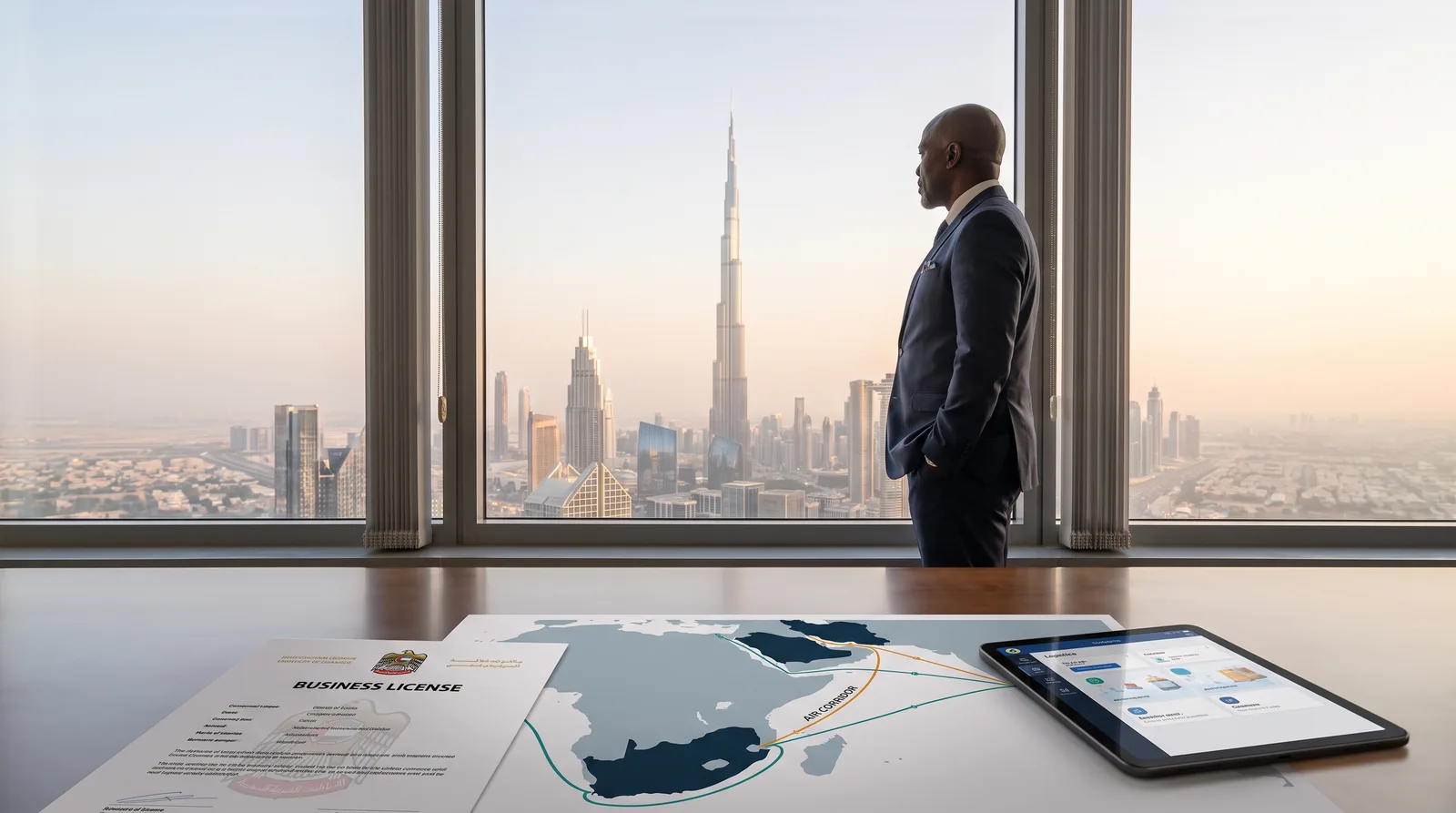
Trade Between South Africa and the UAE: License and Routes
Topic Summary
What Is Trade Between South Africa and the UAE and Why It Matters
Trade between South Africa and the UAE covers the two-way flow of goods, services, and capital between both countries. South African founders use UAE free zone companies, particularly near Jebel Ali and Al Maktoum, to import, re-export, and distribute across Africa, the Gulf, and Asia from a single licensed entity.
How to Structure Your Dubai Trade License for South Africa Routes
South African founders trading between South Africa and the UAE need a free zone trading license that lists the correct import-export activities. The license sits under Federal Decree-Law No. 47 of 2022 on commercial companies. Residency status is issued by the Identity, Citizenship, Customs and Ports Security authority (ICP) and the General Directorate of Residency and Foreigners Affairs (GDRFA) , and the Emirates ID is required to open a corporate bank account.
Steps to Set Up a DSBH Company for South Africa–UAE Trade
Setting up a Dubai South Business Hub company for trade between South Africa and the UAE takes three clear phases: choose your license and calculate cost, prepare and attest your South African documents, then activate residency and banking. Here's exactly how each phase works.
Customs, Compliance, and the South Africa Side of the Trade Route
South African founders must manage two regulatory environments simultaneously. On the South Africa side, SARS administers customs duties and VAT on exports and imports, while SARB governs foreign exchange and the repatriation of export proceeds. Both agencies apply to any South African-registered entity or individual trading internationally.
Logistics Infrastructure Near Al Maktoum and Jebel Ali
The Dubai South free zone sits between Al Maktoum International Airport and Jebel Ali Port, creating an integrated air-sea logistics corridor. Jebel Ali processes over 14 million TEUs annually, while Al Maktoum is expanding to handle 12 million tonnes of air cargo per year, making this the most efficient transshipment point for South Africa–UAE trade routes.
Key Facts: South Africa–UAE Trade at a Glance
The trade between South Africa and the UAE is a well-established, high-volume corridor. A DSBH free zone license from AED 12,500 gives South African founders the legal entity, residency pathway, and customs access to operate both ends of the route from a single Dubai company. The table below maps the key metrics side by side.
In 2026, bilateral trade between South Africa and the UAE exceeds USD 10 billion annually (World Bank, 2024). The UAE ranks among South Africa's top five non-African trading partners. DSBH free zone licenses start from AED 12,500. Jebel Ali Port processes 14+ million TEUs per year (DP World, 2024). A direct cargo flight from Johannesburg to Al Maktoum takes roughly 8 hours. South African exports to the UAE are zero-rated for VAT under SARS rules, with proof of export. And the UAE's VAT registration threshold sits at AED 375,000 (Federal Tax Authority, 2024).
This article shows South African founders exactly how to structure trade between South Africa and the UAE: which license to hold, which regulatory bodies govern each side of the corridor, and how the logistics infrastructure at Al Maktoum and Jebel Ali makes Dubai South the natural gateway for this route.
What Is Trade Between South Africa and the UAE and Why It Matters
Trade between South Africa and the UAE covers the two-way flow of goods, services, and capital between both countries. South African founders use UAE free zone companies, particularly near Jebel Ali and Al Maktoum, to import, re-export, and distribute across Africa, the Gulf, and Asia from a single licensed entity.
The Scale of the South Africa–UAE Corridor
The numbers are hard to ignore. Bilateral trade between South Africa and the UAE surpasses USD 10 billion annually (World Bank, 2024), making the UAE one of South Africa's most significant non-African trading partners. South Africa ships gold, diamonds, machinery, and agricultural products northward; the UAE sends back petroleum products, chemicals, and manufactured goods.
What makes this corridor genuinely interesting for founders is the gateway logic. A single Dubai free zone entity lets you sell into the Gulf, re-export into Africa, and source from Asia, all through one licensed company. Take a South African diamond processor who sets up a free zone trading company at Dubai South: they import rough stones from SA, use polishing contractors for value-adding, and re-export to buyers in India and Europe, with everything cleared through Jebel Ali. That's the corridor working as designed.
Why Dubai South Is the Preferred Entry Point
Dubai South free zone sits adjacent to Al Maktoum International Airport and within 15 km of Jebel Ali Port, the largest port in the Middle East. That proximity isn't incidental, it means goods can move between air and sea freight without leaving the free zone perimeter, cutting handling time and cost significantly.
Cargo from Johannesburg OR Tambo reaches Al Maktoum in roughly 8 hours on a direct flight. Perishable fruit from the Western Cape, for instance, can be flown in, cleared through the free zone, and distributed to Gulf supermarket chains within 24 hours of landing. Free zone status means no customs duty on goods in transit or re-export, subject to the Federal Tax Authority (FTA) rules on VAT and excise. For South African founders moving to Dubai, this infrastructure advantage is a primary reason Dubai South makes operational sense.
How to Structure Your Dubai Trade License for South Africa Routes
South African founders trading between South Africa and the UAE need a free zone trading license that lists the correct import-export activities. The license sits under Federal Decree-Law No. 47 of 2022 on commercial companies. Residency status is issued by the Identity, Citizenship, Customs and Ports Security authority (ICP) and the General Directorate of Residency and Foreigners Affairs (GDRFA), and the Emirates ID is required to open a corporate bank account.
Choosing the Right License Activities
A general trading license covers the broadest range of goods. A specific trading license is narrower but costs less, the right choice depends on your product mix. Activities must be declared at license issuance; adding them later is possible but incurs an amendment fee, so it's worth getting this right upfront.
Common activities for the SA–UAE corridor include general trading, import and export of foodstuffs, mining commodities trading, and raw materials trading. A Johannesburg-based mining supplies company, for example, might list "trading in industrial equipment and machinery" plus "import and export of raw materials" on its DSBH license, covering both its inbound SA supply chain and outbound Gulf sales. You can explore the full list of business activities on the DSBH portal before committing.
Regulatory Bodies Every South African Founder Must Know
Federal Decree-Law No. 47 of 2022 (the Commercial Companies Law) is the primary legislation governing free zone company formation in the UAE. It sets the legal framework your DSBH entity operates within, alongside the free zone authority's own regulations.
The Federal Tax Authority (FTA) administers VAT at 5% and excise tax. Free zone companies exporting goods are generally zero-rated for VAT, but you must register if turnover exceeds AED 375,000 (FTA, 2024). The ICP processes entry permits and residency visas for founders and staff. The GDRFA manages visa stamping and status changes inside the UAE. And the Emirates ID, issued by ICP, is the biometric document required for bank account opening, tenancy, and most government transactions.
Here's how it plays out in practice: a Cape Town founder applies for an investor visa through ICP, has it stamped by GDRFA at the airport on arrival, and collects her Emirates ID within five working days, at which point she can open a UAE corporate bank account. For end-to-end guidance, the DSBH company formation support team handles PRO services and government transactions on your behalf.
Steps to Set Up a DSBH Company for South Africa–UAE Trade
Setting up a Dubai South Business Hub company for trade between South Africa and the UAE takes three clear phases: choose your license and calculate cost, prepare and attest your South African documents, then activate residency and banking. Here's exactly how each phase works.
Step 1: Select Activities and Calculate Setup Cost
Start with the DSBH cost calculator to model your license fee, visa allocation, and office or flexi-desk requirement before committing to anything. DSBH trading licenses start from AED 12,500, with visa packages priced per slot included. Deciding upfront how many residency visas you need determines your facility package, and changes later cost money.
A Durban textile trader, for instance, runs the cost calculator, selects a general trading license with two visa slots and a flexi-desk, and gets a clear first-year cost figure before calling the DSBH team. Licenses can be issued in as few as 3 working days once documents are in order. Calculate your company setup cost in Dubai to get your numbers before the first conversation.
Step 2: Prepare and Attest South African Documents
Required documents typically include a certified copy of your South African passport, proof of address, and depending on your activity, a business plan or letter of no objection. The key procedural point: South African documents must be apostilled via the Department of International Relations and Cooperation (DIRCO) before submission, because the UAE is a signatory to the Hague Apostille Convention.
Certified copy of South African passport
Proof of residential address
Business plan (required for certain activity types)
Apostille stamp from DIRCO on all notarised documents
Apostille processing through DIRCO typically takes 5–10 working days. A Pretoria-based founder who apostilles her SA ID and company resolution, couriers the originals to DSBH, and receives her trade license within three working days of submission, that's a realistic timeline once documents are correctly prepared.
Step 3: Activate Residency and Banking
Once the trade license is issued, apply for your investor visa entry permit through the Identity, Citizenship, Customs and Ports Security authority (ICP) via icp.gov.ae. The General Directorate of Residency and Foreigners Affairs (GDRFA) stamps the visa on entry to the UAE; the Emirates ID biometric appointment follows within days, typically within 5 working days of application.
Emirates ID in hand, you can open a UAE corporate bank account. Most major UAE banks require the trade license, Emirates ID, and a source-of-funds declaration as a minimum. The DSBH business support team can assist with PRO services and government transactions throughout this phase.
Customs, Compliance, and the South Africa Side of the Trade Route
South African founders must manage two regulatory environments simultaneously. On the South Africa side, SARS administers customs duties and VAT on exports and imports, while SARB governs foreign exchange and the repatriation of export proceeds. Both agencies apply to any South African-registered entity or individual trading internationally.
SARS Export and Import Obligations
The South African Revenue Service (SARS) requires exporters to register formally as exporters and submit Customs Declaration forms (SAD 500) for each commercial shipment. Goods exported from South Africa to the UAE are zero-rated for South African VAT, provided the exporter holds proof of export, this is a meaningful cash-flow advantage for high-volume corridors.
Import tariffs on UAE goods entering South Africa depend on HS code classification and applicable SACU (Southern African Customs Union) rates. SARS e-filing and the Customs Connect portal manage declarations digitally. A Johannesburg auto-parts exporter, for example, registers with SARS as an exporter, zero-rates VAT on UAE shipments, and appoints a Cape Town freight forwarder to handle SAD 500 submissions, keeping compliance costs predictable and auditable.
SARB Foreign Exchange Rules for UAE Trade
The South African Reserve Bank (SARB) regulates cross-border capital flows under the Currency and Exchanges Act. The rule most founders trip over: export proceeds from UAE buyers must be repatriated to South Africa within 30 days of receipt, unless SARB grants a specific dispensation.
Licensing fees or dividends flowing from your UAE company to your South African accounts must be properly reported as foreign capital inflows. Holding working capital in a UAE corporate bank account for the trade corridor is permitted, but persistent retention of export proceeds offshore requires explicit SARB approval. This isn't legal advice; it's a practical flag to raise with your South African tax advisor before you start transacting at volume.
Is a free zone company right for selling inside the UAE as well as exporting?
A DSBH free zone company is ideal for import, re-export, and distribution outside the UAE. To sell directly to UAE mainland customers without a local distributor, you'd need a separate mainland entity. Most South African founders using this corridor focus on Gulf re-export and Africa distribution, where the free zone structure is fully sufficient.
Logistics Infrastructure Near Al Maktoum and Jebel Ali
The Dubai South free zone sits between Al Maktoum International Airport and Jebel Ali Port, creating an integrated air-sea logistics corridor. Jebel Ali processes over 14 million TEUs annually, while Al Maktoum is expanding to handle 12 million tonnes of air cargo per year, making this the most efficient transshipment point for South Africa–UAE trade routes.
Jebel Ali Port: Sea Freight from South Africa
Jebel Ali Port, operated by DP World, is the largest port in the Middle East and 9th busiest globally, processing 14+ million TEUs annually (DP World, 2024). Direct shipping lines connect Durban, Cape Town, and Port Elizabeth to Jebel Ali, with transit times of approximately 14–18 days.
Free zone companies at Dubai South can store, repackage, and re-export goods without paying UAE import duty. A Cape Town wine exporter, for instance, ships 20-foot containers direct from Cape Town to Jebel Ali, stores them in a Dubai South bonded warehouse, and distributes to Gulf retail chains over a rolling three-month schedule, paying no UAE import duty on re-exported stock. That duty exemption is a real cost advantage for South African commodity traders operating at scale.
Al Maktoum Airport: Air Freight and Time-Sensitive Cargo
Al Maktoum International Airport (DWC) is the dedicated cargo and logistics airport of Dubai South, with current capacity exceeding 800,000 tonnes per year and expansion plans targeting 12 million tonnes. Direct cargo flights connect Johannesburg OR Tambo to Al Maktoum in approximately 8 hours, perishables, electronics, and high-value goods suit this route well.
Dubai South's integrated free zone means cargo cleared at Al Maktoum can move to bonded storage or onward sea freight at Jebel Ali with minimal re-handling. A Stellenbosch fresh-produce exporter uses Al Maktoum's cold-chain facilities to fly stone fruit to Gulf supermarkets, the 8-hour flight time and same-zone customs clearance keeps shelf life intact and handling costs low. It's a setup that's genuinely hard to replicate from any other free zone location in the UAE. Read more about how South African founders are using Dubai South as their operational base.
Key Facts: South Africa–UAE Trade at a Glance
The trade between South Africa and the UAE is a well-established, high-volume corridor. A DSBH free zone license from AED 12,500 gives South African founders the legal entity, residency pathway, and customs access to operate both ends of the route from a single Dubai company. The table below maps the key metrics side by side.
South Africa vs. UAE: Trade Corridor Key Facts
Feature | South Africa | UAE (Dubai South Free Zone) |
|---|---|---|
Customs authority | SARS, exporters register formally; SAD 500 required per commercial shipment; SACU tariff framework applies to imports | Federal Tax Authority (FTA), free zone re-exports are duty-exempt; goods in transit do not attract UAE import duty |
Foreign exchange regulator | SARB under the Currency and Exchanges Act, export proceeds must be repatriated within 30 days unless SARB grants dispensation | No foreign exchange controls, UAE dirham is freely convertible; working capital can be held in UAE corporate accounts |
Main export ports/airports |
References
Frequently Asked Questions