US Founders Selling Into the Gulf From Dubai: The Rules and What It Costs
Topic Summary
One License, Six GCC Markets
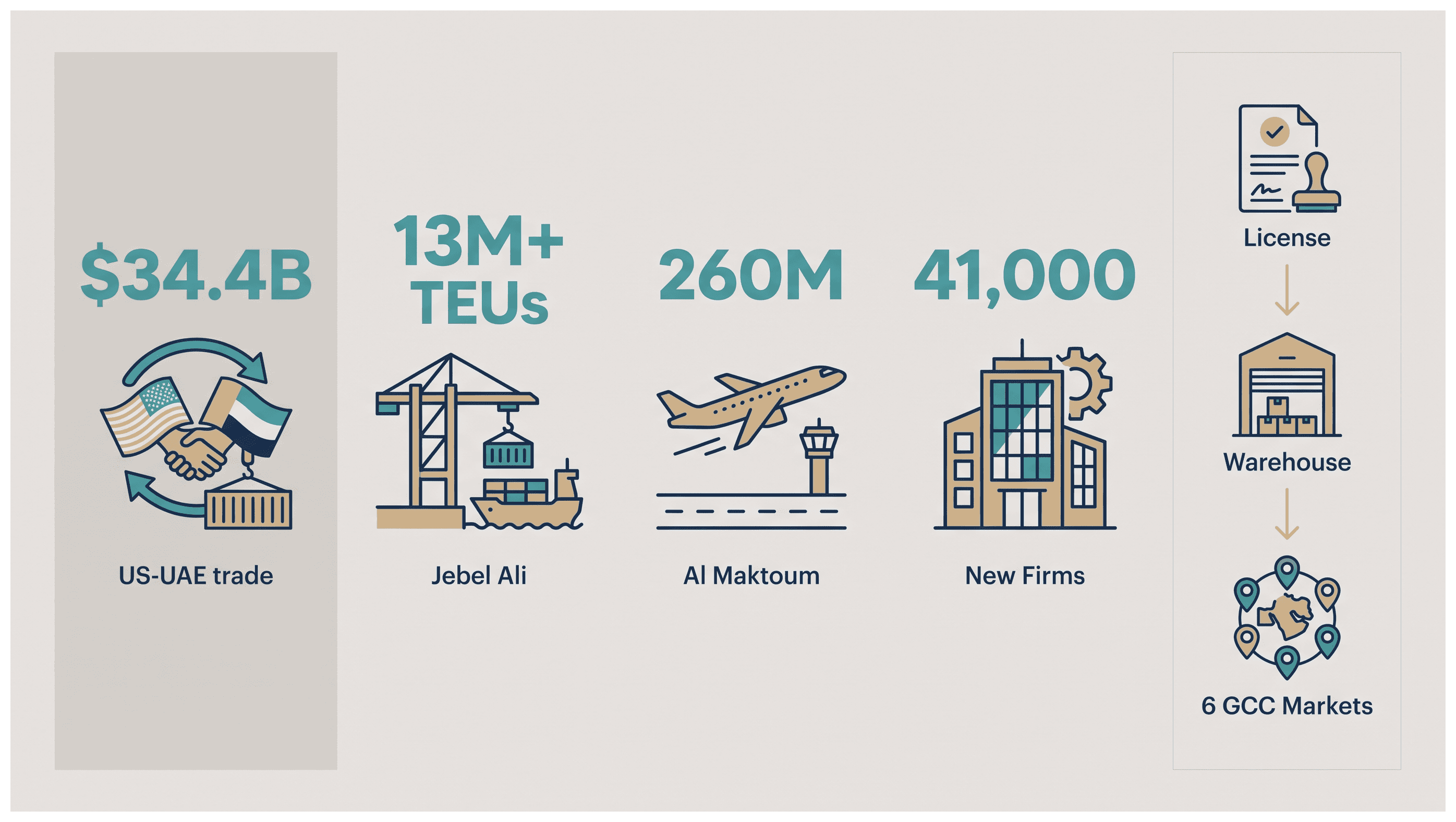
A Dubai South Business Hub license lets US founders import, warehouse, and re-export goods across the GCC without registering separately in each country. This single-entity model cuts customs clearance from six processes down to one.
Fast-Track Residency Process
Founders typically complete ICP entry permits, GDRFA status changes, and Emirates ID issuance within two to four weeks of license approval. Medical tests and biometrics are required before the ID is finalized.
Choosing the Right Trade Activity
Founders must pick either a general trading license covering multiple product lines or a specific commodity code for one category. This choice determines which customs categories the business qualifies for later, so it should be made carefully.
Strategic Warehousing Near Major Ports
Proximity to Jebel Ali port or the expanding Al Maktoum International Airport gives founders fast access to shipping and freight infrastructure. Jebel Ali alone handled over 13 million TEUs in recent reporting, underscoring the region's logistics scale.
US Tax Obligations Still Apply
Even while operating a UAE-based company, American founders must continue filing IRS returns, FBAR disclosures, and FATCA reports annually. These obligations exist regardless of the company's UAE tax status.
Customs Registration Comes First
Before any shipment can clear customs, founders need an FTA import/export code tied to their trade license. This step is a prerequisite for using Jebel Ali or Al Maktoum warehousing facilities.
Formation Costs Scale With Needs
License packages differ based on visa allocation and whether founders add office or warehouse space. A founder can start with a lean package and expand as their GCC distribution grows.
In 2026, US founders selling into the Gulf from Dubai are moving faster than ever, and the numbers back it up. US-UAE non-oil trade hit $34.4 billion in 2023 [1], up sharply from prior years. Dubai's Jebel Ali port handled over 13 million TEUs in recent reporting [2]. Al Maktoum International is being built to eventually handle 260 million passengers and matching freight volume [3]. Dubai Chamber recorded 41,000 new member companies in a single recent year [4]. For US founders selling into the Gulf from Dubai, the math is simple: one license, one warehouse zone, six GCC markets within reach.
What Is US Founders Selling Into the Gulf From Dubai and Why It Matters
US founders selling into the Gulf from Dubai means registering a Dubai South Business Hub company to import goods from American suppliers, clear UAE customs, warehouse near Jebel Ali or Al Maktoum, and re-export or distribute across the GCC under one trade license.
Why Dubai Is the Launch Point
Riyadh, Doha and Muscat are all a few hours' flight from Dubai, which makes it a natural staging ground for GCC-wide distribution. The re-export infrastructure here has decades of history behind it, and the time zone overlaps nicely with both US East Coast mornings and Gulf business afternoons. Picture a US-based skincare brand routing inventory through Dubai South before distributing to Saudi retailers, clearing customs once instead of six separate times.
Who This Route Suits
Founders with existing US supply chains ready to scale regionally
E-commerce sellers expanding beyond a single Gulf market
Traders wanting one license instead of six national registrations
A Texas-based hardware exporter, for instance, can use one Dubai entity to serve the UAE, Saudi Arabia and Oman without separate incorporations in each country.
Key Facts for US Founders Selling Into the Gulf From Dubai
Feature | Requirement | Detail |
|---|---|---|
Trade license activity | General trading or product-specific code | Chosen at registration; determines customs eligibility |
Residency steps | ICP entry permit, GDRFA status change, Emirates ID | Typically completed within weeks of license issuance |
Customs registration | FTA import/export code | Required before first shipment clears customs |
Warehousing | Proximity to Al Maktoum airport or Jebel Ali port | Leased on terms tied to license validity |
US compliance | IRS filing, FBAR disclosure, FATCA reporting | Annual obligation regardless of UAE tax status |
Setting Up Your Dubai South Business Hub Company
Setting up requires a free zone trade license, a business activity code matching trading or re-export, and residency processing through the ICP and GDRFA, ending with Emirates ID issuance for the founder and any dependents.
Step 1: Choose Your Trading Activity
You'll pick between general trading, which covers multiple product lines, or a specific commodity code tied to one category. An electronics reseller carrying dozens of SKUs usually picks general trading to avoid re-filing for every new product line. Review the business activities list before you commit, since the code you choose determines which customs categories you qualify for later.
Step 2: Register Through ICP and GDRFA
The ICP (Federal Authority for Identity, Citizenship, Customs and Port Security) handles entry permits once your license is issued. The GDRFA (General Directorate of Residency and Foreign Affairs) then processes the residency status change. After a medical test and biometrics, you'll receive your Emirates ID. A founder converting from visit visa status to investor residency can usually finish within a few weeks.
How long does UAE company residency take for US founders?
Most founders complete ICP entry permits, GDRFA status change and Emirates ID issuance within two to four weeks after license approval, assuming documents are in order.
Step 3: Company Formation Costs
License packages vary by visa allocation and whether you add office or warehouse space. A founder relocating from Chicago, for example, might start with a lean package covering one visa, then upgrade once staff join. Run the numbers yourself using the cost calculator before you commit to a package tier.
Warehousing and Logistics Near Al Maktoum and Jebel Ali
Warehousing near Al Maktoum International Airport and the Jebel Ali port gives Dubai South companies fast air-sea connections for re-export, letting founders store US inventory close to customs clearance points before shipping onward across the GCC.
Choosing Warehouse Space
Pallet racking near air cargo terminals for fast-moving SKUs
Bulk storage tiers for heavier freight and lower turnover goods
Lease terms tied directly to trade license validity periods
A footwear importer leasing pallet space next to the Al Maktoum cargo terminal can turn around shipments within days instead of weeks.
Moving Goods Through Jebel Ali Port
Jebel Ali handles sea freight consolidation and transshipment for onward GCC delivery, backed by DP World's global network (DP World, 2024). A furniture brand can consolidate containers at Jebel Ali before splitting shipments to Riyadh, cutting per-unit freight costs. Bonded storage lets you hold goods before customs clearance finalizes, which matters when you're waiting on paperwork from a US supplier.
Tax and Customs Rules Every American Founder Must Know
Federal Decree-Law No. 47 of 2022 sets UAE corporate tax rules, while the FTA (Federal Tax Authority) manages VAT and customs codes needed to import, warehouse and re-export goods legally through Dubai South.
Corporate Tax Basics Under Federal Decree-Law No. 47 of 2022
The standard rate applies above a defined profit threshold, with qualifying free zone income potentially taxed differently depending on activity type (Federal Tax Authority, 2024). A founder relocating from Denver structured their trading entity to track qualifying and non-qualifying income separately from day one, which made filing far simpler at year-end. Filing deadlines follow your fiscal year, so mark that date the moment your license issues.
Customs Codes and the FTA
Register an import/export code with the FTA before shipping
VAT treatment on re-exported goods differs from domestic sales
Duty exemptions often apply when goods are genuinely re-exported
A trader registering an FTA customs code before their first container clears Jebel Ali avoids costly delays at the port. Check the trading business license page for activity-specific customs guidance.
5 Steps to Launch Your Cross-Gulf Trading Operation
Launching a cross-Gulf trading operation involves choosing a trading activity, registering the license, securing an FTA customs code, arranging warehouse space near Jebel Ali or Al Maktoum, and filing US tax disclosures before shipping the first order.
Step 1: Pick a Trading Activity Code
Match your activity to your primary product line
Confirm the code against the official business activities directory
Verify eligibility before ordering inventory
Step 2: Register the License and Visas
Submit your ICP entry permit application
Complete GDRFA medical and Emirates ID steps
Add dependent visas if needed at this stage
Step 3: Secure Customs and Warehousing
Apply for an FTA customs code early
Lease warehouse space near Jebel Ali or Al Maktoum
Confirm lease terms match your license validity
Step 4: File US Compliance Ahead of Launch
Flag any new foreign accounts for FBAR
Confirm FATCA thresholds with your accountant
Keep records ready before your first shipment
US Reporting Duties You Cannot Skip
American founders owning a Dubai South company must still file US income taxes with the IRS, disclose foreign bank accounts through FBAR, and report specified foreign assets under FATCA, regardless of UAE tax treatment.
IRS Filing While Living Abroad
Worldwide income stays taxable for US citizens no matter where you operate. The Foreign Earned Income Exclusion can offset some liability, but it doesn't eliminate filing obligations. A founder filing IRS Form 2555 alongside their UAE company's annual accounts still needs a cross-border accountant who understands both systems.
FBAR and FATCA Thresholds
FBAR triggers once foreign account balances exceed $10,000
FATCA reporting uses Form 8938 above higher thresholds
Missed disclosures carry steep IRS penalties
Real Cost Breakdown for American Founders
Total cost for US founders selling into the Gulf from Dubai typically includes license fees, warehouse leasing, customs registration and visa charges, with packages varying based on activity scope and warehouse size near Jebel Ali or Al Maktoum.
License and Visa Costs
Package tiers scale with visa allocation, so a solo founder pays less than a team of five. Renewal fees kick in from year two onward, typically lower than the initial setup cost. Explore business support services if you need help managing renewals annually.
Warehousing and Customs Fees
Warehouse leasing is priced by square footage, so bulk goods traders pay more than founders shipping compact electronics. The FTA customs code registration carries its own separate fee, paid once and renewed periodically. Run your specific scenario through the cost calculator to see real numbers for your activity type.
US founders selling into the Gulf from Dubai now have a clear path: pick the right trading activity, register through ICP and GDRFA, secure an FTA customs code, warehouse near Jebel Ali or Al Maktoum, and stay current on IRS, FBAR and FATCA duties back home. If you're relocating from the United States, start with the Moving to Dubai from the United States guide before you file anything. Explore Business Activities or run the Cost Calculator to set up or buy your license today.
References
Frequently Asked Questions