What a Dubai Company Costs an Indian Founder: License Options, Cost and Documents

Topic Summary
What a Dubai Company Costs an Indian Founder and Why It Matters
What a Dubai company costs an Indian founder depends on license type, activity, and visa quota, typically starting from a few thousand dirhams for a free zone license plus government registration fees under Federal Decree-Law No. 47 of 2022, which governs UAE corporate tax.
License Options Available to Indian Founders
License Options Available to Indian Founders
How Residency Links to Your Dubai Free Zone Company
A Dubai free zone company license opens up a residency visa quota processed through the ICP (Federal Authority for Identity, Citizenship, Customs and Port Security) and the GDRFA (General Directorate of Residency and Foreigners Affairs), followed by an Emirates ID. Founders typically receive their status within weeks of license issuance, tying company ownership directly to their right to live in the UAE.
Steps to Set Up Your Dubai Company from India
Setting up a Dubai company from India follows five steps: check name availability, pick a license and activity, submit documents, pay fees, and apply for a residency visa. Most founders complete formation remotely before traveling for Emirates ID biometrics.
Tax and Money Rules Indian Founders Must Track
Indian founders running a Dubai company must track UAE corporate tax filings with the FTA, report foreign income to the Income Tax Department in India, and remit funds under the RBI (Reserve Bank of India) LRS (Liberalised Remittance Scheme) limit, while the India-UAE CEPA (Comprehensive Economic Partnership Agreement) can ease certain trade costs.
Documents Indian Founders Need Before Applying
Indian founders need a valid passport, passport-size photo, proposed trade name options, activity description, and proof of address to apply for a Dubai free zone license. Additional documents like a business plan may be requested for regulated activities such as healthcare or financial services.
In 2026, over 100,000 Golden Visas have been issued to investors and entrepreneurs across the UAE, and a growing share belong to Indian founders setting up companies in Dubai [1]. What a Dubai company costs an Indian founder varies by license type, but most free zone founders budget somewhere between the license fee, a visa allowance, and a small office package. This guide breaks down what a Dubai company costs an Indian founder: license options, ownership rules, real fees, required documents, and how company formation links to residency. If you're weighing business setup in Dubai from India against staying local, the numbers below should make the decision easier.
What a Dubai Company Costs an Indian Founder and Why It Matters
What a Dubai company costs an Indian founder depends on license type, activity, and visa quota, typically starting from a few thousand dirhams for a free zone license plus government registration fees under Federal Decree-Law No. 47 of 2022, which governs UAE corporate tax.
Defining the Core Cost Components
Your license fee, registration fee, and visa fee are three separate line items, not one bundled number. An Indian founder opening a trading company typically budgets separately for the license, a visa, and bank account setup, because each stage has its own timeline and cost. Office type matters too: a flexi-desk costs far less than physical office space, and it still qualifies for a visa quota under most packages. FTA (Federal Tax Authority) registration is mandatory regardless of company size, so factor that compliance step into your first-year cost, not as an afterthought.
Why Indian Founders Choose Free Zones
Full foreign ownership, no local Emirati sponsor required.
Setup process is simplified for first-time founders.
Licensing is tied to a defined business activities list.
Activity mismatches can delay approval or add fees.
A Bengaluru-based consultant, for example, picks a professional license over a trading license because it actually matches her service model. That single decision affects her share capital requirement and her visa allocation later.
Free Zone License Options Compared
Feature | Trading License | Professional/Services License |
|---|---|---|
Best for import/export activity | Ideal, covers goods movement and HS code activities | Not suited, no goods clearance scope |
Best for consultants and freelisted services | Not applicable | Ideal, matches consulting and advisory scopes |
Visa quota tied to office size | Yes, scales with warehouse or desk package | Yes, scales with flexi-desk or office package |
Activity list defines allowed operations | Restricted to trading and distribution codes | Restricted to service and advisory codes |
Share capital requirements vary | Generally higher due to goods liability | Generally lower for solo consultants |
License Options Available to Indian Founders
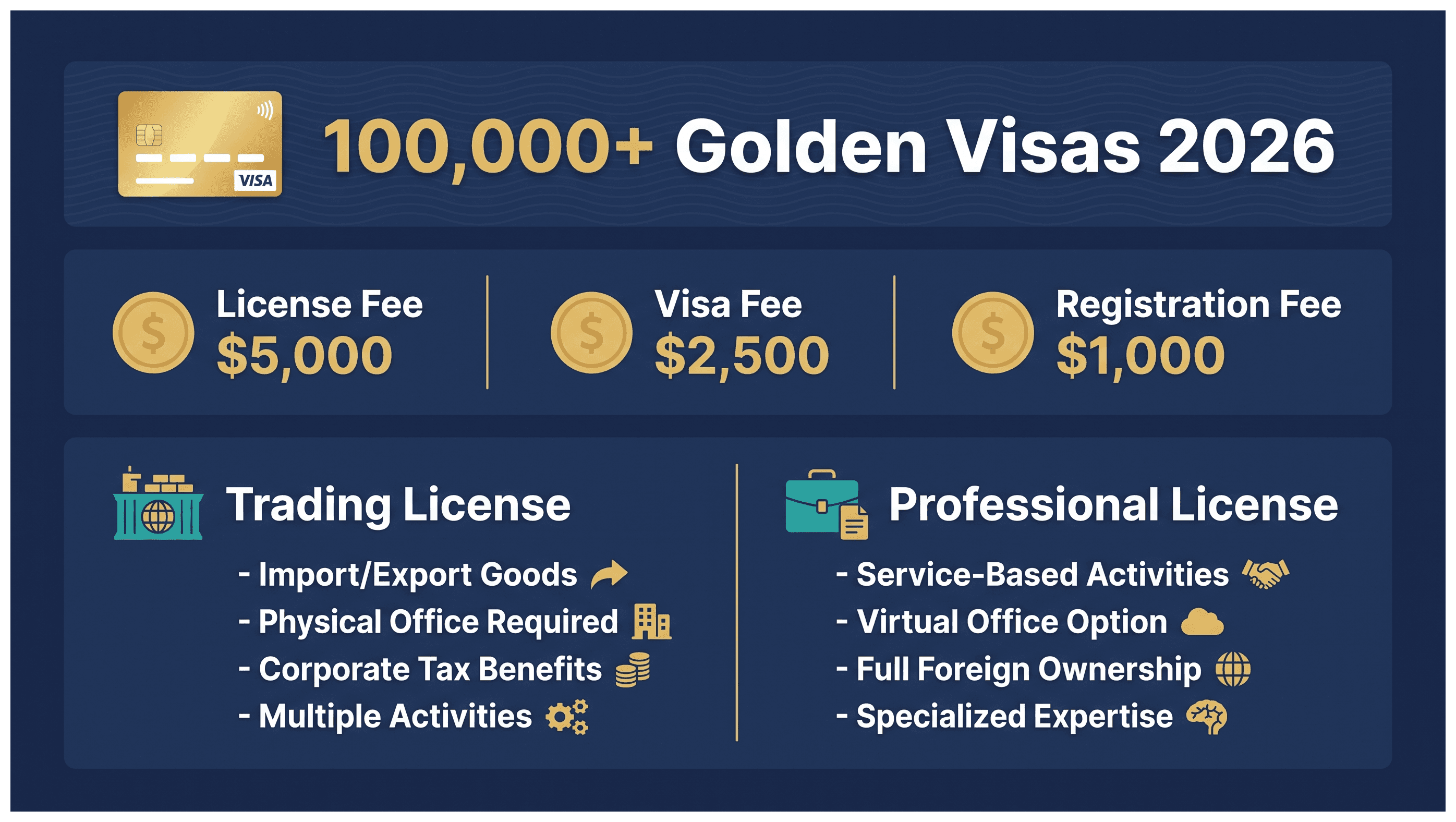
Indian founders choosing a dubai free zone indian company license select between trading, professional, and services licenses based on their planned activity. Each license type maps to a specific activity list, and combining unrelated activities on one license can trigger extra fees or rejection.
Trading Licenses for Import-Export Founders
If you're shipping goods to or from India, a trading business license is your starting point. It requires you to select clear HS code activities that match what you actually move, not a broad catch-all description. Many founders pair this license with a warehouse or a logistics partner near ports like Jebel Ali, since Dubai handles a significant share of GCC re-export trade (Dubai Chamber, 2024).
Professional and Service Licenses
Fits consultants, IT freelancers converting to companies, and advisors.
Lower minimum share capital requirements, generally.
Activity selection directly affects visa allocation count.
A Chennai-based software architect, for instance, opens an ICT business license entity to invoice GCC clients directly instead of routing through an Indian employer. Choosing a professional business license here keeps her setup lean and compliant.
How Residency Links to Your Dubai Free Zone Company
A Dubai free zone company license opens up a residency visa quota processed through the ICP (Federal Authority for Identity, Citizenship, Customs and Port Security) and the GDRFA (General Directorate of Residency and Foreigners Affairs), followed by an Emirates ID. Founders typically receive their status within weeks of license issuance, tying company ownership directly to their right to live in the UAE.
The Visa Quota Attached to Your License
Your visa quota depends on office space size and the package you select at formation. Once your status is issued, you can sponsor family members, including a spouse and children. GDRFA handles the entry permit stage first, before your status is converted inside the country.
Getting Your Emirates ID and Status
Is a Dubai company for Indian founders worth the residency step? For most founders, yes, since the visa comes bundled with formation rather than as a separate application.
ICP manages federal identity registration for every applicant.
Medical test and biometrics come before card issuance.
Your Emirates ID is needed for banking and telecom setup.
Once issued, this card becomes your daily-use ID, from opening a corporate bank account to signing a lease.
Steps to Set Up Your Dubai Company from India
Setting up a Dubai company from India follows five steps: check name availability, pick a license and activity, submit documents, pay fees, and apply for a residency visa. Most founders complete formation remotely before traveling for Emirates ID biometrics.
Step 1: Reserve Your Trade Name
Search availability before drafting any documents.
Avoid restricted or trademarked terms in your name.
A reservation locks your name for a set period.
Run this through Name Check first, it saves you from redoing paperwork later.
Step 2: Choose License and Activity
Match your activity to the official catalogue.
Confirm ownership structure allowed under your license.
Decide office package based on visa needs.
Step 3: Submit Passport and KYC Documents
Passport copy, photo, and application form required.
No-objection certificate rarely needed for free zone setup.
Digital submission speeds up your approval timeline.
Step 4: Pay Fees and Receive License
Government and registration fees are paid upfront.
License is issued digitally within days.
Bank account opening follows license issuance.
Tax and Money Rules Indian Founders Must Track
Indian founders running a Dubai company must track UAE corporate tax filings with the FTA, report foreign income to the Income Tax Department in India, and remit funds under the RBI (Reserve Bank of India) LRS (Liberalised Remittance Scheme) limit, while the India-UAE CEPA (Comprehensive Economic Partnership Agreement) can ease certain trade costs.
UAE Corporate Tax Obligations
FTA registration is required even for small entities, no exceptions based on size alone. Filing deadlines follow your financial year end, not the calendar year automatically. Federal Decree-Law No. 47 of 2022 sets the thresholds and exemptions that determine whether you owe tax at all, so read your specific bracket carefully before assuming a flat rate applies. Review the framework directly on the Federal Tax Authority portal.
Reporting Requirements Back in India
Income Tax Department requires disclosure of foreign assets.
RBI LRS caps annual outward remittance for individuals.
India-UAE CEPA can reduce duties on certain trade flows.
A Delhi-based founder funding her Dubai company equity uses her LRS limit for the transfer and declares the holding in her India tax return the same year. Skipping that disclosure is the most common compliance mistake we see among first-time founders.
Documents Indian Founders Need Before Applying
Indian founders need a valid passport, passport-size photo, proposed trade name options, activity description, and proof of address to apply for a Dubai free zone license. Additional documents like a business plan may be requested for regulated activities such as healthcare or financial services.
Standard Documents for Most Activities
Passport copy and a recent photo.
Application form with your activity selection.
Proof of current address in India.
Extra Documents for Regulated Activities
Financial services activities may need extra regulatory approvals.
Healthcare activities require regulatory sign-off before licensing.
Education activities need curriculum details submitted upfront.
What a Dubai company costs an Indian founder ultimately comes down to license type, activity, office package, and the residency visa attached to it. With clear documents and the right license, formation moves fast, often faster than founders expect coming from a heavier bureaucratic system back home. If you're comparing this route against staying purely India-based, our Moving to Dubai from India guide covers the wider relocation picture.
Use the Cost Calculator to estimate your total setup cost, then run a Name Check before you Build your Dubai company.
References
Frequently Asked Questions