Topic Summary
Dubai's Geography Gives 3PLs a Global Edge
An eight-hour flight from Dubai reaches 66% of the world's population across Europe, Asia, and Africa. This makes Dubai a natural consolidation hub for regional distribution, particularly for businesses serving the GCC and beyond.
Trade License Must Cover Every Activity
A 3PL trade license in Dubai must list each specific logistics activity the business intends to perform, such as freight forwarding, warehousing, and last-mile delivery. Adding an activity after the license is issued requires a paid amendment, so planning your full service offering upfront saves time and money.
DSBH Offers an Affordable Entry Point
The base trade license at Dubai South Business Hub Free Zone starts from AED 12,500, with no paid-up share capital required. A sole founder with one visa package can expect to pay from AED 18,350 in the first year.
Free Zone Storage Is Duty-Suspended, Not Duty-Free
Goods stored in a Dubai free zone are duty-suspended during storage, meaning standard UAE customs duties apply the moment goods enter the UAE mainland customs territory. Founders should factor this into their pricing and client contracts from day one.
Regulated Activities Require Separate Approvals
Certain 3PL services, such as customs brokerage, require approval from the relevant UAE regulator in addition to the free zone trade license. Mapping all planned service lines before applying helps avoid costly mid-year license amendments.
Late Tax Registration Carries a Steep Penalty
The Federal Tax Authority imposes a flat AED 10,000 penalty per tax type for late registration. 3PL founders should prioritise tax registration as part of their setup process, not as an afterthought.
UAE Logistics Sector Is a Significant GDP Contributor
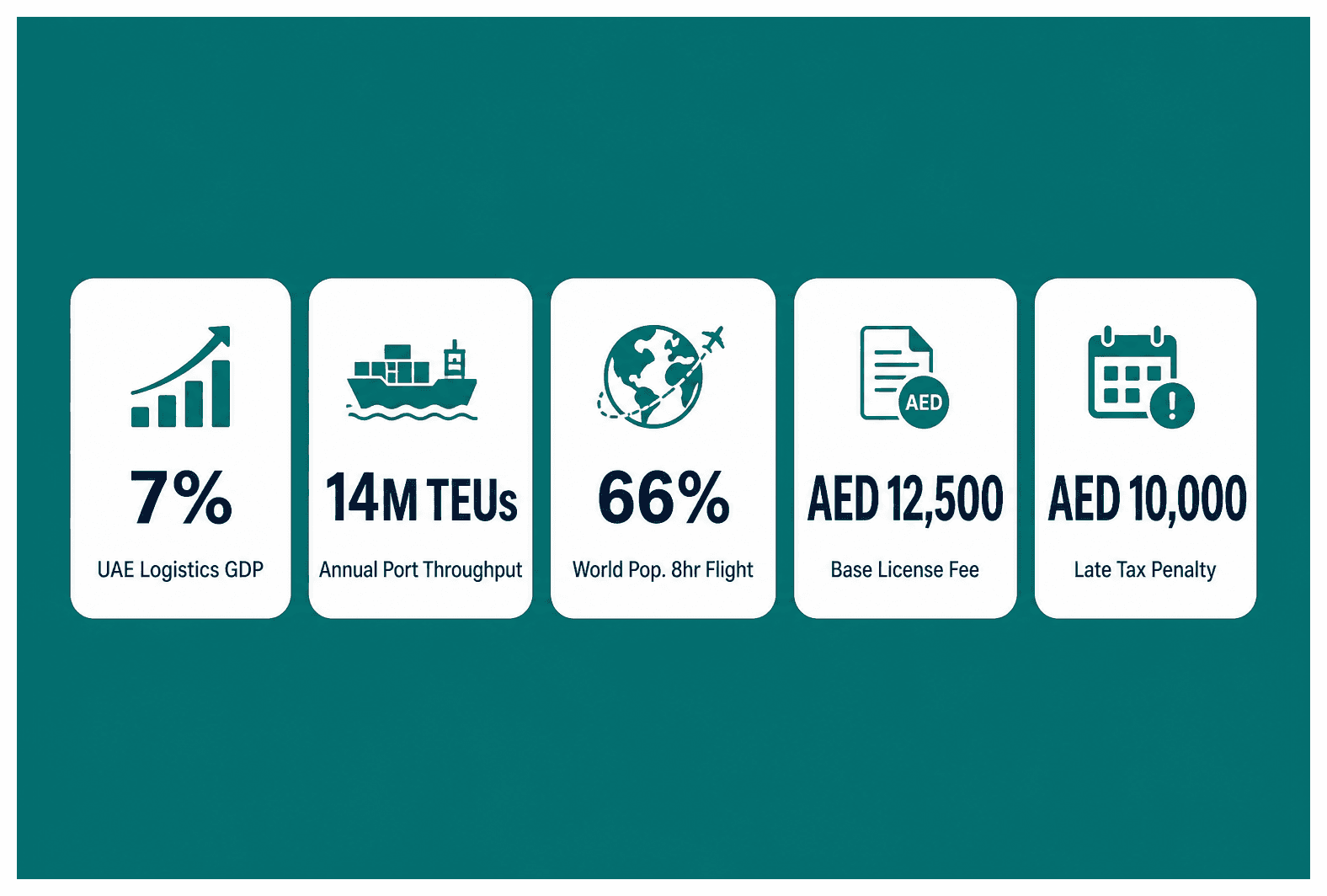
The UAE's logistics sector accounts for approximately 7% of GDP in 2026, with Dubai handling over 14 million TEUs of container throughput annually. This scale signals strong demand for professional 3PL operators across freight, warehousing, and last-mile services.
In 2026, the UAE's logistics sector accounts for approximately 7% of GDP (Dubai Chamber, 2024). Dubai handles over 14 million TEUs of container throughput annually through its ports and free zones (Dubai Chamber, 2024). An eight-hour flight from Dubai reaches 66% of the world's population. The base trade license for a 3PL business setup in Dubai at Dubai South Business Hub Free Zone (DSBH) starts from AED 12,500. Zero paid-up share capital is required. A sole founder with one visa package pays from AED 18,350 in year one. Late tax registration carries a flat AED 10,000 penalty per tax type (Federal Tax Authority, 2026).
This article walks first-time founders through everything they need to know about 3PL business setup in Dubai: the legal definition, the operational and regulatory requirements, the real costs using DSBH figures, and a clear step-by-step process to get your license issued in as little as one business day.
What Is a 3PL Business and How Does It Fit Dubai's Logistics Landscape
A third-party logistics (3PL) business provides outsourced supply-chain services, including freight forwarding, warehousing, inventory management, and last-mile delivery, on behalf of client companies. In Dubai, 3PL operators are classified under ISIC Section H (Transportation and Storage) and require a trade license covering the specific logistics activities they intend to perform.
Defining Third-Party Logistics Under UAE Classification Standards
Under ISIC Revision 4, 3PL businesses sit within Section H, which covers transportation, storage, and support activities for transportation. That classification matters practically: your trade license must reflect the specific activities within that section that your business will perform.
Typical 3PL activities include:
Freight forwarding (air, sea, and land)
Cargo consolidation and packing
Warehousing and inventory management
Customs brokerage coordination
Last-mile delivery management
The key distinction: a 3PL operator contracts with client businesses to manage part or all of their supply chain. It does not sell goods to end consumers. A Dubai-based e-commerce brand, for example, might outsource its inbound freight, pick-and-pack operations, and last-mile courier coordination entirely to a licensed 3PL operator.
Why Dubai Is a Strategic Base for 3PL Companies
Dubai's geography is genuinely hard to beat for logistics. Within an eight-hour flight, you can reach 66% of the world's population across Europe, Asia, and Africa. That's not a marketing line; it's the operational reason why a European medical device brand would use a Dubai-based 3PL operator to consolidate GCC-bound shipments before distributing across the region.
Free zone infrastructure gives 3PL operators access to warehousing near major air and sea cargo hubs without requiring a local UAE partner. Worth flagging clearly: goods stored in a free zone are duty-suspended during storage, not duty-exempt. Standard UAE customs duties apply the moment goods cross into the UAE mainland customs territory. DSBH is a free zone but is not a designated zone, so it does not carry designated-zone VAT or customs benefits.
Licensing and Regulatory Requirements for 3PL Business Dubai Operations
A 3PL business in Dubai requires a trade license covering each logistics activity it will perform. Regulated activities such as customs brokerage require separate approval from the named regulator in addition to the free zone license. The license must list every activity; each activity beyond the first five costs AED 2,000 at DSBH.
Core License Activities a 3PL Operator Typically Needs
Before you apply, map every service line your business will offer. Adding an activity mid-year means a license amendment, which costs time and money. A founder planning to cover all core 3PL services would typically need:
Freight forwarding (air, sea, and land)
Warehousing and storage
Cargo packing and consolidation
Last-mile delivery coordination
Customs documentation support
That's five activities, all covered within the base DSBH license. You can explore the full list of business activities in Dubai at DSBH before you apply. Each activity beyond the first five costs AED 2,000. So plan ahead.
Regulated Activities That Need a Named Regulator's Approval
Some logistics activities carry a dual-approval requirement. The DSBH trade license lists the activity, but a separate named regulator must approve the operator before it can legally perform that work. This is a critical distinction that catches many first-time founders off guard.
Regulated activities requiring secondary approval include:
Customs brokerage: DSBH licenses the activity; Dubai Customs approves the operator independently
Dangerous goods freight: requires approval from the relevant transport authority
Food product logistics: may require Dubai Municipality clearance
A 3PL operator adding customs brokerage to its license must complete DSBH's activity registration and then apply to Dubai Customs separately. The free zone approval does not substitute for the customs authority permit. Always confirm the full regulatory chain before finalising your activity list.
What DSBH Does and Does Not Provide for 3PL Operators
DSBH issues the trade license and provides the legal entity structure. That's its core function. But it's worth being precise about what DSBH does not provide, so you can budget and plan accordingly:
DSBH is not a designated zone; no designated-zone VAT or customs benefits apply
DSBH does not provide bonded warehousing
DSBH does not offer customs integration services
If your 3PL operation requires bonded storage for dutiable goods, you'll need to contract a separately licensed bonded warehouse operator. DSBH's license covers your company's commercial activities, not the physical bonded facility.
3PL Business Setup Cost Summary at DSBH (2026)
Cost Item | Amount (AED) |
|---|---|
Base trade license (B2B) | From 12,500 |
Base trade license (B2C) | From 11,375 |
First-year cost, sole founder + one visa | From 18,350 |
Each activity beyond first five | 2,000 per activity |
Paid-up share capital required | 0 (none required) |
Corporate tax late registration penalty (one-time flat) | 10,000 |
VAT late registration penalty | 10,000 |
Cost Breakdown for a 3PL Business Setup in Dubai
At Dubai South Business Hub Free Zone, a 3PL trade license starts from AED 12,500 with zero paid-up share capital required. A sole founder adding one visa package brings the first-year cost to AED 18,350. Visas are always an additional cost. Each activity beyond the first five adds AED 2,000 to the license fee.
DSBH License and First-Year Cost Figures
DSBH launched in September 2025 and publishes its pricing clearly. Here's what a 3PL founder should budget for year one:
Base trade license (B2B): from AED 12,500
Base trade license (B2C variant): from AED 12,500
First-year cost, sole founder + one investor visa: from AED 18,350
Paid-up share capital: AED 0, no bank deposit required before incorporation
License issuance: one business day once documents are submitted and approved
A sole founder setting up a freight forwarding and warehousing 3PL company at DSBH with one investor visa pays from AED 18,350 in year one. No share capital deposit is required. You can calculate your business setup cost using DSBH's online tool before committing.
Additional Cost Factors to Budget For
The license fee is just the starting point. A realistic first-year budget for a 3PL business setup in Dubai should also account for:
Extra activities: AED 2,000 each beyond the first five; eight activities means AED 12,500 + AED 6,000 = AED 18,500 for the license alone
Additional employee visas: priced separately and never bundled
Corporate tax late registration: AED 10,000 one-time flat penalty if you miss the window (Federal Tax Authority, 2026)
VAT late registration: AED 10,000 penalty if you exceed the AED 375,000 threshold without registering (Federal Tax Authority, 2026)
Operational costs: warehouse leasing, WMS software, and cargo insurance are outside the license fee entirely
How to Complete Your 3PL Business Setup in Dubai: A Step-by-Step Process
Setting up a 3PL business in Dubai involves six core steps: defining your activity list, reserving a trade name, submitting incorporation documents, paying the license fee, applying for investor visas, and opening a corporate bank account. At DSBH, the license can be issued in one business day once documents are approved.
Step 1: Define Your Activity List and Legal Structure
Start here before you touch any paperwork. List every logistics service you plan to offer, confirm which activities need secondary regulatory approval, and choose your legal structure.
Map all planned services: freight forwarding, warehousing, distribution, cargo consolidation, regulated activities
Identify which need secondary regulator approval beyond DSBH
Choose your entity type: Free Zone Establishment (FZE) for a sole founder, Free Zone Company (FZC) for multiple shareholders
100% foreign ownership is available at DSBH with no local partner requirement
A founder planning air freight forwarding, sea freight forwarding, warehousing, cargo packing, and last-mile coordination maps five activities, all covered in the base license, before submitting any paperwork.
Step 2: Reserve Your Trade Name and Submit Incorporation Documents
Check trade name availability before reserving. The name must not duplicate any existing UAE-registered name and must comply with UAE naming rules. A founder searching for "Gulf Link Logistics" checks availability first, avoiding rejection due to a duplicate already on the register.
You can check company name availability at DSBH before submitting. Required documents typically include:
Passport copies of all shareholders
A business plan summary
A completed application form
DSBH processes incorporation documents and issues the license in one business day once everything is approved.
Step 3: Pay License Fees, Apply for Visas, and Open Your Bank Account
Once your documents are approved, the remaining steps are:
Pay the license fee from AED 12,500 (plus AED 2,000 per activity beyond five); zero share capital deposit required
Apply for UAE residency visas separately after license issuance; visas are always an additional cost
Open a corporate bank account; bring your trade license, Emirates ID, and incorporation documents to accelerate onboarding
Register for corporate tax within the required window to avoid the AED 10,000 one-time flat penalty
Register for VAT if annual taxable supplies exceed AED 375,000
After receiving the DSBH license, a sole founder applies for one investor visa and then approaches a UAE bank with the trade license, passport, and Emirates ID to open a dirham-denominated corporate account. You can get support with bank account opening in the UAE through DSBH's beyond-hub services.
Visa and Workforce Requirements for Your 3PL Operation
A DSBH free zone license allows the company to sponsor UAE residency visas for its investors and employees. Visa costs are always additional to the license fee. 3PL operators hiring logistics staff must comply with MoHRE employment contract and wage protection requirements for all UAE-based employees.
Investor and Employee Visa Allocation
A DSBH license entitles the company to sponsor investor and employee visas. The number of visas available depends on the package selected. Visa costs are always separate from the license fee and are never described as included.
First-year cost of AED 18,350 for a sole founder assumes one visa package added to the base license
Additional employee visas are priced separately
You can review UAE residency visa services at DSBH to understand the packages available before you apply.
Is a free zone employer subject to MoHRE labour rules?
Yes. Free zone employees fall under MoHRE's jurisdiction for labour law purposes even when the employer is a free zone entity. Founders should not assume free zone status exempts them from Wages Protection System or employment contract registration obligations. Both apply in full.
MoHRE Compliance for Logistics Employees
All UAE-based employees of a 3PL company must have employment contracts registered with the Ministry of Human Resources and Emiratisation (MoHRE). The Wages Protection System (WPS) is mandatory; salaries must be paid through an approved WPS channel.
MoHRE employment contract registration is required for every employee
WPS enrolment must happen before the first payroll cycle
Drivers, warehouse operatives, and freight coordinators all fall under standard UAE labour law protections
A 3PL company hiring five warehouse operatives must register each employment contract with MoHRE and enrol in WPS before paying the first salary. For guidance on the process, the MoHRE inquiry system UAE guide covers the key steps.
Corporate Tax and VAT Obligations for a 3PL Business in Dubai
UAE corporate tax applies at 9% on taxable income above AED 375,000. VAT applies at 5% on most logistics services supplied in the UAE. Late registration for either tax carries a penalty of AED 10,000. The corporate tax penalty is a one-time flat charge, not a monthly fee.
Corporate Tax Registration and the 9% Rate
UAE corporate tax at 9% applies on taxable income above AED 375,000 per financial year under Federal Decree-Law No. 47 of 2022. Register promptly after license issuance; late registration carries a one-time flat penalty of AED 10,000 from the Federal Tax Authority.
A Qualifying Free Zone Person (QFZP) may access a 0% rate on qualifying income, but only if all four conditions are met:
Maintains adequate substance in the free zone
Derives qualifying income as defined under the CT law
Does not elect to be subject to standard corporate tax
Meets the de minimis non-qualifying revenue requirements
A 3PL company earning AED 2 million in annual profit that registers on time avoids the AED 10,000 penalty and can then assess whether its activities meet QFZP conditions. Seek qualified UAE tax advice before making that determination.
VAT on Logistics Services
VAT at 5% applies to most logistics services supplied within the UAE, including freight forwarding and warehousing. The mandatory registration threshold is AED 375,000 in annual taxable supplies.
5% VAT applies on UAE-supplied logistics services
References
Frequently Asked Questions