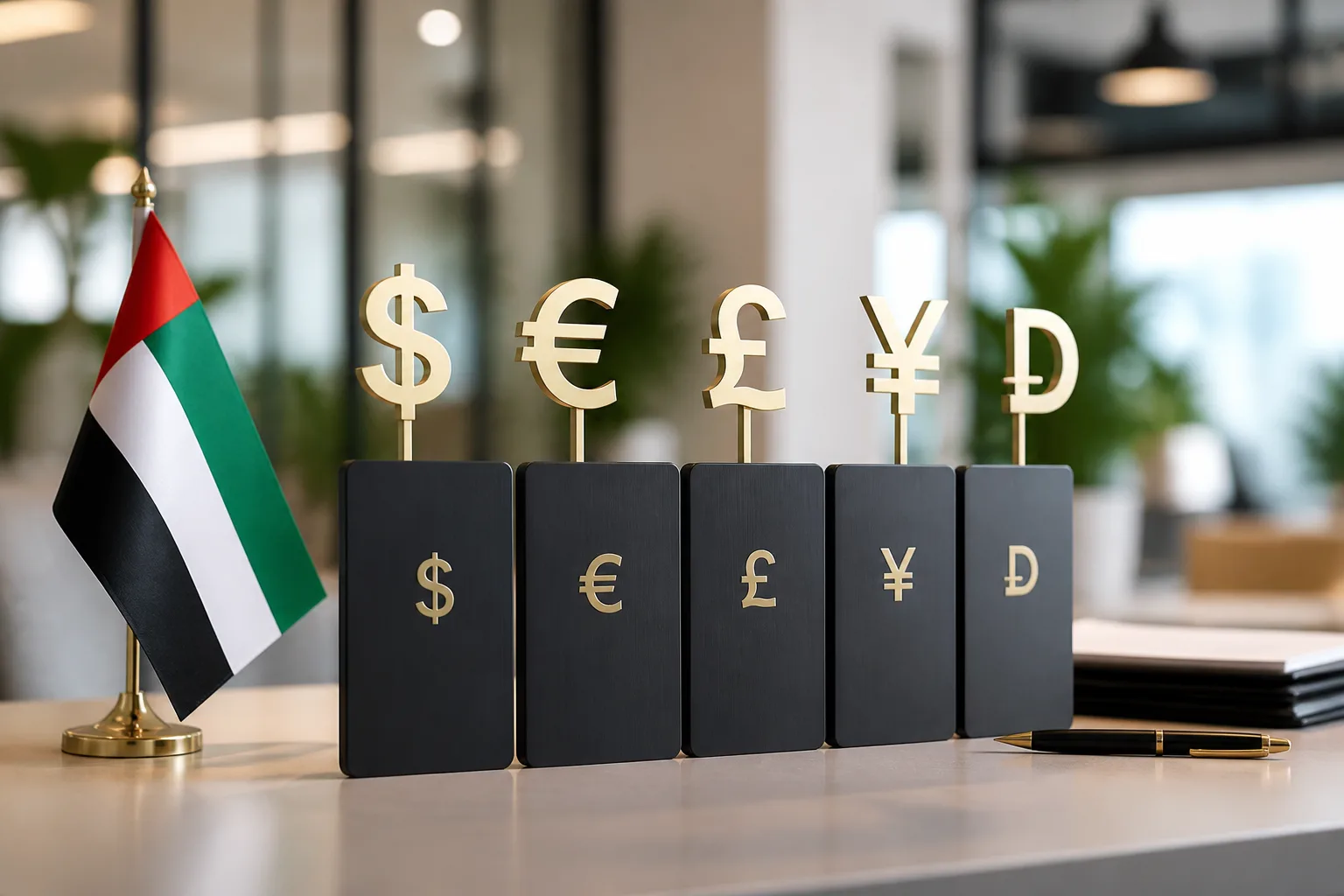
Topic Summary
Avoid Costly Forced Currency Conversions
Standard AED-only accounts automatically convert incoming foreign payments at a 1–3% FX spread the moment funds arrive. A multi-currency account lets you hold receipts in their original currency and convert only when the rate is favorable, saving meaningful margin on every transaction.
Hold Multiple Currencies in One Structure
Multi-currency corporate accounts create named sub-wallets or IBANs for each currency, commonly AED, USD, EUR, and GBP, within a single account. This means funds from different markets settle separately without triggering an automatic conversion.
USD Support Is Universal Thanks to the AED Peg
The AED has been pegged to the USD at 3.6725 since 1997, making dollar support a baseline feature at every UAE institution. Founders trading with US clients benefit immediately, but EUR, GBP, CNY, and INR wallets are increasingly standard for broader international reach.
Both Free Zone and Mainland Companies Are Eligible
Your company's jurisdiction, whether free zone or mainland, is not the primary barrier to opening a multi-currency account. The bank's own due-diligence criteria determine eligibility, so first-time founders in either structure can apply.
All Providers Are Regulated to the Same Standard
The Central Bank of the UAE licenses and supervises every bank and licensed fintech operating in the country. Whether you choose a traditional bank or a digital provider, the regulatory protection covering your account is equivalent.
CNY and INR Access Reflects Growing Trade Volumes
As UAE-China and UAE-India trade continues to expand, Chinese yuan and Indian rupee wallets are becoming available at more institutions. Founders with counterparties in either market should confirm currency availability before submitting a full application, since offerings vary significantly.
Simplify VAT Records and Signal Credibility
Keeping receipts in their original transaction currency makes VAT record-keeping more straightforward and reduces reconciliation errors. Presenting overseas clients with a local currency IBAN also signals financial credibility and can accelerate payment from international counterparties.
In 2026, more than 40% of UAE-registered companies transact in at least two currencies, yet many first-time founders open a single-currency dirham account and lose margin on every cross-border payment they make. A multiple currency corporate UAE bank account solves this directly: it lets your company hold, send, and receive USD, EUR, GBP, and AED in one structure without forced conversion at the point of receipt.
This guide covers what a multiple currency corporate UAE account is, the requirements you need to meet, what it costs, and exactly how to open one, so you can collect and pay in your clients' currencies from day one. The AED is pegged to the USD at 3.6725 (since 1997) [1], which makes USD support universal, but EUR, GBP, CNY, and INR matter just as much for founders with European, Chinese, or Indian counterparties. Standard AED-only accounts apply a 1–3% FX spread on every incoming foreign payment [2]. A multi-currency account cuts that cost significantly by letting you choose when to convert. The Central Bank of the UAE licenses every bank and payment institution operating in the country [3], so both traditional banks and digital providers are regulated to the same standard.
What Is a Multiple Currency Corporate Bank Account in the UAE
A multiple currency corporate UAE bank account lets a registered company hold, send, and receive funds in several currencies, commonly AED, USD, EUR, and GBP, within a single account structure, avoiding forced conversion at the point of receipt and reducing foreign-exchange costs on international transactions. It's the practical alternative to a standard AED-only account for any founder dealing with overseas clients or suppliers. Both free zone and mainland companies are eligible; the bank's own due-diligence criteria, not your company's jurisdiction, is the primary filter.
How Multi-Currency Accounts Differ from Standard Corporate Accounts
A standard AED-only account converts every incoming foreign payment at the bank's spot rate the moment it arrives. That conversion typically costs 1–3% per transaction, a real drag if you're receiving regular USD or EUR payments from overseas clients.
A multi-currency account creates named sub-wallets or IBANs for each currency, so funds settle in their original denomination. A Dubai-based e-commerce company receiving USD payments from US customers, for example, holds them in a USD wallet and converts in bulk when the rate is favourable, saving roughly 1.5% compared with auto-conversion on each individual order. The company controls the timing, not the bank.
Both traditional UAE banks and licensed fintech providers offer this structure. The Central Bank of the UAE licenses and supervises all of them, so the regulatory protection is equivalent regardless of which type of institution you choose.
Which Currencies Are Typically Supported in the UAE
Here's what you'll find at most major UAE banks and licensed providers:
AED, always included as the base currency
USD, universally supported given the AED peg to the dollar at 3.6725 since 1997
EUR and GBP, standard additions at most institutions
CNY (Chinese yuan) and INR (Indian rupee), increasingly available as UAE-China and UAE-India trade volumes grow
Emerging-market currencies, may require a separate correspondent-bank arrangement; confirm availability before applying
A UK founder setting up a consulting company in Dubai, for instance, can hold GBP receipts from British clients and EUR receipts from European clients in separate wallets, then convert each to AED monthly for local expenses. Always confirm the exact currency list with your chosen bank before submitting a full application, offerings vary more than most founders expect.
Key Benefits of a Multiple Currency Corporate UAE Account for First-Time Founders
A multiple currency corporate UAE account reduces FX conversion costs, speeds up international settlements, simplifies VAT record-keeping in the transaction currency, and signals credibility to overseas clients and suppliers who prefer to pay in their home currency rather than converting to AED. For a first-time founder, these aren't abstract advantages, they show up directly in your margins and your ability to win international clients.
Reducing Foreign-Exchange Costs on Every Transaction
Holding USD receipts in a USD sub-wallet and converting in bulk cuts the effective FX spread significantly compared with auto-conversion on arrival. Founders can time conversions around favourable rate windows rather than accepting whatever rate the bank applies at 9am on the day the wire lands.
Consider a Dubai consultancy billing European clients in EUR. It holds EUR in its account, then converts a monthly lump sum to AED for local payroll, cutting conversion events from 20-plus per month down to one. That single change eliminates repeated 0.5–2% spreads on every individual payment. For businesses invoicing in both EUR and GBP, avoiding double conversion (foreign currency to AED, then back to foreign currency for outbound payments) protects even more margin.
Simplifying Cross-Border Payments and Client Relationships
Here's a practical benefit that founders often overlook: overseas clients can pay into a local IBAN in their own currency, removing their conversion cost entirely. That makes your invoices easier to accept, and easier to get paid faster.
Suppliers in Asia or Europe can be paid directly in CNY, INR, or EUR without correspondent-bank delays
Same-currency SWIFT transfers typically settle in 1 business day; cross-currency transfers can take 2–5 business days
Named currency accounts signal financial sophistication to international counterparties
Faster settlement reduces working-capital pressure for early-stage businesses
If you're exploring what financial services business activities look like under a UAE trade license, the multi-currency account structure becomes even more relevant to your daily operations.
Step-by-Step Guide to Opening a Multiple Currency Corporate Account in the UAE
To open a multiple currency corporate UAE account, incorporate your company and obtain a trade license, then gather KYC documents, select a bank or licensed provider that supports your required currencies, submit the application, pass compliance review, and activate each currency wallet before making your first transaction. This multiple currency uae guide breaks each step into what you actually need to do.
Step 1: Incorporate Your Company and Obtain a Trade License
Every UAE bank requires a valid trade license before opening any corporate account. No license, no account, it's that straightforward. The license is your entry point to the entire banking relationship.
Dubai South Business Hub (DSBH) Free Zone issues licenses from AED 12,500, with the license ready in one business day. The free zone launched in September 2025 and requires zero paid-up share capital, so no funds are locked up at incorporation. The first-year total for a sole founder with one visa starts from AED 18,350. Each activity beyond the first five costs AED 2,000. Visas are always an additional cost, not included in the license fee.
A founder setting up a trading company at DSBH can have a trade license in hand the next business day, then walk into a bank with a compliant document set immediately. You can review the full list of business activities to match your license scope to your banking profile before you apply.
Step 2: Prepare Your KYC Document Pack
Banks won't accept incomplete submissions. Prepare these documents before you approach any institution:
Trade license (original or certified copy)
Memorandum and Articles of Association
Passport copies and Emirates ID for all shareholders and directors
Proof of registered address (tenancy contract or free zone lease letter)
Business plan or description of trading activities and expected transaction volumes
Source-of-funds documentation, required under Central Bank of the UAE AML guidelines for all new corporate accounts
DSBH issues a standard letter of good standing that satisfies most bank KYC requirements, so free zone applicants don't face additional document hurdles compared with mainland companies.
Step 3: Select a Bank or Licensed Provider and Submit Your Application
Confirm which currencies the institution supports before applying, this step alone saves weeks of wasted compliance time. Ask specifically about minimum average balance requirements per currency wallet, as these vary widely between institutions.
Licensed fintech providers regulated by the Central Bank of the UAE can be faster to onboard than traditional banks but may carry lower transaction limits. Traditional banks tend to favour companies with 12 or more months of trading history. If you're a new company, a regulated digital provider may be the more practical starting point.
Submit the full KYC pack and expect a compliance review period of 2–6 weeks for traditional banks. Once approved, activate each currency wallet and test with a small inbound transfer before going live with client payments.
Requirements for Opening a Multiple Currency Corporate Account in the UAE
UAE banks require a valid trade license, certified constitutional documents, KYC identification for all beneficial owners holding 25% or more, a registered business address, and a clear description of expected transaction currencies and volumes before approving a multiple currency corporate UAE account. Meeting these requirements upfront is what separates a smooth application from a months-long back-and-forth.
Eligibility Criteria Banks Apply to Corporate Applicants
The company must be legally incorporated in the UAE with an active trade license. All beneficial owners with 25% or more shareholding must be disclosed under Central Bank of the UAE AML regulations, this is a hard requirement, not a formality.
Your stated business activities must align with the currencies you want to hold. A purely local service business requesting eight currency wallets will face enhanced due diligence. Banks want to see a logical connection between what your company does and which currencies it needs. Some institutions also impose a minimum monthly turnover threshold, commonly AED 20,000–50,000, or a minimum opening deposit (confirm the exact figure with each bank before applying).
Regulated Activities and Additional Approvals
If your business involves financial services, money transfer, or payment aggregation, the Central Bank of the UAE licenses the activity, and that regulator's approval must be in place before a bank will open the account. DSBH licenses the activity on the trade license; the named sector regulator approves it separately. Both are required, and presenting them together in your KYC pack avoids delays.
A practical example: a payment-services startup holds a DSBH trade license covering payment facilitation and a Central Bank of the UAE stored-value facility license. The bank requires both documents before activating the multi-currency account. For healthcare businesses, the Dubai Health Authority (DHA) issues its own approval separately from the trade license, the same principle applies.
Multi-Currency Corporate Account: Traditional Bank vs. Licensed Digital Provider
Feature | Traditional UAE Bank | Licensed Digital Provider |
|---|---|---|
Onboarding timeline | 2–6 weeks compliance review | Often 3–10 business days |
Currency wallet range | Typically AED, USD, EUR, GBP, CNY, INR at major banks | Varies by provider; some offer 30+ currencies |
Minimum balance requirement | Commonly AED 20,000–50,000 average monthly balance | Often lower or nil; varies by provider |
SWIFT transfer fee | AED 50–150 per outgoing transfer | Often lower flat fee or per-transaction rate |
FX conversion spread | Typically 0.5–2% above mid-market rate | Often 0.3–0.8% above mid-market rate |
Established-company preference | Strong preference for 12+ months trading history | More accessible to newly incorporated companies |
Is a free zone trade license accepted by UAE banks for account opening?
Yes. Free zone trade licenses from DSBH are accepted by UAE banks on the same basis as mainland DET licenses for account-opening purposes. The free zone issues a standard letter of good standing that satisfies most bank KYC requirements, so there's no jurisdictional disadvantage for free zone applicants.
Costs of a Multiple Currency Corporate UAE Account
Costs for a multiple currency corporate UAE account include a monthly or annual account maintenance fee, per-currency wallet charges, minimum balance requirements, SWIFT transfer fees per transaction, and FX conversion spreads. This multiple currency uae guide breaks those costs down so you can budget accurately before you apply. Digital providers often charge lower monthly fees but higher per-transaction rates, so the right choice depends on your transaction volume.
Typical Fee Structures at UAE Banks and Licensed Providers
Monthly account maintenance fees: vary by institution; confirm the exact figure before applying (UNVERIFIED: confirm before publishing)
Per-currency wallet activation fee: varies by institution (UNVERIFIED: confirm before publishing)
SWIFT outgoing transfer fees: typically AED 50–150 per transaction depending on the bank and destination
FX conversion spreads: bank platforms typically 0.5–2% above mid-market rate; digital providers often 0.3–0.8%
Maintenance fee waivers: some banks waive the fee if the average monthly balance across all wallets exceeds a set threshold
The gap between 0.3% and 2% FX spread might sound small, but on AED 500,000 of monthly international turnover it's the difference between AED 1,500 and AED 10,000 in conversion costs. Worth calculating before you commit to a provider.
Company Formation Costs Before You Reach the Bank
A trade license is the prerequisite cost. DSBH issues licenses from AED 12,500, with the first-year total for a sole founder with one visa starting from AED 18,350. Zero paid-up share capital means no funds are locked up at incorporation, that's a meaningful cash-flow advantage compared with structures that require capital deposits.
Use the business setup cost calculator to model your specific activity and visa combination before committing. Then budget for the bank's minimum opening deposit on top of your formation costs, that figure varies by institution, so ask for it in writing before you apply.
VAT, Corporate Tax, and Your Multiple Currency Corporate Account in the UAE
UAE VAT at 5% applies to taxable supplies over AED 375,000 per 12 months regardless of which currency you invoice in. Corporate tax at 9% applies to taxable income above AED 375,000. Late registration for either carries a flat AED 10,000 penalty each; the corporate tax penalty is a one-time charge. Your multiple currency corporate UAE account directly affects how you record and report both taxes.
Recording Transactions in Foreign Currencies for UAE Tax Purposes
VAT returns must be filed in AED. Foreign-currency invoices are converted using the exchange rate on the date of supply, with the Federal Tax Authority accepting the UAE Central Bank's published rate as the conversion reference.
Multi-currency account statements that show each transaction's original currency alongside the AED equivalent simplify VAT return preparation significantly. You're not manually reconstructing exchange rates for dozens of transactions, the statement does it for you. Keeping currency wallets segregated by business activity also helps when you're calculating taxable turnover per activity, particularly if you run more than one revenue stream through the same entity.
Corporate Tax Considerations for Multi-Currency Businesses
Corporate tax at 9% applies to taxable income above AED 375,000 per financial year under Federal Decree-Law No. 47 of 2022. Qualifying Free Zone Person (QFZP) status can result in 0% corporate tax on qualifying income, but only when four conditions are met: the company maintains adequate substance in the UAE, derives qualifying income as defined by the legislation, does not elect to be subject to the standard tax regime, and meets transfer-pricing requirements.
One nuance worth flagging: FX gains realised when converting currency wallets may be treated as taxable income. Confirm the treatment with a UAE tax adviser before your first large conversion. Late corporate tax registration carries a one-time flat penalty of AED 10,000, set a calendar reminder at incorporation so it doesn't catch you off guard.
Common Mistakes Founders Make With Multiple Currency Corporate Accounts in the UAE
The most common mistakes include applying before the trade license is issued, underestimating KYC document requirements, choosing a bank that does not support all required currencies, ignoring minimum balance rules that trigger fees, and failing to register for VAT before the AED 375,000 turnover threshold is crossed. Each of these is avoidable with a bit of preparation, here's how to sidestep them.
Applying to the Wrong Institution for Your Business Profile
Traditional UAE banks tend to favour established companies with 12 or more months of trading history. If you're a newly incorporated company, you'll likely find a regulated digital provider more accessible as a starting point, and you can always add a traditional bank account once you have a track record to show.
Not every bank supports all currencies. Applying without confirming the currency roster wastes weeks in the compliance queue. A mismatch between your stated business activities and the currencies you request triggers enhanced due diligence and can lead to outright rejection. Always ask for the bank's exact multi-currency product sheet before submitting a full application. For more detail on bank account opening in the UAE, the DSBH banking guide covers the process in full.
References
Frequently Asked Questions