
Topic Summary
Understand Why Accounting Is Regulated
Accounting and auditing in Dubai require both a professional trade license and a separate regulatory approval from the Ministry of Economy UAE. A trade license alone is not legally sufficient to offer services to clients.
Know the Corporate and VAT Tax Thresholds
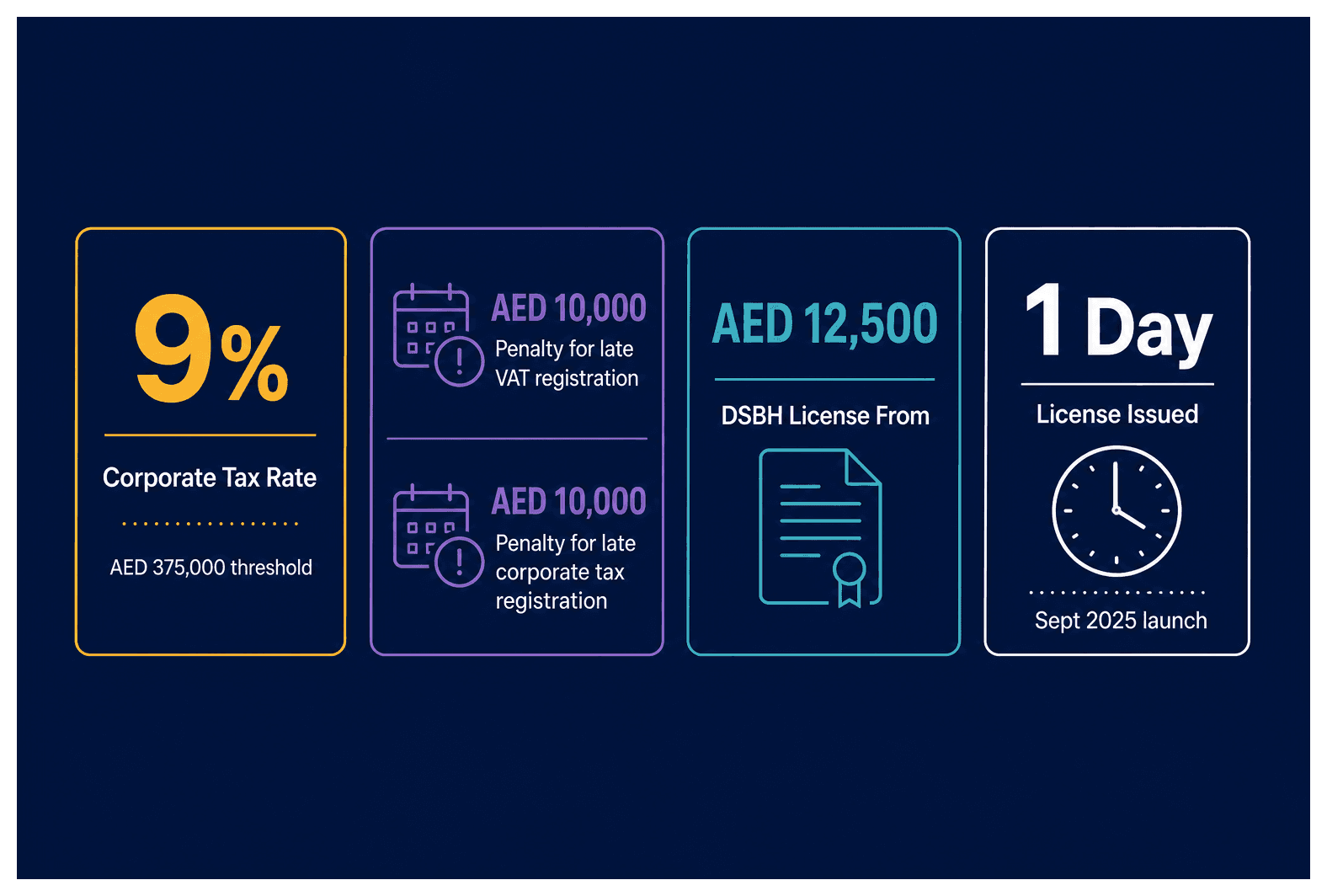
The UAE imposes a 9% corporate tax on taxable income above AED 375,000, and mandatory VAT registration kicks in at the same AED 375,000 annual turnover threshold. Missing either registration deadline triggers a one-time AED 10,000 flat penalty.
Choose Between Free Zone and Mainland Structure
Free zone licenses offer 100% foreign ownership and faster setup, while a mainland license via DET is typically needed to physically audit onshore-registered entities. A founder focused on SME bookkeeping and tax filing can usually operate effectively from a free zone.
Consider Dubai South Business Hub for Speed
DSBH, launched in September 2025, issues professional licenses for accounting activities from AED 12,500 and can complete issuance in one business day. First-year total costs for a sole founder with one visa start from AED 18,350.
Match Your Approval Path to Your Services
A sole-founder CPA offering bookkeeping and VAT filing faces a lighter regulatory approval path than a partner-led firm seeking statutory audit registration with the Ministry of Economy. Getting this distinction wrong at the outset can delay your launch by weeks.
Secure Your Own Firm's Compliance First
Accounting practices must meet their own VAT and corporate tax registration obligations before advising clients on the same. Failing to do so exposes the firm to the same AED 10,000 penalties it helps clients avoid.
Federal Decree-Law No. 47 of 2022 introduced a 9% corporate tax rate on taxable income above AED 375,000 (Ministry of Finance UAE, 2022). That single regulation has driven a sharp rise in demand for professional accounting services across the UAE. The mandatory VAT registration threshold sits at AED 375,000 in annual taxable turnover (Federal Tax Authority, 2018, still accurate as of 2026). Late VAT registration carries a one-time AED 10,000 penalty. Late corporate tax registration carries the same AED 10,000 flat penalty. Dubai South Business Hub Free Zone (DSBH) issues professional licenses for accounting activities from AED 12,500, with first-year costs for a sole founder with one visa starting from AED 18,350. DSBH launched in September 2025 and can issue a license in one business day.
This article covers the regulatory requirements, realistic first-year costs, and the exact step-by-step process to complete your accounting firm setup in Dubai correctly from day one, whether you choose a free zone or mainland structure.
What Accounting Firm Setup in Dubai Actually Means for Regulated Practices
Accounting firm setup in Dubai means obtaining a professional trade license for accounting or auditing activities, then securing a separate regulatory approval from the Ministry of Economy UAE or a recognized professional body. Both the license and the approval are mandatory before you can legally offer services to clients.
Why Accounting Is a Regulated Activity in the UAE
Accounting and auditing are classified as regulated professional activities under UAE law. A trade license alone is not sufficient to practice. The Ministry of Economy UAE maintains an official register of approved auditors, and only firms on that register can sign statutory audit reports.
Firms offering VAT filing, corporate tax advisory, or audit services face additional oversight from the Federal Tax Authority. The distinction between service types matters enormously here. A sole-founder CPA launching a bookkeeping and VAT-filing practice faces a lighter approval path than a partner-led firm seeking statutory audit registration with the Ministry of Economy. Getting this wrong at the outset delays your launch by weeks.
Federal Decree-Law No. 47 of 2022 introduced the 9% corporate tax rate, creating a compliance wave that has pushed demand for qualified accounting practices to new highs. Both the AED 10,000 VAT late registration penalty and the AED 10,000 corporate tax late registration penalty (one-time flat, not monthly) are real risks for practices that don't get their own compliance right alongside their clients'.
Free Zone vs. Mainland: Which Structure Fits an Accounting Practice
The choice comes down to your client base and the scope of services you plan to offer. Here's how the two paths compare for an accounting practice:
Free zone license (e.g., DSBH): 100% foreign ownership, zero paid-up share capital, license from AED 12,500, issued in one business day
Mainland license via DET: typically required for firms that need to physically audit entities registered onshore
Free zone firms can serve clients anywhere in the UAE, but confirm whether your specific regulated approval permits cross-jurisdiction client work
DSBH launched September 2025 and supports professional service activities including accounting and financial consulting
A founder targeting SME bookkeeping and tax-filing clients across Dubai can operate effectively from a free zone. A firm contracted to audit a mainland LLC's statutory accounts may need a mainland presence or a co-engagement arrangement. DSBH supports accounting and financial consulting under a professional license in Dubai, but it does not provide bonded warehousing or designated-zone VAT benefits, which don't affect accounting service firms anyway.
Accounting Firm Dubai Requirements: License Activities and Professional Qualifications
To meet accounting firm Dubai requirements, you need a professional trade license covering your chosen activities, a qualified licensee holding a recognized accounting credential, and in most cases a separate approval from the Ministry of Economy UAE or the relevant professional body. Qualifications, experience records, and attested certificates are always required.
Which Business Activities to List on Your License
Choosing the right activities at the outset is one of the most practical decisions in your accounting firm setup in Dubai. Core activities for an accounting practice typically include:
Accounting and bookkeeping services
Financial consulting
VAT advisory
Corporate tax advisory
Payroll processing
Statutory audit is a separate, more restricted activity requiring Ministry of Economy registration. At DSBH, the first five activities are included in the base license price. Each activity beyond five costs AED 2,000 and requires a license amendment. A founder wanting to offer bookkeeping, VAT filing, payroll, financial consulting, and corporate tax advisory covers five activities within the base license, a sixth activity such as internal audit advisory adds AED 2,000. Check the full list of business activities at DSBH to confirm the exact activity codes that match your service offering before submitting.
Professional Qualifications the Approval Bodies Expect
The Ministry of Economy UAE requires auditors to hold a recognized professional qualification such as CPA, ACCA, CA, or equivalent, along with relevant post-qualification experience. Exact year requirements should be confirmed directly with the Ministry before applying.
All foreign-issued certificates must be attested by the country of issuance and then counter-attested by the UAE Ministry of Foreign Affairs. An ACCA-qualified founder from the UK, for example, must have their ACCA certificate attested in the UK and then counter-attested by the UAE MoFA before submitting to the Ministry of Economy (Ministry of Economy UAE, 2024).
A UAE residency visa is required before the Ministry of Economy will process an individual auditor registration. Bookkeeping and accounting firms that don't offer statutory audit face a lighter qualification check, but the license holder should still hold a recognized credential to build client trust and meet any future regulatory changes.
Regulatory Approvals Every Accounting Firm in Dubai Must Secure
Every accounting firm in Dubai must secure a trade license from either a free zone authority or DET, and then obtain a separate approval from the Ministry of Economy UAE for audit work or from the Federal Tax Authority for registered tax agents. DSBH issues the license; the named regulator approves the practice independently. Neither approval is bundled with the license.
Ministry of Economy Registration for Auditors
The Ministry of Economy UAE maintains the official register of licensed auditors permitted to sign statutory audit reports in the UAE. Application requires the following documents:
Attested professional qualifications
Proof of post-qualification experience
Valid UAE residence visa
Clean criminal record certificate
Copy of the trade license
Registered audit firms must renew their Ministry of Economy approval annually alongside the trade license renewal. A Dubai-based SME accounting firm offering only bookkeeping, payroll, and VAT returns does not need Ministry of Economy audit registration, but the moment it takes on a statutory audit engagement, registration becomes a legal requirement. Plan for this before you pitch for audit work (Ministry of Economy UAE, 2024).
Federal Tax Authority Registration for Tax Agents
Firms that want to represent clients before the Federal Tax Authority must register as Registered Tax Agents. The FTA has its own eligibility criteria covering qualifications, fit-and-proper checks, and professional indemnity insurance, separate from anything the trade license authority requires.
VAT registration for the firm itself is also required once taxable turnover exceeds AED 375,000. An accounting firm handling VAT filings for 20 SME clients will almost certainly exceed that threshold in annual fees, triggering mandatory VAT registration for the firm itself, not just its clients. Failure to register triggers a one-time AED 10,000 penalty. The same penalty applies for late corporate tax registration (Federal Tax Authority, 2024).
For financial services licensing in Dubai, DSBH licenses the activity; the FTA and Ministry of Economy each issue their own approvals independently.
How to Complete Your Accounting Firm Setup in Dubai: A Step-by-Step Process
To complete your accounting firm setup in Dubai, select your jurisdiction and activities, reserve your trade name, submit your license application, obtain regulatory approvals from the Ministry of Economy or FTA, open a corporate bank account, and apply for residence visas. The full process typically takes two to six weeks depending on the approval bodies involved.
Accounting Firm Setup in Dubai: Key Cost and Requirement Comparison
Feature | Dubai South Business Hub Free Zone | Mainland (DET) |
|---|---|---|
License cost | From AED 12,500 (professional) | UNVERIFIED: confirm current DET professional license fee before publishing |
Time to issue license | 1 business day once documents are complete | Typically several business days; timeline varies by activity and approvals required |
Paid-up share capital | Zero, no capital locked up at incorporation | Varies by legal structure; confirm with DET for current requirements |
Foreign ownership | 100% foreign ownership permitted | 100% foreign ownership also available on the mainland for most professional activities |
Ministry of Economy audit approval | Required separately; DSBH licenses the activity, Ministry of Economy approves the audit practice independently | Required separately; same Ministry of Economy registration process applies |
Suitable for mainland statutory audit clients | Confirm with Ministry of Economy whether free zone license satisfies jurisdiction requirements; co-engagement arrangements may be needed | Typically the preferred structure for firms with onshore statutory audit engagements |
Step 1: Choose Your Jurisdiction and Confirm Your Activities
Decide between a free zone license (DSBH) and a mainland DET license based on your target client base and audit scope
List all intended activities now, adding activities post-license costs AED 2,000 each at DSBH
Check activity descriptions against the official list to ensure wording matches your intended services exactly
Confirm whether planned activities require Ministry of Economy or FTA approval and factor that timeline into your launch plan
A sole founder planning bookkeeping, VAT advisory, and payroll services selects three activities within the base license, leaving two more slots before the AED 2,000-per-activity charge applies. Use the business setup cost calculator to model your specific activity combination before committing.
Step 2: Reserve Your Trade Name and Submit the License Application
Trade name must comply with UAE naming rules, no offensive terms, no references to political or religious bodies
No misleading professional titles unless the license and regulatory approval support them
Check your company name availability before committing to any branding spend
Documents typically required: passport copy, visa page or entry stamp, application form, trade name approval
At DSBH, the license can be issued in one business day once the application is complete
Using a name like "XYZ Certified Auditors" requires the firm to hold an audit-grade license and Ministry of Economy registration. Using the word "certified" without the corresponding approval is a compliance risk, and a common one.
Step 3: Obtain Regulatory Approvals and Finalize Operations
Submit to the Ministry of Economy for auditor registration if the scope includes statutory audit
Apply to the FTA for Tax Agent registration if client representation before the FTA is part of the offering
Apply for UAE residency visas for the founder and any staff, visas are always an additional cost, never included in the license fee
Open a corporate bank account; UAE banks require the trade license, Emirates ID, and often a business plan
First-year total cost for a sole founder with one visa at DSBH starts from AED 18,350
A sole founder at DSBH budgets AED 18,350 for year one covering the license and one visa, then allocates a separate budget for Ministry of Economy registration fees and professional indemnity insurance. For guidance on bank account opening in the UAE, DSBH's beyond-hub services cover the key steps.
What Does Accounting Firm Setup in Dubai Cost in Year One
For a sole founder at Dubai South Business Hub Free Zone, accounting firm setup in Dubai starts from AED 18,350 in year one, covering the license from AED 12,500 and one visa. Regulatory approval fees, professional indemnity insurance, and bank account minimums are additional and vary by provider.
Core License and Visa Costs at a Glance
Professional license from AED 12,500
First-year all-in cost from AED 18,350 for a sole founder with one visa
Each activity beyond the first five: AED 2,000
Zero paid-up share capital required, no cash locked up at incorporation
Visas are always an additional cost, never included in the base license price
A sole founder adding six activities (one beyond the base five) pays AED 12,500 plus AED 2,000 for the sixth activity, totaling AED 14,500 for the license alone before visa costs. That's a straightforward figure to plan around.
Additional Costs Founders Often Overlook
Ministry of Economy registration fee for auditors: UNVERIFIED, confirm before publishing
Professional indemnity insurance: required by the Ministry of Economy for registered auditors; market rates vary by coverage level
Certificate attestation costs: vary by country of issuance and document type
Corporate bank account minimum balance: UAE banks often require a minimum balance for professional service firms, confirm directly with your chosen bank before opening
VAT registration is free but mandatory once turnover exceeds AED 375,000; late registration triggers a AED 10,000 penalty (Federal Tax Authority, 2024)
Founders frequently budget for the license and visa but forget attestation costs for foreign qualifications. These vary by source country and document type, so get quotes from an attestation service early in the process rather than treating it as a minor line item.
VAT, Corporate Tax, and Compliance Obligations for an Accounting Firm in Dubai
An accounting firm in Dubai must register for VAT once annual taxable turnover exceeds AED 375,000, and for corporate tax as a taxable person. The 9% corporate tax rate applies above AED 375,000 in taxable income. Qualifying Free Zone Person status requires four specific conditions and does not apply automatically to all free zone firms.
VAT Obligations for Accounting Practices
Mandatory VAT registration threshold: AED 375,000 in taxable turnover over 12 months
Voluntary registration available above AED 187,500, useful for reclaiming input VAT on startup costs
Late registration penalty: AED 10,000 one-time, set a calendar reminder tied to revenue milestones
Most accounting and consulting services within the UAE are standard-rated at 5%; services to non-UAE clients may qualify as zero-rated, confirm with a tax specialist
A firm billing AED 40,000 per month hits the mandatory registration threshold around month 10. Register proactively rather than waiting for the threshold to be breached (Federal Tax Authority, 2024).
Corporate Tax and Qualifying Free Zone Person Conditions
Corporate tax applies at 9% on taxable income above AED 375,000 for all UAE businesses, including free zone firms. Qualifying Free Zone Person (QFZP) status can provide a 0% rate on qualifying income, but only if all four conditions are met:
Maintain adequate substance in the free zone
Derive qualifying income as defined under the corporate tax law
Have not elected to be subject to standard corporate tax
Comply with transfer pricing rules
QFZP status is not automatic. A DSBH-licensed accounting firm must assess all four conditions before assuming a 0% rate applies. Income from mainland UAE clients may constitute non-qualifying income and be taxed at 9%. The late corporate tax registration penalty is AED 10,000 one-time flat, not monthly (Ministry of Finance UAE
Frequently Asked Questions