
Topic Summary
Understand the Four Core License Categories
Dubai authorities classify all business activities into four categories: trading, professional/service, industrial, and tourism. Each category maps to a specific license type, and mixing incompatible categories on a single license will result in a rejected application.
Know the ISIC Rev.4 Framework Behind the Rules
Dubai's activity classification system references the UN's ISIC Rev.4 hierarchical framework, which organizes activities across 21 economic sections using a four-level coding hierarchy. Understanding where your activities fall within this structure helps you predict which combinations are permitted before you apply.
Free Zones and Mainland Rules Are Not the Same
Mainland licenses are governed by DET, while each free zone authority sets its own activity grouping policies within its published permitted activity list. Free zones can sometimes allow more flexible blended activity packages, but only within compatible clusters they have explicitly approved.
Bundle Activities Strategically to Control Costs
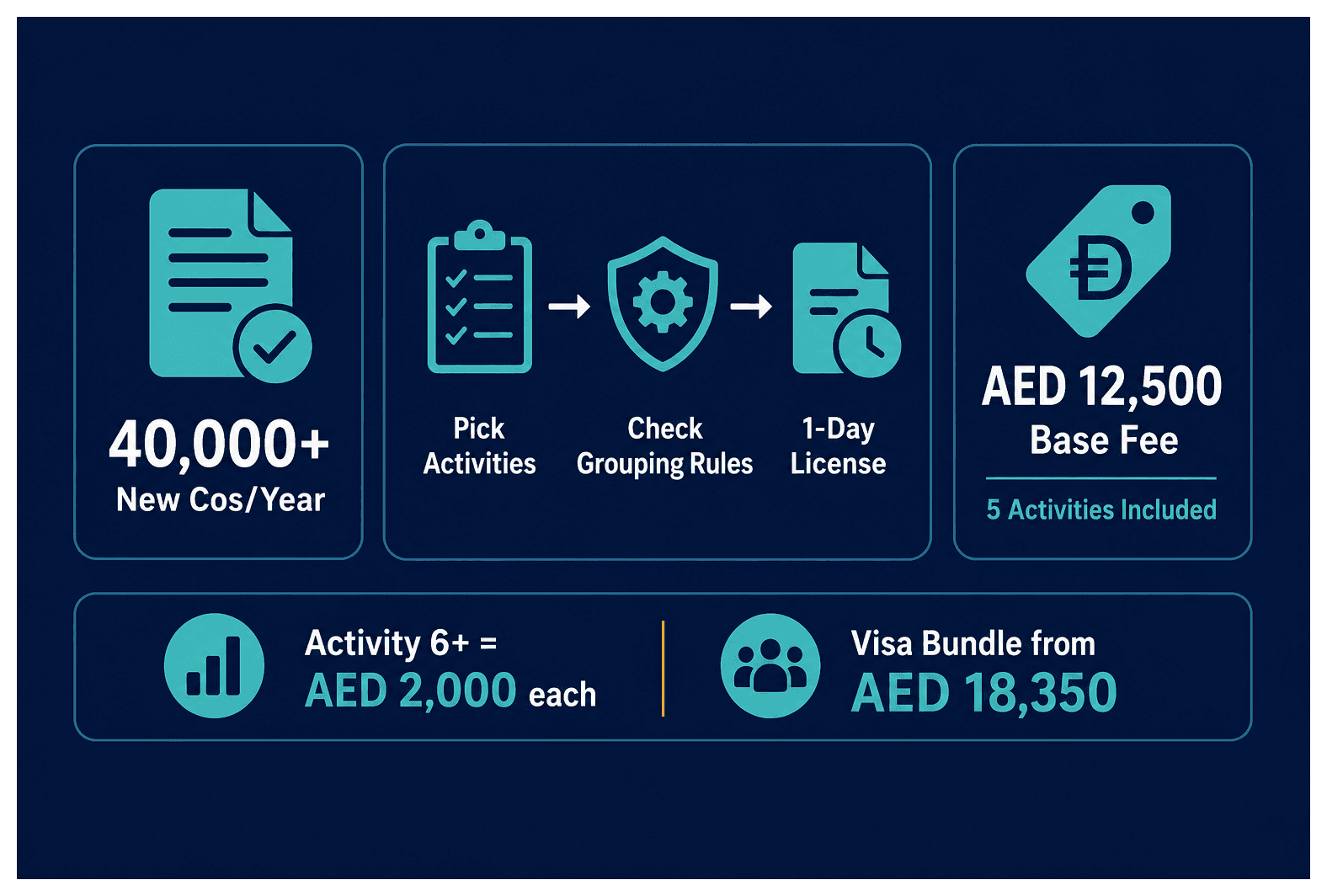
Some free zones, such as Dubai South Business Hub Free Zone, include up to five activities within the base license fee, with each additional activity costing AED 2,000. Planning your activity list carefully before applying can prevent unnecessary amendment fees and delays.
Verify Activity Schedules Before Choosing a Free Zone
Not every free zone permits every activity combination, so founders should cross-check the authority's specific activity schedule against their intended business model before committing. Discovering an incompatibility after application means amendment fees and processing delays that can set timelines back by weeks.
Separate Licenses May Be the Correct Solution
When two desired activities fall into incompatible categories, such as ICT hardware trading and software consultancy, the legally correct path is often obtaining two separate licenses rather than forcing an invalid combination. This approach adds cost but keeps both licenses compliant and avoids rejection risk.
Foreign Ownership and Duty Rules Apply Equally
100% foreign ownership is available on both the mainland and in free zones, so it should not be the sole reason for choosing a free zone structure. Additionally, free zone goods operate under duty suspension rather than full duty exemption, a distinction that matters when combining trading and importing activities on the same license.
In 2026, over 40,000 new companies register in Dubai's free zones each year (Dubai Chamber, 2025). Yet a significant share of first-time founders arrive at the licensing stage without realising that the activities listed on their license are governed by strict grouping rules. Pick the wrong combination and you're looking at a rejected application, an amendment fee, and weeks of delay. The activity grouping rules for Dubai licenses determine which activities can sit on a single trade license, and getting this wrong is far more common than most guides admit. Dubai South Business Hub Free Zone (DSBH), launched September 2025, issues licenses from AED 12,500 [1], bundles the first five activities in the base fee [2], and issues licenses in one business day [3]. The first-year total for a sole founder with one visa starts from AED 18,350 [4]. Each activity beyond five costs AED 2,000 [5]. This guide covers the requirements, costs, and exact steps to get your activity selection right from day one.
What Are Activity Grouping Rules for Dubai Licenses
Activity grouping rules for Dubai licenses are the regulatory framework that determines which commercial activities can appear together on a single trade license. Authorities cluster activities by economic nature, trading, service, industrial, and prohibit combinations that mix incompatible categories, protecting market integrity and simplifying regulatory oversight.
The Logic Behind Activity Categories
Dubai authorities classify business activities in Dubai using the ISIC Rev.4 hierarchical framework, grouping them by economic nature: trading, professional/service, industrial, and tourism. ISIC Rev.4, approved by the UN Statistical Commission and published by the UN Statistics Division, defines activity codes across 21 top-level economic sections and uses a four-level coding hierarchy: section, division, group, and class. The UAE Ministry of Economy references this framework when structuring its national activity classification system.
Each category maps to a specific license type. A trading license covers buying and selling physical goods. A service license covers professional consultancy and knowledge-based delivery. Mixing those categories, say, adding light manufacturing to a pure trading license, requires either a separate license or explicit regulatory approval from the issuing authority.
Here's a practical illustration. A founder wanting to sell ICT hardware (trading) and also provide software consultancy (service) cannot combine these under one mainland DET license by default. They must either obtain two separate licenses or apply under a free zone that permits blended activity packages within a compatible cluster.
Why the Rules Differ Between Free Zones and the Mainland
Mainland licenses are regulated by DET (Dubai Economy and Tourism). Free zone licenses are regulated by each individual free zone authority under its own activity schedule. That distinction matters because free zone authorities can set their own grouping policies, which are sometimes more flexible than mainland rules, but only within the bounds of their published permitted activity lists.
Worth flagging: 100% foreign ownership is available on both the mainland and in free zones. It's not a free-zone-exclusive benefit. And free zone goods operate under duty suspension, not duty exemption, a distinction that becomes important when you're combining trading and importing activities on the same license.
Dubai South Business Hub Free Zone, launched September 2025, allows founders to bundle up to five activities within a compatible category on a single license from AED 12,500. Founders choosing any free zone should verify the authority's specific activity schedule against their intended business model before applying.
Activity Grouping Dubai Requirements by License Category
Activity grouping Dubai requirements separate activities into trading, professional/service, industrial, and tourism categories. A single license may only carry activities from one primary category unless the issuing authority explicitly permits blended packages. Free zones publish their own permitted activity schedules, which founders must review before submitting an application.
Trading Activities: What Can Be Bundled
Trading activities cover import, export, re-export, distribution, and general trading of physical goods.
Multiple trading sub-activities within the same commodity class can typically appear on one license, electronics trading and accessories trading, for example.
General trading licenses grant the broadest scope but still exclude professional services and manufacturing.
At DSBH, a trading license in Dubai covers the full spectrum of permitted goods trading activities within the free zone's activity schedule, from AED 12,500.
Each activity beyond the first five costs AED 2,000, plan your commodity list before applying.
A founder importing and reselling consumer electronics and mobile accessories can list both sub-activities on a single trading license without triggering a second application, provided both fall within the same commodity cluster on the authority's schedule.
Professional and Service Activities: Compatible Groupings
Professional and service licenses cover consultancy, advisory, management, IT services, marketing, and similar knowledge-based outputs. Activities within the same professional cluster can be grouped on one license. Business consultancy and management consultancy, for example, share the same ISIC division and sit comfortably together.
Combining a professional activity with a trading activity requires either two separate licenses or a free zone authority that explicitly permits mixed-category packages.
ICT and technology service activities fall under professional/service and can be grouped with related digital consultancy activities.
A professional license in Dubai at DSBH starts from AED 12,500.
A digital agency offering social media management and content strategy can list both under a single professional service license, as they share the same ISIC division. The same applies to an ICT license in Dubai covering software development and IT consultancy together.
Industrial and Mixed-Use Activities: Higher Complexity
Industrial licenses cover light manufacturing, assembly, and processing. These require dedicated facility approvals and cannot typically be bundled with pure trading or service activities on the same license. The regulatory checks for mixed-use activity combinations are more involved, and authorities assess facility suitability separately from the license application itself.
DSBH does not provide bonded warehousing or customs integration. Founders planning customs-linked industrial operations must verify facility requirements separately. DSBH is not a designated zone and receives no designated-zone customs or VAT treatment. Duty suspension applies to free zone goods, not duty exemption. These are meaningfully different positions, and conflating them creates compliance risk.
A founder assembling electronic kits and also selling them retail must obtain separate industrial and trading approvals. The two activities cannot sit on the same standard license at most authorities. Confirm compatibility with your formation advisor before selecting activities.
Regulated Activities and Dual-Approval Requirements
Certain Dubai license activities require approval from a named sector regulator in addition to the free zone or mainland authority. The free zone licenses the activity on the trade license; the sector regulator, such as DHA for healthcare or the UAE Central Bank for financial services, issues the operating permit separately. Both approvals are mandatory before operations can begin.
Key Regulated Sectors and Their Approving Bodies
Healthcare: DSBH licenses the activity on the trade license; DHA (Dubai Health Authority) issues the clinical or facility permit separately.
Financial services: DSBH licenses the activity; the UAE Central Bank or relevant authority approves the financial services operation independently.
Education: DSBH licenses the activity; KHDA or the relevant education authority approves the curriculum and facility as a separate process.
Founders must budget time and fees for both approval tracks. The free zone license alone does not authorise regulated operations.
A telemedicine startup lists its healthcare activity on its DSBH license, then separately applies to DHA for a digital health facility permit. The two processes run in parallel but are independently assessed. Neither approval substitutes for the other. For a healthcare license in Dubai, this dual-track process is non-negotiable.
How Regulated Activities Affect Your Activity Group Selection
Regulated activities must appear individually and precisely on the license. Generic descriptions are rejected by sector regulators, "Health Services" will not satisfy DHA where "Telemedicine Services" is the required description. If a regulated activity is paired with an unregulated one, the regulator's approval scope covers only the regulated element. The unregulated activity remains the free zone's responsibility.
There's also a tax compliance angle here. Late registration with the Federal Tax Authority carries a one-time AED 10,000 flat corporate tax penalty (Federal Tax Authority, 2023, still accurate as of 2026). A separate AED 10,000 penalty applies for late VAT registration. Both risks rise when license amendments delay the formal start of operations, another reason to get your activity list right before you apply.
Can I add a regulated activity to an existing license?
Yes, but it triggers an amendment process with the free zone authority and restarts the sector regulator approval track for that activity. Amendment fees apply, and the bank may require an updated license before processing transactions. Planning regulated activities at the initial application stage is always faster and cheaper than adding them post-issuance.
How to Select and Group Your Activities Correctly: A Step-by-Step Process
To select and group activities correctly for a Dubai license, map your business model to permitted activity categories, verify compatibility with the issuing authority's schedule, confirm any regulated-sector approvals needed, choose your license type, and submit your application with the precise activity descriptions required by the authority.
Step 1: Map Your Business Model to Activity Categories
List every revenue stream your business will generate in year one, be specific, not aspirational.
Classify each stream: trading (physical goods), service/professional (knowledge, consultancy), or industrial (manufacturing, assembly, processing).
Identify whether any stream falls into a regulated sector: healthcare, financial services, education, or legal.
Separate any activity that sits in a different primary category from the rest, it will need its own license or a compatible free zone package.
A logistics software founder lists: SaaS subscriptions (service), implementation consultancy (service), hardware resale (trading). Two categories appear. She decides to start with a service license and add a trading license when hardware revenue becomes material. That's a cleaner, cheaper starting position than forcing both into one application.
Step 2: Check the Authority's Permitted Activity Schedule
Review the free zone's published activity list. At DSBH, the full list of business activities in Dubai is available on the authority's website.
Match your revenue streams to the exact activity descriptions on the schedule. Do not paraphrase, regulators match wording precisely.
Confirm all chosen activities fall within one compatible category group on that schedule.
Flag any activity requiring a sector regulator approval and note the parallel process required before operations begin.
Using DSBH's activity list, the same logistics software founder confirms "Software Development" and "IT Consultancy" both appear under the ICT service cluster. A single license covers both, and she can reference the exact wording when completing her application.
Activity Grouping at Dubai South Business Hub Free Zone: Cost Summary
Cost Item | Amount (AED) |
|---|---|
Standard license (first five activities included) | 12,500 |
B2C license (first five activities included) | 11,375 |
Each activity beyond the first five | 2,000 per activity |
First-year total, sole founder, one visa | From 18,350 |
Paid-up share capital required | 0 (none required) |
License issuance time | 1 business day |
Step 3: Calculate Cost, Apply, and Activate
A license at DSBH starts from AED 12,500. Use the business setup cost calculator to model your first-year total.
The first five activities are included in the base license fee. Each activity beyond five costs AED 2,000.
No paid-up share capital is required at DSBH, nothing needs to be deposited to activate the license.
Licenses are issued in one business day once documents are complete.
Visas are always an additional cost. They are never included in the license fee.
The first-year total for a sole founder with one visa starts from AED 18,350.
A founder listing seven activities pays the base license fee of AED 12,500 plus AED 4,000 for the two additional activities beyond the five included in the standard package, AED 16,500 for the license component alone, before visa costs.
Activity Grouping Dubai Costs: What to Budget
Activity grouping costs in Dubai depend on how many activities you add and whether any require sector regulator approval fees. At Dubai South Business Hub Free Zone, the base license covers up to five activities from AED 12,500. Each activity beyond five adds AED 2,000. Visa and regulator fees are always separate additional costs.
License Fee Structure at Dubai South Business Hub Free Zone
Standard license from AED 12,500.
Up to five activities included in the base fee.
Each activity added beyond the first five: AED 2,000 per activity.
Zero paid-up share capital required, no capital needs to be deposited to activate the license.
First-year all-in cost for a sole founder with one visa starts from AED 18,350. Visas are always an additional cost, never included in the license fee.
A consultancy founder listing six activities, five standard plus one specialist, pays AED 12,500 plus AED 2,000, totalling AED 14,500 for the license component alone before visa costs. That's a predictable, transparent structure that makes budgeting straightforward.
Hidden Costs Founders Miss in Activity Grouping
Sector regulator approval fees are separate from free zone license fees and vary by regulator and activity type.
Amending activities after license issuance incurs an amendment fee. Getting the activity list right at application stage avoids this entirely.
Corporate tax and VAT registration are separate obligations. Late registration penalties are AED 10,000 each, the corporate tax penalty is a one-time flat fee, not a monthly charge (Federal Tax Authority, 2023, still accurate as of 2026).
Bank account opening requires a license that accurately reflects your business activities. Having the correct activities listed is a prerequisite, not an optional step.
A founder who omits a revenue-generating activity from the initial license must pay an amendment fee to add it later. That cost is easily avoided with thorough upfront activity mapping before submission.
What does activity grouping cost beyond the license fee?
Beyond the license fee, founders should budget for sector regulator approval fees (amounts vary by authority), post-issuance amendment fees if activities need to be changed, and AED 10,000 each for late corporate tax or VAT registration. Visa costs are always separate. Plan all of these before applying.
Common Activity Grouping Mistakes and How to Avoid Them
The most common activity grouping mistakes in Dubai include mixing incompatible license categories on one application, using imprecise activity descriptions that regulators reject, overlooking dual-approval requirements for regulated sectors, and adding activities post-issuance instead of planning the full list upfront. Each mistake adds cost and delays operations.
Mixing Incompatible Categories
Listing both trading and professional service activities on one application without confirming the authority permits blended packages is the most frequent rejection trigger. A founder applying for a single license covering both furniture import (trading) and interior design consultancy (service) at a mainland DET application receives a rejection. The two categories require separate licenses, and no amount of resubmission changes that without a structural change to the application.
The fix is straightforward: map every activity to its category before applying and confirm the authority's schedule explicitly permits the combination. When in doubt, plan for two separate licenses from the outset rather than attempting a post-rejection amendment. The amendment route costs more in time and fees than getting it right the first time.
Vague Activity Descriptions and Post-Issuance Amendments
Copy the authority's exact activity wording, not a paraphrase. Regulators match descriptions precisely.
Adding activities after license issuance triggers amendment fees and can delay bank account opening if the bank requires an updated license before processing.
Compile the full intended activity list before submission and cross-reference it against the authority's published schedule word for word.
A tech founder writes "Technology Services" on the application instead of the authority's listed description "Information Technology Consultancy." The bank's compliance team flags the mismatch when reviewing the license for account opening. DSBH's published activity list uses precise descriptions aligned with ISIC Rev.4 coding, which reduces this risk significantly, provided founders copy the exact wording from the schedule rather than summarising it.
Activity Grouping Rules for Dubai Licenses: Key Takeaways
Activity grouping rules for Dubai licenses determine which activities can appear on a single trade license, how many can be bundled, and which require additional sector regulator approval. Getting this right at the application stage prevents rejection, amendment fees, and operational delays, making upfront activity mapping the highest-value step in company formation.
What to Do Before You Apply
List all revenue streams and classify each by category: trading, service/professional, or industrial.
Confirm compatibility with the issuing authority's published activity schedule using exact wording, not paraphrases.
Identify any regulated activities and map the parallel sector regulator approval process before submitting.
Calculate your activity count. If you need more than five at D
References
Frequently Asked Questions