
Topic Summary
World's Busiest Airport Drives Constant Demand
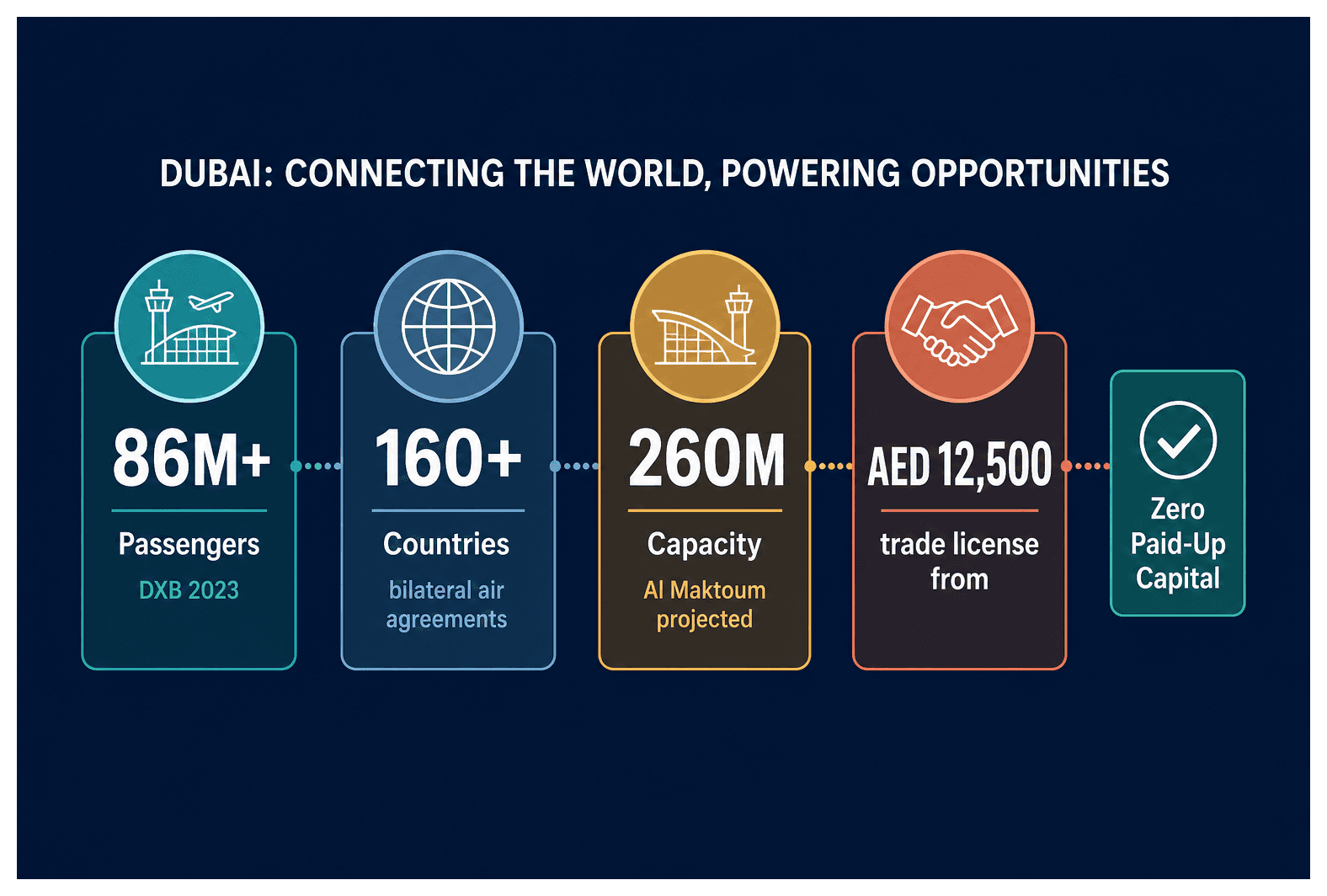
Dubai International Airport handled over 86 million passengers in 2023, making it the world's busiest international airport by passenger volume. That traffic creates sustained, high-volume demand for MRO, ground handling, and avionics services.
Al Maktoum Expansion Creates a Future-Proof Location
Al Maktoum International Airport is expanding toward a projected capacity of 260 million passengers annually. Setting up at Dubai South positions aerospace businesses directly alongside what is expected to become the world's largest airport.
Low Setup Costs With Zero Share Capital Required
A trade license at Dubai South Business Hub Free Zone starts from AED 12,500, with no paid-up share capital required. Founders can launch without locking cash in a statutory deposit account, keeping early-stage capital free for operations.
160-Plus Bilateral Agreements Unlock a Global Client Base
The UAE holds bilateral air service agreements with over 160 countries, giving any aerospace services company in Dubai immediate access to a genuinely diverse international client base. This open-skies framework is a structural advantage few other jurisdictions can match.
Get Your ISIC Activity Classification Right From Day One
Aerospace services span multiple ISIC Rev.4 divisions, including Division 33 for MRO, Division 51 for air transport, and Section M for consulting. Selecting the wrong principal activity on your license application creates downstream compliance risk with the GCAA and the Federal Tax Authority.
Dual Licensing Requirements for Regulated Activities
An aerospace services company in Dubai must hold a DSBH Free Zone trade license and, for regulated activities, a separate approval from the GCAA or DCAA. Understanding both requirements before applying prevents costly amendments and regulatory delays.
Dubai International Airport handled more than 86 million passengers in 2023 (Dubai Airports, 2024) [1], making it the world's busiest international airport by passenger volume [2]. The UAE has bilateral air service agreements with over 160 countries [3]. Al Maktoum International Airport is expanding toward a projected capacity of 260 million passengers annually [4]. A trade license at Dubai South Business Hub (DSBH) Free Zone starts from AED 12,500 [5], with zero paid-up share capital required [6]. If you're planning to launch an aerospace services company Dubai, the demand side has never been stronger and the setup cost has never been lower.
This guide covers the regulatory requirements for an aerospace services company Dubai, the real costs broken down to the dirham, and the exact steps to get licensed at Dubai South Business Hub Free Zone, so you can move forward with full information and no surprises.
What Is an Aerospace Services Company Dubai and Why It Matters
An aerospace services company Dubai is a licensed entity providing technical, operational, or consultancy services within the aviation and aerospace sector, including MRO (maintenance, repair, and overhaul), avionics, ground handling, aerospace engineering, and related support. It must hold a Dubai South Business Hub Free Zone trade license and, for regulated activities, a separate approval from the General Civil Aviation Authority (GCAA) or the Dubai Civil Aviation Authority (DCAA).
How ISIC Classifies Aerospace Services Activities
Getting your activity classification right at the licensing stage matters more than most founders realise. Under ISIC Rev.4 (the UN's International Standard Industrial Classification, Revision 4), aerospace services fall across several divisions depending on what your company actually does. MRO work sits under Division 33 (Repair and installation of machinery and equipment). Air transport operations fall under Division 51. Manufacturing of aerospace components lands in Division 30 (Manufacture of other transport equipment). Consulting and engineering advisory services belong to Section M (Professional, scientific and technical activities).
When your aerospace services company Dubai covers multiple activities, ISIC uses a top-down method to identify the principal activity, working from the highest classification level down to the category that accounts for the largest share of value added. That determination directly shapes which activity codes you select on your DSBH license application. Choosing the wrong principal activity creates downstream compliance risk with the GCAA and the Federal Tax Authority.
A founder setting up an avionics repair and MRO consultancy, for example, would declare MRO as the principal activity (Division 33) and list consultancy as a secondary activity on the same license. Getting this right at day one avoids amendment fees and regulatory friction later.
Why Dubai Is the Logical Base for an Aerospace Services Business
The structural case for basing an aerospace services company Dubai here is straightforward:
Dubai International Airport (DXB) is the world's busiest international airport by passenger volume, 86 million-plus passengers in 2023 alone (Dubai Airports, 2024). That traffic generates constant demand for MRO, ground handling, and avionics services.
Al Maktoum International Airport at Dubai South is expanding to become the world's largest airport, making the surrounding free zone the natural address for aerospace suppliers and service providers.
The UAE's open-skies policy and bilateral air agreements with over 160 countries give any aerospace services company Dubai a genuinely diverse client base from day one.
Zero paid-up share capital at DSBH means founders can launch without locking cash in a statutory deposit account.
A European MRO firm establishing its regional hub chose Dubai South specifically because its anchor airline clients already run heavy maintenance rotations through Al Maktoum International. The address wasn't incidental, it was the deciding factor. You can set up a company at Dubai South Business Hub and position yourself at the centre of that same demand.
Aerospace Services Dubai Requirements You Must Meet
Aerospace services Dubai requirements include a free zone trade license from Dubai South Business Hub, a separate regulatory approval from the GCAA or DCAA for any air-safety-adjacent activity, VAT registration if turnover exceeds AED 375,000, and corporate tax registration with the Federal Tax Authority within the prescribed deadline after the financial year ends.
Aerospace Services Company Dubai: Key Setup Figures at a Glance
Setup Factor | Detail |
|---|---|
Trade license fee (standard) | From AED 12,500 at DSBH |
Trade license fee (B2C) | From AED 12,500, confirm eligibility at activity selection stage |
First-year cost (sole founder, one visa) | From AED 18,350, license plus establishment card; visas additional |
Additional activity fee (beyond first five) | AED 2,000 per activity |
Paid-up share capital required | Zero, no statutory deposit required |
License issuance time | 1 business day once documents and payment are confirmed |
VAT late registration penalty | AED 10,000 (Federal Tax Authority) |
Trade License and Activity Selection at DSBH
The DSBH trade license is the foundational corporate document every other regulator will ask for. It's what the GCAA, the DCAA, and your bank will want to see before any other conversation begins. DSBH includes the first five business activities in the base license fee. Each activity beyond five costs AED 2,000. That fee structure rewards founders who plan thoroughly at the outset.
List all planned activities from the start rather than adding them through amendments later. An aerospace consultancy offering MRO advisory, spare-parts trading, ground-support equipment supply, technical training, and quality audits would consume all five base activities. Adding a sixth, say, avionics installation, triggers the AED 2,000 per-activity fee. Review the full list of business activities in Dubai at DSBH to confirm which codes apply to your specific services before you submit.
GCAA and DCAA Approval for Regulated Aerospace Activities
DSBH licenses the commercial activity. The General Civil Aviation Authority (GCAA) separately approves any activity touching airworthiness, aircraft maintenance, or air operator certification. These are two distinct processes running on two distinct timelines, and both must be completed before regulated operations begin.
The Dubai Civil Aviation Authority (DCAA) adds a third layer for operations physically conducted at Dubai airports. If your aerospace services company Dubai plans to work airside at DXB or Dubai South airport facilities, DCAA jurisdiction applies on top of GCAA requirements.
A firm offering aircraft component repair (CAMO services, for instance) must hold a DSBH trade license AND a GCAA Part-145 approval before accepting any airworthiness-critical work orders. Budget 4 to 12 weeks beyond license issuance for GCAA or DCAA approval, depending on activity type and technical complexity.
Is corporate tax registration required for a free zone aerospace company?
Yes. Corporate tax registration is mandatory for all UAE businesses, including free zone companies. The Federal Tax Authority issues the Tax Registration Number (TRN). Late registration carries a one-time flat penalty of AED 10,000. A founder who delays by three months pays that penalty regardless of how small the company is, a cost that exceeds the gap between the B2C and standard DSBH license tiers.
VAT registration is mandatory once taxable turnover exceeds AED 375,000. Late registration triggers an AED 10,000 penalty from the Federal Tax Authority. The 0% corporate tax rate for Qualifying Free Zone Persons (QFZP) requires four conditions: adequate UAE substance, qualifying income from free zone or foreign sources, no election to be taxed at the standard rate, and transfer pricing compliance. All four must be met. Never assume the DSBH license alone confirms QFZP eligibility, get a tax adviser to verify your specific structure.
Costs to Set Up an Aerospace Services Company Dubai
The first-year cost to set up an aerospace services company Dubai at Dubai South Business Hub Free Zone starts from AED 18,350 for a sole founder with one visa. The trade license alone starts from AED 12,500. Visas are an additional cost. Zero paid-up share capital is required.
DSBH License and First-Year Cost Breakdown
Trade license: from AED 12,500
First-year total (sole founder, one visa): from AED 18,350, covers license plus establishment card
Additional activities: AED 2,000 per activity beyond the first five
Paid-up share capital: zero, no funds locked in a statutory account
License issuance: one business day once documents and payment are confirmed
A sole founder launching an aerospace technical consultancy with four activities, one investor visa, and a flexi-desk arrangement can expect first-year costs to sit close to the AED 18,350 base figure. Use the business setup cost in Dubai calculator to model your specific activity count and visa requirements before committing.
Additional Costs Founders Overlook
Visa fees: investor and employee visa costs are always additional, budget for ICP medical, Emirates ID per applicant
GCAA or DCAA approval fees: vary by certification type; obtain a fee schedule directly from the relevant authority before finalising your budget
Corporate bank account: no fixed opening fee, but some banks require a minimum average balance, factor this into year-one working capital planning
Physical space: DSBH does not provide bonded warehousing or customs integration; founders needing hangar or warehouse space must arrange this separately
Step-by-Step Guide to Registering Your Aerospace Services Company Dubai
To register an aerospace services company Dubai at DSBH: choose your activities, reserve your trade name, submit incorporation documents, receive your license (issued in one day), open a corporate bank account, apply for investor visas, then obtain GCAA or DCAA approval for any regulated aerospace activity before commencing operations.
The Registration Process at Dubai South Business Hub
DSBH launched in September 2025. The process below applies to a Free Zone Establishment (FZE) or Free Zone Company (FZC) registered there. Complete all steps in sequence, skipping the trade name check creates downstream delays at the incorporation stage. The license issues in one business day once documents are in order and payment is confirmed.
A UK-based aerospace engineer relocating to Dubai completed Steps 1 through 5 in under a week, with the GCAA Part-66 recognition application submitted on Day 8. The authority approval, not the license, was the critical path item. That's the pattern you should plan around.
Step-by-Step: From Application to First Client
Step 1, Define your activities: Identify your principal and secondary aerospace activities using the ISIC top-down method. Confirm the activity codes available at DSBH before proceeding, the business activities list at DSBH is your reference point.
Step 2, Check your trade name: Check company name availability using the DSBH trade name search tool to confirm your preferred name is available and compliant with UAE naming conventions.
Step 3, Submit incorporation documents: Passport copies, proposed company name, shareholder details, and your activity list go to DSBH at this stage.
Step 4, Pay the license fee and receive your license: From AED 12,500. DSBH issues the license within one business day of payment confirmation.
Step 5, Apply for visas: Use DSBH's UAE residency visa services for investor or employee visa applications. Visa costs are always additional and separate from the license fee.
Step 6, Open your corporate bank account: Present your trade license, passport copies, Emirates ID, and activity description to your chosen bank.
Step 7, Submit your GCAA or DCAA application: This is where most aerospace founders lose time. GCAA Part-145 approval for an MRO facility requires a technical capability assessment, staffing evidence, and quality manual submission, budget 8 to 12 weeks for that process specifically.
Register for VAT once you project turnover will exceed AED 375,000. Register for corporate tax with the Federal Tax Authority within the prescribed deadline after your financial year ends, late registration costs AED 10,000.
Choosing the Right Structure for Your Aerospace Services Company Dubai
Most first-time founders setting up an aerospace services company Dubai choose a Free Zone Establishment (FZE) for sole ownership or a Free Zone Company (FZC) for two or more shareholders. Both structures at DSBH offer 100% foreign ownership, zero paid-up share capital, and a one-day license issuance timeline.
FZE vs FZC: Which Structure Fits Aerospace Services
A Free Zone Establishment (FZE) has a single shareholder, the right structure for a sole founder launching an aerospace consultancy or MRO advisory practice. A Free Zone Company (FZC) accommodates two or more shareholders, making it suited to joint ventures between aerospace engineers, OEM representatives, or technical partners.
Both structures at DSBH offer 100% foreign ownership as standard. Worth noting: 100% foreign ownership is also available on the UAE mainland and is unrelated to free zone or designated-zone status. Neither structure requires paid-up share capital, which distinguishes DSBH from offshore jurisdictions that mandate statutory deposits.
Two aerospace engineers, one from Germany, one from Singapore, forming a joint avionics testing consultancy would select the FZC structure, listing each as a 50% shareholder with no minimum capital deposit required.
Build Your Team: Visas and Residency at DSBH
Each trade license entitles the holder to sponsor a defined number of employee and investor visas, confirm the allocation for your chosen package directly with DSBH.
Investor and employee visa costs are always additional to the license fee.
The investor visa UAE package through DSBH covers application, medical, Emirates ID as a single-window process.
Aerospace founders hiring licensed engineers must confirm those individuals hold GCAA-recognised qualifications before the visa application is submitted, workforce compliance is a separate check from the visa process itself.
A founder issuing three employee visas for GCAA Part-66 licensed engineers should budget visa costs per applicant through ICP and verify each engineer's license recognition with GCAA in advance.
Banking, Taxation, and Ongoing Compliance for Your Aerospace Business
After licensing, an aerospace services company Dubai must open a UAE corporate bank account, register for corporate tax with the Federal Tax Authority, and register for VAT if taxable turnover exceeds AED 375,000. Ongoing compliance includes annual license renewal, GCAA permit renewals, and maintaining sufficient economic substance in the UAE.
Opening a Corporate Bank Account in the UAE
A UAE corporate bank account is a practical necessity. Most B2B aerospace clients and international suppliers require local banking details for settlement. Banks require the trade license, shareholder passport copies, Emirates ID, and a business plan or activity description, prepare all of these before approaching any institution.
An aerospace spare-parts trading company was rejected by its first bank choice because the activity description on the license was too broad. A specific, accurate activity list on the trade license accelerates bank onboarding considerably. The bank account opening in Dubai support service through DSBH can guide founders through institution selection and documentation preparation. Some banks impose minimum average balance requirements, factor this into year-one cash flow planning before you choose an institution.
Corporate Tax, VAT, and Economic Substance
Corporate tax late registration: AED 10,000 one-time flat penalty
VAT late registration: AED 10,000 penalty
QFZP status (0% rate): requires four conditions, all four must be met, not just one or two
The four QFZP conditions are: adequate UAE substance, qualifying income from free zone or foreign sources, no election to be taxed at the standard rate, and transfer pricing compliance. An aerospace consulting firm that routes all client meetings through a home-country office and uses the DSBH address only for mail risks failing the economic substance test, and losing QFZP eligibility entirely. Genuine decision-making, management, and operational activity must happen in the
References
Frequently Asked Questions