Topic Summary
Lock In Lower Land Costs Now
Land near Al Maktoum International Airport is still available and priced well below comparable plots near Dubai International. Companies that secure space early avoid the price surge that typically follows major infrastructure completions.
Logistics Firms Face Massive Cargo Demand
The airport is targeting 12 million tonnes of cargo annually, dwarfing Dubai International's current 2.5 million tonne capacity. Warehousing, customs clearance, and last-mile delivery operators stand to benefit most directly from this volume increase.
Proximity to Jebel Ali Port Is a Game-Changer
Al Maktoum sits just 15 km from Jebel Ali Port, enabling sea-to-air transfers in under two hours by road. That connectivity gives freight operators a significant edge over businesses based near the more distant Dubai International.
Aviation Support Services Will Scale Rapidly
Emirates airline plans to shift its entire hub to Al Maktoum once new terminals open, bringing enormous demand for ground handling, aircraft maintenance, crew training, and catering. Businesses in these sectors that establish a presence early will be positioned ahead of that wave.
Dubai South Is Becoming a City, Not Just a Free Zone
The expansion transforms Dubai South into a planned city targeting one million residents, with new districts for retail, hospitality, and professional services. That residential and commercial growth creates sustained, long-term demand well beyond the airport itself.
Free Zone Status Offers 100% Foreign Ownership
The Dubai South Business Hub free zone allows full foreign ownership, an advantage not available through any free zone directly on-site at Dubai International. This structure makes it straightforward for international founders and operators to set up and retain full control.
Build Supplier Relationships Before Peak Demand Arrives
Infrastructure projects of this scale generate demand for construction supply chains, workforce housing, and professional services years before opening day. Businesses that establish client and supplier networks now will have a measurable head start when the main commercial activity begins.
In 2026, Al Maktoum International Airport is on course to become the world's largest airport. Its planned capacity sits at 260 million passengers a year (u.ae, 2024). The cargo target is 12 million tonnes annually. The UAE government has committed AED 128 billion to the build. Emirates airline is planning to shift its entire hub from Dubai International once the new terminals open.
This article is for business owners, founders, and logistics operators who want to know what the expansion means in practice: which sectors gain the most, how Dubai South changes, and how to set up close to one of the biggest infrastructure projects on earth.
What Is Al Maktoum International Airport and Why Its Expansion Matters
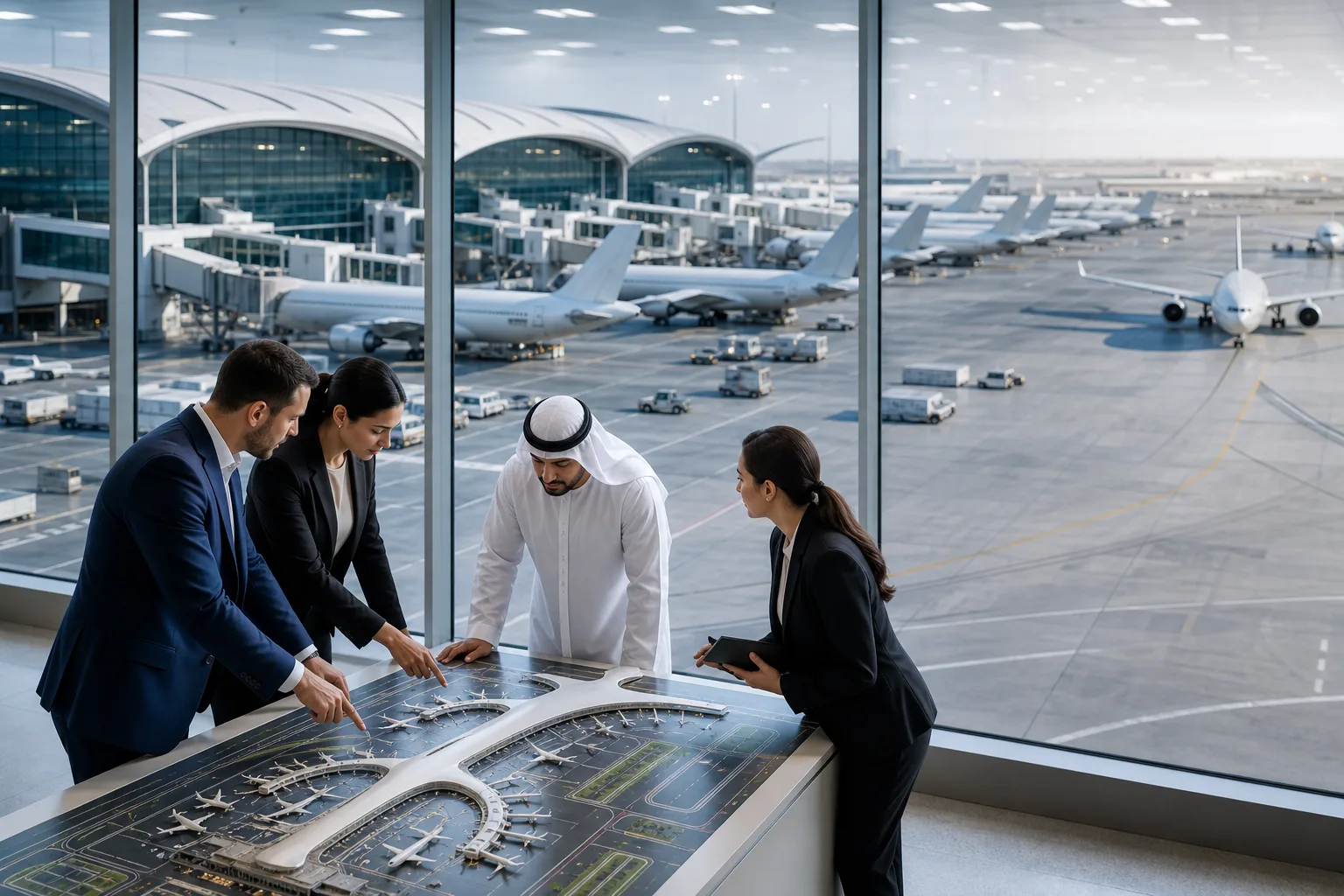
Al Maktoum International Airport, also called Dubai World Central, is a mega-airport in Dubai South. It is designed to handle 260 million passengers and 12 million tonnes of cargo a year at full build-out. Its expansion reshapes the trade, logistics, and business landscape across the UAE (u.ae, 2024). For more detail, see our guide on Dubai World Central and Al Maktoum Airport.
Scale and Timeline
260 million passenger capacity at full build-out
AED 128 billion committed by the UAE government
12 million tonnes annual cargo target
Phased delivery running through the 2030s
Emirates airline is already planning to shift its hub to Al Maktoum International as the new terminals open. That move will redirect a large share of connecting passengers through Dubai South, creating demand that businesses in the area can serve from day one.
Why Businesses Should Pay Attention Now
Infrastructure projects of this scale create demand years before they open. Construction supply chains, workforce housing, professional services, and logistics all ramp up early. Land near Al Maktoum International Airport is still available and priced well below comparable plots near Dubai International.
Companies that set up now lock in lower costs. They also build supplier and client relationships before the main wave of demand arrives.
How the Expansion Changes Dubai South
The expansion turns Dubai South from a mid-sized free zone into the commercial core of a planned city for one million residents. New districts for aviation, logistics, retail, hospitality, and professional services are being built around the airport (Dubai South, 2024).
Sectors That Gain the Most
Logistics and freight forwarding: more cargo volume means more demand for warehousing, customs clearance, and last-mile delivery.
Aviation support services: ground handling, aircraft maintenance, crew training, and in-flight catering all scale with passenger numbers.
Hospitality and food and beverage: a larger terminal and a growing resident population drive hotel, café, and restaurant demand.
ICT and tech: a smart city needs digital infrastructure, cybersecurity, and software firms to run it.
Professional services: legal, accounting, HR, and consultancy firms follow corporate clients as they relocate near the airport.
6 Ways the Airport Expansion Directly Benefits Your Business
Al Maktoum International Airport vs Dubai International Airport: Key Business Factors
Feature | Al Maktoum International Airport (Dubai South) | Dubai International Airport (DXB) |
|---|---|---|
Planned passenger capacity | 260 million per year at full build-out | Approximately 90 million per year (current design capacity) |
Cargo capacity | 12 million tonnes per year at full build-out | Approximately 2.5 million tonnes per year |
Free zone on site | Yes, Dubai South Business Hub free zone, 100% foreign ownership | No free zone directly on site for general business licensing |
Distance to Jebel Ali Port | 15 km, under 2 hours sea-to-air transfer by road | Approximately 40 km, longer inland haulage |
Land availability for business | Available, priced below comparable DXB-area plots | Highly limited, premium pricing in surrounding areas |
Current cargo terminal status | Operational, handled over 900,000 tonnes in 2023 | Operational, high-volume but congested at peak periods |
The Six Business Benefits
Faster cargo clearance: automated systems cut customs dwell time and reduce spoilage for perishable goods.
Lower freight costs: more airlines and more belly-hold capacity push air-freight rates down over time.
A built-in customer base: one million planned residents plus millions of transit passengers create local demand.
Better staff connectivity: more direct routes mean your team reaches clients in Asia, Africa, and Europe without a stopover.
Rising asset values: land and property near the airport are expected to appreciate as construction milestones hit.
100% foreign ownership: a free zone license at Dubai South gives you full ownership from day one, no local partner needed.
What to Keep in Mind
The expansion runs in phases. Check which terminals and cargo zones are operational before you plan your supply chain around them.
Free zone licenses cover most commercial activities. If you need direct UAE retail access, a mainland license may be the better fit.
Use the business setup cost calculator to get a firm first-year figure before you commit.
Logistics and Trade Benefits
Al Maktoum International Airport sits 15 kilometres from Jebel Ali Port, the largest port in the Middle East. Together they form a sea-air corridor that lets businesses move goods from ship to plane with minimal inland haulage.
The Sea-Air Corridor Advantage
15 km between Jebel Ali Port and Al Maktoum International Airport
Under 2 hours for a sea-to-air transfer by road
Dubai Customs single-window clearance covers both the port and the airport
DP World has invested in road links between the port and the airport (DP World, 2023)
What the Cargo City Means for Import-Export Businesses
Al Maktoum's dedicated cargo city operates as a bonded zone. Goods can be stored, sorted, and re-exported without paying UAE import duty until they enter the local market. That makes it a strong base for regional distribution centres serving Africa, South Asia, and the GCC.
The cargo city includes cold-chain facilities, a pharmaceutical handling zone, and a live animal station. Check the Dubai Customs portal for the full list of approved goods and clearance procedures before you ship.
How to Set Up a Business Near Al Maktoum International Airport
The process takes 3 to 5 working days and gives you 100% foreign ownership from day one, with no local partner required.
Step-by-Step Setup Guide
Step 1, pick your activity: check the full list of business activities at Dubai South. Trading, logistics, ICT, professional services, and aviation support are all available.
Step 2, check your trade name: run a name search to confirm your chosen name is free and meets UAE naming rules.
Step 3, choose your package: decide on your license type, office or flexi-desk option, and visa quota before you commit.
Step 4, send your documents: passport copy, passport photo, and a completed application form. No notarised papers are needed at this stage.
Step 5, get your license: approval comes in 3 to 5 working days. Your trade license is issued digitally.
Visa and Residency Options
A free zone license from Dubai South Business Hub comes with a visa quota tied to the package you choose. The investor visa lets you live and work in the UAE and sponsor family members. You can apply through DSBH's in-house residency services, which handle the full ICP process on your behalf.
Is a free zone license right for your business?
A Dubai South Business Hub free zone license suits businesses that trade internationally or need airport-linked logistics. If you need direct access to UAE retail customers on the mainland, a mainland license from the Dubai Department of Economy and Tourism may be the better fit.
Compliance Basics for Businesses at Dubai South
Businesses near Al Maktoum International Airport must comply with UAE corporate tax rules, Dubai Customs requirements, and free zone license conditions.
Corporate Tax and VAT
Corporate tax: the UAE charges 9% on profits above AED 375,000 (Federal Tax Authority, 2023). All companies must register with the Federal Tax Authority once set up. A free zone company can pay 0% corporate tax if it meets the Qualifying Free Zone Person conditions the FTA sets.
VAT: VAT runs at 5% on most goods and services. Businesses with annual revenue above AED 375,000 must register. Keep financial records for 7 years. Review the banking and taxation guidance at DSBH before you file your first return.
Customs and Trade Compliance
All goods moving through Al Maktoum International Airport require Dubai Customs clearance. You need a customs code to import or export.
Bonded goods held in the cargo city do not attract UAE import duty until they enter the local market.
Prohibited and restricted goods lists apply at the airport. Check the Dubai Customs portal before you ship.
Free zone companies selling goods into the UAE mainland are treated as importers and must pay the standard duty rate.
Who Should Set Up Near Al Maktoum International Airport
The strongest candidates are logistics and freight companies, aviation support firms, e-commerce businesses needing fast regional delivery, hospitality and food businesses, and ICT companies supporting the smart city infrastructure being built across Dubai South.
Businesses That Fit the Zone Best
Logistics and freight forwarding: the core activity of the airport zone, with direct ramp access and bonded storage.
E-commerce fulfilment: fast air-freight links to the GCC, Africa, and South Asia make Dubai South a strong base for regional delivery.
Aviation services: catering, ground handling, maintenance, and crew training all sit inside or close to the airport perimeter.
Hospitality: hotels, serviced apartments, and food outlets will be in high demand as passenger numbers grow.
ICT and smart-city tech: the Dubai South master plan calls for a fully connected city. An ICT license in Dubai covers most of these activities.
What to Check Before You Commit
Work out how many visas you need and how much office or warehouse space you want before you pick a package.
Confirm your business activity is on the approved list for Dubai South Business Hub.
Get a cost estimate using the online cost calculator so you know your first-year outlay before you sign anything.
Al Maktoum International Airport is not a distant infrastructure promise. Construction is live, cargo is moving, and businesses that set up in Dubai South now are already benefiting from the connectivity, bonded storage, and free zone advantages the zone offers.
References
u.ae (u.ae)
Dubai South (dubaisouth.ae)
Dubai Airports (dubaiairports.ae)
DP World (dpworld.com)
Dubai Customs (dubaicustoms.gov.ae)
Federal Tax Authority (tax.gov.ae)
Frequently Asked Questions