
Topic Summary
Typical Audit Cost Ranges for Dubai Companies
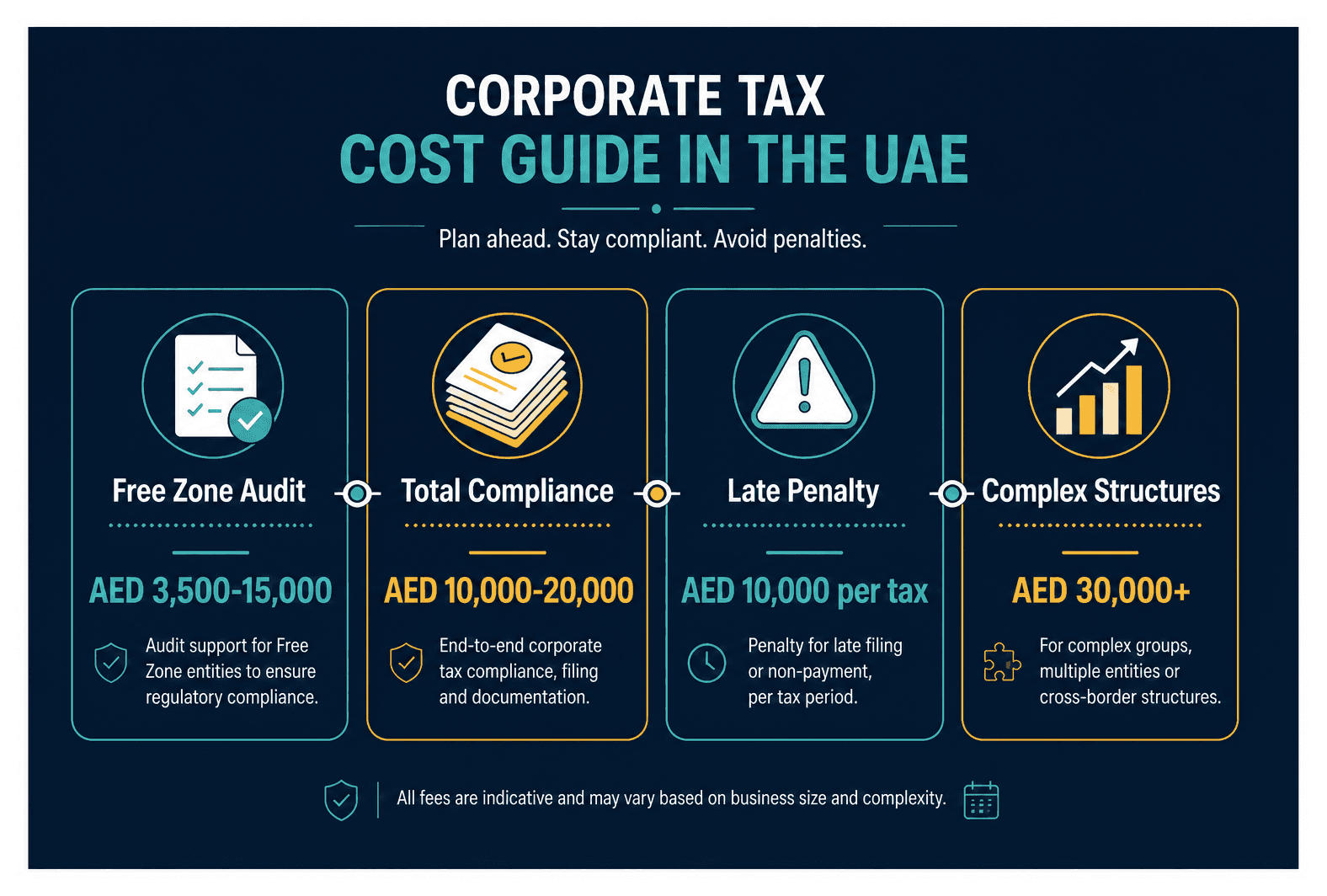
Most free zone entities pay between AED 3,500 and AED 15,000 for an annual audit, while mainland or multi-activity structures can exceed AED 30,000. Knowing your bracket early helps you budget accurately from year one.
Four Core Documents Every Audit Must Cover
A statutory audit examines the balance sheet, profit and loss account, cash flow statement, and notes to accounts. Auditors also review supporting evidence such as invoices, bank reconciliations, VAT returns, and contracts before issuing their opinion.
Total Compliance Costs Go Beyond the Audit Fee
Adding bookkeeping (AED 3,000–12,000), corporate tax filing (AED 2,000–5,000), and VAT return support (AED 1,500–4,000) can push your total annual compliance spend to AED 10,000–20,000. First-time founders who budget only for the audit fee are often caught off guard at renewal.
Poor Bookkeeping Can Inflate Your Audit Bill
Founders who neglect bookkeeping throughout the year may pay up to 40% more in audit fees, because the auditor must reconstruct records before the real audit work begins. Maintaining clean, up-to-date books is one of the most effective ways to control audit costs.
Missing Deadlines Triggers Steep Flat Penalties
The Federal Tax Authority imposes a flat AED 10,000 penalty for missing either the corporate tax or VAT registration deadline. Staying ahead of these deadlines is far cheaper than absorbing the fines after the fact.
Who Is Legally Required to File a Statutory Audit
All UAE free zone companies must submit audited financials to their free zone authority as a condition of license renewal, and mainland companies under UAE Companies Law face the same requirement. Entities seeking Qualifying Free Zone Person status must also maintain audited accounts to access the 0% corporate tax rate on qualifying income.
Choosing the Right Free Zone Keeps Costs Predictable
Setting up at a structured free zone like Dubai South Business Hub Free Zone gives founders clear compliance requirements from the outset, making it easier to plan audit and bookkeeping budgets in advance. Predictable requirements reduce the risk of last-minute auditor bookings, which typically attract premium fees.
In 2026, the annual audit cost for a Dubai company runs between AED 3,500 and AED 15,000 for most free zone entities, with mainland or complex multi-activity structures reaching AED 30,000 or more. That figure surprises a lot of first-time founders, because it's not the only compliance cost you'll face each year. Add bookkeeping (AED 3,000 to AED 12,000), corporate tax filing (AED 2,000 to AED 5,000), and VAT return support (AED 1,500 to AED 4,000), and your total annual compliance spend can land between AED 10,000 and AED 20,000 for a well-run small company. Miss the corporate tax or VAT registration deadlines and you're looking at a flat AED 10,000 penalty for each (Federal Tax Authority, 2023). This guide separates every component of the annual audit cost for a Dubai company, explains who is legally required to audit, and shows how setting up a company at Dubai South Business Hub Free Zone keeps your compliance budget predictable from year one.
What Is Annual Audit Cost for a Dubai Company and Why It Matters
The annual audit cost for a Dubai company is the total fee paid to a licensed external auditor to examine and certify the company's financial statements each year. For free zone entities it typically ranges from AED 3,500 to AED 15,000. The audit satisfies free zone authority requirements and supports corporate tax compliance.
Definition: What a Statutory Audit Actually Covers
An external audit is an independent examination of your company's financial statements by a UAE-licensed audit firm. The auditor issues a signed opinion confirming whether the accounts give a true and fair view of the company's financial position. For most free zone companies, that report must be submitted to the free zone authority annually alongside the license renewal application.
The audit scope covers four core documents: the balance sheet, profit and loss account, cash flow statement, and notes to accounts. The auditor also reviews supporting evidence, invoices, bank reconciliations, VAT returns, and contracts, before signing off.
Small free zone firms (simple revenue, single activity): AED 3,500 to AED 8,000
Mid-size firms with complex activities or multiple revenue streams: AED 8,000 to AED 15,000
A Dubai South Business Hub Free Zone trading company with AED 2 million in annual revenue, for example, commissions an audit firm in Q4. The firm reviews invoices, bank reconciliations, and VAT returns before issuing a clean audit opinion used for both license renewal and corporate tax filing.
Why the Annual Audit Cost Dubai Founders Often Underestimate
First-time founders typically focus on the license fee and visa costs at setup, then absorb compliance costs as an unwelcome surprise at renewal. The audit isn't optional for most UAE entities: free zone authorities require it, and UAE Corporate Tax Law requires audited financials for entities claiming Qualifying Free Zone Person (QFZP) status.
Bookkeeping quality directly drives audit cost. A founder who sets up a professional services company and ignores bookkeeping for ten months may pay 40% more in audit fees, because the auditor must reconstruct records before the actual audit begins. Delaying auditor appointment compounds the problem: last-minute bookings attract premium fees. Late tax registration adds AED 10,000 per tax in flat penalties (Federal Tax Authority, 2023).
Who Must File a Statutory Audit in Dubai
All UAE free zone companies are required to submit audited financial statements to their free zone authority annually. Mainland companies registered under the UAE Companies Law must also be audited. Under UAE Corporate Tax Law, Qualifying Free Zone Persons must maintain audited accounts to access the 0% rate on qualifying income.
Free Zone Companies: Audit as a License Renewal Condition
Free zone authorities, including Dubai South Business Hub Free Zone, require submission of audited financials before renewing a trade license. Failure to submit an audit report can result in license suspension. The audit must be conducted by a firm on the free zone authority's approved auditor list, so confirm that list at the start of each financial year rather than at renewal time.
A Dubai South Business Hub Free Zone ICT company approaching its first renewal deadline must submit audited accounts for the period from incorporation to the financial year end, even if that period covers only seven or eight months. DSBH launched in September 2025 and issues licenses in as little as one business day, so founders incorporated in late 2025 will hit their first audit deadline sooner than they expect.
Corporate Tax Rules That Affect Audit Obligations
UAE Corporate Tax Law (effective June 2023) imposes a 9% rate on taxable income above AED 375,000. Free zone entities can access the 0% rate on qualifying income only by satisfying all four QFZP conditions simultaneously: adequate economic substance in the UAE, qualifying income streams, no permanent establishment on the mainland, and audited financial statements. Missing any single condition removes the 0% benefit entirely.
Any entity registered for corporate tax must file an annual tax return and maintain financial records for seven years. Entities with revenue above AED 50 million must prepare financial statements in accordance with IFRS. A free zone holding company with AED 1.2 million in dividend income from a qualifying subsidiary must have audited accounts to demonstrate QFZP status and apply the 0% rate on that income (Federal Tax Authority, 2023).
Annual Audit Cost Dubai: One-Off vs. Recurring Compliance Costs
Cost Item | One-Off (Setup Year Only) | Recurring (Every Year) |
|---|---|---|
Accounting software & configuration | AED 500 to AED 2,000, paid once at incorporation | Subscription only (typically AED 300 to AED 800/yr for cloud tools) |
Chart-of-accounts design | AED 500 to AED 1,500, one-time professional fee | Not applicable after initial setup |
VAT & corporate tax registration support | AED 500 to AED 1,500 per tax, paid once via FTA portal | Not applicable (registration is one-time) |
External audit fee | Not applicable in setup year (first audit covers year one) | AED 3,500 to AED 15,000 depending on size and complexity |
Bookkeeping / accounting services | Not applicable (ongoing from month one) | AED 3,000 to AED 12,000 per year outsourced |
Corporate tax return filing | Not applicable | AED 2,000 to AED 5,000 via tax agent |
VAT return filing support | Not applicable | AED 1,500 to AED 4,000 per year (quarterly filing) |
DSBH license fee | From AED 18,350 (sole founder, one visa, first year) | From AED 12,500 renewal; visas always additional |
NOT included anywhere | Tax advisory, transfer pricing documentation, regulatory approvals (DHA, KHDA, Central Bank), bonded warehousing, customs integration |
Full Annual Audit Cost Dubai Breakdown: One-Off vs. Recurring
The annual audit cost for a Dubai company splits into one-off setup expenses and recurring annual fees. Recurring costs include the audit firm fee, bookkeeping, and tax filing. One-off costs include software setup and chart-of-accounts design. Knowing this split lets founders budget accurately from day one rather than absorbing surprise invoices at renewal.
Recurring Annual Compliance Costs
External audit fee: AED 3,500 to AED 15,000 depending on company size and complexity
Bookkeeping and accounting: AED 3,000 to AED 12,000 per year for small entities outsourcing to a UAE accounting firm
Corporate tax return preparation and filing: AED 2,000 to AED 5,000 if handled by a tax agent
VAT return filing (if VAT-registered): AED 1,500 to AED 4,000 per year for quarterly filing support
DSBH license renewal: from AED 12,500; visas are always an additional cost; each activity beyond the first five costs AED 2,000
A sole-founder consultancy at Dubai South Business Hub Free Zone with AED 800,000 in annual billings and clean bookkeeping throughout the year can expect a total annual compliance bill of roughly AED 10,000 to AED 14,000, covering audit, bookkeeping, and corporate tax filing. That's a manageable number, provided the books are clean from month one.
One-Off Setup Costs for Accounting Infrastructure
Chart-of-accounts design and accounting software configuration: AED 500 to AED 2,000, a one-time cost at incorporation
Bank account document preparation support: most UAE banks charge no setup fee, but professional assistance is a separate cost
VAT registration support: no FTA fee, but a tax agent may charge AED 500 to AED 1,500
Corporate tax registration support: no FTA fee, but professional assistance costs AED 500 to AED 1,500
A founder who sets up accounting software at incorporation and registers for VAT and corporate tax in the same month avoids duplication of professional fees. That means clean records from day one, which directly lowers the annual audit cost in Dubai when the first audit arrives.
What Is NOT Included in a Standard Audit Engagement
Tax advisory or structuring advice: billed separately by the audit or tax firm
Bookkeeping catch-up for incomplete records: billed hourly, can add AED 2,000 to AED 8,000 to the audit cost
Transfer pricing documentation: a separate specialist engagement for related-party transactions
Regulatory approvals: the auditor certifies financials but does not interact with the Central Bank, DHA, or any other sector regulator
DSBH does not provide: bonded warehousing, customs integration, or designated-zone customs and VAT benefits
A healthcare consultancy at DSBH that needs a Dubai Health Authority (DHA) approval must engage DHA separately. The audit firm's report does not substitute for or accelerate that regulatory process.
5 Steps to Control Your Annual Audit Cost Dubai from Day One
To control your annual audit cost in Dubai: start bookkeeping from incorporation, register for corporate tax and VAT on time, choose an auditor from your free zone's approved list before year end, maintain digital records for seven years, and review your activity list to avoid unnecessary complexity that inflates audit scope and fees.
Step 1: Start Clean Bookkeeping at Incorporation
Open a dedicated business bank account immediately after your license is issued, mixing personal and business transactions is the single fastest way to inflate your audit bill. Use cloud accounting software such as Xero, QuickBooks, or Zoho Books, configured for UAE VAT from month one. Categorise every transaction against the correct chart-of-accounts code as it happens.
A trading company at Dubai South Business Hub Free Zone that reconciles its bank account monthly and files VAT returns on time typically receives an audit quote 20 to 30% lower than a comparable company with 12 months of unreconciled transactions. UAE law requires financial records to be kept for seven years, so build that discipline into your process from the start.
Step 2: Register for Taxes Before Thresholds Are Breached
VAT registration is mandatory once taxable turnover exceeds AED 375,000 in any 12-month period. Corporate tax registration is mandatory for all UAE juridical persons regardless of revenue, there's no minimum threshold. Register early: the late registration penalty is AED 10,000 flat for VAT and AED 10,000 one-time flat for corporate tax.
A founder who registers for both VAT and corporate tax in the month of incorporation pays zero penalties and gives the auditor clean compliance records from the first financial year. A tax agent can handle both registrations through the Federal Tax Authority portal at modest cost.
Step 3: Appoint an Approved Auditor Early
Free zone authorities maintain lists of approved audit firms. Only firms on that list can sign the audit report accepted for license renewal. Appoint your auditor at the start of the financial year, not in the final month, so the auditor can advise on record-keeping during the year and reduce year-end adjustments. Get at least three quotes; audit quality and fee vary significantly across approved firms.
A DSBH company incorporated in October 2025 should appoint an auditor by January 2026 for its first financial year ending December 2026, giving the auditor 12 months of visibility rather than a rushed four-week engagement.
Steps 4 and 5: Manage Activity Complexity and Keep Digital Records
Each additional business activity beyond the first five costs AED 2,000 at DSBH; unnecessary activities also broaden audit scope and can raise fees
Review your activity list annually and remove activities you are not actively using
Store all invoices, contracts, and bank statements digitally in a structured folder system accessible to the auditor
Seven-year record retention is a legal requirement under UAE tax law, not optional
A professional services firm carrying 12 registered activities but actively using only four can reduce both its license cost and audit complexity by trimming the list to active activities at renewal. That's a double saving: lower license fee and a narrower audit scope.
Corporate Tax and VAT Obligations That Drive the Annual Audit Cost Dubai
UAE Corporate Tax at 9% on taxable income above AED 375,000 and VAT at 5% on taxable supplies are the two compliance obligations most directly linked to audit cost. Both require accurate financial records and periodic filings. Errors in either regime generate penalties and additional audit work, inflating the overall annual compliance bill.
Corporate Tax: The Four QFZP Conditions You Must Satisfy
Free zone entities can access the 0% rate on qualifying income only by meeting all four QFZP conditions simultaneously: adequate economic substance in the UAE, qualifying income streams, no permanent establishment on the mainland, and audited financial statements. Miss any single condition and the entity is taxed at 9% on all taxable income above AED 375,000.
The auditor's report is therefore not just a free zone formality, it's a corporate tax compliance document. A DSBH-based software distribution company earning AED 900,000 in qualifying income that fails to produce audited financials loses QFZP status and faces a 9% corporate tax bill on income above AED 375,000. That liability is far larger than the audit fee itself. Confirm QFZP eligibility with a UAE tax
References
Frequently Asked Questions