
Topic Summary
Know Why Most First-Time Applicants Fail
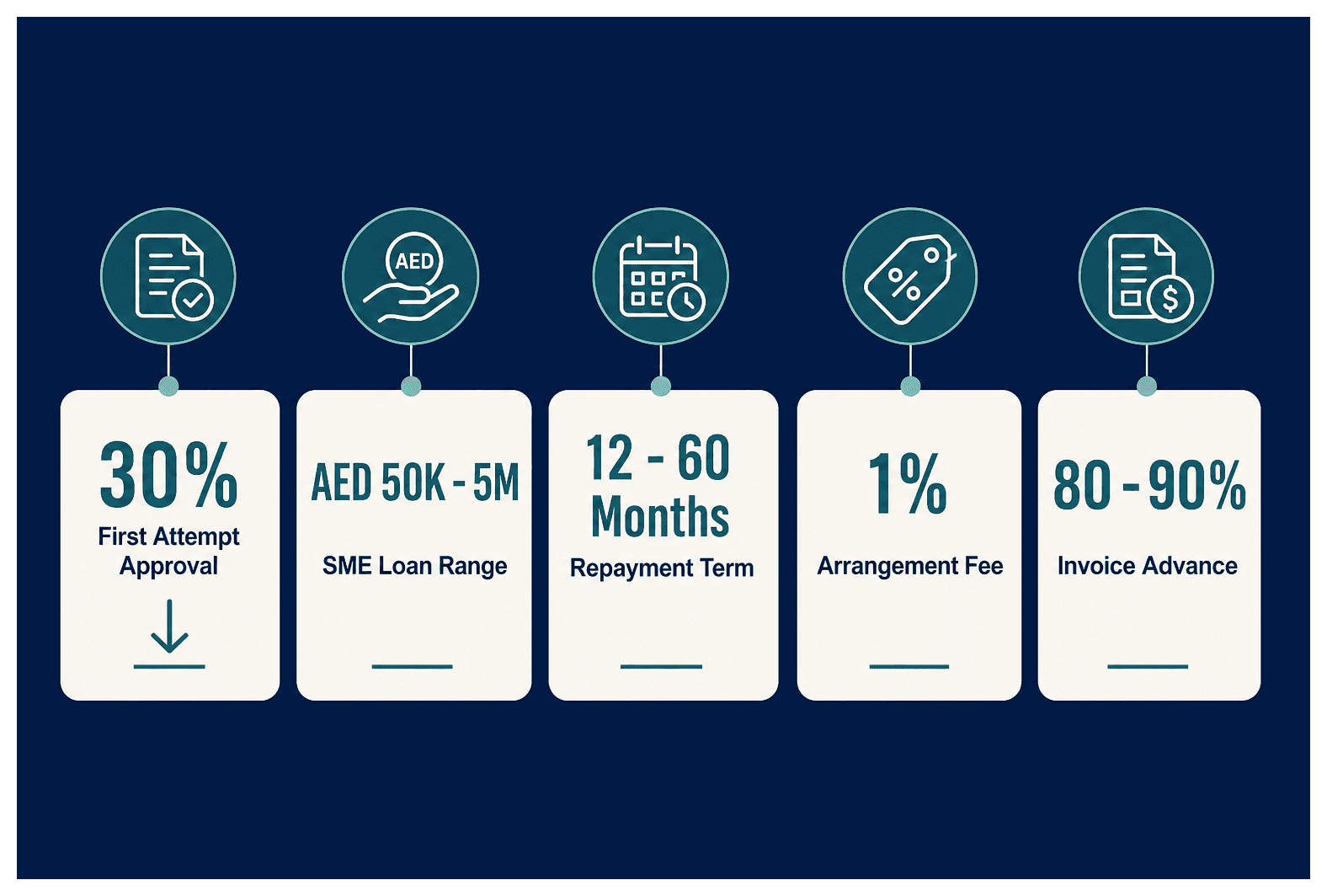
Fewer than 30% of first-time founders in Dubai get approved on their first attempt. The most common reasons are missing paperwork and a trade license that is less than two years old.
Understand the Loan Amounts and Terms
SME loans in Dubai typically range from AED 50,000 to AED 5 million, with repayment terms between 12 and 60 months. Arrangement fees start at 1% of the loan value, so factor that into your cost planning.
Choose the Right Loan Type for Your Needs
Dubai lenders offer several products, including conventional term loans, Islamic Murabaha facilities, overdrafts, invoice financing, and government-backed SME loans. Matching the loan type to your specific purpose, such as equipment or working capital, significantly improves your approval odds.
State a Clear, Specific Purpose for the Funds
Lenders almost always require a stated purpose before approving funds, and vague applications are rejected quickly. A specific, asset-tied request, like financing delivery vehicles over 36 months, is exactly what credit committees want to see.
Consider Islamic Finance If Interest Is a Concern
Murabaha is a Sharia-compliant alternative where a profit rate replaces conventional interest, making it suitable for founders who prefer interest-free structures. It works especially well for asset acquisition and is widely available from UAE-licensed banks.
Calculate Your Setup Costs Before Applying
Sizing your loan request accurately requires knowing your full business setup costs upfront. For example, a sole founder at Dubai South Business Hub starts from AED 18,350 in year one, with the license itself from AED 12,500, and those figures belong in your financial plan before you approach any bank.
Build a Credit Profile With Your First Loan
Getting approved for an initial facility does more than provide capital; it establishes a credit track record that makes future financing cheaper and faster. Early access to capital also lets you hire, stock inventory, and market before cash flow turns positive.
Applying for a business loan in Dubai means formally requesting debt financing from a UAE-licensed bank or financial institution to fund operations, expansion, or working capital. Fewer than 30% of first-time founders in Dubai get approved on their first attempt, according to regional SME financing surveys, and the gap almost always comes down to missing paperwork or a trade license that is less than two years old. Loan amounts for SMEs typically range from AED 50,000 to AED 5 million (Central Bank of UAE, 2025). Repayment terms run 12 to 60 months. Arrangement fees start at 1% of the loan value. This guide covers requirements, costs, and the exact process from choosing a lender to receiving funds, so you walk in prepared.
What Is Applying for a Business Loan in Dubai and Why It Matters
Applying for a business loan in Dubai is the formal process of requesting debt financing from a UAE-licensed bank or financial institution to fund business operations, expansion, or working capital. Lenders assess your trade license, financial statements, and credit history before approving funds, typically ranging from AED 50,000 to AED 5 million for SMEs.
How Business Loans Work in the UAE
A business loan is a lump sum or revolving credit facility extended by a Central Bank of UAE-licensed bank or finance company. The Central Bank of UAE supervises all lending institutions operating in the country, setting the regulatory floor for how products are structured and disclosed.
Repayment is structured over a fixed term, typically 12 to 60 months, with interest or profit rates depending on whether the product is conventional or Sharia-compliant. Loan proceeds can fund equipment, inventory, payroll, or premises. Lenders almost always ask for a stated purpose before approving funds, so vague applications get rejected fast.
A logistics startup at a Dubai free zone, for example, used a AED 300,000 equipment finance facility to purchase delivery vehicles in month six of trading, repaying over 36 months at a fixed profit rate. That kind of specific, asset-tied purpose is exactly what credit committees want to see.
Business Loan Types in Dubai: Key Features at a Glance
Loan Type | Key Feature | Best For |
|---|---|---|
Term Loan (Conventional) | Fixed or variable interest; lump sum disbursed upfront; 12–60 month tenor | Equipment purchases, premises fit-out, or a defined capital project |
Murabaha (Islamic) | Cost-plus sale structure; profit rate replaces interest; Sharia-compliant | Founders who prefer interest-free structures; asset acquisition |
Overdraft Facility | Revolving credit up to an approved limit; interest charged only on drawn amount | Businesses with uneven monthly cash cycles needing flexible working capital |
Invoice Financing | Advance of 80–90% of outstanding invoice value; repaid when client pays | B2B service or trading firms with slow-paying corporate clients |
Government-Backed SME Loan | Guarantee scheme reduces lender risk; lower revenue thresholds than standard bank products | Early-stage companies that don't yet meet standard bank criteria |
Why Getting Financed Early Can Define Your Growth
Access to capital in the first 24 months lets you hire, stock inventory, and market before cash flow turns positive. Dubai's market moves fast. Delayed investment often means lost market share to better-funded rivals who moved while you were waiting.
Loan approval also builds a credit profile that makes future financing cheaper and faster. That first approved facility is not just money; it's a track record. And knowing your funding gap before you launch is part of sound planning. If you're still in the setup phase, calculate your business setup cost in Dubai first so you can size your loan request accurately from day one. At Dubai South Business Hub (DSBH), a sole founder with one visa starts from AED 18,350 in year one, with the license itself from AED 12,500. That number belongs in your financial plan before you walk into any bank.
Types of Business Loans Available in Dubai
Dubai businesses can access term loans, overdraft facilities, invoice financing, equipment finance, and Sharia-compliant Murabaha or Ijara products. Government-backed SME programs through Dubai SME and the UAE Ministry of Economy also offer subsidised or guaranteed financing specifically for early-stage and small businesses.
Conventional and Islamic Financing Products
Here's the practical split you need to understand:
Conventional term loan: Fixed or variable interest rate; lump sum upfront; 12–60 month repayment
Murabaha (Islamic): Cost-plus sale where the bank buys the asset and resells it to you at a profit; no interest charged
Ijara (Islamic): Lease-to-own structure; you pay periodic rent until ownership transfers at the end of the term
Overdraft facility: Revolving working capital up to an approved limit; interest charged only on the drawn amount
Invoice financing: Advance of 80 to 90% of outstanding receivables; the lender collects when your client pays
Most major UAE banks offer both conventional and Islamic windows. You choose the structure that suits your preference or business type. The effective cost is often comparable across both.
Government-Backed SME Support Programs
Dubai SME, an agency of the UAE Ministry of Economy, offers guarantee schemes that reduce lender risk and improve approval odds for early-stage companies. These schemes don't lend you money directly; they backstop the bank if you default, which means lenders are willing to approve businesses they'd otherwise decline.
The Khalifa Fund provides soft loans and grants for qualifying UAE-registered businesses. Eligibility criteria typically include:
Valid UAE trade license
Two years of audited financial accounts
A structured business plan with revenue projections
Minimum UAE ownership threshold (varies by program)
Worth flagging: government guarantee schemes may require mainland registration or UAE national ownership. Verify eligibility directly with each program before applying, because assumptions here waste time.
Key Requirements Before Applying for a Business Loan in Dubai
UAE banks typically require a valid trade license, six to twenty-four months of trading history, audited financial statements, six months of bank statements, a minimum monthly revenue (often AED 25,000 or more), and a clean credit bureau report. Some lenders also require collateral or a personal guarantee from the business owner.
Documents Every Lender Will Ask For
Valid trade license: Most banks require it to be at least six months old; some require two years
Memorandum of Association (MOA) or free zone incorporation certificate: Proves ownership structure
Passport copies and Emirates ID: Required for all shareholders and authorised signatories
Six months of business bank statements: Showing actual cash flow patterns, not just end balances
Audited financial statements: For the past one to two years, prepared by a UAE-registered auditor
That last point is the single most common rejection trigger. A consultancy founder licensed at a Dubai free zone was rejected by two banks because her accounts were audited by a firm registered outside the UAE. She switched to a UAE-registered auditor, reapplied three months later with updated accounts, and was approved. The fix was straightforward. The delay was entirely avoidable.
Financial Thresholds and Credit Checks
Most banks set a minimum monthly revenue of AED 25,000 to AED 50,000 for unsecured SME loans. (UNVERIFIED: confirm exact thresholds with individual lenders before publishing.) The Al Etihad Credit Bureau (AECB) report is pulled for both the company and the individual director. An unpaid telecoms bill or a personal loan in arrears can block a business loan application entirely.
Lenders also check your debt-service coverage ratio: existing obligations plus the new repayment must not exceed a set proportion of monthly revenue. If you're setting up through DSBH, zero paid-up share capital is permitted and doesn't automatically disqualify you. But lenders will weight your bank statement evidence more heavily when there's no paid-in capital to point to.
Collateral and Personal Guarantee Rules
Unsecured loans up to AED 500,000 are available at some banks, relying on cash flow and AECB score
Larger facilities typically require a charge over business assets, a property mortgage, or a personal guarantee
Free zone entities cannot pledge mainland property they don't own; plan your collateral options early
Some banks accept a fixed deposit as collateral, which can also improve the profit rate offered
Opening your business bank account in Dubai on day one of trading matters more than most founders realise. Most lenders count the clock from your first bank statement date, not your license issue date.
What It Costs to Apply for a Business Loan in Dubai
Applying for a business loan in Dubai involves upfront arrangement fees of one to two percent of the loan amount, plus profit or interest rates typically between six and twelve percent per annum for SME products. Processing fees, valuation fees for collateral, and early settlement charges may also apply depending on the lender and product.
Fees You Pay Before Funds Are Released
Arrangement or processing fee: Typically 1–2% of the loan amount, deducted upfront or added to the first repayment
Valuation fee: Required when property or equipment is pledged as collateral; ranges from AED 2,500 to AED 10,000 depending on asset type (UNVERIFIED: confirm with individual lenders before publishing)
Life insurance or credit shield: Some banks require a policy covering the outstanding balance; the premium is often built into the monthly repayment
Legal documentation fees: Apply to larger structured facilities, particularly those involving property charges
Ongoing Rates and Early Settlement Costs
Profit or interest rates for SME term loans in the UAE range from approximately 6 to 12% per annum. (UNVERIFIED: confirm current rates with individual lenders before publishing.) Islamic Murabaha products express cost as a profit rate rather than interest, but the effective cost is broadly comparable to conventional products at the same risk tier.
Early settlement penalties can reach 1 to 3% of the outstanding balance. Always read that clause before signing. Late payment fees are governed by Central Bank of UAE regulations, so they're capped, but they still add up. Know the schedule before you commit to a repayment timeline.
Step-by-Step Guide to Applying for a Business Loan in Dubai
Applying for a business loan in Dubai follows six core steps: confirm eligibility, gather documents, compare lenders, submit the application, complete due diligence, and receive funds. The full process takes between two weeks and three months depending on loan size, lender, and how quickly you supply complete documentation.
Step 1: Confirm Your Eligibility and Loan Size
Review your trade license age, monthly revenue, and AECB credit standing before approaching any lender
Calculate the maximum monthly repayment your cash flow can support; most advisors recommend keeping debt service below 30% of monthly revenue
Decide between a term loan for a specific purchase or a revolving facility for working capital
Use your business plan to justify the amount; lenders reject applications where the loan size isn't tied to a credible use of funds
Step 2: Gather Documents and Prepare Financials
Compile your trade license, MOA, Emirates ID, passport copies, six months of bank statements, and audited accounts
If accounts aren't yet audited, engage a UAE-registered auditor immediately; this is the single most common delay in the process
Prepare a one-page loan purpose summary: amount needed, how it will be used, and how it will be repaid
Pull your own AECB report in advance and resolve any discrepancies before the lender does it for you
Step 3: Compare Lenders and Submit Your Application
Request indicative term sheets from at least three Central Bank of UAE-licensed banks before committing. Rates and fees vary significantly across institutions, and a half-percentage-point difference in profit rate compounds over a 48-month term. Your existing business bank holds a practical advantage: they already have your statement history and can process your file faster than a bank seeing you for the first time.
Submit a complete application in one go. Partial submissions slow processing and can signal disorganisation to the credit team. Track your application reference number and follow up every five business days.
Step 4: Complete Due Diligence and Receive Funds
The bank's credit team verifies documents and completes Know Your Customer (KYC) checks
Site visits may be conducted for larger loan facilities
Respond to information requests within 24 to 48 hours; delayed responses push your file to the back of the queue
Review the offer letter carefully before signing: confirm rate, tenor, fees, and early settlement terms
Funds are typically disbursed within two to five business days of signing
Is it better to apply through your existing bank or a new lender?
Your existing business bank is usually the faster route. They already hold your transaction history, which means KYC is simpler and the credit team has real data to assess. A new lender starts from zero. That said, if your current bank's rates are uncompetitive, the time saving may not justify the higher cost over a 36-month term.
How Your Business Structure Affects Loan Eligibility
Free zone companies, mainland LLCs, and sole establishments each face different lender criteria in Dubai. Free zone entities may encounter additional collateral requirements from some banks, while mainland companies often have a broader pool of lenders to approach. Your license type, ownership structure, and registered activity all influence which products you can access when applying for a business loan in Dubai.
Free Zone Versus Mainland Borrowing Conditions
Free zone companies are legally separate from the mainland. Some banks treat them as higher risk and require stronger collateral or a personal guarantee as a result. Worth noting: 100% foreign ownership is available on both the mainland and in free zones under current UAE company law. It doesn't give a free zone company any lending advantage over a mainland LLC.
Mainland LLCs can pledge UAE property more straightforwardly and often qualify for a wider range of bank products. The practical gap is narrowing, though. Many UAE banks now run dedicated free zone SME desks with products specifically tailored to free zone-licensed businesses.
How Your Licensed Activity Influences What You Can Borrow
Regulated activities such as financial services or healthcare require approval from the named regulator (Central Bank of UAE for financial services; Dubai Health Authority for healthcare) in addition to the DSBH trade license; lenders check both
Trading businesses with inventory can access asset-backed financing tied to stock or receivables
Service and consulting businesses typically rely on cash flow-based unsecured facilities, which carry stricter revenue thresholds
Choosing the right business activities in Dubai from the outset shapes your financing options for years. At DSBH, founders can add activities beyond the first five for AED 2,000 each. Getting the activity list right at setup, rather than amending it later, keeps your license aligned with what lenders see when they verify your registration.
Common Reasons Business Loan Applications Are Rejected in Dubai
The most common reasons UAE banks reject business loan applications are insufficient trading history, unaudited or incomplete financials, a poor AECB credit score, loan amount mismatched to stated revenue, and missing or expired trade license documents. Addressing these issues before applying for a business loan in Dubai significantly improves your approval odds.
Documentation and Financial Red Flags
Unaudited accounts or accounts prepared by a firm outside the UAE are the leading technical rejection cause
Bank statements showing irregular deposits, large unexplained transfers, or dormant months raise compliance flags immediately
An expired trade license at the time of application results in automatic rejection at most banks; renew before you apply
Mismatched figures between bank statements and financial statements signal inconsistency that underwriters flag on the first review
Behavioural and Structural Issues to Fix Before Applying
Applying to multiple lenders simultaneously can lower your AECB score; space applications out or use a broker who submits to one lender at a time
A personal credit default, even from a previous employer's salary advance, can block a business loan application entirely
Requesting an amount far above what your revenue supports signals poor financial planning to the credit committee
A declined application stays on your
References
Frequently Asked Questions