
Topic Summary
Residency Status Determines Everything
Your residency status is the single biggest variable when opening a Dubai bank account as a foreigner. Resident expats with an Emirates ID face standard requirements, while non-residents encounter higher minimums and far fewer bank options.
Resident Expats Face Standard, Manageable Requirements
UAE resident foreigners typically need a valid Emirates ID, residency visa, passport copy, and proof of income or an employment contract. Most banks also require a minimum monthly salary of AED 3,000–5,000 and accounts can open within 2–5 business days.
Non-Residents Must Meet Stricter Conditions
Foreigners without UAE residency face minimum balances of AED 25,000 or more and must visit a UAE branch in person. Significantly fewer banks offer personal account products to non-residents.
Personal and Business Accounts Are Not Interchangeable
UAE AML/CFT regulations require licensed companies to maintain segregated business accounts, so you cannot run a free zone company through a personal account. Banks will flag the activity and risk account suspension.
Free Zone Companies Need a Separate Corporate Account
Entrepreneurs who incorporate in a Dubai free zone must open a corporate account in the company's name, not their own. This pathway operates under its own compliance track with distinct documentation requirements.
Over 50 Banks Operate in the UAE
The UAE Central Bank licenses more than 50 retail banks across the country, giving residents a wide range of options. However, the number of banks willing to serve non-residents is considerably smaller.
By Editorial Team, UAE business setup specialists covering free zone incorporation, corporate banking, and expat financial services. Full bio →
In 2026, the UAE is home to over 9 million expatriates, roughly 88% of the total population (UAE Federal Competitiveness and Statistics Centre, 2024). Over 50 licensed retail banks operate across the country (UAE Central Bank, 2025). Despite this, many foreigners arrive without a clear roadmap for opening a bank account in Dubai. The good news: a bank account in Dubai for foreigners is absolutely achievable. The catch is that requirements differ sharply based on three variables: your residency status, whether you need a personal or business account, and which bank you approach. Resident expats face a standard process. Non-residents face higher minimum balances of AED 25,000 or more. Free zone company owners need a separate corporate account entirely. This guide covers all three pathways, with specific bank names, document lists, and realistic timelines, so you know exactly what to prepare before you apply.
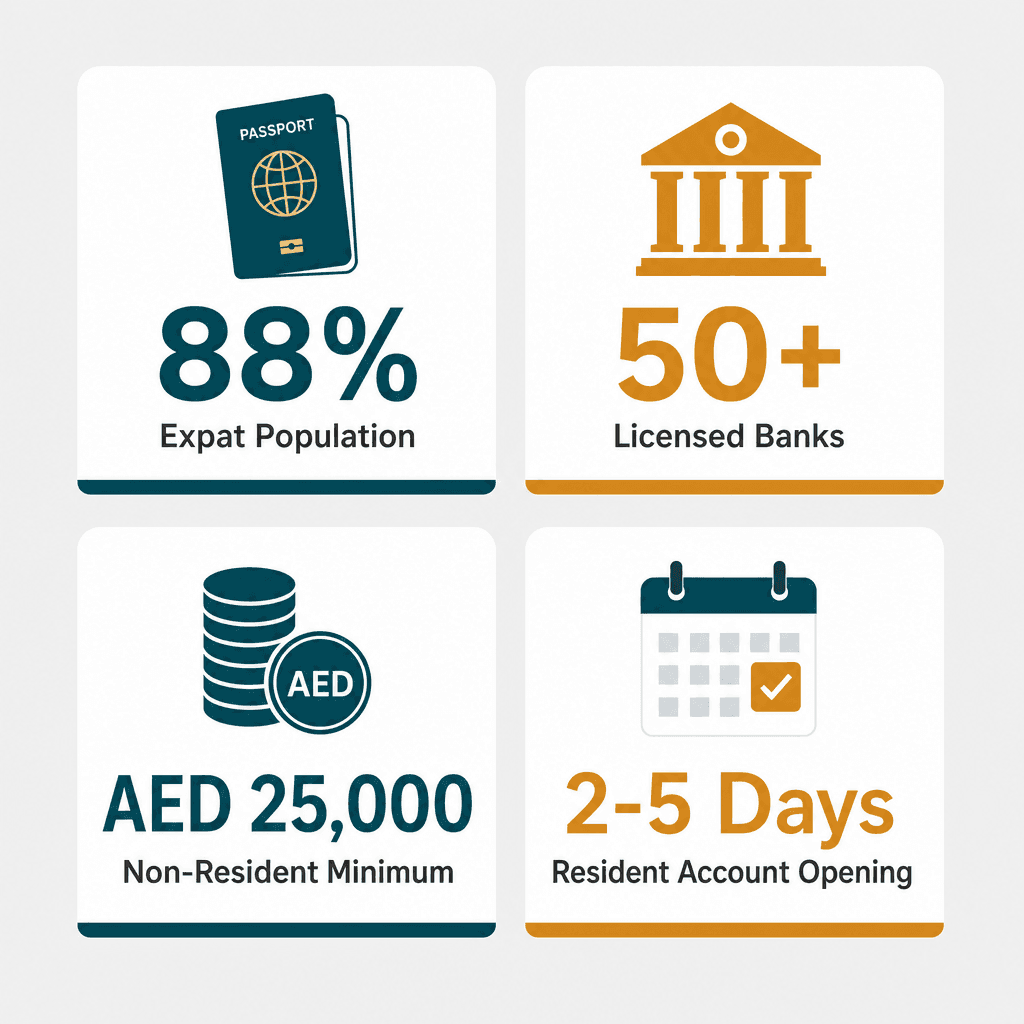
A bank account in Dubai for foreigners is a personal or business account held at a UAE Central Bank-licensed institution by a non-UAE national. Eligibility depends on residency status: UAE resident expats face standard requirements, while non-residents face stricter rules, higher minimum balances, and fewer bank options.
The Two Scenarios Every Foreign Applicant Faces
Your residency status is the single biggest variable in the entire application process. There are two distinct scenarios, and confusing them wastes time and causes rejections. Opening a UAE business bank account is a key step in completing your Dubai company setup as a foreign owner.
Scenario 1, UAE resident foreigner: You hold a valid Emirates ID and UAE residency visa. Nearly all major banks serve you. Standard retail banking requirements apply, and most accounts open within 2–5 business days.
Scenario 2, Non-resident foreigner: You have no UAE residency. Far fewer banks offer personal products to you. Minimum balances are significantly higher, and a physical UAE branch visit is almost always required.
An American software consultant relocating to Dubai on an employment visa follows a completely different process than a UK investor who wants a UAE account without moving there. The first person opens a standard current account at Emirates NBD in a few days. The second faces a minimum balance of AED 25,000 and a mandatory in-person visit. There is also a third pathway, corporate accounts for free zone companies, which operates under its own compliance track entirely.
Personal vs. Business Accounts: Understanding the Difference
Personal accounts handle salary receipts, daily expenses, and international remittances. Business accounts are mandatory for invoicing clients, holding company funds, and processing trade payments. You cannot substitute one for the other.
Can you run a Dubai free zone company through your personal account? No, and banks will flag it. The UAE's Anti-Money Laundering and Combating the Financing of Terrorism (AML/CFT) framework, overseen by the UAE Central Bank, requires licensed entities to maintain segregated business accounts. A Canadian entrepreneur who incorporates at Dubai South Business Hub Free Zone must open a corporate account in the company name. Using a personal Emirates NBD account for business receipts violates UAE AML regulations and risks account suspension.
UAE Resident Expats: Standard Personal Bank Account Requirements in Dubai
UAE resident expats need a valid Emirates ID, residency visa, passport copy, and proof of income or an employment contract to open a personal bank account in Dubai. Most banks require a minimum monthly salary of AED 3,000–5,000 and a minimum balance of AED 3,000–10,000 depending on the account tier.
Documents You Must Have Before Applying
Emirates ID (original): Issued by the Identity and Citizenship Authority (ICP); mandatory for all UAE residents, a photocopy alone is not accepted.
Valid UAE residency visa page in your passport.
Salary certificate or employment contract showing your monthly income figure.
Proof of UAE address: A recent utility bill or a tenancy contract registered through Ejari (Dubai's official rental registration system).
Home-country bank statements: Some banks request 3–6 months of statements from your overseas account, particularly if you're new to the UAE.
Emirates NBD's Liv. digital account is worth highlighting here. UAE resident expats with an Emirates ID and a salary transfer can open an account entirely via the app, no branch visit, active within minutes. First Abu Dhabi Bank (FAB) sets its current account salary threshold at AED 5,000 per month; ADCB starts at AED 3,000. Know your salary before choosing a bank.
Minimum Balance and Salary Requirements by Account Type
Mashreq's Salaam Account targets resident expats earning AED 3,000 or more per month with zero minimum balance if salary is credited to the account. Emirates Islamic's Flex Account requires an AED 3,000 average monthly balance. Fall below that, and you'll typically pay AED 25–100 per month in non-maintenance fees.
UAE Resident vs. Non-Resident Personal Banking: Key Differences
Feature | UAE Resident Expat | Non-Resident Foreigner |
|---|---|---|
Banks Available | ✅ All 50+ licensed retail banks | ❌ 3–5 banks only (Emirates NBD, ADCB, HSBC UAE) |
Minimum Balance | AED 3,000–10,000 | AED 25,000–350,000+ |
Branch Visit Required | ✅ Optional (many digital options) | ❌ Almost always mandatory |
Approval Timeline | 2–5 business days | 5–15 business days |
Key Documents | Emirates ID, visa, salary proof | Passport, overseas address proof, source-of-funds declaration |
Account Functionality | ✅ Full, transfers, cards, overdraft | ❌ Restricted initially, limited transfers, no overdraft |
Note that resident expat personal accounts are entirely separate from the corporate accounts required by free zone license holders. Even if you already have a personal account at Emirates NBD, your free zone company still needs its own corporate account.
5 Steps to Open a Bank Account in Dubai as a Foreigner
To open a bank account in Dubai as a foreigner: choose the right bank for your residency status, gather required documents, submit an application online or in-branch, pass KYC and compliance checks, and fund the account to meet the minimum balance. The process takes 2–10 business days for residents.
Step 1: Choose the Right Bank for Your Situation
If you're a UAE resident expat, you have the widest choice: Emirates NBD, FAB, ADCB, RAKBank, Mashreq, and HSBC UAE all serve you. Non-residents should focus on Emirates NBD, ADCB, and HSBC UAE, they're the most accessible. For free zone business owners, check whether your bank has a formal relationship with your specific free zone before applying cold.
RAKBank business banking at Dubai South offers streamlined onboarding for Dubai South Business Hub Free Zone license holders, cutting the typical documentation turnaround from several weeks to around 8 business days. Mashreq corporate banking at Dubai South provides a similar advantage with dedicated relationship managers for new incorporations.
Step 2: Prepare Your Document Pack
Document | Resident Personal | Non-Resident Personal | Free Zone Business |
|---|---|---|---|
Passport | ✅ | ✅ | ✅ All shareholders |
Emirates ID | ✅ Required | ❌ Not applicable | ✅ If resident director |
Salary / Income Proof | ✅ Required | ✅ Source-of-funds declaration | ✅ Business plan (some banks) |
Trade License / MoA | ❌ Not required | ❌ Not required | ✅ Mandatory |
Home Bank Reference Letter | Sometimes requested | ✅ Strongly recommended | Sometimes requested |
When opening a business account for a newly incorporated Free Zone Company (FZCO) at Dubai South, HSBC UAE typically requests a 12-month business plan alongside the standard trade license and Memorandum of Association (MoA) pack. Have it ready before you apply.
Non-Resident Foreigners: Opening a Bank Account in Dubai Without Residency
Non-resident foreigners can open a bank account in Dubai without residency, but options are limited. Emirates NBD, ADCB, and HSBC UAE are among the few banks offering non-resident personal accounts. Expect minimum balances of AED 25,000–350,000+, mandatory UAE branch visits, and stricter source-of-funds scrutiny.
Which Banks Accept Non-Resident Applications
Emirates NBD: Offers a dedicated Non-Resident Account with an AED 25,000 minimum average balance. USD and EUR accounts are also available, making it a practical choice for international investors (Emirates NBD, 2025).
ADCB: Non-resident personal banking is available but requires a branch visit and an AED 25,000 or higher minimum balance (ADCB, 2025).
HSBC UAE: Premier non-resident accounts are available but carry a high barrier: an existing HSBC relationship in your home country or AED 350,000 in qualifying assets (HSBC UAE, 2025). The payoff is strong international connectivity and multi-currency functionality.
Smaller local banks: Generally do not offer non-resident retail products. Don't waste time applying at banks without a dedicated non-resident product line.
A German property investor purchasing a Dubai apartment without relocating can open a non-resident account at Emirates NBD by visiting a Dubai branch and presenting a valid passport, proof of overseas address, and a reference letter from Deutsche Bank. That combination typically satisfies the KYC requirements.
What Non-Residents Should Expect During the Process
Physical presence in the UAE is almost always required. Remote onboarding for non-residents remains unavailable at most banks. Source-of-funds documentation is scrutinised closely, expect to explain whether your income comes from salary, investments, property sales, or business revenue. Vague answers trigger delays or outright rejection.
Accounts opened by non-residents are often restricted in the early months: limited international transfer destinations, no overdraft facility, and no credit card until a track record is established. A US-based entrepreneur who opened a non-resident account at ADCB reported a 10-business-day approval after an in-branch visit in Dubai Marina, with initial transfer functionality capped at 5 destination countries. Plan for this limitation if you need immediate global payment capability.
Is a non-resident bank account in Dubai worth it?
Yes, if you own UAE property, receive rental income from the UAE, or plan to incorporate a free zone company. A UAE IBAN simplifies rent collection, supplier payments, and tax reporting. The AED 25,000 minimum balance is the real barrier for most applicants, not the process itself.
Business Bank Accounts for Foreign-Owned UAE Free Zone Companies
Foreign-owned UAE free zone companies must open a dedicated corporate bank account using the trade license, Memorandum of Association, and passport copies of all shareholders. RAKBank and Mashreq are among the most accessible options for newly incorporated companies, particularly those established at Dubai South Business Hub Free Zone.
Core Documents Every Free Zone Company Needs
Trade license (original and certified copy), must be valid at the time of application; an expired license will result in immediate rejection.
Certificate of Incorporation and Memorandum and Articles of Association (MoA/AoA).
Passport copies of all shareholders, directors, and Ultimate Beneficial Owners (UBOs), UAE AML regulations require full UBO disclosure for all licensed entities.
Board resolution authorising the account opening and naming authorised signatories.
Business plan: Not always mandatory, but increasingly requested by bank compliance teams for companies under 12 months old.
A South African entrepreneur incorporating a logistics consultancy at Dubai South Business Hub Free Zone submitted a trade license, MoA, passport, and a two-page business plan to RAKBank. The account was live within 8 business days through the bank's dedicated Dubai South partnership channel, a timeline that would typically take 3–4 weeks via a standard cold application.
Most Accessible Banks for Newly Incorporated Free Zone Companies
RAKBank: Strong SME focus, competitive minimum balances, and a formal partnership with Dubai South Business Hub Free Zone that speeds onboarding. See RAKBank business banking at Dubai South for details.
Mashreq: Corporate banking partnership with Dubai South Business Hub; digital-first processes reduce branch visits for newly licensed entities. Mashreq corporate banking at Dubai South includes dedicated relationship managers, a material advantage over cold applications.
Emirates NBD: Large network and multi-currency accounts, but compliance scrutiny is higher for companies under 12 months old.
FAB (First Abu Dhabi Bank): Better suited to companies with an established trading history and international payment flows.
The practical tip here is simple: if you
Citations
Central Bank of the UAE.. centralbank.ae. CBUAE, 2024.
Federal Authority for Identity, Citizenship, Customs and Port Security.. icp.gov.ae. ICP UAE, 2024.
Dubai Economy and Tourism.. dubaidet.gov.ae. DET Dubai, 2024.
General Directorate of Residency and Foreigners Affairs Dubai.. gdrfad.gov.ae. GDRFA Dubai, 2024.
Ministry of Human Resources and Emiratisation.. mohre.gov.ae. MoHRE UAE, 2024.
Frequently Asked Questions