
Topic Summary
Choose a Free Zone Over Mainland First
For overseas founders with no existing UAE presence, a free zone license offers faster setup, lower costs, and no local service agent requirement. Both structures now allow 100% foreign ownership, so the real differentiator is speed and operational friction.
Get Licensed in as Little as One Day
Free zones like Dubai South Business Hub can issue a trade license in a single business day, even without the founder traveling to the UAE. This makes it one of the fastest legal entity formations available to international entrepreneurs anywhere.
Zero Paid-Up Share Capital Required
Unlike many jurisdictions, UAE free zone companies require no blocked or deposited share capital to incorporate. This removes a common cash-flow barrier for overseas founders entering the market.
Budget From AED 18,350 for Year One
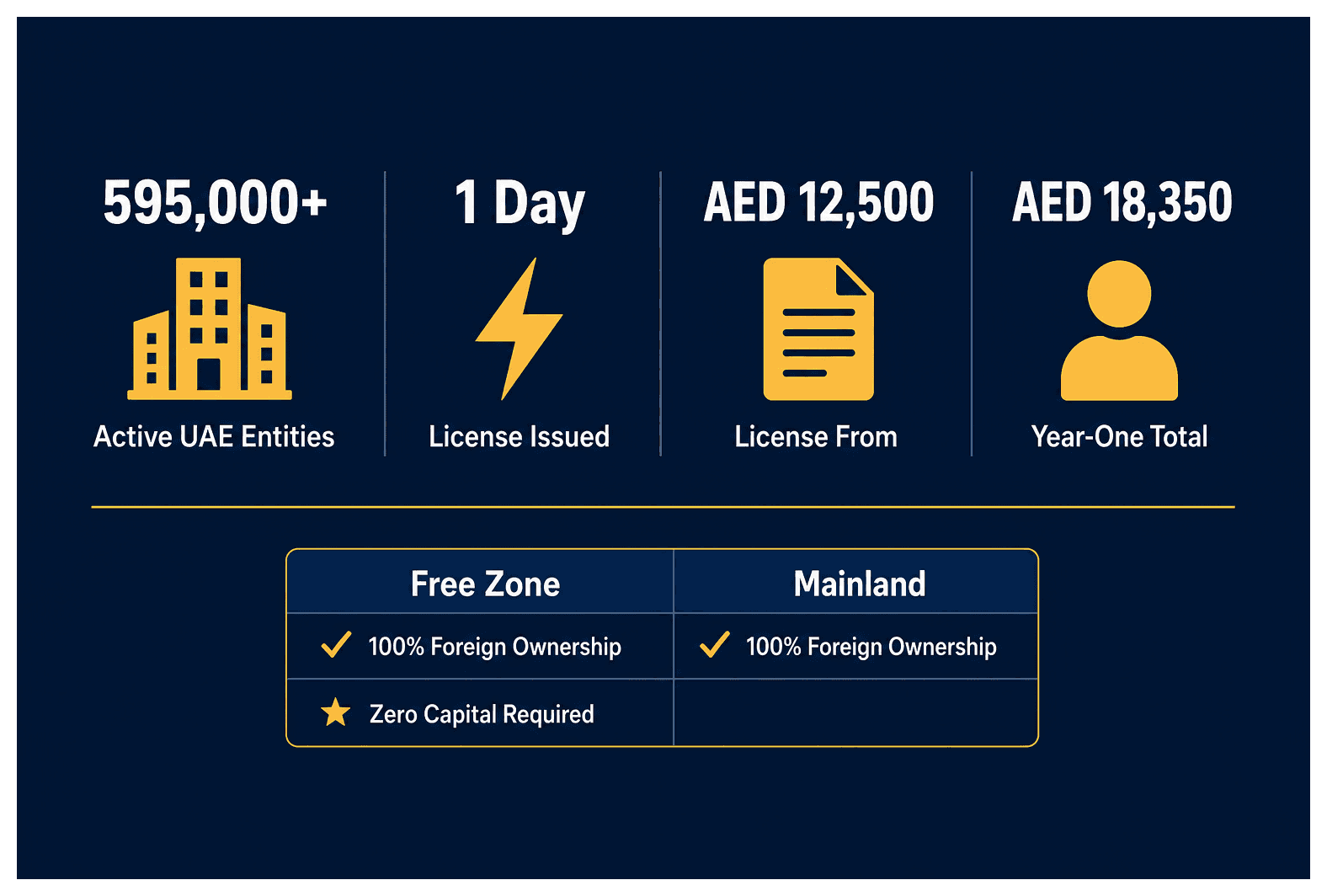
A sole founder with a single visa can be fully licensed and operational for approximately AED 18,350 in the first year, with the standard license starting from AED 12,500. Knowing this upfront helps founders plan without unexpected cost overruns.
Understand What the License Actually Unlocks
A UAE trade license grants a legal company identity, eligibility for a corporate bank account, the ability to sponsor residency visas, and a compliant entity for invoicing clients in AED. These four benefits together make the free zone structure a practical operating base, not just a registration.
Know the Mainland Route for Government Contracts
If your business needs to bid on UAE government contracts or operate retail premises across an emirate, a mainland license issued by DET is the appropriate structure. Free zone entities are generally restricted from direct government procurement.
Factor in Duty Treatment for Physical Goods
Goods held inside a free zone are duty-suspended, not duty-exempt, meaning standard import duties apply once products move to the UAE mainland. Founders selling physical goods to UAE customers should account for this in their pricing and logistics planning.
In 2026, the UAE hosts more than 595,000 active commercial entities (Dubai Chamber), and overseas founders account for a growing share of new registrations each year. A free zone trade license can be issued in one business day. Zero paid-up share capital is required. The standard license starts from AED 12,500. A sole founder with one visa can be fully set up from AED 18,350 in year one. And since Federal Decree-Law No. 26 of 2020 extended 100% foreign ownership to most commercial activities (Ministry of Economy), there's no longer a structural reason to delay. This guide covers the exact requirements, costs, and steps for the best setup overseas UAE, so you can move from decision to licensed entity without wasted time or budget.
What Is the Best Setup for an Overseas Company Entering the UAE
The best setup for an overseas company entering the UAE is a free zone trade license, which grants 100% foreign ownership, zero paid-up share capital, and same-day issuance. A free zone structure separates your UAE entity from your home-country company while giving you a compliant local base for operations, invoicing, and residency visas.
Free Zone vs. Mainland: Choosing the Right Structure
Both free zone and mainland structures now permit 100% foreign ownership, that reform came through Federal Decree-Law No. 26 of 2020, so ownership is no longer a differentiator between the two routes. The real differences sit in speed, cost, and what you can do with the license.
Free zones offer faster setup, lower minimum costs, and no local service agent requirement for most activities. Mainland licenses issued by DET (Dubai Department of Economy and Tourism) suit businesses that must trade directly with UAE government bodies or run retail premises across the emirate. For an overseas founder with no UAE presence yet, a free zone license is the faster, lower-friction entry point.
Free Zone vs. Mainland: Quick Comparison for Overseas Founders
Feature | Free Zone (DSBH) | Mainland (DET) |
|---|---|---|
Foreign ownership | 100%, no local partner needed | 100%, available for most activities post-2021 reform |
Setup speed | 1 business day at DSBH | Several days to several weeks depending on activity |
Local sponsor required | No | No for most activities (post-2021 reform) |
Paid-up share capital | Zero, no blocked account required | Activity-dependent; some activities require minimum capital |
Direct UAE government contracts | Restricted, free zone entity trades within the zone | Permitted, full access to government procurement |
Designated-zone VAT/customs benefit | Not applicable, DSBH is not a designated zone | Not applicable |
A Singapore-based logistics consultancy wanting to invoice UAE clients can incorporate at Dubai South Business Hub Free Zone in one business day without traveling to the UAE. That's a genuinely hard-to-match proposition for overseas founders who need a licensed entity fast.
What a Free Zone License Actually Gives You
A free zone trade license is the legal instrument authorising your company to carry out the specific business activities listed on the license. The free zone authority acts as both regulator and registrar within its jurisdiction, which is why issuance is faster than a mainland application routed through multiple government departments.
A UAE trade license number, your legal identity in the UAE commercial system
Eligibility to open a UAE corporate bank account
The ability to sponsor investor and employee residency visas
A compliant local entity for invoicing clients in AED
Worth flagging: goods moved between the free zone and the UAE mainland are subject to standard import duties. Free zone goods are duty-suspended while inside the zone, not duty-exempt. A UK-based e-commerce brand licensing trading activities at Dubai South Business Hub Free Zone (launched September 2025) can legally sell to UAE customers via a local entity, invoice in AED, and open a UAE corporate bank account, but mainland sales attract standard duty treatment.
Key Requirements for the Best Setup Overseas UAE
To complete the best setup overseas UAE, you need a valid passport, proof of residential address, a chosen trade name, and a defined list of business activities. Regulated activities, such as financial services, healthcare, or education, require separate approval from the named UAE regulator in addition to the free zone license.
Document Checklist for Overseas Founders
The document list is short. All of it can be submitted digitally. Here's exactly what you need:
Passport copy for all founders and shareholders, valid for at least six months from the application date
Proof of residential address, utility bill or bank statement dated within the last three months
Passport-size photograph for each applicant
Proposed trade name, must comply with UAE naming conventions (no offensive terms, no country or religion references without prior approval)
Completed application form provided by the free zone authority
A Canadian founder can submit all documents digitally to DSBH without flying to Dubai. The license is issued the same day and can be courier-delivered if a physical copy is needed. Zero paid-up share capital means no funds are locked in a blocked account at any stage.
Regulated Activities: What Overseas Founders Must Know
DSBH can list a regulated activity on your trade license, but the named UAE regulator must grant a separate operating permit before you can actually trade in that activity. The license and the operating permit are two distinct approvals.
Financial services: The Central Bank of the UAE approves payment facilitation, lending, and most financial activities separately from the free zone license
Healthcare: DHA (Dubai Health Authority) approval is required in addition to the DSBH license, see the healthcare business license page for activity scope
Education: KHDA (Knowledge and Human Development Authority) approval is required before any education or training activity can operate
ICT and professional services: Generally non-regulated, your ICT license or professional services license operates on the free zone license alone
A German fintech startup licensing payment facilitation at DSBH must also obtain Central Bank approval before processing UAE transactions. The free zone license alone is not sufficient. Plan for regulator timelines in addition to the one-day license issuance.
Step-by-Step Guide to the Best Setup Overseas UAE
Setting up a UAE company from overseas takes six key steps: choose your structure and activities, reserve your trade name, submit your application and documents, receive your trade license, open a corporate bank account, and apply for residency visas. The full process at Dubai South Business Hub Free Zone can be completed remotely in as little as one business day.
The Six Steps to Your UAE Trade License
Select your legal structure and business activities. Choose a free zone company and confirm which activities you need. The first five activities are included in the base license fee; each additional activity costs AED 2,000.
Reserve your trade name.Check your trade name availability and confirm it before submitting the application. Names must comply with UAE naming conventions.
Complete and submit your application. Upload your passport copies, proof of address, photographs, and completed application form. All steps are done remotely.
Receive your trade license. At DSBH, the license is typically issued within one business day of a complete application.
Open a UAE corporate bank account. Use your issued trade license and company documents to begin the bank onboarding process. Most banks require at least one in-person signatory visit, plan a short Dubai trip for this step.
Apply for residency visas. Investor and employee UAE residency visas can be applied for immediately after the license is issued. Visa costs are always an additional cost, separate from the license fee.
An Indian founder setting up a professional consultancy at DSBH completed steps 1 through 4 in a single day remotely, then flew to Dubai in week two to complete in-person bank account opening. That's a realistic timeline for most overseas founders.
What Happens After the License Is Issued
The license is the starting line, not the finish line. Here's what you need to action immediately:
Corporate bank account: Most UAE banks require in-person attendance for at least one authorised signatory. Timelines vary by institution and are outside the free zone's control.
Residency visa: Applications run through ICP (Federal Authority for Identity, Citizenship, Customs and Ports Security), start the process as soon as the license is in hand.
Corporate tax registration: All UAE entities must register with the Federal Tax Authority. Late registration carries a one-time flat penalty of AED 10,000.
VAT registration: Mandatory once taxable supplies exceed AED 375,000 in the preceding 12 months. Late registration carries an AED 10,000 penalty.
QFZP status: A 0% corporate tax rate on qualifying income requires meeting all four Qualified Free Zone Person conditions simultaneously, economic substance, qualifying income, de minimis non-qualifying revenue, and audited financial statements.
A US-based SaaS company licensed at DSBH must register for corporate tax with the Federal Tax Authority within the statutory deadline to avoid that AED 10,000 flat penalty. Build the compliance calendar before you start trading.
What Does the Best Setup Overseas UAE Actually Cost
A free zone trade license at Dubai South Business Hub Free Zone starts from AED 12,500. The first-year all-in cost for a sole founder with one visa starts from AED 18,350. Each business activity beyond the first five adds AED 2,000. Zero paid-up share capital is required. Visa costs are always separate.
License Fees and First-Year Cost Breakdown
Trade license: From AED 12,500
First-year all-in cost: From AED 18,350 for a sole founder with one visa
Additional activities: AED 2,000 per activity beyond the first five (included in the base fee)
Paid-up share capital: Zero, no funds locked in a blocked account at any stage
Visa costs: Always an additional cost, never included in the license fee
A sole founder registering a consultancy with three activities pays the base license fee. Add eight activities instead of three (three beyond the first five), and you add AED 6,000 to the license cost. Use the business setup cost calculator to build a personalised budget before committing.
Hidden Costs Overseas Founders Often Miss
Visa fees: Each founder and employee visa is priced separately from the license
Bank minimum balance: Some UAE banks require a minimum deposit to maintain a corporate account, confirm with your chosen bank before opening
Regulated activity approvals: Fees set by the relevant UAE regulator (DHA, KHDA, Central Bank) are not included in the DSBH license fee
Annual renewal: License renewal fees apply each year, budget for these from day one
Document attestation and translation: Foreign-language founding documents may require certified translation and notarisation before submission (UNVERIFIED: attestation cost range AED 1,500 to AED 3,000. Confirm before publishing.)
Tax and Compliance Obligations Every Overseas Founder Must Know
UAE free zone companies must register for corporate tax with the Federal Tax Authority. A 0% corporate tax rate on qualifying income is available only to entities that meet all four Qualified Free Zone Person conditions: economic substance, qualifying income, de minimis non-qualifying revenue, and audited financial statements. VAT registration is mandatory above AED 375,000 in taxable supplies.
Corporate Tax: What the 0% Rate Actually Requires
All UAE entities, including free zone companies, must register for corporate tax. There is no automatic exemption.
The 0% rate on qualifying income applies only when all four QFZP conditions are met simultaneously.
The four conditions: adequate economic substance in the UAE; income classified as qualifying income; non-qualifying revenue below the de minimis threshold; audited financial statements prepared annually.
For entities that don't meet QFZP conditions, corporate tax applies at 9% on taxable income above AED 375,000.
Late registration carries a one-time flat penalty of AED 10,000, not a monthly charge.
A Dutch holding company with a DSBH subsidiary must assess whether the subsidiary generates qualifying income and maintains genuine UAE substance before relying on the 0% rate. Don't assume it applies automatically.
VAT Registration and Ongoing Filing
VAT registration is mandatory once taxable supplies exceed AED 375,000 in the preceding 12 months, or if projected to exceed that threshold within the next 30 days.
Voluntary registration is available from AED 187,500 in taxable supplies.
Late VAT registration carries a penalty of AED 10,000.
Free zone companies supplying goods or services to UAE mainland customers must account for VAT on those supplies.
Quarterly VAT returns are filed with the Federal Tax Authority.
A DSBH-licensed trading company that begins invoicing UAE mainland clients must monitor its taxable supply total closely and register for VAT before breaching AED 375,000. See the banking and taxation services page for practical guidance on managing both obligations.
Is the UAE truly tax-free for free zone companies?
No. The UAE is not tax-free. Corporate tax at 9% applies to taxable income above AED 375,000 for entities that do not qualify as a Qualified Free Zone Person. QFZP status, which allows a 0% rate on qualifying income, requires meeting four specific conditions verified by audited financial statements each year (Federal Tax Authority, 2023, still accurate as of 2026).
Residency Visas and Banking: Completing Your UAE Presence
A UAE free zone trade license entitles the holder to apply for investor residency visas and sponsor employee visas. Visa costs are always separate from the license fee. A UAE corporate bank account requires the issued trade license plus supporting KYC documents. Most banks require at least one in-person signatory visit to complete account opening.
Investor Residency Visa: Who Qualifies and What It Costs
Each founder holding a share in the licensed company qualifies to apply for an investor residency visa.
Applications are processed through ICP (Federal Authority for Identity, Citizenship, Customs and Ports Security).
Visa costs are always an additional cost, never bundled with the DSBH license fee.
The visa grants the right to reside in the UAE
References
Frequently Asked Questions