
Topic Summary
Start With the All-In Year One Figure
A sole founder launching a software company at Dubai South Business Hub Free Zone can get fully licensed from AED 18,350 in year one, covering the ICT trade license and one visa package. Zero paid-up share capital is required, making the entry point more accessible than most mainland or premium free zone options.
Separate One-Off Fees From Annual Recurring Costs
The most common budgeting mistake is treating the license fee as the total cost. One-off fees like company registration, trade name reservation, and initial visa stamping only apply at setup, while the license renewal, visa renewal, and Emirates ID renewal recur every year or every renewal cycle.
Software Licenses Cover Up to Five Activities
A DSBH ICT trade license from AED 12,500 covers up to five business activities, such as SaaS, app development, and IT consulting, under a single license. Each additional activity beyond five costs AED 2,000, so planning your activity list upfront avoids unexpected fees later.
B2C Software Businesses Get a Lower License Rate
If your software company sells directly to consumers rather than businessesB2B rate of AED 12,500. Choosing the correct license type from day one ensures you are not overpaying on your annual renewal.
Visas Are Always a Separate Line Item
Visa costs are never bundled into the license fee itself and must be budgeted independently for each person requiring UAE residency. Each visa involves initial stamping, Emirates ID issuance, and a medical fitness test, all of which recur at each renewal cycle every two to three years.
Year Two Renewal Costs Less Than Year One
Certain one-off government fees paid at incorporation do not repeat at renewal, so a founder's second-year cost is typically lower than the AED 18,350 year-one figure. The license renewal from AED 12,500 and any visa renewals remain fixed annual obligations regardless of company profitability.
Software Companies Avoid Inventory and Import Costs
Unlike trading or manufacturing businesses, software companies carry no inventory, no warehouse obligation, and no import duty exposure under ISIC Section J classification. This means your entire cost structure is service-side, making budgeting more predictable once you account for the license, visas, compliance, and banking.
In 2026, a sole founder launching a software company in Dubai through Dubai South Business Hub (DSBH) Free Zone can get fully licensed from AED 18,350 in year one, covering the ICT trade license from AED 12,500 and one visa package, with zero paid-up share capital required. The UAE's ICT sector contributed approximately 4.3% of GDP in 2023 (Statista, 2024), and Dubai's digital economy continues to attract founders from over 90 countries. The business setup cost in Dubai for a software company is more predictable than most guides suggest, if you know which line items to separate. This article breaks down every material cost layer: one-off fees, recurring annual charges, visa costs, compliance obligations, and the items most guides leave out entirely, so you can budget with confidence before you commit.
What Is Business Setup Cost for a Software Company in Dubai
Business setup cost for a software company in Dubai covers a trade license, visa fees, office or flexi-desk arrangement, and annual compliance charges. At Dubai South Business Hub Free Zone, a sole founder with one visa starts from AED 18,350 in year one, with zero paid-up share capital required.
Why Software Companies Have a Distinct Cost Profile
Software development, SaaS, app development, and IT consulting fall under ISIC Section J (Information and Communication), the classification that Dubai free zone licensing frameworks use to define ICT activities. That matters for cost because unlike trading or manufacturing businesses, a software company carries no inventory, no warehouse obligation, and no import duty exposure. Your cost drivers are almost entirely service-side: the license, visas, compliance, and banking.
DSBH launched in September 2025 and issues ICT trade licenses from AED 12,500, with the license issued in one business day. Dubai South Business Hub Free Zone licenses start from AED 12,500. A two-person SaaS startup licensing software-as-a-service and custom software development at DSBH pays AED 12,500 for the license covering up to five activities; a sixth activity adds AED 2,000.
License from AED 12,500 (B2B)
B2C license from AED 12,500
License issued in 1 business day
Each additional activity beyond five: AED 2,000
One-Off vs. Recurring Costs: How to Read the Numbers
The single biggest budgeting mistake founders make is treating the license fee as the total cost. It isn't. You need to separate one-off incorporation fees, paid once at setup, from recurring annual fees paid every renewal cycle.
One-off costs include company registration, trade name reservation, initial visa stamping, Emirates ID, and medical fitness test. Recurring costs include the license renewal (from AED 12,500 annually), visa renewal per person, Emirates ID renewal, accounting and audit fees, and VAT filing if you're registered. Visas are always an additional cost, they're never bundled into the license fee itself.
A founder who pays AED 18,350 in year one will face a lower renewal figure in year two because certain one-off government fees don't repeat. But the license renewal and visa renewal remain annual obligations regardless.
Software Company Setup Cost Dubai: One-Off vs. Recurring Fees at DSBH
Fee Item | One-Off (Year One Only) | Recurring (Annual) |
|---|---|---|
Company registration fee | Paid once at incorporation; does not repeat at renewal | Not applicable, one-off only |
ICT trade license, from AED 12,500 | First-year license fee included in AED 18,350 all-in figure | Renewed annually from AED 12,500; due each year regardless of profit |
Visa stamping and Emirates ID (per person) | Initial stamping and Emirates ID issuance paid at setup | Visa and Emirates ID renewal required every 2–3 years; budget annually |
Medical fitness test (per person) | Required at initial visa application (UNVERIFIED: confirm current DHA rate before publishing) | Required again at each visa renewal cycle |
Corporate bank account setup | One-time account opening process; 2–8 weeks timeline | Ongoing minimum balance and transaction fees set by the bank independently |
VAT registration (if applicable) | One-time registration once AED 375,000 threshold is crossed | Quarterly or annual VAT return filing; accountant retainer ongoing |
Corporate tax registration | Mandatory one-time registration for all UAE businesses; AED 10,000 penalty if late | Annual corporate tax return filing; audit fees if QFZP status claimed |
The Full Business Setup Cost Dubai Breakdown for a Software Founder
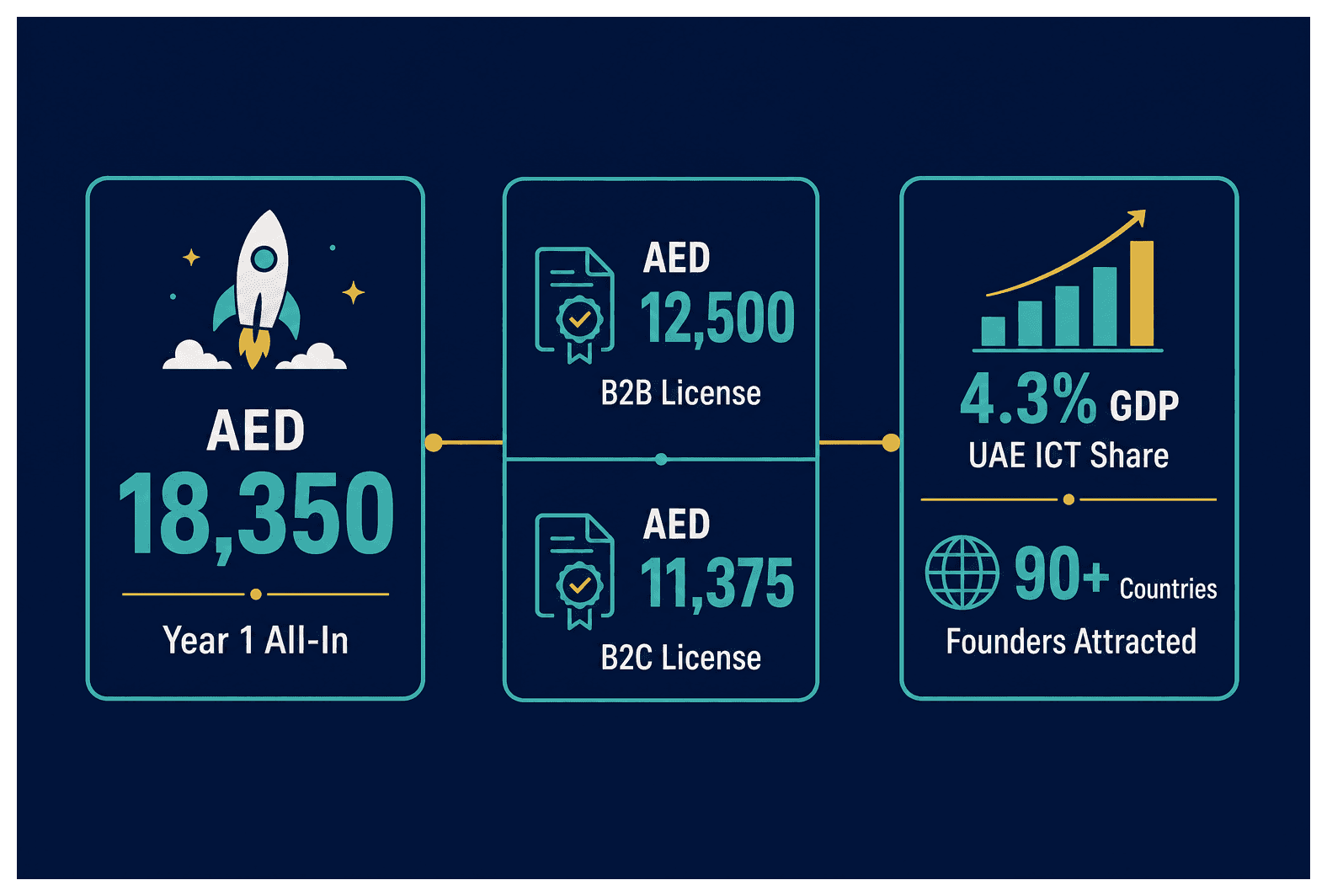
A software founder at Dubai South Business Hub Free Zone pays from AED 18,350 in year one: the ICT license from AED 12,500 plus one visa package. Recurring year-two costs are lower once one-off government fees drop away. Visas, accounting, and VAT registration are always separate line items.
Year-One Cost Table: One-Off and Recurring Line Items
The table above separates your one-off from recurring obligations. Here's what the base figures include and, critically, what they don't.
A mobile app studio with three activities (software development, IT consultancy, digital marketing) stays within the five-activity threshold and pays no additional activity fee. That's the base case. The all-in first-year figure of AED 18,350 covers the license and one visa package for a sole founder. Each additional visa adds cost.
What's not included in the AED 18,350 figure:
Mainland DET approval fees (if you later want UAE mainland commercial presence)
Secondary regulatory approvals for fintech, healthtech, or edtech activities
Accounting and audit retainer (a separate annual cost)
Corporate bank account minimum balance (set by the bank, not DSBH)
VAT registration if your taxable turnover exceeds AED 375,000 (Federal Tax Authority, 2026)
Corporate tax registration (compulsory for all UAE businesses)
What the License Fee Does and Does Not Cover
The DSBH ICT trade license gives you the legal right to operate your listed software activities within the free zone and internationally. It does not give you UAE mainland commercial presence, that requires a separate DET license.
Worth flagging for regulated software activities: if you're building fintech software, healthtech platforms, or edtech tools, DSBH licenses the activity and the named regulator approves it separately. Both steps are mandatory. A healthtech SaaS company that stores patient data must obtain a DHA digital health permit in addition to the DSBH ICT license, the free zone license alone is not sufficient to operate clinically.
Banking setup is also entirely separate. UAE banks set their own minimum balance requirements independently of the free zone. For detail on opening a Dubai bank account as a newly incorporated free zone company, review the banking and taxation guidance before you start the process.
Five Steps to Calculate Your Software Company Setup Cost in Dubai
To calculate your software company business setup cost in Dubai: confirm your activity list, choose your jurisdiction, price the license, add visa costs per person, then layer in compliance and banking. Each step affects the total materially, skipping one is how founders underbudget by thousands of dirhams.
Step 1: List Your Business Activities and Check the Activity Count
Start by identifying every revenue-generating service your software company will offer. Common ICT activities include custom software development, SaaS licensing, IT consultancy, cybersecurity services, and mobile app development. The DSBH base license covers up to five business activities; each activity beyond five costs AED 2,000.
A startup offering software development, cloud hosting management, IT training, UX design, and data analytics covers five activities, no surcharge. Adding e-commerce platform development as a sixth triggers an AED 2,000 additional activity fee. Check the DSBH business activities list to confirm how each ICT activity is described for licensing purposes before you finalise your list.
Step 2: Price Visas, Emirates ID, and Residency Costs
Visas are always an additional cost. Each investor or employee visa involves several sub-costs:
Visa application fee
Entry permit
Status change or in-country stamping
Emirates ID (governed by ICP)
Medical fitness test
For a sole founder with one visa, DSBH's first-year package starts from AED 18,350 total, meaning the visa component is the difference between AED 12,500 and AED 18,350. A founder planning to hire two software engineers in year one should budget for three visa packages total (one investor plus two employment visas) and factor in MoHRE-related employment contract registration costs for each employee. For a full breakdown of UAE residency visa options tied to your license, review the DSBH residency services page.
Step 3: Factor In Compliance, Accounting, and Tax Registration
VAT registration is mandatory once taxable turnover exceeds AED 375,000 in any 12-month period. The late registration penalty is AED 10,000 one-time, register before you cross the threshold, not after. A SaaS company billing AED 400,000 to UAE clients in its first year crosses the VAT threshold and must register before it files its first return.
Corporate tax registration is compulsory for all UAE businesses regardless of profit level. The late registration penalty is a AED 10,000 flat one-time charge, it doesn't compound monthly. Free zone companies can qualify as a Qualifying Free Zone Person (QFZP) for a 0% rate on qualifying income, but only if all four conditions are met: (1) adequate economic substance in the UAE, (2) qualifying income as defined in the CT law, (3) no election to apply the standard CT regime, and (4) audited financial statements prepared and maintained. Don't assume QFZP status applies automatically. Annual accounting and audit fees are a separate retainer, budget for a UAE-based accountant from day one (Federal Tax Authority, 2026).
Hidden Costs Most Software Founders Miss in Their Dubai Budget
The line items most software founders omit from their Dubai setup budget include corporate bank account minimum balances, accounting retainers, secondary regulatory approvals for fintech or healthtech activities, corporate tax registration, and VAT compliance costs. Each can add AED 5,000 to AED 20,000 or more annually depending on your business model.
Banking Minimums and Account Setup Timelines
UAE banks set their own minimum average balance requirements for corporate accounts, these are not set by DSBH and vary significantly by bank and account type. Account opening timelines range from two to eight weeks depending on the bank's due diligence process for newly incorporated free zone companies. Plan for this gap: your license can be issued in one business day, but you won't have a functioning bank account for several weeks after that.
A software company receiving USD payments from US clients needs a multi-currency account. Some UAE banks require a minimum monthly balance for corporate accounts (UNVERIFIED: confirm current figure with your chosen bank before publishing). For current guidance on bank account opening in Dubai, review the DSBH banking and taxation page before selecting your bank.
Secondary Regulatory Approvals for Regulated Software Activities
If your software falls into a regulated category, the DSBH ICT license is necessary but not sufficient. You'll need a secondary approval from the relevant authority. Here's how it breaks down by activity type:
Fintech (payment gateways, lending platforms, crypto wallets): CBUAE or VARA approval required in addition to the DSBH license
Healthtech (telemedicine, EMR systems, diagnostic tools): DHA approval required (Dubai Health Authority, 2026)
Edtech (accredited courses, credentialled learning platforms): KHDA approval required
A startup building a patient-facing telemedicine app must hold both the DSBH ICT license and a DHA digital health permit. The free zone license alone does not authorise clinical digital services. Secondary approval fees are not included in the DSBH license cost and vary by regulator (UNVERIFIED: confirm current fee schedules with each regulator before publishing).
Free Zone vs. Mainland: Which Structure Fits Your Software Company
A free zone ICT license suits a software company serving international clients or operating remotely. A Dubai mainland structure under DET is preferable if you need to contract directly with UAE government entities or open a retail-facing office. Both allow 100% foreign ownership, that advantage is not exclusive to free zones (Ministry of Economy, 2021).
When a Free Zone ICT License Is the Right Choice
A DSBH free zone license is well suited for:
SaaS companies and subscription software businesses
App developers and mobile software studios
IT consultancies serving clients outside the UAE
Software agencies whose clients are primarily in other free zones or overseas
A UK-based software consultancy expanding to the Gulf, for example, sets up at DSBH to serve regional clients across Saudi Arabia, Kuwait, and the UAE. Its free zone structure is efficient for cross-border service delivery. The license is issued in one business day, zero paid-up share capital is required, and 100% foreign ownership is available. Worth noting: free zone companies transacting with UAE mainland clients typically do so through a local commercial agent or branch arrangement, clarify this with a business setup advisor if mainland sales are part of your model.
When a Mainland DET License Adds Value
Mainland software companies licensed by DET can contract directly with UAE federal and emirate government entities without restrictions. That's the primary reason a software founder would choose mainland over free zone. A cybersecurity software firm bidding on Dubai Government contracts needs a mainland DET license, free zone status restricts direct government tendering in most cases.
The trade-off is cost. Mainland setup typically runs AED 30,000 to AED 50,000 in year one before visas, once DET fees, Ejari office lease registration, Chamber of Commerce membership, and notarisation are included. If your growth plan targets large UAE enterprise or government contracts, weigh that higher cost against the unrestricted commercial access it provides. If you're ready to start your business in Dubai, your jurisdiction choice should follow your client base, not the other way around.
VAT, Corporate Tax, and Compliance Costs You Cannot Ignore
UAE VAT applies at 5% on most software services supplied to UAE clients. Corporate tax runs at 9% on taxable income above AED 375,000. Free zone companies may qualify for 0% on qualifying income only if all four QFZP conditions are satisfied. Late registration for either tax carries an AED 10,000 one-time flat penalty.
VAT Obligations for Software and SaaS Businesses
UAE VAT at 5% applies to software services, SaaS subscriptions, IT consultancy, and app development supplied to UAE-resident clients. Here are the key thresholds:
Mandatory registration: AED 375,000 taxable turnover in any 12-month period
Voluntary registration: available from AED 187,500
Late registration penalty:AED 10,000 one-time, register before you cross the threshold
A SaaS platform charging AED 40,000 per month to UAE enterprise clients hits the AED 375,000 VAT threshold in month ten. The founder must register before that point to avoid the penalty. Software exported to non-UAE
References
Frequently Asked Questions