
Topic Summary
Base License Fee Starts at AED 12,500
A B2C e-commerce license at Dubai South Business Hub Free Zone begins at AED 12,500, with the first-year all-in cost for a sole founder with one visa running from AED 18,350. Zero paid-up share capital is required, making it accessible for bootstrapped founders.
Extra Activities Cost AED 2,000 Each
Your base package includes up to five business activities at no additional charge. Every activity you add beyond that threshold costs AED 2,000, so selecting the right activities before submission prevents costly paid amendments later.
E-commerce Is Not a Standalone License Category
The UAE classifies e-commerce by the nature of goods or services sold, not as a separate industry. A founder selling physical products needs a trading license, while a digital services platform may require a services or ICT license instead.
Free Zone Goods Are Duty-Suspended, Not Exempt
Import duty is deferred while goods remain inside the free zone, but it applies the moment products enter the UAE mainland market. This distinction is critical if your fulfilment model involves shipping directly to mainland customers.
Late Tax Registration Carries a AED 10,000 Penalty
A AED 10,000 penalty applies separately to both VAT and corporate tax late registration, meaning a founder who misses both deadlines faces a combined AED 20,000 exposure. Factoring compliance timelines into your setup plan from day one avoids this entirely.
Licenses Can Be Issued in One Business Day
Dubai South Business Hub Free Zone, launched in September 2025, processes and issues licenses within a single business day. The entire incorporation process can be completed remotely, with no in-person visit required.
Split Costs Into One-Off and Recurring Buckets
E-commerce setup costs divide into one-off charges at incorporation, such as the license fee, registration, and name reservation, and annual recurring fees like license renewal, visa renewal, and office packages. Mapping both categories upfront is essential for accurate cash-flow planning.
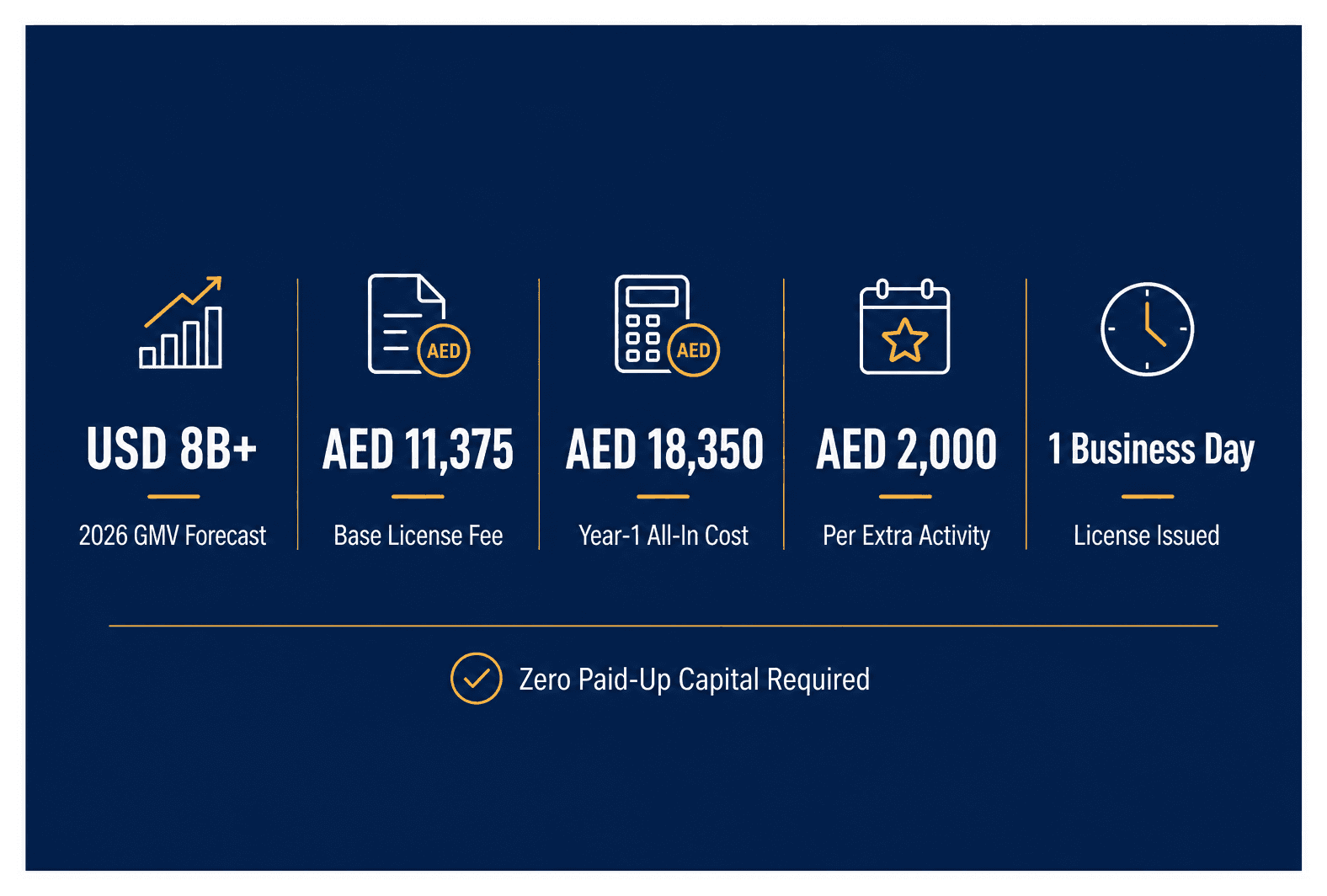
In 2026, Dubai's e-commerce sector is projected to surpass USD 8 billion in gross merchandise value (Statista, 2024). Dubai South Business Hub Free Zone licenses start from AED 12,500. First-year all-in cost for a sole founder with one visa runs from AED 18,350 [2]. Zero paid-up share capital is required [3]. Each activity beyond the first five costs AED 2,000 [4]. The AED 10,000 late registration penalty applies separately to both VAT and corporate tax [5]. Licenses are issued in one business day [6]. Most first-time founders still underestimate the full picture, so this article walks you through every business setup cost step: what you pay once, what recurs annually, what the business setup Dubai rules require, and exactly what your base license fee does not cover.
What Is Business Setup Cost in Dubai for E-commerce and Why It Matters
Business setup cost in Dubai for e-commerce is the total capital outlay required to legally incorporate, license, and activate an online retail or digital trading company. It covers a one-off license fee, government registration charges, and optional visa and office costs, each governed by specific business setup Dubai rules that determine your compliance baseline from day one. Getting the full picture before you commit prevents the shortfalls that catch most early-stage founders off guard.
How E-commerce Is Classified Under UAE Licensing Rules
E-commerce is not a standalone license category in the UAE. It's classified by the nature of the goods or services you sell, consistent with how ISIC Revision 4 treats digital channel sales as extensions of underlying trade activities, not as a separate industry class. A B2C operation selling physical goods falls under a trading license in Dubai; a platform delivering digital services may sit under a services or ICT license instead.
At incorporation, you must select the correct business activities in Dubai from the approved list. The first five activities are included in your package. Each activity beyond five costs AED 2,000 at Dubai South Business Hub Free Zone. Getting the activity list wrong creates a compliance gap that requires a paid amendment later, so it's worth spending time on this before you submit.
Activity selection also affects VAT treatment. A founder launching a direct-to-consumer skincare brand selling via their own website would select retail sale of cosmetics as the principal activity, then add e-commerce as a secondary activity, both within the five included slots, at no extra cost.
Why the Free Zone Route Is the Default Starting Point
Free zone incorporation requires zero paid-up share capital. That makes it genuinely accessible for bootstrapped founders who don't want to lock capital in a bank account before their first sale. Worth noting: 100% foreign ownership is available on both the mainland and in free zones under current UAE law, so ownership structure alone isn't a reason to choose one route over the other.
One distinction that matters more than ownership: free zone goods are duty-suspended, not duty-exempt. Import duty is deferred within the free zone, but it applies when goods enter the UAE mainland market. That's a meaningful difference if your fulfilment model involves shipping to mainland customers directly.
Dubai South Business Hub Free Zone launched in September 2025 and issues licenses in one business day. A founder based in Europe setting up a dropshipping operation with no physical UAE inventory can incorporate without visiting in person, the entire process runs remotely from a completed application.
Business Setup Cost Steps: One-Off vs Recurring Fees Explained
E-commerce business setup costs in Dubai split into two buckets: one-off charges paid at incorporation (license fee, registration, name reservation) and recurring annual fees (license renewal, visa renewal, office package). Understanding which costs repeat every year is essential for cash-flow planning and is a core part of sequencing your business setup cost steps correctly.
One-Off Costs You Pay at Incorporation
The B2C e-commerce license starts from AED 12,500, paid once at setup. A standard trading e-commerce license starts from AED 12,500. Trade name reservation is included in the Dubai South Business Hub Free Zone package, so there's no separate line item for that. MOA drafting and notarisation fees: confirm the current figure directly with DSBH at the time of application, as these can vary.
Critically, zero paid-up share capital is required. No bank deposit certificate is needed to satisfy incorporation rules, which removes a common barrier for first-time founders. A solo founder setting up a B2C fashion e-commerce store at Dubai South Business Hub Free Zone pays from AED 18,350 in year one, covering the license and one residence visa, then a lower renewal figure from year two onward.
E-commerce Business Setup Cost Breakdown: One-Off vs Recurring
Cost Item | One-Off Cost (Year 1) | Recurring Cost (Annual / Biennial) |
|---|---|---|
License Fee | From AED 12,500 | License renewal: from AED 12,500 per year |
Trade Name Reservation | Included in DSBH package | Corporate tax filing: varies by accountant |
MOA / Incorporation Documents | Confirm current fee with DSBH | Visa renewal (2-year cycle): additional cost |
First-Year All-In (sole founder, 1 visa) | From AED 18,350 | Emirates ID renewal: additional cost |
Paid-Up Share Capital | AED 0, no bank deposit required | Medical insurance per visa holder: additional, legally mandatory |
Activity Beyond First Five | AED 2,000 each (one-off per addition) | Office / flexi-desk package renewal: confirm with DSBH |
Recurring Annual Costs to Budget From Year Two
Annual license renewal mirrors the initial license cost, budget AED 12,500 per year depending on your license type. Visa renewal follows a two-year cycle; Emirates ID renewal is a separate cost on top of that. Neither is bundled into the base license renewal fee.
Office or flexi-desk package renewal: varies by package, confirm current pricing with DSBH
Accounting and bookkeeping:mandatory under UAE corporate tax law; outsourced cost varies by transaction volume
Corporate tax registration: required for all UAE entities regardless of profit level; late registration triggers a one-time flat penalty of AED 10,000 (Federal Tax Authority, 2023)
By year two, a founder with one visa is budgeting for license renewal, visa renewal on the two-year cycle, and a mandatory corporate tax filing, three separate line items that first-year cost estimates rarely capture in full.
What the Base License Fee Does Not Cover
Not included in your base license fee:
Visas, always an additional cost, never described as included
Medical insurance per visa holder, legally required, purchased separately from a UAE-licensed insurer
Bonded warehousing and customs integration, Dubai South Business Hub Free Zone does not provide these services
Payment gateway setup and merchant account fees, a commercial cost, not a licensing cost
Website localisation, Arabic language compliance, and consumer protection obligations under UAE e-commerce regulations
Dubai South Business Hub Free Zone licenses start from AED 12,500.
Step-by-Step Guide to Business Setup Cost Steps for E-commerce in Dubai
The business setup cost steps for an e-commerce company in Dubai run from activity selection and trade name reservation through license issuance, visa application, and bank account opening. Each step carries a distinct cost or timeline. Completing them in the correct sequence avoids duplicate fees and compliance gaps under business setup Dubai rules.
Step 1: Select Your Business Activities and Reserve Your Trade Name
Start by choosing your principal e-commerce activity and up to four additional activities within the included allocation. A founder selling electronics online, for example, selects "retail sale of electronics via internet" as the principal activity and adds "import of electronics" as a secondary activity, both within the five included slots, at no extra charge.
Each activity beyond five costs AED 2,000. So get the list right the first time. Trade names must comply with UAE naming rules: no offensive terms, no names of ruling families, and the name must reflect your activity. Check company name availability before you commit to a brand identity, amendments after registration carry a fee. Activity selection also determines which regulators, if any, must approve your operation alongside the DSBH license.
Step 2: Submit Your Application and Receive Your License
Dubai South Business Hub Free Zone issues licenses in one business day from a completed application. Required documents typically include passport copies, your proposed activity list, trade name, and MOA details, confirm the current checklist with DSBH directly. Zero paid-up share capital means no bank deposit certificate is needed at this stage.
For regulated activities, selling food products, health supplements, or financial products online, the process has two parts. DSBH licenses the activity; the relevant named regulator approves it separately. Both steps are required before you go live. A founder selling certified organic food online receives their DSBH e-commerce license in one business day, then separately applies to the relevant food safety authority for product approval.
Step 3: Apply for Residency Visas and Open Your Bank Account
Visa applications are submitted after license issuance. They are always an additional cost, separate from the license fee, always. Each visa holder requires an entry permit, status change (if already in-country), medical fitness test, Emirates ID, and medical insurance. You can manage UAE residency visa applications through DSBH's residency services.
Bank account opening in the UAE requires a valid trade license, passport, Emirates ID, and a business plan. Timelines vary by bank. Corporate tax registration with the Federal Tax Authority (tax.gov.ae) must be completed within the prescribed deadline, late registration triggers a one-time flat penalty of AED 10,000. That's not a monthly charge; it's a single fixed penalty, but it's entirely avoidable.
Business Setup Dubai Rules That Govern E-commerce Licensing
Business setup Dubai rules for e-commerce require a valid trade license matching your activity, VAT registration when turnover exceeds AED 375,000, and corporate tax registration for all entities regardless of turnover. Regulated product categories, including health supplements, financial services, and food, require additional approvals from the relevant named UAE regulator beyond the free zone license itself.
VAT Rules for Online Sellers in the UAE
VAT registration is mandatory when taxable turnover exceeds AED 375,000 per annum. Voluntary registration is available from AED 187,500. The standard VAT rate is 5% on most goods; zero-rating applies to qualifying exports and certain categories. Late VAT registration triggers a penalty of AED 10,000, separate from the corporate tax late registration penalty.
A B2C e-commerce store reaching AED 400,000 in annual sales must register for VAT with the Federal Tax Authority, charge 5% on eligible sales, and file quarterly returns, regardless of its free zone location. The free zone location does not create a VAT shelter for B2C sales to mainland customers. DSBH is not a designated zone and carries no designated-zone VAT benefit.
Corporate Tax Obligations for E-commerce Companies
UAE corporate tax applies at 9% on taxable income above AED 375,000 for financial years starting on or after 1 June 2023 (UAE Cabinet, 2022). All UAE-incorporated entities must register for corporate tax regardless of profit level. Late registration: one-time flat penalty of AED 10,000.
Qualifying Free Zone Person (QFZP) status may allow a 0% rate on qualifying income only, but four conditions must all be met simultaneously:
Adequate economic substance in the free zone
Qualifying income as defined under the decree-law
No mainland permanent establishment
Compliance with transfer pricing rules
An e-commerce company earning AED 500,000 in net profit pays 9% corporate tax on AED 125,000 (the amount above the threshold), a liability of AED 11,250, unless it meets all four QFZP conditions. Never describe any UAE business structure as tax-free.
Hidden and Overlooked Costs in E-commerce Company Formation
Beyond the headline license fee, e-commerce founders in Dubai regularly underestimate costs for medical insurance, accounting software, payment gateway integration, and Arabic-language consumer-facing compliance. These costs don't appear in standard license quotations but are real obligations under UAE law and business setup Dubai rules.
Operational Costs That Start on Day One
Medical insurance per visa holder: mandatory under UAE law. Cost varies by age, nationality, and coverage tier. (UNVERIFIED: budget figure. Confirm before publishing.)
Accounting and bookkeeping: mandatory under UAE corporate tax law. Financial records must be maintained; outsourced monthly bookkeeping costs vary by transaction volume.
Payment gateway fees: platforms charge per-transaction percentages plus monthly minimums, a recurring commercial cost not captured in the license fee.
Website hosting, domain, and SSL: recurring annual costs outside the scope of any licensing package.
Visa allocations vary by free zone and package.
Regulatory and Compliance Costs for Specific Product Categories
Health supplements, cosmetics, and food products require product registration with the relevant UAE regulatory authority. DSBH licenses the activity; the named regulator approves each product separately, this dual-approval rule is non-negotiable.
Electronics must carry MoIAT conformity marks before sale in the UAE market.
Financial products or payment services require Central Bank of the UAE approval, DSBH cannot substitute for this approval.
Consumer protection regulations require Arabic-language terms and conditions, a clear returns policy, and accurate product descriptions, non-compliance carries fines.
An e-commerce store selling protein supplements in the UAE must register each SKU with the relevant food and health authority before listing it for sale, a process that runs parallel to, not through, the free zone license.
How to Reduce Your Total Business Setup Cost Steps Without Cutting Corners
You can reduce total business setup cost steps in Dubai for e-commerce by starting with the minimum viable activity list, taking only the visas you need in year one, using a flexi-desk rather than a dedicated office, and registering for VAT and corporate tax on time to avoid the AED 10,000 penalties each. Sequence matters as much as price.
Start Lean: Minimum Viable License Configuration
Select only the activities you need on day one. You can add activities later, but each addition beyond the first five costs AED 2,000, so over-engineering the list at setup adds unnecessary upfront cost. Apply for only the visas you need immediately; your visa allocation can increase as the team grows.
A flexi-desk or shared workspace package satisfies the registered address requirement at lower cost than a dedicated office. Use the business setup cost calculator to model your exact configuration before committing. Dubai South Business Hub Free Zone licenses start from AED 12,500. A solo founder launching a Shopify-based store starts with the B2C license, one visa, and a flexi-desk, reaching a first-year all-in from AED 18,350 and deferring additional activities and visas to year two.
Build a Compliance Calendar to Avoid Penalty Costs
Corporate tax registration: complete within the Federal Tax Authority deadline, one-time flat penalty of References
Frequently Asked Questions