
Topic Summary
Know Your One-Off Setup Fees Upfront
At Dubai South Business Hub Free Zone, a sole founder pays from AED 18,350 in year one, covering the license from AED 12,500 and one residency visa. These incorporation costs are sunk once and do not repeat, so they should never be confused with what you owe in year two.
License Renewal Hits Every Single Year
The license renewal fee returns annually at the same tier rate as your original license issuance. Founders who budget only for year-one costs are often blindsided when this invoice arrives twelve months later.
Visa Costs Are Never Included in the License Price
Investor and employee visas are always an additional line item, both at setup and at renewal every two to three years. Annualising these costs across your budget cycle gives you a more accurate picture of true annual spend.
Emirates ID and Medical Fees Recur at Every Renewal
Each visa renewal cycle triggers mandatory Emirates ID renewal and medical fitness fees on top of the visa cost itself. These are government-mandated charges that cannot be avoided or bundled away.
VAT and Corporate Tax Deadlines Carry Flat Penalties
VAT registration becomes compulsory once taxable turnover exceeds AED 375,000, and missing that threshold triggers a flat AED 10,000 penalty. Late corporate tax registration carries its own separate AED 10,000 one-time flat penalty, making compliance calendar management a genuine financial priority.
Model a Full Two-Year Cash Commitment Before Signing
Mapping one-off setup costs against recurring annual costs side by side reveals the true working capital requirement for your first two years of operation. Skipping this exercise is the single most common reason founders underfund their Dubai entity.
In 2026, a sole founder can start a business at Dubai South Business Hub (DSBH) Free Zone for as little as AED 18,350 in year one. That figure covers the license and one residency visa. The license itself starts from AED 12,500 and is issued within one business day. Zero paid-up share capital is required. Up to five business activities are included in the base fee. Yet many first-time founders arrive with only that AED 18,350 figure in mind, and the renewal invoice twelve months later catches them completely off guard.
This article breaks down every material business setup cost fee you pay once at incorporation, maps those costs against the annual running costs that repeat every year, flags what is never included in the license price, and shows you how to model a realistic two-year cash commitment before you sign anything.
What Are Business Setup Cost Fees in Dubai and Why the Distinction Matters
Business setup cost fees in Dubai are the one-off charges paid at incorporation: license issuance, registration, and name reservation. Annual running costs are the recurring fees paid every year to keep that company active. Confusing the two causes founders to underfund year two and underestimate the true cost of operating in Dubai. The distinction is not just semantic; it affects how much working capital you need on day one versus how much you need to reserve every twelve months.
One-Off Setup Fees: What You Pay Once
At DSBH, the business setup cost fees you pay once at incorporation include:
License issuance fee from AED 12,500
First-year all-in total for a sole founder with one visa from AED 18,350
Each business activity beyond the first five costs AED 2,000 per activity
Zero paid-up share capital required, no minimum deposit at incorporation
Trade name reservation and registration folded into the DSBH package, no separate government name fee at the free zone level
License issued within one business day of payment confirmation
Consider a consultant launching a single-activity management advisory firm at DSBH in 2026. She pays AED 18,350 in year one: AED 12,500 for the license plus the residency visa cost. She does not pay that license issuance fee again in year two. That is the core logic of one-off fees: they are sunk at incorporation and do not recur.
Recurring Annual Costs: What Comes Back Every Year
The costs that return every year are a different category entirely. Visa costs are always an additional line, they are never included in the license price. The same consultant in year two faces:
License renewal fee (budget at the same license-tier rate as year one)
Visa renewal if her two-year cycle falls due, investor and employee visas renew every two or three years depending on visa type; annualise the cost for budget planning
Emirates ID renewal and medical fitness fees, mandatory at each visa renewal cycle
Office or flexi-desk package fees, if applicable, renewing annually
Accounting, bookkeeping, and corporate tax filing fees, recurring operational costs not included in the DSBH license fee
Two compliance thresholds matter here. VAT registration becomes mandatory once taxable turnover exceeds AED 375,000 (Federal Tax Authority, 2026). Miss that registration deadline and you face a flat AED 10,000 penalty. Corporate tax late registration carries its own AED 10,000 one-time flat penalty, not a monthly charge.
Business Setup Cost Fees vs Annual Running Costs at Dubai South Business Hub Free Zone
Fee Item | One-Off Setup Costs (Year One) | Annual Recurring Costs (Year Two Onwards) |
|---|---|---|
License issuance fee | Paid once at incorporation; issued within one business day | License renewal fee applies annually at the same tier rate |
Visa issuance per person (always additional) | Paid at incorporation for each person sponsored; never included in license price | Visa renewal fees recur every 2-3 years per person; annualise for budgeting |
Emirates ID issuance (per visa) | One-off government fee paid per visa at issuance; governed by ICP | Emirates ID renewal due at each visa renewal cycle |
Medical fitness fee (per visa) | Mandatory at initial visa issuance for each applicant | Required again at each visa renewal cycle |
Trade name reservation and registration | Folded into the DSBH package; no separate government name fee at free zone level | Not a recurring charge, name is registered once at incorporation |
License renewal (annual) | Not applicable in year one, this is a recurring charge from year two | Recurring annually; budget at the same license-tier rate as year one |
Visa renewal (per cycle, typically every 2-3 years) | Not applicable at inception, renewal cycle begins after initial issuance period | Full visa packet (medical, Emirates ID, ICP fee) repeats at each renewal cycle |
The Cost Breakdown Table: One-Off vs Recurring Fees at a Glance
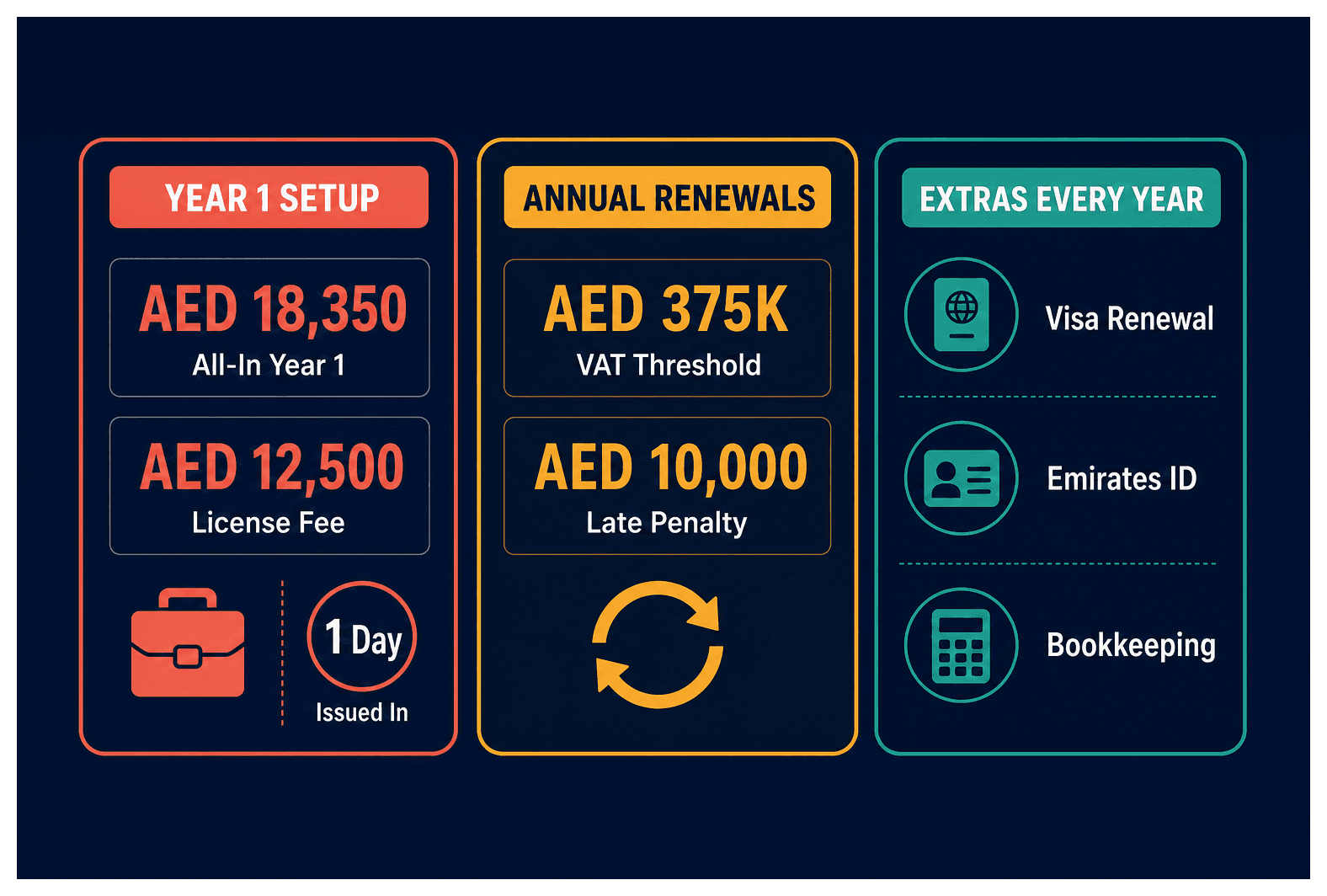
A Dubai free zone company carries two distinct cost layers: one-off setup fees paid at incorporation (license, registration, visa issuance) and recurring annual fees (license renewal, visa renewal, Emirates ID, accounting). The table above separates both layers. What neither category covers is equally important to understand before you budget.
Reading the Table: What Is and Is Not Included
The DSBH license fee covers the license itself and the name registration. It does not cover everything a trading or service business needs to operate. Items outside any DSBH fee include:
Bonded warehousing, DSBH does not provide bonded warehousing or customs integration
Customs integration services
Regulated-activity approval fees charged by third-party regulators (DHA, KHDA, Central Bank)
PRO fees for external government transactions
Corporate bank account opening charges
Worth flagging: a trading company importing goods through the Dubai South airport logistics corridor still pays standard UAE customs duty on mainland clearance. DSBH's free zone status suspends duty only while goods remain in the free zone storage area, not on mainland clearance. DSBH is not a designated zone and carries no designated-zone customs or VAT benefit.
Why Visa Costs Are Always a Separate Line
Residency visa costs flow through ICP (Federal Authority for Identity, Citizenship, Customs and Port Security) and GDRFAD. These are government fees, not free zone fees. The components in each visa packet include:
Visa application and status change fee (ICP tariff)
Medical fitness examination fee
Emirates ID biometrics and issuance fee
Entry permit and stamping fees
A founder who sponsors two employees in year one will see three visa packets, one investor, two employee, each with its own medical, ID, and ICP fee, all added on top of the AED 18,350 base figure. The AED 18,350 year-one figure is for one visa only. For UAE residency visa package pricing, check the DSBH residency services page for current government fee schedules.
Business Setup Dubai Steps: A Numbered Guide from Application to License
Setting up a company at Dubai South Business Hub Free Zone takes five core steps: choose your business activities, reserve your trade name, submit your application with supporting documents, pay the license and visa fees, and receive your license, typically within one business day of payment confirmation. Visa processing follows as a separate workflow. Here is how each business setup Dubai step works in practice.
Step 1: Choose Your Business Activities and Check Name Availability
Start by selecting your business activities from the business activities list on the DSBH portal. Up to five activities are included in the base license fee. Each activity beyond five costs AED 2,000. Match your operations to the approved activity codes carefully, the activity description on your license defines what you can legally do.
An e-commerce founder selling consumer electronics selects "Retail Sale via Internet" as her primary activity and adds "General Trading" as a second. Both fall within the five-activity base, so no additional AED 2,000 charge applies. Once activities are confirmed, check company name availability before submitting. Names must comply with UAE naming conventions: no offensive terms, no names of ruling families, and no names of government bodies.
Step 2: Submit Documents, Pay Fees, and Receive Your License
The standard document set is minimal. DSBH does not require a local sponsor or local service agent for free zone companies. Required documents include:
Passport copy (all pages with a valid visa or entry stamp)
Passport-size photograph
Completed application form
Zero paid-up share capital means no bank deposit proof is needed at the incorporation stage. A software consultancy submitting a passport copy and completed form on a Monday morning typically receives its license by Tuesday. The founder then opens the visa workflow, which runs in parallel with bank account applications.
Important for regulated activities: DSBH licenses the legal entity and the activity on its register. A separate named regulator, DHA for healthcare, KHDA for education, the Central Bank of the UAE or SCA for financial services, must approve the actual practice of that activity independently. Both approvals are required before you can operate. Budget the regulator's fees and timelines separately from the business setup cost fees at DSBH.
Annual Running Costs Every Dubai Company Owner Must Budget For
Annual running costs for a Dubai free zone company typically include license renewal, visa renewal cycles, Emirates ID renewal, accounting and bookkeeping, corporate tax filing, and, above AED 375,000 in taxable turnover, VAT compliance. These costs recur regardless of whether the business generates revenue in that year. Knowing the business setup cost fees is only half the picture; the recurring layer is where most founders underestimate their cash commitment.
Tax Compliance Costs: VAT, Corporate Tax, and Registration Deadlines
VAT registration is mandatory once taxable turnover exceeds AED 375,000. Voluntary registration is available below that threshold and can be strategically useful for input tax recovery. Late VAT registration carries an AED 10,000 penalty (Federal Tax Authority, 2026). Free zone companies are subject to UAE VAT and corporate tax under the same thresholds as mainland companies.
Corporate tax at 9% applies to taxable income above AED 375,000 for non-Qualifying Free Zone Persons. QFZP status, which can reduce the effective rate on qualifying income, requires all four of the following conditions to be met simultaneously:
Adequate substance in the free zone, genuine operations, not a shell
Qualifying income, income from specific permitted sources
No mainland permanent establishment, no taxable presence on the mainland
Audited accounts, annual audited financial statements required
A free zone trading company with AED 500,000 in annual revenue that misses its corporate tax registration deadline pays a flat AED 10,000 penalty on top of normal filing costs. That is a one-time charge, not a monthly recurring fee, but it is entirely avoidable with a calendar reminder set at the 10-month mark.
Staffing, Payroll, and MoHRE-Related Annual Costs
Each employee you hire adds a recurring cost layer. Work permits and residency visas are annual or biennial costs. MoHRE-registered employment contracts and WPS (Wages Protection System) compliance are mandatory for any salaried employee (Ministry of Human Resources and Emiratisation, 2026). For labour compliance queries, the MoHRE inquiry system handles employer and employee enquiries online.
End-of-service gratuity accrues at a minimum of 21 calendar days' basic salary per year of service for the first five years. A company with three employees on AED 8,000 basic salary accrues roughly AED 50,400 in gratuity liability over three years, a balance sheet item that builds annually even if it is not paid until termination.
Regulated Activities: What the License Covers and What the Regulator Approves Separately
For regulated activities in Dubai, DSBH licenses the legal entity and the activity on its register. A separate named regulator then approves the actual practice of that activity. Both approvals are required before you can operate. The regulator's fees and timelines are independent of the free zone license cost and must be budgeted as a distinct line in your business setup cost fees model.
Healthcare, Education, and Financial Services: Dual-Approval Explained
The dual-approval rule applies across three major regulated sectors:
Healthcare: DSBH licenses the entity; the Dubai Health Authority (DHA) approves the clinical activity, facility, and professionals separately. DHA fees and inspection timelines are additional to the DSBH license cost. For a healthcare license in Dubai, both approvals are required.
Education and training: DSBH licenses the entity; KHDA (Knowledge and Human Development Authority) approves the curriculum, facility, and instructors.
Financial services: DSBH licenses the entity; the Central Bank of the UAE governs lending and insurance activities; SCA governs securities activities.
A telemedicine startup licenses its entity at DSBH (AED 12,500 license fee, one-day issuance) and simultaneously submits a DHA facility and practitioner approval application. The DHA process runs on its own timeline and fee schedule, which can add weeks and several thousand dirhams to the pre-launch phase. Never treat the DSBH license as sufficient for regulated practice.
ICT and Professional Services: Lighter Regulatory Load, Same Dual-Step Logic
An ICT license in Dubai for technology activities generally carries lighter third-party regulatory requirements than healthcare or financial services. But data protection compliance under UAE Federal Decree-Law No. 45 of 2021 (the UAE PDPL) may apply if your company processes personal data of UAE residents.
DET (Department of Economy and Tourism) oversees commercial activity standards on the mainland. Free zone activities are governed by DSBH with reference to federal law. Always verify with DSBH which activities on your license require a named regulator's secondary approval before finalising your launch timeline and budget.
How to Model Your Two-Year Cash Commitment Before You Apply
To model a realistic two-year cost, add your one-off setup fees (year one only) to your recurring annual costs (years one and two), then add visa costs for every person you plan to sponsor and any regulated-activity approval fees. Use the business setup cost in Dubai calculator to stress-test the figures before committing to a license tier or activity list.
Year-One vs Year-Two Cost Comparison: A Practical Model
Here is how the two years compare for a sole founder with one visa and a single-activity license:
Year one: License issuance from AED 12,500, visa issuance, Emirates ID, medical fitness, registration, total from AED 18,350
Year two: License renewal, visa renewal if the two-year cycle falls due, Emirates ID renewal, accounting retainer, corporate tax filing, VAT compliance if above AED 375,000 threshold
Adding a sixth activity in year two costs AED 2,000 per additional activity
Zero paid-up capital means no trapped cash in either year
In year two, that sole founder pays license renewal plus accountant fees, likely AED 14,000 to AED 18,000 depending on the accounting package chosen. Her two-year total runs roughly AED 32,000 to AED 36,000 before any regulated-activity or staff costs. Year two is typically lower in cash outflow than year one because the one-off setup fees do not recur. But do not assume it is dramatically cheaper without modelling each line item.
Banking Setup: An Often-Overlooked Cost Layer
Corporate bank account opening is not included in any free zone license fee. It is a separate process with
References
Frequently Asked Questions