
Topic Summary
License Fee Is Just the Starting Point
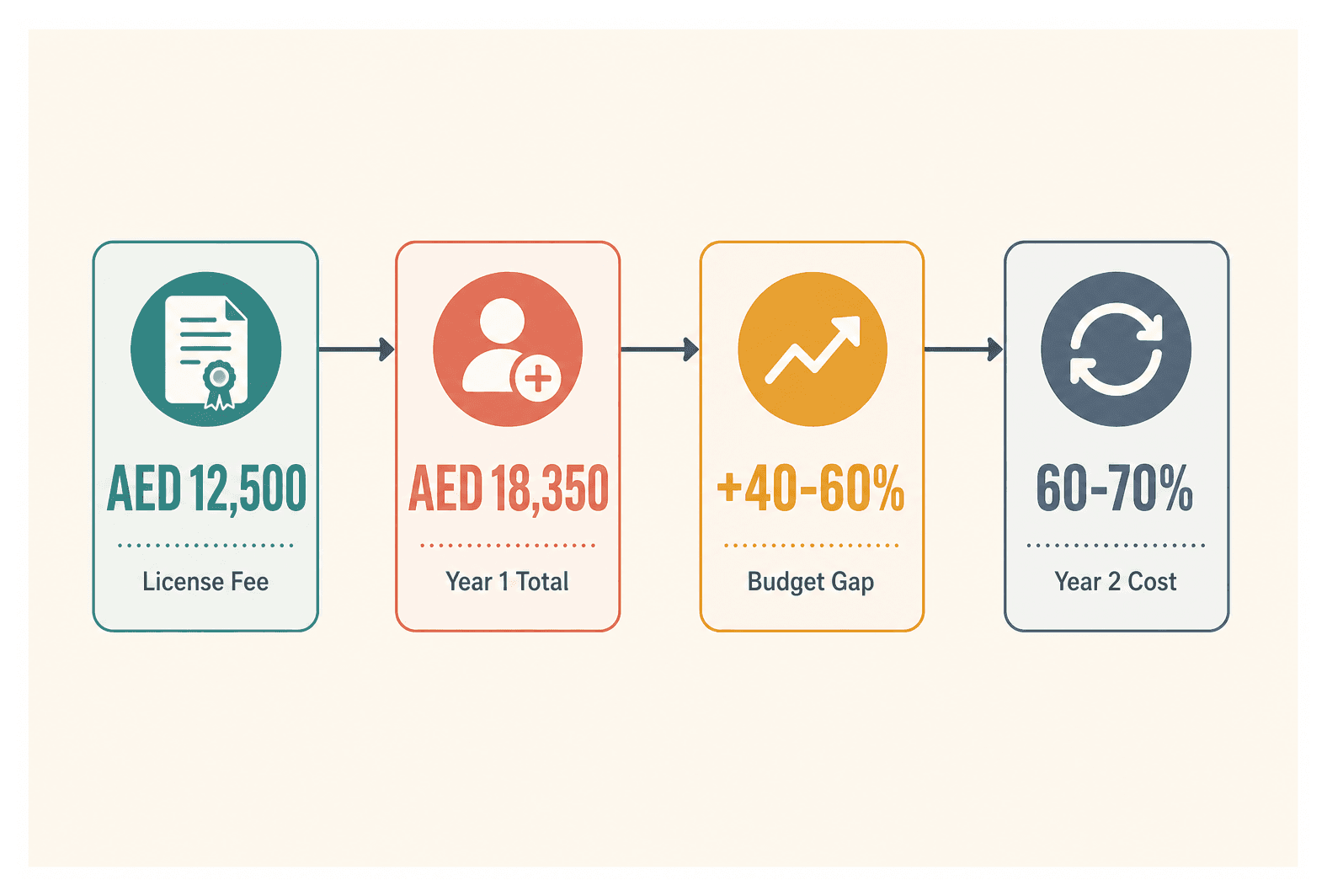
A trade license at Dubai South Business Hub Free Zone starts from AED 12,500, but a sole founder's true first-year cost begins at AED 18,350. Founders who budget only for the license routinely face a 40 to 60 percent shortfall before a bank account is even opened.
Visa and Emirates ID Add Significant Costs
The AED 5,850 gap between the license fee and the all-in first-year price is largely made up of visa processing, Emirates ID biometrics, and registered address fees. These are mandatory government charges that no headline package price can eliminate.
Separate One-Off Costs From Recurring Ones
One-off costs include incorporation fees, trade name reservation, initial visa stamping, and Emirates ID setup, while recurring costs include license renewal, visa renewal, and accounting fees. Modeling both buckets separately before you apply is the single most useful budgeting step you can take.
Year Two Costs Are Still Substantial
Annual renewal expenses typically run 60 to 70 percent of year-one spend, catching many founders off guard when working capital runs short. Recurring costs like registered address, visa renewals, and accounting fees return every one to three years depending on the item.
Banking and Accounting Fees Are Often Overlooked
Bank account opening carries a one-off administration fee that varies by institution, and accounting or bookkeeping services typically cost AED 5,000 to AED 15,000 per year. VAT return filing adds a further quarterly obligation for most registered businesses.
Zero Share Capital Helps, But Doesn't Reduce Total Costs
DSBH Free Zone requires no paid-up share capital and issues licenses in one business day, which are genuine accessibility advantages. However, neither benefit reduces the mandatory government fees, visa charges, or recurring costs that make up the full invoice.
In 2026, a sole founder who sets up a company at Dubai South Business Hub (DSBH) Free Zone pays from AED 18,350 in year one, yet the trade license itself starts at just AED 12,500. That AED 5,850 gap, and everything layered on top of it, covers costs that most comparison guides never mention: visas, Emirates ID, office address, bank account fees, VAT registration, corporate tax registration, and annual renewals. This article breaks down every material business setup cost in Dubai sitting above the license fee, separates one-off from recurring charges, and flags exactly what no headline package price includes, so you can budget accurately before you commit.
What Are Business Setup Costs in Dubai and Why the License Is Only the Start
Business setup costs in Dubai cover every mandatory payment required to incorporate, staff, and operate a company legally, not just the trade license fee. These include visa fees, Emirates ID, office or flexi-desk rent, bank account opening deposits, VAT registration, and annual renewal charges, which often exceed the license fee itself in year one. If you're planning to set up a company in a Dubai free zone, you need a full picture of every line item before you sign anything.
The Gap Between the Headline Price and the Real Invoice
At DSBH Free Zone, the license starts from AED 12,500, yet the all-in first-year cost for one sole founder plus one visa starts from AED 18,350. That gap is made up of government fees, visa processing, Emirates ID, and the registered address or flexi-desk.
Here's the reality: founders who budget only for the license routinely face a 40 to 60 percent shortfall before they even open a bank account. Take a sole founder launching a consulting firm at DSBH who budgets AED 12,500 for the license. The actual invoice lands closer to AED 18,350 once visa and Emirates ID costs are added, and that's before any banking or accounting fees touch the total.
One practical upside: DSBH issues licenses in one business day, and zero paid-up share capital is required. Speed and accessibility are genuine advantages. But neither of those facts changes what you owe in total during year one.
One-Off vs. Recurring: How to Categorise Every Line Item
Splitting your costs into two buckets is the single most useful thing you can do before you apply. One-off costs hit only in year one: incorporation fees, trade name reservation, notarisation (where required), initial visa stamping, and Emirates ID biometrics. Recurring costs return every year or every two to three years: license renewal, visa renewal, Emirates ID renewal, registered address, accounting, and audit where required.
Year-two cash requirements are often 60 to 70 percent of year-one spend. Founders who don't model this separately run short on working capital at renewal time. Use the cost of setting up a company in Dubai calculator to map both buckets before you commit.
Dubai Free Zone Company Cost Breakdown: One-Off vs. Recurring
Cost Item | One-Off Cost (Year One) | Recurring Cost (Annual or Per Cycle) |
|---|---|---|
Trade License | From AED 12,500 at DSBH | Annual renewal mirrors the initial license fee |
Company Incorporation and Registration | One-time government registration fee paid at setup | Registered address or flexi-desk continuation fee (annual) |
Trade Name Reservation | One-time fee at incorporation; check availability first | Visa renewal per holder (every 2 to 3 years per cycle) |
Initial Visa Stamping and Emirates ID | Entry permit, status change (if applicable), biometrics, and stamping per person | Emirates ID renewal (tied to visa duration; every 1 to 3 years) |
Medical Fitness Test | Required per applicant at a government-approved health centre | Accounting and bookkeeping (AED 5,000 to AED 15,000 per year, estimated) |
Bank Account Opening | One-off administration fee (varies by bank) | VAT return filing (quarterly for most registered businesses) |
Visa, Emirates ID, and Residency Costs for You and Your Team
Visas are always an additional cost and are never included in a DSBH license package. Each investor or employee visa carries government fees for the entry permit, status change, medical fitness test, Emirates ID biometrics. Budget these per person, per visa cycle, separately from the license fee. Your UAE residency visa application sequence matters as much as the cost itself.
Investor Visa: What Each Application Actually Costs
An investor visa involves five distinct steps, each with its own government fee:
Entry permit (issued by GDRFA Dubai, which governs residency stamping)
Status change (required if you're already in-country on a tourist or other visa)
Medical fitness test at a government-approved health centre
Emirates ID biometrics and card issuance (governed by the ICP)
Residency visa stamping in the passport
A founder already on a tourist visa in Dubai needs that status-change step before the investor visa is stamped. It's an extra government fee that first-time applicants frequently miss, and skipping it creates a compliance issue with GDRFA Dubai (gdrfad.gov.ae, 2026).
Emirates ID and Medical Fitness: The Hidden Per-Person Charges
Every visa holder must obtain an Emirates ID. The application fee is paid to the ICP and varies by visa duration (icp.gov.ae, 2026). A mandatory medical fitness test (blood test and chest X-ray) is required before residency stamping and is conducted at a government-approved health centre. These are not optional steps.
For a founder sponsoring two employees in addition to their own investor visa, that's three separate Emirates ID applications and three medical tests, each charged individually. Renewal of the Emirates ID is required every one to three years depending on the visa term. Budget these per person, not per company.
Office, Banking, and Operational Costs That Appear After Incorporation
After incorporation, a Dubai free zone company typically needs a registered address or flexi-desk, a UAE corporate bank account, and basic accounting services. Banks may require minimum account balances or opening deposits. These operational costs are separate from the license and visa fees and recur annually or per banking cycle. They're also the costs most founders discover only after the license is issued.
Registered Address and Flexi-Desk: What Free Zone Packages Cover
Most free zone packages include a registered address or flexi-desk allowance. Before signing, confirm exactly what's covered: how many hours of desk access, what correspondence address is provided, and whether any physical space is included.
If your business activities require a physical warehouse or retail premises, those are separate lease agreements not covered by any license package. Worth flagging: DSBH does not provide bonded warehousing or customs integration. Founders needing those services must arrange them independently. An e-commerce founder at DSBH, for example, uses the registered address for official correspondence but contracts a third-party fulfilment warehouse separately for inventory storage. Two distinct budgets, two distinct contracts.
Corporate Bank Account Opening: Minimum Deposits and Timelines
UAE banks typically require a minimum monthly balance ranging from AED 10,000 to AED 50,000 for SME corporate accounts. Some charge a monthly fee if the balance falls below the threshold (Central Bank UAE, 2026). Account opening timelines vary from one week to six weeks depending on the bank's KYC process and the nature of your business activities.
A tech startup founder discovered that a bank's AED 25,000 minimum balance requirement effectively locked up working capital for the first quarter, a cost not reflected in any license-fee comparison. Budget for the minimum balance as a cash reserve, not just a one-off deposit. Bank account opening in Dubai support can help you select the right bank and prepare documents correctly.
Seven Cost Layers Every Founder Must Budget Before Day One
The seven cost layers for a Dubai company beyond the license fee are: (1) trade license fee, (2) visa and Emirates ID fees, (3) medical fitness tests, (4) registered address or office lease, (5) corporate bank account minimum balance, (6) accounting and bookkeeping, and (7) VAT and corporate tax registration and compliance costs. Map all seven before you apply.
Step 1 Through Step 4: Incorporation to Banking
Trade license fee. At DSBH, from AED 12,500. Each activity beyond the first five costs AED 2,000. Zero paid-up share capital required. Check your preferred business activities in Dubai before selecting your package.
Visa and Emirates ID. Always an additional cost. Budget per person for entry permit, status change (if applicable), medical fitness, Emirates ID biometrics.
Registered address or office lease. Confirm exactly what your package includes. Warehouse or retail space is always a separate contract, never bundled.
Corporate bank account. Allow for the minimum balance as a working capital reserve plus any one-off administration fees charged by the bank.
A sole founder with one visa at DSBH starts from AED 18,350 all-in for steps one and two combined, before banking and compliance costs enter the picture.
Step 5 Through Step 7: Compliance, Accounting, and Tax Registration
Accounting and bookkeeping. UAE corporate tax law requires businesses to maintain adequate financial records. Many free zone entities also need an annual audit to qualify for relevant tax positions. Budget this from day one.
VAT registration. Mandatory when taxable supplies exceed AED 375,000 per year; voluntary from AED 187,500. Late registration carries a one-time AED 10,000 penalty per the Federal Tax Authority (tax.gov.ae, 2026). A SaaS founder who delays registration after crossing the threshold faces that penalty plus back-filing obligations.
Corporate tax registration. All UAE-incorporated entities must register for corporate tax regardless of income level. The late registration penalty is AED 10,000, a one-time flat charge, not a monthly accumulating fee.
VAT, Corporate Tax, and Penalty Exposure Every Founder Must Budget For
UAE VAT applies at 5% on most taxable supplies. Corporate tax applies at 9% on taxable income above AED 375,000. Late VAT registration and late corporate tax registration each carry a one-time AED 10,000 penalty. These obligations apply to free zone companies and must be budgeted as part of total business setup costs in Dubai from the outset.
VAT Registration Thresholds and What Triggers the Obligation
Mandatory VAT registration applies when taxable supplies in any 12-month period exceed or are expected to exceed AED 375,000. Voluntary registration is available from AED 187,500, which allows input tax recovery on business expenses, a genuine cash-flow benefit worth considering early.
VAT rate: 5% on most taxable supplies
Mandatory threshold: AED 375,000 per 12-month period
Voluntary threshold: AED 187,500
Late registration penalty: AED 10,000, one-time
Returns filed quarterly for most registered businesses
A trading company importing goods and selling to UAE customers can hit the AED 375,000 threshold within its first eight months. Missing the registration deadline triggers the AED 10,000 one-time penalty immediately, with no grace period. The Federal Tax Authority governs all VAT registration and compliance in the UAE (tax.gov.ae, 2026).
Corporate Tax: What Free Zone Companies Must Know
Corporate tax at 9% applies to taxable income above AED 375,000 for the financial year. All UAE-incorporated entities must register, and the late registration penalty is AED 10,000, a flat one-time charge (Ministry of Finance, 2026).
Free zone companies may qualify for 0% on qualifying income as a Qualifying Free Zone Person (QFZP), but only when all four conditions are satisfied: adequate substance in the UAE, qualifying income sources, non-qualifying revenue within the de minimis threshold, and compliance with transfer pricing rules. All four must be met. A free zone tech company earning revenue from mainland UAE clients must assess whether that income qualifies under QFZP rules before assuming the 0% rate applies, because non-qualifying income is taxed at 9%. Never describe the position as tax-free.
Regulated Activities: Additional Approvals That Add to Your Total Cost
For regulated activities in business setup in Dubai UAE, the free zone licenses the commercial activity and a named government regulator approves it separately. Healthcare requires Dubai Health Authority (DHA) approval; education requires Knowledge and Human Development Authority (KHDA) approval; financial services require Central Bank of the UAE (CBUAE) or Securities and Commodities Authority (SCA) approval. Each regulatory approval carries its own application fee and timeline.
How the Dual-Approval Model Works and What It Costs
For any regulated activity, two approvals are required. DSBH issues the trade license; the relevant UAE regulator grants its own sector approval independently. Both fees apply, and both timelines run separately. Regulatory approval fees and renewal costs vary significantly by sector and must be researched per activity before you finalise your budget.
A founder setting up a healthcare business at DSBH pays the DSBH license fee and separately applies to the DHA for its own approval (dha.gov.ae, 2026). Each process carries distinct fees and processing timelines. Failure to hold both approvals before trading in a regulated sector carries enforcement risk from the relevant regulator.
Sector Examples: Healthcare, Education, and Financial Services
Healthcare: DSBH licenses the activity; DHA approves the facility and practitioners. DHA fees depend on facility type and the number of licensed professionals. See the healthcare business license in Dubai page for activity details.
Education: DSBH licenses the activity; KHDA governs educational institutions in Dubai. An e-learning company obtains its license from DSBH within one business day but must separately complete KHDA registration before marketing courses to students in the emirate. See the education business license in Dubai page.
Financial services: DSBH licenses the activity; CBUAE or SCA approves regulated financial activities. Minimum capital and compliance requirements apply. See the financial services business license in Dubai page.
Annual Renewal and Year-Two Costs: What Most Guides Leave Out
Year-two costs for a Dubai free zone company typically include license renewal, visa renewal (if the cycle falls due), Emirates ID renewal, registered address or flexi-desk continuation, accounting and bookkeeping, and VAT return filing. These recurring charges are often 60 to 70 percent of year-one spend and must be planned before the first renewal deadline arrives.
License Renewal: Timing, Fees, and Grace Periods
The annual license renewal fee at DSBH mirrors the initial license fee. Plan for this as a fixed recurring line in your operating budget from month one, not a surprise in month twelve. Renewal deadlines are fixed
References
Frequently Asked Questions