
Topic Summary
What Accepting Crypto Means for a Dubai Free Zone Company
A Dubai free zone company can accept cryptocurrency payments for its licensed goods or services if it uses a compliant route, records every receipt, and stays within its licensed activity. Running an exchange or custody business is different and needs separate regulatory approval.
Rules Behind a Dubai Free Zone Company Accept Cryptocurrency Payments Decision
Rules Behind a Dubai Free Zone Company Accept Cryptocurrency Payments Decision
Step-by-Step Process for a Dubai Free Zone Company to Accept Cryptocurrency Payments
Confirm your license activity, open a UAE corporate bank account, choose a licensed provider, set a conversion policy, update contracts, then record each receipt at its AED value. Have an accountant review it first.
Tax, VAT and Bookkeeping for Crypto Income
Crypto received for goods or services is business income, recorded at AED fair value on the date received. Corporate tax and VAT still apply to cryptocurrency payments.
Payment Providers, Wallets and Banking Options
Most companies accept cryptocurrency payments through a licensed gateway that converts to fiat and settles into a UAE bank account. Self-custody wallets add security and accounting burdens.
Risks and Mistakes to Avoid When Accepting Crypto
The main risks are volatility, unlicensed providers, poor records, breaching license scope and weak AML checks. Convert promptly, verify licenses and document everything.
Setting Up a Compliant Dubai South Company for Crypto-Friendly Trade
Start with the right free zone license, a visa package linked to your company, and a UAE bank account. Dubai South Business Hub offers company formation and trade licenses, so your base is compliant before you add crypto.
Can a Dubai free zone company accept cryptocurrency payments? Usually, yes. The UAE handles over USD 500 billion in cross-border trade a year (Central Bank of the UAE, 2026) [1], and buyers increasingly ask to settle in crypto. With 40+ free zones hosting 750,000+ businesses (u.ae, 2026) [2], you're not alone. This guide helps Dubai South founders say yes to clients safely.
What Accepting Crypto Means for a Dubai Free Zone Company
A Dubai free zone company can accept cryptocurrency payments for its licensed goods or services if it uses a compliant route, records every receipt, and stays within its licensed activity. Running an exchange or custody business is different and needs separate regulatory approval.
Accepting Crypto Versus Operating a Crypto Business
Picture a Dubai South logistics consultancy invoicing a Singapore client in USD. The client pays through a licensed provider that converts to AED. That's a merchant receiving payment. Now picture a firm that holds client tokens and offers swaps. That's a regulated virtual asset activity.
Your trade license activity must match what you invoice, whatever the currency. Free zone status doesn't exempt you from federal payment or AML rules.
Why Clients Are Asking for Crypto Settlement
Settlement can beat some correspondent banking routes.
Web3 and fintech clients hold treasury in crypto.
A software reseller might receive USDT from a blockchain start-up.
It wins deals but never replaces banking.
If your clients are in that space, see our guide to starting a blockchain and web3 business in Dubai.
Rules Behind a Dubai Free Zone Company Accept Cryptocurrency Payments Decision
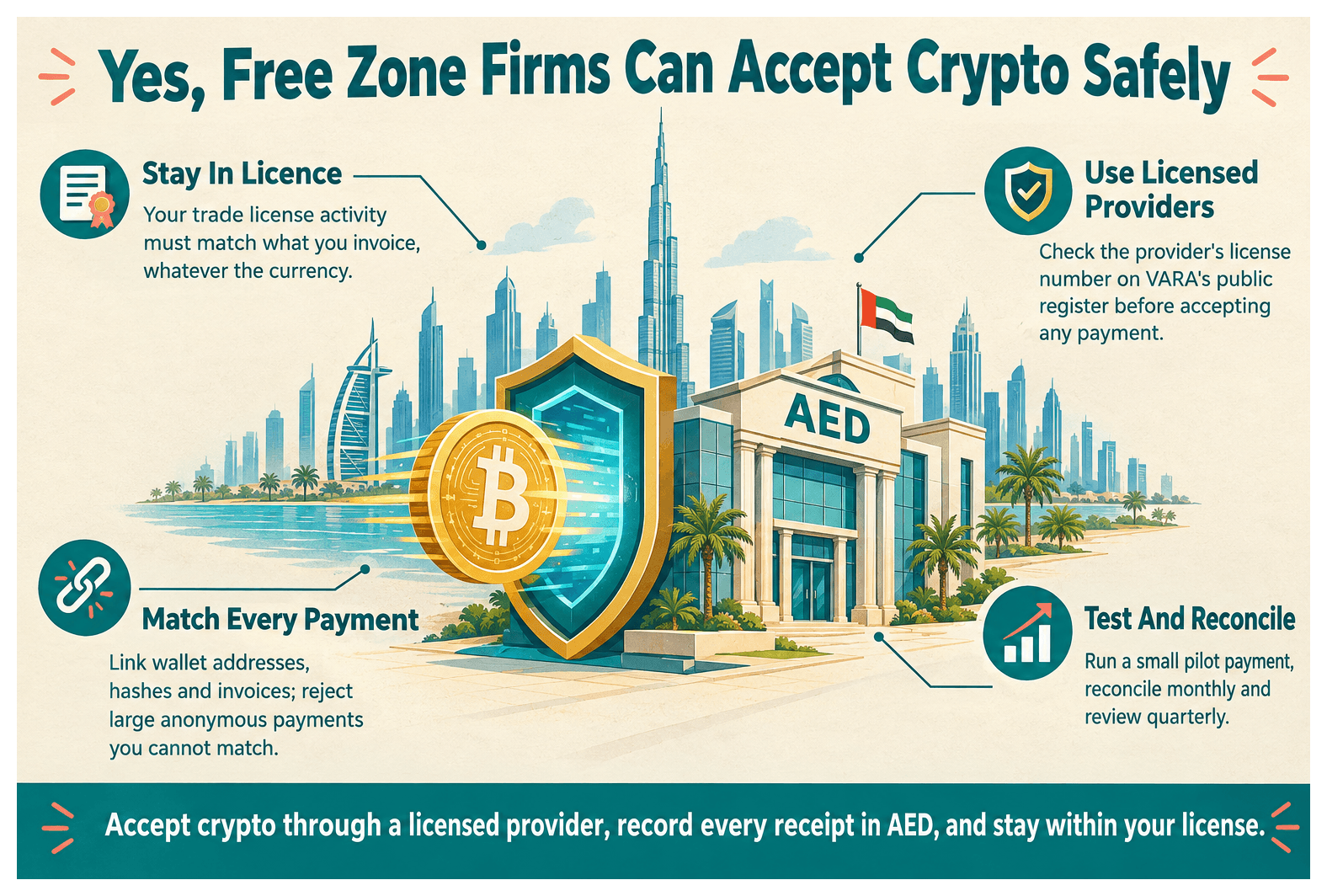
Several layers apply: Central Bank payment token rules, VARA (Virtual Assets Regulatory Authority) for Dubai service providers, AML obligations, and your license terms. Confirm which tokens and routes are currently permitted before accepting any receipt.
Central Bank and Payment Token Rules
The Central Bank is the federal payments regulator. Its Payment Token Services Regulation (2024) centres on dirham-backed stablecoins and licensed issuers. Don't assume every token suits payment for goods. Check current guidance before launch, because rules shift.
VARA and Dubai Virtual Asset Oversight
VARA covers Dubai, including free zones except DIFC.
Merchants only receiving payment usually sit outside licensing.
Your provider must be licensed.
Check its license number on VARA's public register.
AML, KYC and Your License Activity
Expect to collect know-your-customer details and source-of-funds evidence. Link wallet addresses, hashes and invoices. If a large anonymous payment can't be matched to an invoiced client, reject it.
Step-by-Step Process for a Dubai Free Zone Company to Accept Cryptocurrency Payments
Confirm your license activity, open a UAE corporate bank account, choose a licensed provider, set a conversion policy, update contracts, then record each receipt at its AED value. Have an accountant review it first.
Confirm license and banking. Your license must cover what you bill. Open your account before approaching any provider.
Select a licensed provider. Prefer instant conversion to AED or USD. Compare fees and tokens. Avoid personal wallets.
Update contracts and invoices. State the currency, token, network and rate time-stamp. Add an underpayment clause. Store hashes with invoices.
Test and reconcile. Run a small pilot payment. Reconcile monthly and review quarterly.
For wider context, read how to accept international payments from a UAE company.
Tax, VAT and Bookkeeping for Crypto Income
Crypto received for goods or services is business income, recorded at AED fair value on the date received. Corporate tax and VAT still apply to cryptocurrency payments.
Corporate Tax Treatment for Free Zone Companies
The standard rate is 9% above AED 375,000 (Federal Tax Authority, 2025) [3]. Qualifying Free Zone Persons can access 0% only on qualifying income and must meet conditions. If you hold tokens for weeks and they rise, that gain may be taxable separately.
Crypto Settlement Versus Bank Transfer for Free Zone Companies
Feature | Crypto Payment via Licensed Gateway | Bank Transfer |
|---|---|---|
Settlement speed | Often minutes to hours, including weekends | Typically 1 to 3 business days cross-border |
Price volatility exposure | Low with stablecoins and instant AED conversion; high if you hold tokens | Minimal for AED or USD invoices |
Compliance and documentation load | Higher: hashes, wallet links, source-of-funds files | Standard invoices and bank records |
Bank acceptance and onboarding | Extra bank questions on crypto-linked inflows | Routine, widely understood |
Typical fees | Gateway and conversion fees, plus network fees | Wire and intermediary bank charges |
VAT on Goods, Services and Virtual Asset Transfers
VAT on your supply applies regardless of payment method.
Virtual asset transfers are exempt financial services under recent amendments.
Show the AED amount, VAT and token amount on one invoice.
Over 350,000 UAE businesses are VAT-registered (Federal Tax Authority, 2025) [3].
Payment Providers, Wallets and Banking Options
Most companies accept cryptocurrency payments through a licensed gateway that converts to fiat and settles into a UAE bank account. Self-custody wallets add security and accounting burdens.
Gateway Settlement Versus Direct Wallet Receipts
A small agency benefits from a gateway: less price risk, simpler books. A larger trader might need multi-signature controls or a licensed custodian. Explore options in our guide to digital wallet electronic payments business license in Dubai.
Working With Banks and Dirham Stablecoins
Banks run risk checks on crypto-linked inflows.
Send a one-page flow chart and sample invoices.
Dirham-backed stablecoins are an emerging, regulated option.
Never make crypto your only collection channel.
Also see getting paid by international clients in the UAE.
Risks and Mistakes to Avoid When Accepting Crypto
The main risks are volatility, unlicensed providers, poor records, breaching license scope and weak AML checks. Convert promptly, verify licenses and document everything.
Volatility and Counterparty Risk
One merchant held a non-stable token two weeks and lost 8% of invoice value.
Use rate locks and prompt conversion.
Vet providers for licensing and financial strength.
Licensing Scope and Documentation Gaps
A trading firm that drifts into client token swaps without approval commits a serious breach. Missing hashes or KYC files also cause audit and banking trouble. Review your license activities whenever your model changes.
Setting Up a Compliant Dubai South Company for Crypto-Friendly Trade
Start with the right free zone license, a visa package linked to your company, and a UAE bank account. Dubai South Business Hub offers company formation and trade licenses, so your base is compliant before you add crypto.
Choosing the Right License Activity
Match the activity to what you sell, such as trading, consulting or e-commerce. An e-commerce trader can pick a trading activity and add crypto at checkout. Regulated virtual asset activities need separate approval. Review free zone company registration in Dubai requirements first.
Company Formation and Visa Packages With Dubai South
Dubai South Business Hub handles formation and trade licenses.
Residency visa packages tie to your license.
Choose banking and payment providers after the license is issued.
Where to Go From Here
A Dubai free zone company can accept cryptocurrency payments when it bills within its licensed activity, uses licensed providers, and records income correctly for corporate tax and VAT. Treat crypto as an added option beside solid banking. Speak with Dubai South Business Hub about formation, a trade license and visa packages, then confirm your model with a licensed adviser.
References
Frequently Asked Questions