
Topic Summary
Match Your License to Your Billed Activity
Your UAE trade license must list every specific activity you invoice for before you send your first bill. A consultancy license cannot legally cover goods trading, and mismatches can invalidate payments or trigger compliance issues.
Use a Corporate Bank Account, Not Personal
International payments must land in a UAE corporate bank account tied to your registered entity. The UAE has 49 nationally licensed banks, giving founders a wide range of onboarding options to find the right fit.
Understand SWIFT, IBAN, and Correspondent Banking
Every UAE corporate account comes with an IBAN that overseas clients use to send wire transfers directly to you. Correspondent banking relationships are what allow currencies like USD, EUR, and GBP to actually land in your UAE account.
Choose a Central Bank-Licensed Payment Method
Every payment gateway, processor, or exchange house operating in the UAE must hold a Central Bank of the UAE license. Using an unlicensed provider risks frozen settlements and serious compliance exposure.
Benefit From the AED-USD Peg on Dollar Receipts
The dirham is fixed at 3.6725 to the US dollar, meaning there is no exchange rate risk on dollar-denominated invoices. This makes USD billing a straightforward and predictable choice for UAE-based founders serving international clients.
Factor in VAT Registration Thresholds Early
If your taxable turnover exceeds AED 375,000 per year, VAT registration becomes a legal requirement before you continue invoicing. Building this threshold into your financial projections from day one avoids costly retroactive compliance work.
Consider Free Zone Formation for Fast, Low-Cost Setup
Dubai South Business Hub Free Zone issues trade licenses in one day, with first-year costs starting from AED 18,350 for a sole founder, and requires zero paid-up share capital. Free zone entities are immediately recognizable to overseas clients and carry full rights to receive foreign currency payments.
To accept international payments from a UAE company, you need three things in place: a valid trade license covering your billed activity, a UAE corporate bank account (not personal), and a licensed payment method matched to how your clients pay. Cross-border e-commerce flows through the UAE are projected to exceed USD 8 billion in 2026 (Statista, 2025). The UAE has 49 nationally licensed banks (Central Bank of the UAE, 2025). The AED is pegged to the USD at 3.6725, removing exchange risk on dollar receipts. Dubai South Business Hub Free Zone (DSBH) issues trade licenses in one day, with a first-year cost from AED 18,350 for a sole founder with one visa. Zero paid-up share capital is required. This guide covers the legal requirements, realistic costs, and the step-by-step process from company formation to receiving your first overseas transfer.
What Is Accepting International Payments From a UAE Company
Accepting international payments from a UAE company means receiving funds in foreign currencies from overseas clients or customers into a UAE-registered corporate bank account. It requires a valid trade license, a UAE corporate bank account, and a compliant payment method such as SWIFT, a payment gateway, or a licensed money transfer service.
Why the Legal Structure You Choose Matters
Both free zone and mainland companies have full rights to receive foreign currency payments. The distinction that matters is which bank will onboard you and under what conditions, not whether you're on the mainland or in a free zone.
A free zone license gives you a legal entity that overseas clients recognize immediately. A Dubai South Business Hub Free Zone consultancy billing a UK client in GBP issues the invoice from the UAE entity, the funds land in a UAE dirham or multi-currency corporate account, and no special import or export permit is needed for a service business.
Every payment service provider operating in the UAE must hold a license from the Central Bank of the UAE. That applies to gateways, processors, and exchange houses alike. Using an unlicensed provider isn't just a compliance risk, it can freeze your ability to settle funds entirely.
Key Terms You Need to Know Before You Start
SWIFT/IBAN: The standard rails for bank-to-bank international wire transfers. Every UAE corporate account has an IBAN; your clients use it to send funds directly to your account.
Payment gateway: A licensed intermediary, such as Stripe, PayTabs, or Telr, that processes card or digital-wallet payments on your behalf and settles to your UAE account.
Correspondent banking: Your UAE bank's relationship with a foreign bank that enables it to receive currencies like USD, EUR, or GBP on your behalf. This is what makes a SWIFT transfer from a UK bank land in your UAE account.
AED/USD peg: The dirham is fixed at 3.6725 to the US dollar (Central Bank of the UAE, 2025), so there's no exchange risk on dollar-denominated receipts.
Requirements to Accept International Payments in the UAE
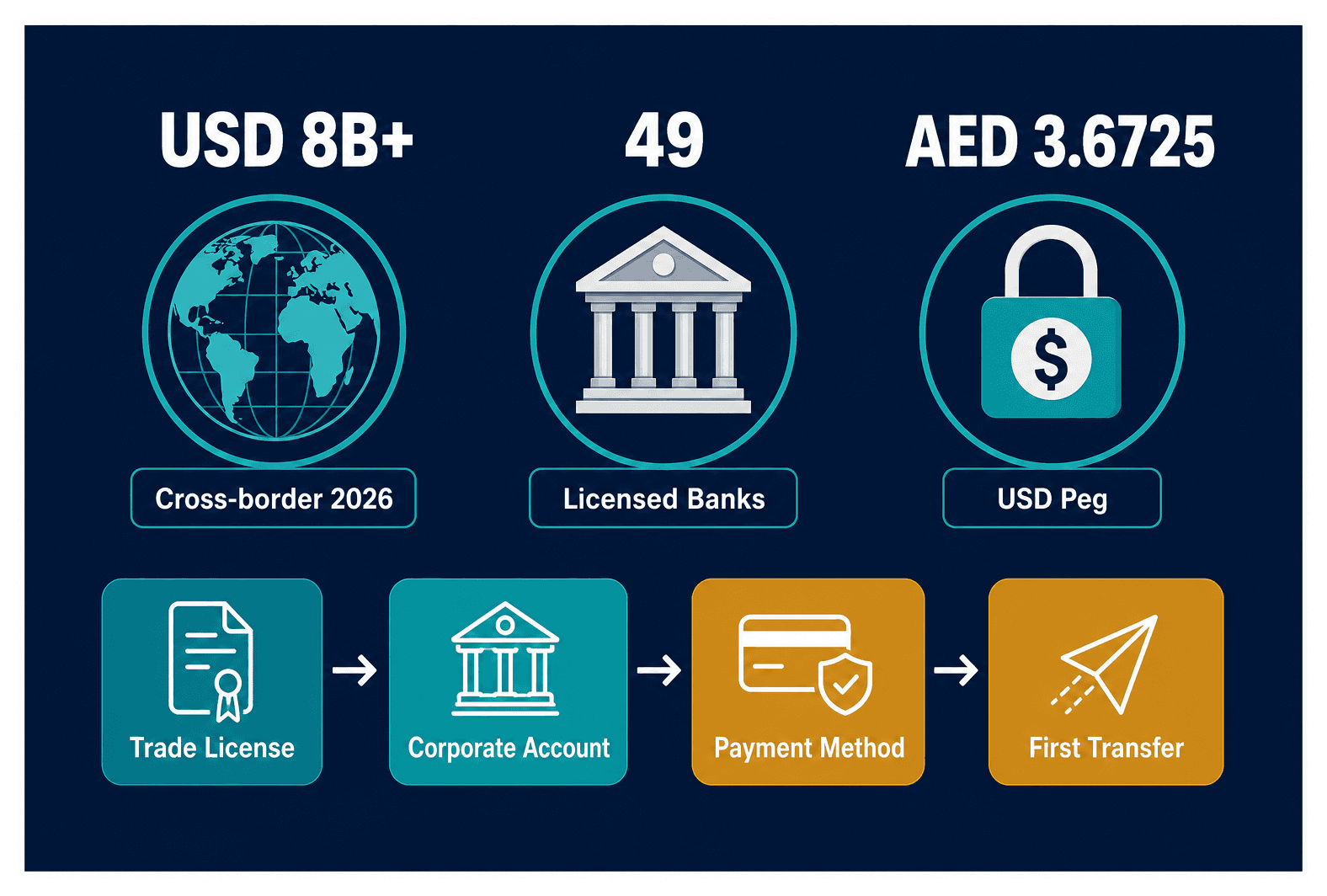
To accept international payments from a UAE company you need: a valid UAE trade license for the relevant activity, a UAE corporate bank account (not a personal account), a licensed payment gateway or SWIFT-enabled account for card or wire payments, and correct VAT registration if your taxable turnover exceeds AED 375,000 per year.
Trade License and Permitted Activities
Your license must list the specific activity you're billing for. A consultancy license cannot legally invoice for trading goods, the activity on the license and the activity on the invoice must match.
DSBH includes the first five business activities in the base license; each additional activity costs AED 2,000.
A founder billing overseas clients for software development and IT consulting needs both activities on the license before the first invoice goes out.
For regulated activities, financial services, healthcare, DSBH licenses the entity, but the named regulator (Central Bank of the UAE for payment services, DHA for health) must grant a separate sector approval before you operate.
DSBH trade licenses start from AED 12,500. Browse the full list of business activities in Dubai before you apply to avoid amendment fees later.
UAE Corporate Bank Account
Banks require your trade license, passport copies, proof of address, and a UBO (ultimate beneficial owner) declaration for anyone holding 25% or more. DSBH requires zero paid-up share capital, which removes one of the most common barriers founders hit during bank onboarding.
Multi-currency accounts, holding USD, EUR, and GBP alongside AED, are available at most major UAE banks and make reconciliation far simpler if you're billing in multiple currencies. Digital-first banks can open accounts in days; full-service commercial banks typically take two to four weeks due to KYC checks.
For guidance on bank account opening in the UAE, DSBH's banking and taxation support team can help you identify the right institution for your business model.
Licensed Payment Gateways and Processors
Any gateway operating in the UAE must hold a Central Bank of the UAE license. Using an unlicensed processor exposes you to regulatory risk and potential account suspension.
PayTabs: Licensed in the UAE; supports card payments and settles to UAE corporate accounts.
Telr: Licensed in the UAE; popular with e-commerce and service businesses billing internationally.
Checkout.com: Licensed in the UAE; suited to higher-volume businesses needing multi-currency settlement.
Stripe UAE: Regulated by the Central Bank of the UAE; supports card payments in multiple currencies with AED settlement in approximately two business days.
A SaaS founder at a Dubai free zone company using Stripe UAE, for example, can accept USD card payments from US clients and receive AED settlements within two business days, no manual currency conversion needed.
Payment Methods to Accept International Payments From a UAE Company
Payment Method | Best For | Settlement Time |
|---|---|---|
SWIFT bank transfer | B2B invoices above AED 10,000; large single payments from corporate clients | 1 to 3 business days via correspondent bank network |
Licensed payment gateway (card) | B2C sales or recurring subscription billing in multiple currencies | 1 to 2 business days to UAE corporate account |
Multi-currency corporate account | Holding USD, EUR, or GBP without forced AED conversion at spot rate | Instant once funds arrive; no conversion delay |
Licensed exchange house (corporate) | Lower-value transfers or markets underserved by SWIFT corridors | Same day to 2 business days depending on corridor |
Direct debit / open banking | Subscription businesses billing EU or UK clients in GBP or EUR | 2 to 5 business days; depends on client's bank scheme |
Step-by-Step Guide to Accept International Payments From a UAE Company
The process has six steps: form a UAE company with the right licensed activities, open a UAE corporate bank account, choose a licensed payment method, set up invoicing in the correct currency, apply VAT treatment correctly on export transactions, and reconcile foreign currency receipts against your AED accounts each month.
Step 1: Form Your UAE Company With the Right Activities
Choose free zone or mainland, both allow you to accept international payments from a UAE company. Base your decision on client location, office needs, and visa requirements.
At DSBH, a license is issued in one day. First-year cost for a sole founder with one visa starts from AED 18,350; zero paid-up share capital is required.
Select every activity you plan to bill for at application, adding activities later costs AED 2,000 each.
A founder offering digital marketing and brand strategy to European clients, for instance, sets up at DSBH with both activities on the license from day one. That avoids a AED 2,000 amendment fee and means the first invoice is compliant immediately. You can start your business in Dubai and receive your license the same day.
Step 2: Open a UAE Corporate Bank Account
Prepare your trade license, Memorandum of Association, passport copies for all shareholders, and a six-month business plan or client pipeline summary.
Request a multi-currency account from the outset, this avoids forced conversion of incoming USD or EUR at the bank's spot rate.
Ask your bank relationship manager about free zone-specific account tiers; some carry lower minimum balances than standard commercial accounts.
UBO threshold: 25% shareholding or more triggers a mandatory declaration. Digital banks open in days; commercial banks typically take two to four weeks.
Step 3: Choose Your Payment Rails and Go Live
B2B wire transfers: Share your IBAN and SWIFT/BIC code with overseas clients. Payments route through correspondent banks and typically arrive in one to three business days.
B2C or recurring card payments: Integrate a Central Bank of the UAE-licensed gateway. Most offer API or hosted-page options with no hardware required.
Test first: Run a small internal transaction before going live with a real client to confirm the full settlement chain works end-to-end.
The AED/USD peg at 3.6725 means there's no exchange risk on dollar-denominated receipts. For EUR or GBP transfers, ask your bank about forward contracts to protect the AED value of large receivables.
Costs to Accept International Payments in the UAE
Costs fall into three layers: company formation (from AED 18,350 for a sole founder with one visa at Dubai South Business Hub Free Zone), bank account fees (AED 0 to AED 500 per month depending on the bank and account tier), and payment processing fees (typically 2% to 3.5% per transaction for card payments via a licensed gateway).
Company Formation and License Costs
Trade license: From AED 12,500; covers the first five business activities.
First-year all-in cost: From AED 18,350 for a sole founder with one residency visa; visa costs are always itemized separately and never bundled into the base license price.
Paid-up share capital: Zero required, you don't need to deposit capital before the license is issued.
Additional activities: AED 2,000 each beyond the first five.
Use the business setup cost calculator to get a precise first-year figure based on your activity count and visa requirements before you apply.
Banking and Gateway Fees
Corporate bank accounts at UAE banks carry monthly maintenance fees of AED 0 to AED 500; some waive the fee if you maintain a minimum balance. Incoming SWIFT transfers cost AED 0 to AED 100 per transfer at most UAE banks, outgoing transfers typically cost more.
Licensed payment gateways charge a percentage per transaction. PayTabs and Telr both publish rates in the 2.5% to 3.5% range for international card payments. Stripe UAE rates vary by card type and currency. Confirm exact published rates with each provider before signing up, as they update periodically.
VAT and Corporate Tax Rules When You Accept International Payments in the UAE
Services exported to overseas clients are generally zero-rated for UAE VAT, meaning you charge 0% VAT but can still recover input VAT on your costs. UAE corporate tax applies at 9% on taxable income above AED 375,000. Late VAT registration carries an AED 10,000 penalty; late corporate tax registration carries a separate one-time AED 10,000 flat penalty.
VAT on Exported Services and Goods
Under UAE VAT law, services supplied to a client whose place of residence is outside the UAE, and who is not present in the UAE at the time of supply, are zero-rated. You charge 0% but the transaction still appears on your VAT return filed with the Federal Tax Authority.
A DSBH consultancy billing a German company for strategy work invoices at 0% VAT, recovers the 5% VAT it paid on UAE office costs, and reports both figures to the Federal Tax Authority each quarter. That input VAT recovery is a real cash benefit that many founders overlook.
VAT registration is mandatory once your taxable turnover, including zero-rated supplies, exceeds AED 375,000 in any 12-month period. Voluntary registration is available from AED 187,500. Missing the mandatory threshold triggers an AED 10,000 penalty.
Corporate Tax and What It Means for International Revenue
Standard rate: 9% on taxable income above AED 375,000; the first AED 375,000 of net profit is taxed at 0% for all businesses.
Qualifying Free Zone Persons (QFZPs): May access a 0% rate on qualifying income, but only if all four conditions are met: adequate substance in the UAE, income from qualifying activities, no election for standard corporate tax, and compliance with transfer pricing rules.
Late registration penalty: AED 10,000 one-time flat penalty, not a monthly charge.
Worth flagging: the QFZP regime is not automatic. If any one of the four conditions is not met, the standard 9% rate applies to all taxable income. Get a qualified UAE tax adviser to confirm your eligibility before you file.
Is VAT charged on services billed to overseas clients from a UAE company?
No, in most cases. Services supplied to a client resident outside the UAE, who is not in the UAE when the service is delivered, are zero-rated under UAE VAT law. You still report the supply on your VAT return and can recover input VAT on your UAE costs. The mandatory registration threshold is AED 375,000 taxable turnover per 12 months.
Common Problems When You Accept International Payments in the UAE and How to Avoid Them
The most common problems are: bank account rejection due to incomplete KYC documents, payment gateway chargebacks from unsupported currencies, VAT misclassification of exported services as standard-rated, and correspondent bank delays on USD transfers. Each has a straightforward fix rooted in preparation and correct license activity selection.
Bank Account Rejection and KYC Delays
Banks reject applications most often because the business activity on the license doesn't match the revenue model described in the KYC questionnaire. Align these precisely before applying.
Prepare a clear one-page business model summary: who your clients are, where they're located, how they pay, and what the funds are for.
If your first-choice bank declines, a UAE corporate account at a digital-first bank or a licensed exchange house with a corporate product can bridge the gap while you reapply.
All UBOs holding 25% or more must be declared. Missing a UBO declaration is one of the most common reasons for delays across all 49 licensed banks in the UAE (Central Bank of the UAE, 2025).
Currency and Settlement Mismatches
If your gateway doesn't support the client's currency, the client's bank forces a conversion at an unfavorable rate and you receive less than invoiced. Always confirm which settlement currencies your gateway supports before signing the merchant agreement. Most UAE-licensed gateways settle in AED, USD, EUR, and GBP as standard.
The AED/USD peg at 3.6725 eliminates settlement risk on dollar receipts entirely. For EUR or GBP receivables, ask your bank about forward contracts or rate-lock products to protect the AED value of large incoming transfers.
What happens if my payment gateway isn't licensed in the UAE?
Using an unlicensed payment processor in the UAE breaches Central Bank of the UAE regulations. In practice, this can result in frozen settlements, account closure by your bank, and regulatory penalties for the business. Always verify a gateway's UAE license status on the Central Bank of the UAE's published list before integration.
References
Frequently Asked Questions