
Topic Summary
What Is Deductible and Why It Matters for a Free Zone Company
Yes. Under Federal Decree-Law No. 47 of 2022, a free zone company can deduct expenses incurred wholly and exclusively for its business, unless a rule specifically disallows them. Deductions cut taxable income, whether it's taxed at 9% or 0%. Allocation and records decide how much relief you actually get.
How a Free Zone Company Can Deduct Expenses Against Its Taxable Income Under QFZP Status
How a Free Zone Company Can Deduct Expenses Against Its Taxable Income Under QFZP Status
Expenses That Are Fully, Partly or Not Deductible
Rent, salaries, utilities, marketing and license fees are fully deductible. Entertainment is limited to 50%. Fines, dividends, bribes and owners' personal costs aren't deductible, and interest is capped under the general interest limitation rule.
Allocating Costs Between Qualifying and Non-Qualifying Income
Trace direct expenses to the income they generate, then split shared overheads with a consistent key such as revenue, headcount or floor area. Document the method and be ready to justify it to the Federal Tax Authority.
Step-by-Step Process to Claim Deductions Correctly
Record expenses in compliant books, confirm each is business-related, allocate between streams, apply statutory limits, then file on the EmaraTax portal within nine months of year end.
Filing Deadlines and Records That Support Every Deduction
Returns are due nine months after year end, and records must be kept seven years. Invoices, contracts, bank statements and allocation workings are the evidence behind each deduction.
Common Deduction Mistakes Free Zone Owners Make
The usual errors: assuming 0% means no records, deducting personal costs, ignoring the 50% entertainment limit, blending income streams, and missing the deadline.
Can a free zone company deduct expenses against its taxable income? Yes. The UAE taxes income above AED 375,000 at 9% [1], and one misclassified cost can inflate that bill. Returns are due within nine months of year end [2], and records must be kept for seven years [2]. This guide is for owners and finance managers who want to claim correctly.
What Is Deductible and Why It Matters for a Free Zone Company
Yes. Under Federal Decree-Law No. 47 of 2022, a free zone company can deduct expenses incurred wholly and exclusively for its business, unless a rule specifically disallows them. Deductions cut taxable income, whether it's taxed at 9% or 0%. Allocation and records decide how much relief you actually get.
Plain-Language Definition of a Deductible Expense
It's a cost you incur to earn taxable income. The law starts from accounting profit, then adjusts it. A Dubai South trading company paying AED 120,000 in warehouse rent and AED 60,000 in salaries reduces its profit by AED 180,000 before adjustments.
Why Deductions Matter Even at a 0% Rate
Qualifying Income is taxed at 0%, but non-qualifying income faces 9%. Say a company earns AED 1 million and AED 200,000 is non-qualifying. Only costs tied to that AED 200,000 offset the taxable base. Unclaimed or undocumented costs push your effective rate up. For wider context, see these tax benefits for Dubai free zone companies.
How a Free Zone Company Can Deduct Expenses Against Its Taxable Income Under QFZP Status
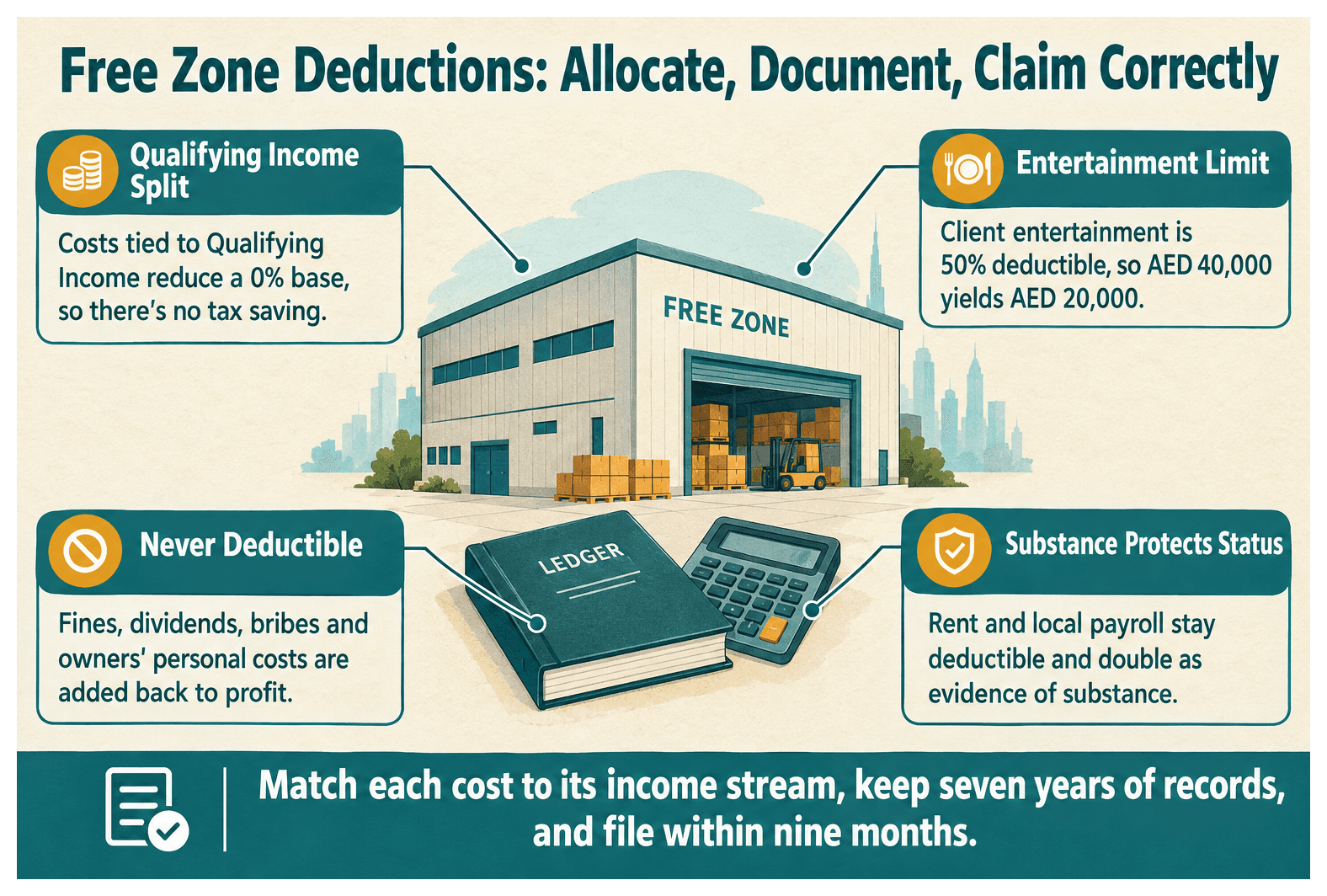
A Qualifying Free Zone Person deducts expenses against the income they relate to. Costs tied to Qualifying Income reduce a 0% base, so there's no tax saving. Costs tied to non-qualifying income reduce the 9% base. Lose status, and all valid expenses reduce one combined taxable profit.
Deductions When You Keep QFZP Status
You compute the two income streams separately. Direct costs follow the stream they generate, and shared costs need a reasonable allocation method. A free zone trader selling to other free zone businesses and to one mainland client splits delivery costs per revenue stream. Non-qualifying revenue must also stay within the de minimis limit. Read more on the Qualifying Free Zone Person conditions.
Deductibility of Common Free Zone Expenses
Expense | Deduction Treatment |
|---|---|
Rent and utilities | Fully deductible if business-related, e.g. AED 120,000 warehouse rent |
Staff salaries and visa costs | Fully deductible, e.g. AED 60,000 payroll |
Client entertainment | 50% deductible, so AED 40,000 yields AED 20,000 |
Fines and penalties | Not deductible, added back to profit |
Net interest | Deductible up to the 30% tax EBITDA cap |
Deductions When You Lose QFZP Status
Failing a condition or breaching de minimis moves all income to 9%.
You generally can't return to QFZP status for the next four tax periods (confirm current FTA guidance).
All allowable expenses then reduce one combined base.
Where Substance Fits Into Your Deductions
Adequate substance, meaning staff, premises and assets, is a QFZP condition. Rent and local payroll stay deductible and double as evidence. Cutting them to save cost can jeopardise your status. A warehouse-based firm is a good example; see operating from a warehouse.
Expenses That Are Fully, Partly or Not Deductible
Rent, salaries, utilities, marketing and license fees are fully deductible. Entertainment is limited to 50%. Fines, dividends, bribes and owners' personal costs aren't deductible, and interest is capped under the general interest limitation rule.
Fully Deductible Operating Costs
Rent, payroll, utilities and professional fees.
Free zone license renewals and employee residency visas.
Marketing, software and depreciation.
Restricted and Non-Deductible Items
Entertainment: 50% only.
Fines, penalties, dividends and bribes: nothing.
Owner's personal costs: nothing.
Net interest: capped at 30% of tax EBITDA where thresholds apply.
Allocating Costs Between Qualifying and Non-Qualifying Income
Trace direct expenses to the income they generate, then split shared overheads with a consistent key such as revenue, headcount or floor area. Document the method and be ready to justify it to the Federal Tax Authority.
Direct Versus Shared Costs
Cost of goods and commissions are direct. Rent and management salaries are shared. Code mainland-sale freight separately from free zone-sale freight in your ledger. It saves hours at filing.
Choosing a Defensible Allocation Key
Revenue is simplest: if 25% of revenue is non-qualifying, 25% of shared rent goes to the taxable stream. Service firms may prefer time-based keys. Consistency beats perfection. See what qualifying income means for a trading company.
Step-by-Step Process to Claim Deductions Correctly
Record expenses in compliant books, confirm each is business-related, allocate between streams, apply statutory limits, then file on the EmaraTax portal within nine months of year end.
Step 1: Record and Classify Every Expense
Keep tax invoices and contracts. Tag each cost by revenue stream every month.
Step 2: Apply Disallowance Rules and Limits
Cut entertainment to 50%, remove fines and personal items, and test interest against the cap in a tax reconciliation schedule.
Step 3: File Through the FTA Portal
Log in to EmaraTax, file and pay by the same deadline. A December year-end company files by 30 September.
Step 4: Review With Your Advisor Before Submission
Check the status conditions, the de minimis test and your allocation notes.
Filing Deadlines and Records That Support Every Deduction
Returns are due nine months after year end, and records must be kept seven years. Invoices, contracts, bank statements and allocation workings are the evidence behind each deduction.
Key Deadlines to Diarise
Return and payment: nine months after year end.
A 31 March year end means 31 December.
Late filing attracts penalties; check EmaraTax for current schedules.
Seven-Year Record Retention
Digital copies work if they're retrievable. Keep one folder per tax period. Missing evidence can mean a disallowed deduction.
Common Deduction Mistakes Free Zone Owners Make
The usual errors: assuming 0% means no records, deducting personal costs, ignoring the 50% entertainment limit, blending income streams, and missing the deadline.
Mixing Personal and Business Spending
A family trip on the company card gets added back to taxable profit. Pay business costs through company accounts and note the purpose.
Assuming 0% Means No Compliance
QFZPs still file returns and keep records.
Non-qualifying income is taxed at 9%.
A trader with AED 150,000 of mainland revenue who misses filing faces a penalty.
Mainland sales deserve extra care; read corporate tax for free zone companies with mainland clients.
Next Steps
A free zone company can deduct expenses against its taxable income, but the benefit depends on matching costs to the right stream, applying limits and keeping evidence. Get allocation and status right and you'll protect both deductions and 0% treatment. Check your activity against qualifying activities, then speak with a Dubai South Business Hub advisor to review your license, activity and cost structure before your next filing.
References
Ministry of Finance, UAE Corporate Tax, 2023.
Federal Tax Authority, Corporate Tax guidance and EmaraTax, 2026.
Frequently Asked Questions