
Topic Summary
Meet the Five Core QFZP Conditions
To keep the 0% rate, a free zone company must maintain adequate substance, earn qualifying income, avoid electing the standard regime, prepare audited financials, and comply with transfer pricing rules. All five conditions must be met continuously, not just at registration.
Understand the De Minimis Threshold
Non-qualifying income must stay below 5% of total revenue or AED 5 million, whichever is lower. Breach either cap and the company loses its preferential 0% rate for five full tax periods.
Confirm Your Free Zone Is Recognised
Your free zone must appear on the Ministry of Finance's official list of recognised free zones. Operating in an unrecognised zone disqualifies you from QFZP status regardless of how well you meet every other condition.
Know Which Entity Types Can Qualify
Only juridical persons incorporated or registered in a recognised UAE free zone are eligible — sole proprietors cannot qualify. Branches of foreign companies may qualify if UAE law treats them as juridical persons.
Separate Qualifying and Non-Qualifying Income
The 0% rate applies only to qualifying income; non-qualifying income earned by the same entity is taxed at the standard 9% rate in the same period. Clear income categorisation is essential to avoid unexpected tax bills.
Maintain Adequate Substance Continuously
Substance requirements are ongoing, not a one-time box-ticking exercise at the point of registration. A company that lets its substance lapse mid-year risks losing QFZP status for that entire tax period.
Factor in the Small Business Relief Threshold
Free zone companies that do not qualify for QFZP status pay 9% corporate tax on taxable income above AED 375,000, identical to a mainland business. Getting QFZP eligibility wrong can therefore be a significant and avoidable cost.
In 2026, every free zone company in the UAE falls under the federal corporate tax regime introduced by Federal Decree-Law No. 47 of 2022, which set the standard rate at 9% from June 2023 (Federal Tax Authority, 2023). Yet the same law preserves a 0% rate for companies that qualify as a Qualifying Free Zone Person. The UAE has over 40 recognised free zones (Ministry of Finance, 2023). The de minimis threshold sits at 5% of total revenue or AED 5 million, whichever is lower. Breach either cap and you lose the preferential rate for five full tax periods. The small business relief threshold is AED 375,000 (Federal Tax Authority, 2023). Getting QFZP status wrong is expensive.
This article explains in plain language what a qualifying free zone person is, what income qualifies for the 0% rate, how the de minimis threshold works, what adequate substance requires, and exactly what happens if you lose QFZP status. Three worked scenarios show how the rules apply in practice. This is general guidance only and not tax advice; confirm your position with a registered UAE tax adviser.
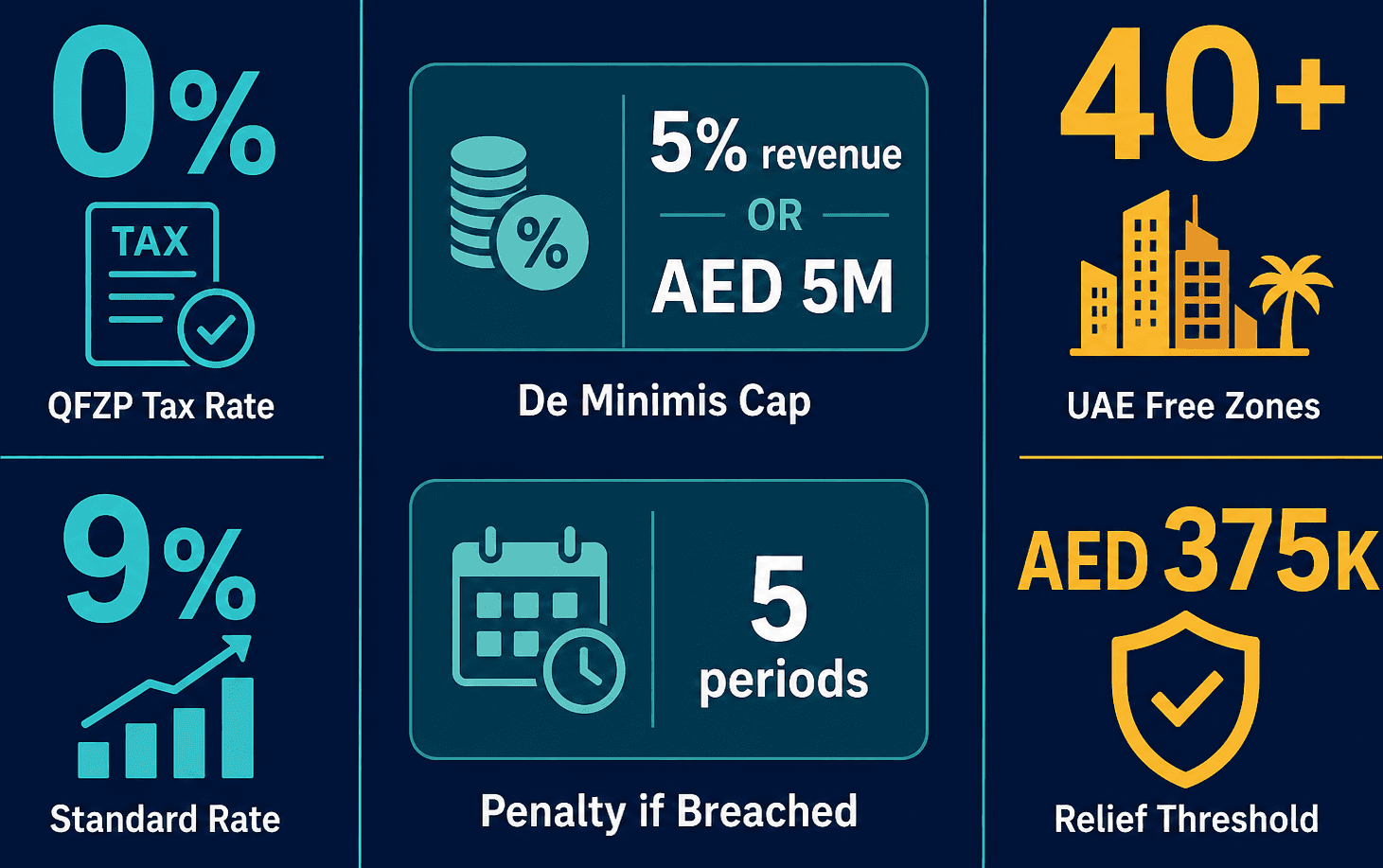
A Qualifying Free Zone Person (QFZP) is a juridical person incorporated in a UAE free zone that meets specific conditions under Federal Decree-Law No. 47 of 2022 to pay 0% corporate tax on qualifying income. Non-qualifying income earned by the same entity is taxed at the standard 9% rate. Free zone companies that do not meet the QFZP conditions pay 9% on all taxable income above AED 375,000, exactly like a mainland business.
The Legal Basis for the 0% Rate
Federal Decree-Law No. 47 of 2022 introduced UAE corporate tax at 9%, effective for financial years starting on or after 1 June 2023. Articles 18 and 19 of that law, read alongside Ministerial Decision No. 139 of 2023, set out the full QFZP framework, including the qualifying income categories, the substance conditions, and the de minimis rule.
The 0% rate applies only to qualifying income. Non-qualifying income within the same entity is taxed at 9% in the same tax period. A logistics firm incorporated in a UAE free zone earning freight income from foreign customers may pay 0% on that income, provided all QFZP conditions are satisfied. Free zone companies that do not elect or do not qualify pay 9% on taxable income above AED 375,000, the same as any mainland business.
Who Can Be a Qualifying Free Zone Person
Not every free zone company is automatically a qualifying free zone person. The eligibility rules are specific:
The entity must be a juridical person: a company incorporated, registered, or otherwise formed in a recognised UAE free zone. Natural persons (sole proprietors) do not qualify.
Branches of foreign companies registered in a free zone may qualify; the test is whether the branch is treated as a juridical person under UAE law.
The free zone itself must appear on the Ministry of Finance's list of recognised free zones (Ministry of Finance, 2023). Being in an unrecognised zone disqualifies you regardless of your other conditions.
The company must not have made an election to be treated as a Resident Person subject to the standard rate.
A UAE-incorporated holding company registered in a free zone qualifies as a juridical person and can pursue QFZP status, provided all other conditions are satisfied. Worth flagging: QFZP status is entity-level, not free-zone-level. Being in a recognised free zone is necessary but not sufficient.
What Conditions Must a Free Zone Company Meet to Be a Qualifying Free Zone Person
To qualify as a Qualifying Free Zone Person, a company must: maintain adequate substance in its free zone, derive only qualifying income (or stay within the de minimis threshold for non-qualifying income), not elect the standard tax regime, prepare audited financial statements, and comply with UAE transfer pricing rules. All five conditions must be met continuously, not just at the point of registration.
The Five Core QFZP Conditions at a Glance
A technology consultancy in a free zone that employs two qualified staff, leases dedicated office space in the zone, invoices foreign clients, and files audited accounts annually would satisfy all five conditions. Failure of any single condition can strip QFZP status for five consecutive tax periods, so each condition needs active monitoring, not just a one-time review.
What Adequate Substance Actually Requires
Substance is the condition that trips up the most companies. CIGAs must be performed inside the free zone. The company must have adequate qualified employees and physical premises commensurate with its level of activity.
CIGAs can be outsourced to a related or third party within the same free zone or another recognised free zone, but management and oversight must remain with the QFZP itself.
Outsourcing CIGAs to a mainland UAE entity or a foreign entity will breach the substance requirement.
The Federal Tax Authority (FTA) has not published a fixed headcount or minimum spend threshold. Adequacy is assessed relative to the nature and scale of the business.
In practice, a holding company with a single director and a registered address but no real operations would likely fail the substance test, even if it earns only dividend income from free zone subsidiaries. Substance requirements under QFZP rules also sit alongside (not instead of) any economic substance requirements that applied under the pre-2023 ESR regime. For more detail, see our guide on economic substance requirements for Dubai free zone companies.
What Counts as Qualifying Income and What Is Excluded
Qualifying income for a QFZP includes income from transactions with other free zone persons, income from qualifying activities listed in Ministerial Decision No. 139 of 2023 (such as manufacturing, fund management, treasury services, and headquarters services), and income from foreign sources. Domestic UAE mainland income and income from excluded activities is taxed at 9%. Income categorisation must be tracked at transaction level, not entity level.
Qualifying Income: The Main Categories
Income from other free zone persons: transactions with companies in the same or a different recognised free zone generally qualify, regardless of the activity type.
Manufacturing and processing of goods in or from a designated zone.
Treasury and financing services provided to related parties at arm's length.
Fund management services regulated by the UAE Securities and Commodities Authority (SCA).
Ship operation, management, chartering, and leasing.
Headquarters services provided to related parties.
Logistics services and distribution in or from a designated zone.
Holding of shares and securities: dividends and capital gains from shareholdings in companies outside the UAE may also qualify as qualifying income under UAE corporate tax rules.
A free zone company providing treasury management services to its group entities and charging an arm's-length fee earns qualifying income on that fee. That income qualifies for the 0% rate, provided all other QFZP conditions are met. Ministerial Decision No. 139 of 2023 is the definitive reference for the full list (Federal Tax Authority, 2023).
Excluded Activities and Non-Qualifying Income Taxed at 9%
Not all income earned by a free zone company is qualifying income. The following categories generate non-qualifying income taxed at 9%:
Transactions with mainland UAE customers on activities that are not qualifying activities.
Ownership or exploitation of intellectual property (IP) assets: IP income is specifically excluded from qualifying income under the current rules.
Banking, insurance, and deposit-taking services (unless specifically regulated and listed as qualifying).
Income from UAE immovable property, other than qualifying commercial property transactions with other free zone persons.
Any income from an activity not on the qualifying activities list and not earned from another free zone person.
A free zone trading company that sells goods to a mainland UAE retailer earns non-qualifying income on that transaction and pays 9% on it, even if all other income qualifies. That is why tracking income at transaction level matters so much. The table in the next section gives you a quick reference for planning.
What Is the De Minimis Rule and How Does It Protect Your QFZP Status
The de minimis rule allows a qualifying free zone person to earn a small amount of non-qualifying income without losing the 0% rate entirely. Non-qualifying income must not exceed 5% of total revenue or AED 5 million, whichever is lower, in a tax period. Breaching either threshold strips QFZP status for that period and the following four tax periods.
How to Calculate Whether You Are Within the De Minimis Threshold
Non-qualifying income that falls within the threshold is still taxed at 9%. The de minimis rule simply prevents it from stripping the 0% rate on qualifying income. Here is a concrete example: a free zone company earns AED 10 million total revenue and receives AED 400,000 from a mainland client (non-qualifying). That is 4% of revenue and below AED 5 million, so de minimis applies and QFZP status is preserved. The AED 400,000 is still taxed at 9%.
What Happens If You Breach the De Minimis Threshold
If non-qualifying income exceeds either limit, the company loses QFZP status for the current tax period and the following four tax periods, five periods in total. During those five periods, all taxable income above AED 375,000 is subject to the standard 9% rate.
There is no partial reinstatement. The penalty is binary: either you qualify or you do not. A free zone consultancy that earns AED 2 million from mainland UAE clients in a year when total revenue is AED 3 million has non-qualifying income at 67% of revenue, far above the 5% threshold. That company loses QFZP status for five full tax periods and pays 9% on all taxable income throughout. The company may re-apply after the five-period window, provided it again meets all conditions. Monitor your de minimis position quarterly, not annually. Waiting until year-end leaves no time to restructure.
Qualifying Activities vs. Excluded Activities Under UAE Corporate Tax
Activity Category | Qualifying Activities (0% Rate Eligible) | Excluded Activities (9% Rate Applies) |
|---|---|---|
Goods and Manufacturing | Manufacturing and processing of goods in or from a designated zone | Ownership or exploitation of intellectual property assets (royalties, brand licensing, IP income) |
Financial Services | Treasury and financing services provided to related parties at arm's length | Banking and deposit-taking services (unless specifically regulated and listed as qualifying) |
Fund and Asset Management | Fund management services regulated by the UAE Securities and Commodities Authority (SCA) | Insurance, reinsurance, and insurance intermediation activities |
Maritime and Logistics | Ship operation, management, chartering, and leasing | Income from UAE immovable property (other than qualifying commercial property transactions with other free zone persons) |
Group and HQ Services | Headquarters services provided to related parties | Retail or wholesale transactions with mainland UAE customers where the activity is not a qualifying activity |
Distribution and Logistics | Logistics services and distribution in or from a designated zone | Financing and leasing activities not specifically listed as qualifying under Ministerial Decision No. 139 of 2023 |
Investment Holdings | Holding of shares and securities; dividends and capital gains from foreign entities | Any income from activities not listed in Ministerial Decision No. 139 of 2023 earned from non-free zone persons |
Qualifying vs. Excluded Activities: A Side-by-Side Reference
Qualifying activities eligible for the free zone corporate tax 0 percent rate include manufacturing, logistics, fund management, treasury services, ship operation, headquarters services, and distribution in a designated zone. Excluded activities include IP ownership and exploitation, retail financial services, insurance, and income from UAE immovable property. Always verify the current list with the FTA directly, as Ministerial Decision No. 139 of 2023 may be updated (Federal Tax Authority, 2023).
Reading the Table and Planning Your Activity Mix
Use the table above as a planning tool, not a definitive legal list. Confirm every activity against the latest version of Ministerial Decision No. 139 of 2023 before filing. A single company can conduct both qualifying and excluded activities. Only the income split and de minimis position determine the tax outcome for each period.
If an activity sits on the border (a hybrid IP-and-manufacturing business, for example), seek a private clarification from the FTA before filing. Structuring decisions made before the first tax period are far easier to get right than restructuring after non-qualifying income has already been earned. A free zone company that manufactures goods (qualifying) and also licenses its brand name to a mainland partner (excluded IP income) must track both income streams separately and verify that IP income stays within the de minimis threshold. You can explore the full range of business activities in Dubai to understand which categories your planned operations fall into before you commit to a structure.
Is there a quick way to check if my income qualifies?
Start with two questions: Is the income from another free zone person? If yes, it almost certainly qualifies. If not, is the underlying activity listed in Ministerial Decision No. 139 of 2023? If yes and the customer is a foreign or free zone entity, it qualifies. If the customer is a mainland UAE entity and the activity is not on the qualifying list, it does not qualify. Always confirm with a registered tax adviser for borderline cases.
Three Worked Scenarios: Who Keeps the 0% Rate and Who Does Not
These three scenarios illustrate how QFZP status works in practice. Scenario one shows a company that keeps the 0% rate on qualifying income. Scenario two shows a company that loses QFZP status through a de minimis breach. Scenario three shows a company that maintains partial qualifying income correctly while paying 9% on the non-qualifying portion. These are illustrative only; confirm your own position with a registered tax adviser.
Scenario 1: The Logistics Firm That Keeps the 0% Rate
A free zone logistics company earns AED 8 million from foreign shipping clients (qualifying income) and AED 200,000 from a mainland UAE client (non-qualifying). Non-qualifying income represents 2.5% of total revenue, well within the 5% de minimis threshold and below AED 5 million.
The company has three full-time employees in the free zone, leases warehouse space in the zone, and files audited accounts annually. All five QFZP conditions are met. Result: QFZP status maintained. AED 8 million taxed at 0%; AED 200,000 taxed at 9%. Incidental mainland income does not automatically destroy QFZP status if it stays within the threshold.
Scenario 2: The Consultancy That Loses QFZP Status
A free zone management consultancy earns AED 1.5 million from mainland UAE clients out of AED 4 million total revenue. Non-qualifying income is 37.5% of revenue, far above the 5% de minimis threshold. The company also uses only a flexi-desk in the free zone rather than dedicated office space, which may not satisfy the substance requirement.
Result: QFZP status lost for five consecutive tax periods. All taxable income above AED 375,000 is subject to 9% for five years. The substance failure compounds the problem. This is the most common trap for service businesses that grow their mainland client base without tracking the income split or reviewing their substance position.
Scenario 3: The Holding Company with Mixed Income
A free zone holding company receives AED 5 million in dividends from a foreign subsidiary (qualifying income) and AED 300,000 in rent from a UAE commercial property (non-qualifying). Total revenue is AED 5.3 million. Non-qualifying income is 5.66% of total revenue, just above the 5% threshold.
De minimis breached. QFZP status at
References
Federal Tax Authority (tax.gov.ae)
Ministry of Finance (mof.gov.ae)
Citations
Federal Tax Authority.. tax.gov.ae. FTA UAE, 2025.
UAE Government Portal.. u.ae. UAE Government, 2025.
UAE Cabinet.. uaecabinet.ae. UAE Cabinet, 2025.
Frequently Asked Questions