Topic Summary
Can an Employee Work Remotely and Still Hold a UAE Work Visa? What It Means
Yes, an employee can work remotely and still hold a UAE work visa, provided the employer agrees, the contract stays valid, and the holder respects absence limits. The visa follows the sponsor and continuous residency, not a physical desk.
How UAE Labour Rules Treat Remote Work Arrangements
How UAE Labour Rules Treat Remote Work Arrangements
Residency Rules That Limit Time Spent Abroad
A standard UAE residence visa can be cancelled after more than six consecutive months (180 days) outside the country without an extension permit. ICP and GDRFA enforce it, so remote work abroad must stay inside that window.
Step-by-Step Guide to Keeping Your UAE Work Visa Valid While Working Remotely
To keep a UAE work visa valid while working remotely, get written approval, track days abroad, keep documents current, and act before six months. Confirm status with MOHRE, ICP or GDRFA.
Common Pitfalls That Put a UAE Work Visa at Risk
The biggest risks are exceeding the absence limit, working abroad without consent, lapsed Emirates ID or insurance, and ignoring foreign tax exposure. Each can trigger cancellation or disputes.
Founder-Led Alternative: Residency Through Your Own Free Zone Company
Entrepreneurs wanting independence from an employer can form a Dubai South Business Hub company and obtain a residency visa package tied to the trade license. Absence rules still apply.
Why Knowing Whether an Employee Can Work Remotely and Hold a UAE Work Visa Pays Off
Understanding the rules protects residency, keeps you compliant and avoids costly cancellations under MOHRE, ICP and GDRFA requirements.
The UAE's private sector workforce exceeds 5.5 million people (MOHRE, 2026). Many ask: can an employee work remotely and still hold a UAE work visa? Yes, if the employer agrees and the employee stays within residency absence limits. This guide is for founders who hire staff.
Can an Employee Work Remotely and Still Hold a UAE Work Visa? What It Means
Yes, an employee can work remotely and still hold a UAE work visa, provided the employer agrees, the contract stays valid, and the holder respects absence limits. The visa follows the sponsor and continuous residency, not a physical desk.
Defining a UAE Work Visa in Plain Terms
It's a residency permit sponsored by a licensed employer, backed by a MOHRE work permit (mainland) or a free zone work permit. It links your Emirates ID, residency and contract. If the contract ends, so does the permit. Picture a Dubai marketing manager spending several weeks working from another country: the visa survives, but only if the sponsorship is untouched.
Why Remote Work and Residency Often Get Confused
Working abroad is a labour matter. Holding residency is an immigration matter. MOHRE sets the first; ICP and GDRFA set the second. One founder we'd describe as typical assumed a relocated employee's visa lasted indefinitely. It doesn't. Read more on managing remote employees from a UAE company.
How UAE Labour Rules Treat Remote Work Arrangements
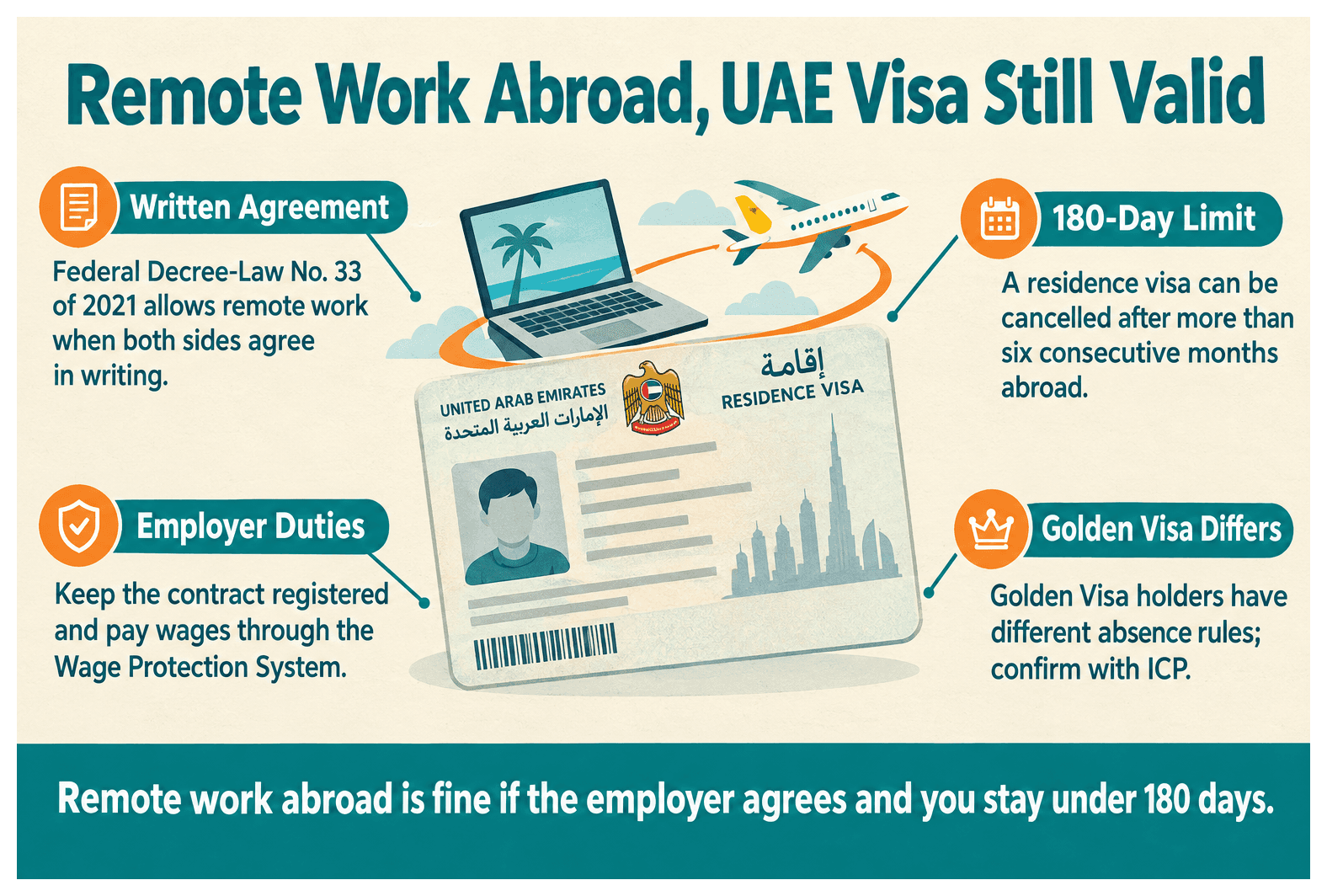
UAE labour law allows flexible and remote models when both sides agree in writing. Federal Decree-Law No. 33 of 2021, administered by MOHRE, governs the relationship, and the permit stays active while the contract is registered and valid.
What Federal Decree-Law No. 33 of 2021 Allows
It recognises flexible, part-time, temporary and remote work.
Your contract should state location, hours and reporting lines.
The employer still owes wages, insurance and end-of-service pay.
A signed remote addendum is the cleanest record.
Remote Work Scenarios and Visa Impact
Feature | Scenario | Visa Impact |
|---|---|---|
Short trip abroad under 30 days | Client visit with laptop work | No effect on residency |
Remote work abroad 3 months with employer approval | Signed addendum, wages continue | Valid; inside the 180-day limit |
Absence over 180 consecutive days | Seven months abroad, no permit | Visa can be cancelled |
Golden Visa holder working remotely abroad | Works for a UAE company from overseas | Different absence rules; confirm with ICP |
Founder with a free zone residency visa package | Self-sponsored through own license | Absence limits still apply |
Employer Obligations While Staff Work From Abroad
Keep the contract registered and pay wages through the Wage Protection System. Maintain health insurance and visa costs as sponsor. Then check tax and permanent establishment risk where the employee sits. A Dubai South Business Hub company with a developer in Europe for a month needs all three. See the employee work permit for a free zone company process.
Residency Rules That Limit Time Spent Abroad
A standard UAE residence visa can be cancelled after more than six consecutive months (180 days) outside the country without an extension permit. ICP and GDRFA enforce it, so remote work abroad must stay inside that window.
The Six-Month Absence Rule Explained
Seven months abroad can mean a cancelled visa on return. Short re-entries may reset the count, but repeated patterns attract scrutiny. Check status through ICP or GDRFA channels. Our guide on returning to the UAE after a long absence covers filing.
Exemptions and Extension Permits
Golden Visa holders follow different absence rules.
Request a re-entry permit before the period ends.
Approval isn't guaranteed.
Confirm conditions before extended travel.
Step-by-Step Guide to Keeping Your UAE Work Visa Valid While Working Remotely
To keep a UAE work visa valid while working remotely, get written approval, track days abroad, keep documents current, and act before six months. Confirm status with MOHRE, ICP or GDRFA.
Secure written approval. Get an HR-signed addendum covering location, duration and hours.
Track days outside the UAE. Log entries and exits. Flag day 150 as your warning.
Keep documents current. Renew Emirates ID, insurance and visa. Check status before booking trips.
Return or regularise. Re-enter before six months, or consider the digital nomad visa Dubai route.
Common Pitfalls That Put a UAE Work Visa at Risk
The biggest risks are exceeding the absence limit, working abroad without consent, lapsed Emirates ID or insurance, and ignoring foreign tax exposure. Each can trigger cancellation or disputes.
Unapproved Remote Arrangements
An employee who relocates without telling HR may receive a warning, and unapproved absence can count as unauthorised leave. Informal deals leave both sides exposed.
Overlooking Tax and Compliance Abroad
A sales lead working from the UK for over half a year may create tax residency or permanent establishment exposure. Take local advice in that country.
Founder-Led Alternative: Residency Through Your Own Free Zone Company
Entrepreneurs wanting independence from an employer can form a Dubai South Business Hub company and obtain a residency visa package tied to the trade license. Absence rules still apply.
How a Free Zone License Supports Your Residency
Visa eligibility links to the license and office tier, so confirm current terms with the team. Over 70% of new free zone applications are processed online (UAE Government Portal, 2026). A consultant can sponsor himself and one remote operations hire under one entity.
Where Shareholders and Remote Teams Fit
Overseas shareholders face different rules than resident founders; read the visa rules for shareholders living outside the UAE. Any remote hire holding a UAE visa still needs a valid work permit.
Why Knowing Whether an Employee Can Work Remotely and Hold a UAE Work Visa Pays Off
Understanding the rules protects residency, keeps you compliant and avoids costly cancellations under MOHRE, ICP and GDRFA requirements.
Clear policies reduce disputes and penalties.
Documented arrangements simplify audits.
You hire wider talent within the law.
Founders can plan travel around the 180-day limit.
Plan Your Next Step
So, can an employee work remotely and still hold a UAE work visa? Yes, with employer approval, a valid contract and absence kept within ICP and GDRFA limits. Speak with the Dubai South Business Hub team about a free zone company and residency visa package that gives you control of your own sponsorship.
References
Frequently Asked Questions