Topic Summary
What Is a Certificate of Incumbency UAE and Why It Matters
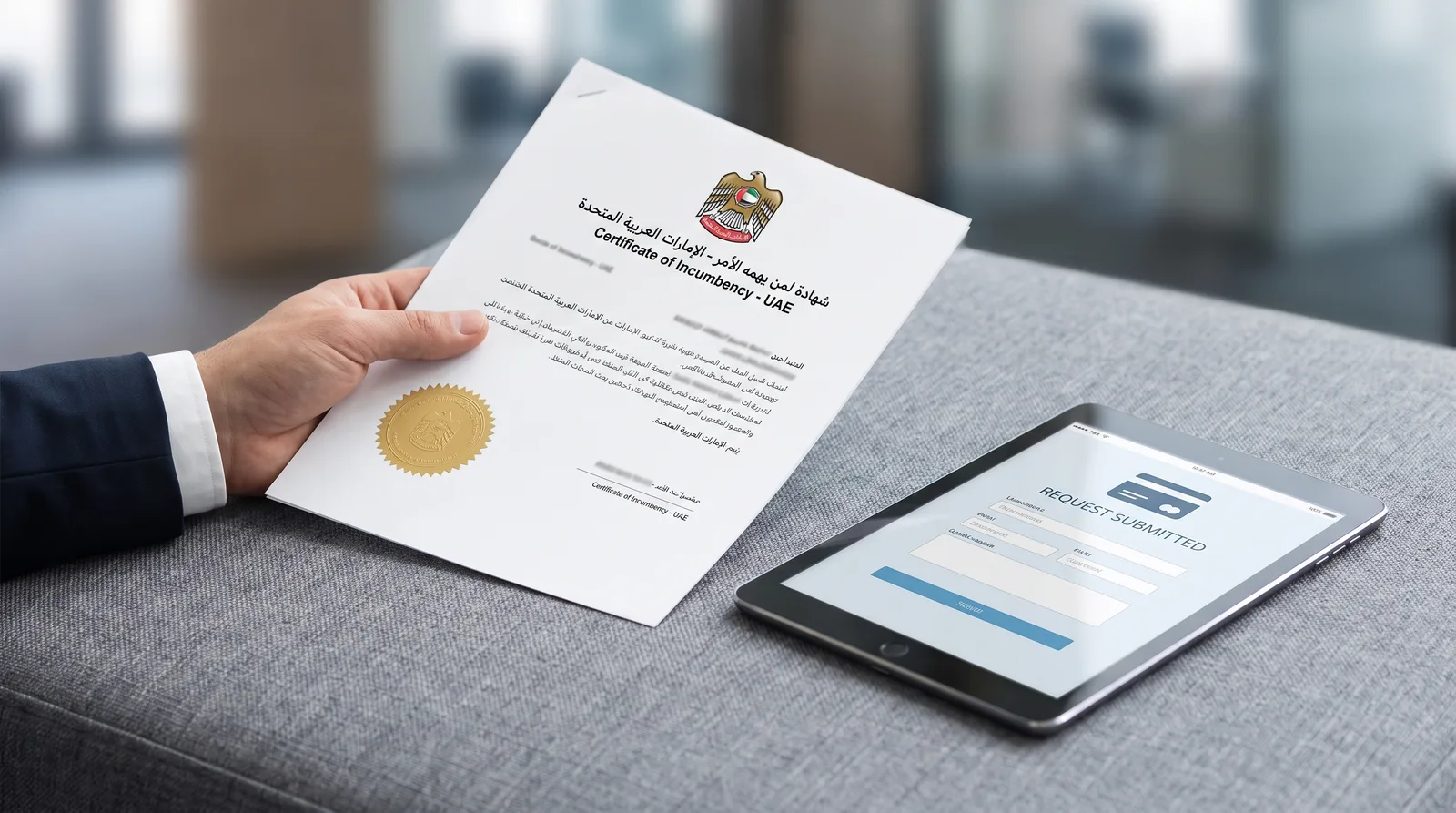
A certificate of incumbency UAE is an official document confirming a company's current directors, shareholders, and authorized signatories at the time of issue. Banks, foreign regulators, and partners request it to verify who legally represents the business before approving transactions or agreements.
Key Benefits of Certificate of Incumbency UAE for Entrepreneurs
Banks, overseas regulators, and counterparties in cross-border transactions regularly request a certificate of incumbency to confirm the company's current directors and authorised signatories. Having the document on file shortens due diligence timelines and prevents delays when opening accounts or signing international agreements.
Step-by-Step Guide to Requesting Certificate of Incumbency UAE
Requesting a certificate of incumbency UAE involves five main steps: confirming current company records, submitting a formal request to the licensing authority, paying the applicable fee, awaiting verification, and collecting the signed, stamped document, usually within three to five working days.
Typical Cost of Certificate of Incumbency UAE
Costs for a certificate of incumbency UAE generally range from AED 500 to AED 1,500, depending on the issuing free zone authority and whether expedited processing is requested. Additional attestation or translation fees may apply for international use.
Common Mistakes When Requesting Certificate of Incumbency UAE
Entrepreneurs often delay their certificate of incumbency UAE request by submitting outdated shareholder records, choosing the wrong authority, or skipping attestation steps required by the receiving institution abroad. Each mistake adds days to processing and can trigger a full resubmission.
How Dubai South Business Hub Simplifies Certificate of Incumbency UAE Requests
Dubai South Business Hub supports free zone company formation clients by coordinating document requests, including certificate of incumbency UAE applications, alongside trade license renewals and residency visa packages tied to an active company license.
In 2026, more than 750,000 active commercial licenses operate across UAE mainland and free zones (Ministry of Economy, 2024). A growing share of these license holders need formal proof of who runs the company. Roughly 3-5 working days is the typical turnaround for a certificate of incumbency UAE request [1]. Fees usually sit between AED 500 and AED 1,500 [2]. Over 40,000 new business licenses get issued across UAE free zones every year (Statista, 2025) [3]. Banks in more than 100 countries accept this document as proof of signatory authority [4]. Dubai alone processed over 55,000 new business registrations in 2024 (Dubai Chamber of Commerce) [5]. That's a lot of companies needing one small, powerful document.
This guide explains what a certificate of incumbency UAE actually confirms, what it costs, which authority issues it, and the exact steps to request one without delays.
What Is a Certificate of Incumbency UAE and Why It Matters
A certificate of incumbency UAE is an official document confirming a company's current directors, shareholders, and authorized signatories at the time of issue. Banks, foreign regulators, and partners request it to verify who legally represents the business before approving transactions or agreements.
Core Purpose of the Document
Think of a certificate of incumbency UAE as a dated snapshot, not a permanent record. Unlike a certificate of incorporation in the UAE, which proves the company exists, this one confirms who's currently authorized to act on its behalf. A Dubai South Business Hub client needed one to open a correspondent account with an overseas bank. Without it, the bank wouldn't process the wire transfer. With over 750,000 active licenses in the UAE, demand for this kind of verification keeps rising every quarter.
Who Typically Requests It
Foreign banks verifying signatory authority before releasing funds
International joint-venture partners checking legal standing
Government tenders abroad requiring proof of active directors
Insurance underwriters assessing corporate risk profiles
A free zone trading firm bidding for a tender in Europe often hits this requirement first. European procurement portals frequently list it as a mandatory attachment.
Certificate of Incumbency vs Certificate of Incorporation
Feature | Certificate of Incumbency | Certificate of Incorporation |
|---|---|---|
Purpose | Confirms current directors and signatories | Confirms the company legally exists |
Validity period | Valid only as a dated snapshot, usually 3-6 months | Valid indefinitely once issued |
Typical requester | Banks, foreign regulators, JV partners | Investors, courts, government registries |
Issuing authority | Free zone registrar or DED | Free zone authority or DED at formation |
Renewal frequency | Re-requested each time a bank or partner asks | Issued once, referenced repeatedly |
Key Benefits of Certificate of Incumbency UAE for Entrepreneurs

A certificate of incumbency UAE speeds up bank onboarding, reassures overseas partners, and satisfies due-diligence checks without releasing full corporate records. It acts as a snapshot credential rather than a complete company file, saving time on recurring verification requests.
Faster Bank Account Approvals
Banks accept it as proof of signatory authority, which reduces repeated document requests during account opening. We've seen corporate account openings stall for weeks purely because of missing incumbency proof, then clear within days once it's submitted. It pairs well with the shareholder documents every Dubai company must keep on file.
Stronger Credibility with Foreign Partners
Signals active legal standing to overseas counterparts
Supports cross-border contract negotiations
Strengthens due-diligence files during M&A talks
Reassures suppliers before extending credit terms
A manufacturing distributor onboarding a European supplier often needs this exact document before the supplier releases a first shipment on credit.
Step-by-Step Guide to Requesting Certificate of Incumbency UAE
Requesting a certificate of incumbency UAE involves five main steps: confirming current company records, submitting a formal request to the licensing authority, paying the applicable fee, awaiting verification, and collecting the signed, stamped document, usually within three to five working days.
Step 1: Verify Current Company Records
Check shareholder and director accuracy first
Update any pending changes before applying
Confirm the trade license is still valid
A company we worked with updated a director record a week before applying, which saved it from a rejected submission.
Step 2: Submit the Formal Request
Apply through the licensing authority's portal
Attach a license copy and passport details
State the certificate's intended purpose clearly
James, a UK founder running a logistics consultancy from a Dubai free zone, submitted his request alongside a license copy and shareholder register, specifying it was for a German bank account.
Step 3: Pay Fees and Await Processing
Fees typically range AED 500 to 1,500
Processing averages 3-5 working days
Expedited service may cost extra
James paid AED 850 and received his stamped certificate in four working days, well within his bank's deadline.
Typical Cost of Certificate of Incumbency UAE
Costs for a certificate of incumbency UAE generally range from AED 500 to AED 1,500, depending on the issuing free zone authority and whether expedited processing is requested. Additional attestation or translation fees may apply for international use.
What Really Drives Your Final Bill?
The base fee is set by the registrar and varies by free zone authority. Some packages bundle incumbency certificates into annual compliance plans, which can lower the per-document cost. Others charge each time. A trading company requesting a fresh certificate every quarter for recurring supplier contracts will pay far more over a year than one requesting it once annually.
Extra Costs for International Use
Notarization charges for foreign use
Translation fees for non-English markets
Courier delivery costs for overseas recipients
Embassy legalization in certain jurisdictions
A company sending its certificate for attestation before use overseas should budget an extra AED 300-600 depending on the destination country, plus courier charges. The Wathiq corporate verification services process can also apply here when extra authentication layers are needed.
Common Mistakes When Requesting Certificate of Incumbency UAE
Entrepreneurs often delay their certificate of incumbency UAE request by submitting outdated shareholder records, choosing the wrong authority, or skipping attestation steps required by the receiving institution abroad. Each mistake adds days to processing and can trigger a full resubmission.
Is an outdated shareholder record a common reason for rejection?
Yes, it's the most common cause of delay. Registrars reject applications when shareholder names don't match current filings. Fixing this first saves a resubmission cycle.
Outdated Corporate Records
Unregistered director changes trigger rejection
An expired license blocks the request entirely
Mismatched shareholder names cause delays
One firm had to resubmit after a shareholder exit went unrecorded for months, pushing the whole process back by nearly two weeks.
Skipping Attestation Requirements
Some receiving banks require a notarized copy
Translation is needed for non-Arabic markets
Certain countries demand embassy legalization
Check the receiving institution's exact requirements before submitting, not after. It's worth flagging this early with whoever's requesting the document. For broader context, see the certificate of good standing for a UAE company, which often gets requested alongside incumbency proof.
How Dubai South Business Hub Simplifies Certificate of Incumbency UAE Requests
Dubai South Business Hub supports free zone company formation clients by coordinating document requests, including certificate of incumbency UAE applications, alongside trade license renewals and residency visa packages tied to an active company license.
Coordinated Document Handling
We align incumbency requests with license renewals wherever possible, which reduces back-and-forth with the registrar. Keeping shareholder records current year-round means fewer surprises when a bank suddenly asks for proof next month. A client renewing a trade license and requesting incumbency proof in the same cycle avoided submitting duplicate paperwork twice.
Support Across the Company Lifecycle
From formation through ongoing compliance checks
Residency visa package coordination tied to the license
Document follow-up services for pending registrar requests
A founder setting up a new free zone trading company can bundle formation, licensing, and residency visa steps, then request the document verification follow-up services once operations are underway.
A certificate of incumbency UAE is a small document with outsized impact on bank approvals, international deals, and due-diligence checks. Knowing its cost and process keeps your company moving without unnecessary delays.
Follow up with Dubai South Business Hub to coordinate your certificate of incumbency UAE alongside your company formation and licensing needs.
References
Frequently Asked Questions