
Topic Summary
Know When a Payment Is Legally Late
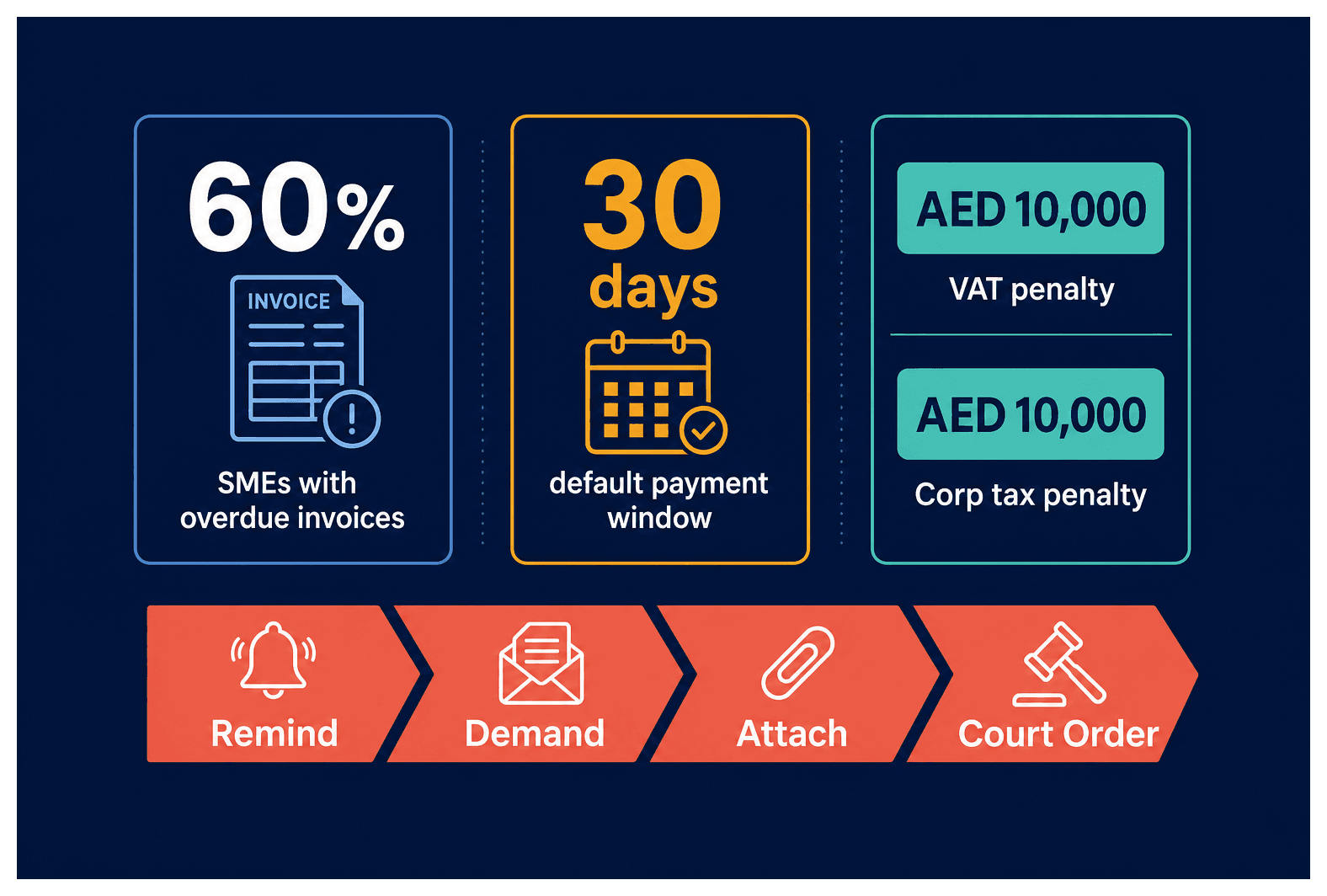
Under UAE Civil Transactions Law (Federal Law No. 5 of 1985), a payment is overdue the day after its agreed due date. If no date is specified, a 30-day default window applies automatically from delivery or service completion.
Always Include an Explicit Interest Rate
UAE Commercial Transactions Law allows interest claims on overdue invoices, but courts default to the Central Bank reference rate if your contract is silent. Specifying your own rate in writing almost always results in a higher, more protective figure.
Written Contracts Are Your Primary Evidence
Without a signed contract or accepted purchase order, proving the agreed payment date in court becomes significantly harder. Verbal assurances and informal schedules leave you exposed if a dispute escalates.
Freeze Assets Before Judgment With Precautionary Attachment
UAE courts allow creditors to apply for a precautionary attachment order that freezes a debtor's assets before a judgment is even issued. This is a powerful early tool that prevents a debtor from moving funds out of reach.
Use Dubai Courts' Payment Order for Undisputed Debts
For clear-cut, undisputed debts, Dubai Courts' payment order process can produce an enforceable court order within days. It is one of the fastest formal recovery routes available to UAE creditors.
Free Zone Status Doesn't Shield You From Civil Debt Rules
Free zone companies transacting with mainland entities fall under the same civil debt recovery framework as any other UAE business. Your free zone license creates no separate legal bubble when it comes to payment disputes.
Late Tax Registration Adds Penalties on Top of Debt Stress
VAT late registration carries a flat AED 10,000 penalty, and corporate tax late registration triggers a separate AED 10,000 one-time penalty. Cash flow disruption from overdue invoices can push founders into missing these deadlines, compounding the financial damage.
More than 60% of UAE SMEs report at least one overdue invoice at any given time, making cash flow disruption one of the most persistent threats to early-stage businesses in the region. The UAE Civil Transactions Law (Federal Law No. 5 of 1985) sets a 30-day default payment window [1]. VAT late registration carries a flat AED 10,000 penalty (Federal Tax Authority, 2026) [2]. Corporate tax late registration triggers a separate AED 10,000 one-time penalty [3]. Court-backed precautionary attachments can freeze a debtor's assets before judgment is issued [4]. And for undisputed debts, Dubai Courts' payment order process can produce an enforceable order within days [5].
This guide walks you through what chasing late payments in the UAE actually involves, your legal rights as a creditor, the step-by-step recovery process, the costs you'll face, and how to protect your business from repeat exposure.
What Is Chasing Late Payments as a UAE Business and Why It Matters
Chasing late payments as a UAE business means formally pursuing a client or counterparty who has not settled an invoice by its agreed due date. It covers pre-legal reminders, structured demand letters, and court-backed debt recovery under UAE civil and commercial law.
How UAE Law Defines a Late Payment
A payment becomes overdue the day after its contractually agreed due date. If no date is specified, the 30-day default rule under UAE Civil Transactions Law (Federal Law No. 5 of 1985) applies automatically. That means the clock starts ticking from day one of delivery or service completion, not from when you get around to chasing it.
Commercial invoices between businesses fall under the UAE Commercial Transactions Law, which allows statutory interest claims on overdue amounts. Free zone companies transacting with mainland entities are subject to the same civil debt recovery framework, your free zone license doesn't create a separate legal bubble for payment disputes.
Consider a practical example: a Dubai-based consultancy issues an AED 50,000 invoice with net-30 terms. If it's unpaid by day 31, the debt is legally overdue and the creditor can begin a formal demand process immediately, with interest accruing from that date.
Why Founders Underestimate the Risk
Many first-time founders rely on verbal assurances and informal payment schedules, leaving them without written evidence when disputes arise.
Without a signed contract or accepted purchase order, proving the agreed payment date in court becomes significantly harder.
Late payments compound fast when VAT return cycles and payroll deadlines collide, making cash flow tighter than any spreadsheet projected.
A sole founder running a services business can find their single largest client is 45 days overdue, representing 70% of that month's expected revenue, a position that's genuinely dangerous without a cash reserve.
Getting your contracts and invoicing right from day one is the most effective protection. Our business support services include contract and invoice template guidance for founders setting up for the first time.
Your Legal Rights When Chasing Late Payments in the UAE
As a UAE business creditor, you have the right to claim the outstanding principal, contractual interest, and reasonable recovery costs under UAE civil and commercial law. You can also apply for a precautionary attachment order to freeze a debtor's assets before a judgment is issued.
Contractual Interest and Penalty Clauses
UAE Commercial Transactions Law permits interest on overdue commercial debts. The rate must be specified in your contract; if it isn't, the court defaults to the Central Bank of UAE reference rate, which is almost always lower than what you'd want. That's reason enough to always include an explicit rate in your standard terms.
Penalty clauses agreed in writing are enforceable, though UAE courts can and do reduce penalties they consider disproportionate to the actual loss. A trading company that includes a 12% per annum late payment clause in its supply agreement is in a strong position: when the buyer defaults, that clause is cited in the demand letter and can be upheld through Dubai Courts' payment order process. Without it in writing, you're relying on judicial discretion alone.
Precautionary Attachment Orders
A precautionary attachment (known in Arabic as hajz tahtiyati) allows you to freeze a debtor's bank accounts or assets before a final judgment, preventing asset dissipation.
You apply to the relevant court ex parte, without notifying the debtor first, and must show a prima facie debt claim supported by documentary evidence.
The order is temporary. A full substantive case must follow within the court's specified timeframe, or the attachment lapses automatically.
This tool is particularly valuable when the debtor is showing signs of relocating assets or winding down operations.
A UAE supplier who suspects their client is transferring funds offshore can apply for a precautionary attachment through Dubai Courts, freezing the client's account while the substantive case proceeds. It's one of the most powerful tools available to creditors chasing late payments in the UAE, and it's underused by founders who don't know it exists.
Step-by-Step Guide to Chasing Late Payments in the UAE
Chasing late payments in the UAE follows a clear escalation path: send a formal reminder, issue a legal demand letter via a notary or lawyer, attempt mediation, file a payment order or civil claim, and enforce any judgment through court execution. Each step is governed by UAE civil procedure rules.
Step 1: Send a Formal Written Reminder
Send a written reminder by email and WhatsApp on day one of the overdue period. Screenshot delivery receipts and save read confirmations, every piece of evidence matters later.
Reference the invoice number, total amount, original due date, and the exact number of days overdue. Vague reminders are easy to ignore.
Keep the tone professional and solution-oriented. Many late payments resolve at this stage, particularly where the delay is administrative rather than intentional.
Set a firm response deadline of five to seven business days. Open-ended reminders invite indefinite delay.
Step 2: Issue a Legal Demand Letter
If the reminder is ignored, instruct a UAE-licensed lawyer or notary public to issue a formal demand letter (known as an inkhar rasmi).
The letter must state the amount owed, the legal basis for the claim, the interest accruing daily, and a final payment deadline, typically 15 calendar days.
A notarised demand letter creates an official record that UAE courts treat as evidence of your good-faith attempt to resolve the dispute before litigation.
Fees for a demand letter from a UAE law firm vary by complexity, confirm current rates directly with your chosen firm before instructing.
Step 3: Attempt Mediation or File a Court Claim
Dubai Courts require most civil disputes to pass through the Centre for Amicable Settlement of Disputes before a judge hears the substantive case.
If mediation fails or the debtor ignores the process, file a payment order application for undisputed debts, it's faster and cheaper than a full civil suit.
A consultancy with an AED 80,000 undisputed invoice can file a payment order through Dubai Courts; the order is often issued within days, and many debtors pay within the objection window to avoid enforcement action.
For disputed debts above the payment order threshold, a substantive civil claim is required; hearing timelines typically run three to nine months depending on complexity.
Free zone companies can also access their free zone's own dispute resolution body for counterparties within the same zone, check your free zone's arbitration rules before defaulting to the civil courts.
Step 4: Enforce the Judgment
Once a judgment or payment order is final, apply to the Execution Court to enforce it against the debtor's bank accounts, assets, or receivables.
The Execution Court can instruct banks directly to transfer funds to satisfy the judgment, no further debtor cooperation is required.
If the debtor is a company, enforcement can extend to directors' personal assets in cases of fraud or deliberate evasion under UAE law.
Court enforcement fees are calculated as a percentage of the judgment amount, confirm the current rate with Dubai Courts at the time of filing.
How Late Payments Affect Your VAT and Tax Obligations
Late payments do not pause your UAE VAT obligations. VAT is due to the Federal Tax Authority on the earlier of the invoice date or payment receipt, meaning you may owe VAT on revenue you have not yet collected. Corporate tax late registration carries a one-time AED 10,000 penalty.
Late Payment Recovery Options in the UAE: Cost and Timeline Comparison
Recovery Method | Estimated Cost | Typical Timeline |
|---|---|---|
Formal written reminder (self-managed) | AED 0, your time only | 1 to 7 business days; resolves many disputes without escalation |
Notarised legal demand letter | Notary: AED 300 to 800; lawyer drafting fees vary, confirm with your firm | Letter issued within 2 to 5 days; debtor given 15-day response window |
Mediation, Centre for Amicable Settlement | Low filing fee; confirm current rate with Dubai Courts directly | Sessions typically scheduled within 2 to 4 weeks of filing |
Payment order application (undisputed debt) | Court filing fee as a percentage of claim value, confirm current rate with Dubai Courts | Order often issued within days; debtor has a short objection window |
Full civil court claim | Court filing fee (percentage of claim) plus lawyer fees for representation | 3 to 9 months to judgment depending on complexity and court schedule |
Execution Court enforcement | Percentage of judgment amount, confirm current rate with Dubai Courts | Weeks to months; banks can be instructed directly without debtor cooperation |
VAT on Unpaid Invoices
Under UAE VAT law, the tax point is the earlier of the date of supply, invoice date, or payment receipt. That means you account for output VAT before you've actually collected the cash. A UAE services company that raises an AED 100,000 invoice inclusive of 5% VAT in January, with the client paying in April, owes the VAT element (AED 4,762) on the January return. That's a real cash flow gap, and it's one that catches founders off guard.
If a debt is eventually written off as bad, you may be eligible to recover the VAT element through a bad debt adjustment, subject to conditions set by the Federal Tax Authority. Those conditions include a minimum period of overdue status and evidence that you've taken reasonable steps to recover the debt. For banking and taxation support on VAT return preparation and bad debt adjustments, speak to a specialist early, not after you've already filed incorrectly.
Corporate Tax Considerations
Corporate tax late registration is a one-time flat penalty of AED 10,000, not a recurring monthly charge, so registering late once doesn't spiral into ongoing fines.
Late payments received in a different tax period from when they were invoiced may affect your taxable income calculation for that period, track the timing carefully.
Founders operating as Qualifying Free Zone Persons (QFZPs) must satisfy all four conditions to benefit from the 0% rate on qualifying income: qualifying income, adequate economic substance, transfer pricing compliance, and no opt-in to the mainland tax regime.
Is VAT recoverable on a bad debt in the UAE?
Yes, subject to Federal Tax Authority conditions. The debt must be written off in the creditor's accounts, a minimum period must have elapsed since the original supply, and the creditor must have taken reasonable recovery steps. The adjustment is made on a subsequent VAT return, not by amending the original filing.
Costs Involved in Chasing Late Payments in the UAE
Recovery costs in the UAE range from minimal for self-managed reminders to several thousand dirhams for legal demand letters and court filing fees. Court filing fees are typically calculated as a percentage of the claim value, with a minimum floor set by the relevant court.
Pre-Legal and Legal Fees
Formal demand letter via a UAE-licensed lawyer: fees vary by firm and complexity, request a quote before instructing.
Notary public fees for attesting demand letters: typically in the low hundreds of dirhams, confirm the current schedule with your chosen notary.
Mediation filing at the Centre for Amicable Settlement of Disputes: confirm the current filing fee directly with Dubai Courts, as these are updated periodically.
Civil court filing fee: calculated as a percentage of the claim amount with a minimum floor, always verify current rates with Dubai Courts before filing, as fee schedules can change.
Weighing Recovery Cost Against Claim Value
For claims below AED 20,000, the cost of full litigation can approach or exceed the debt itself. A founder with an AED 15,000 overdue invoice who calculates that full litigation would consume AED 8,000 to AED 12,000 in fees is better served by a notarised demand letter followed by a direct settlement offer at a 10% discount, the net recovery is higher and the process takes weeks rather than months.
For larger claims, the investment in a lawyer and court process is almost always justified, particularly when a precautionary attachment is available to protect the asset base. Some UAE law firms offer contingency or partial-contingency arrangements for commercial debt recovery, ask explicitly during your initial consultation rather than assuming a fixed-fee model. And factor in management time as a real cost: every hour spent chasing late payments in the UAE is an hour not spent generating new revenue.
How to Protect Your UAE Business from Late Payments
Preventing late payments in the UAE starts with watertight contracts, clear invoice terms, and upfront deposits. Requiring partial payment before delivery, running credit checks on new clients, and issuing invoices the same day work is completed all reduce your exposure significantly.
Contracts and Invoice Discipline
Every engagement, however small, needs a signed contract or accepted purchase order specifying the payment due date, late payment interest rate, and governing law (UAE).
Issue invoices on the same day as delivery or service completion. Delayed invoicing is the most common self-inflicted cause of late payment, and it weakens your legal position on the start date for interest.
State payment terms prominently on the invoice face: "Payment due within 30 days of invoice date" leaves no room for interpretation. Don't bury it in the footer.
Use sequential invoice numbering and a tracking log so overdue items are flagged automatically rather than discovered by accident three months later.
A UAE-based ICT company that switches from 45-day net terms to 30-day net terms with a 5% upfront deposit for all new clients can see average days-to-payment drop by 12 days in the following quarter, purely through process change, with no legal action required.
Client Vetting and Payment Milestones
Run a basic credit check or ask for trade references before extending credit to a new client, particularly for contracts above AED 50,000.
Structure larger projects with milestone payments: typically 30% upfront, 40% at mid-point, 30% on completion. This limits your maximum exposure at any one time to a fraction of the total contract value.
For international clients, consider requiring payment in advance or using a letter of credit arranged through your UAE bank, it transfers the credit risk to the banking system rather than leaving it with you.
If you haven't yet formalised your business structure, that's the starting point for everything else. You can't issue tax-compliant invoices or open a business bank account without a valid license. Start your business at Dubai South Business Hub Free Zone, where a license starts from AED 12,500 and can be issued in one business day.
What's the fastest way to reduce late payment risk in the UAE?
Require a partial upfront deposit, typically 30%, before beginning any work. Combined with a signed contract specifying UAE governing law and a written late payment interest rate, this single change reduces both the frequency and the impact of overdue invoices without requiring any legal action.
Chasing late payments as a UAE business is a structured process with clear legal tools available at every stage, from a written reminder through to court-enforced judgment. The founders who recover fastest are the ones who invest in prevention first: solid contracts, same-day invoicing, milestone payments, and a disciplined escalation policy from day one of any overdue balance.
If you're still in the process of formalising your business structure, getting the right license in place is the foundation for everything that follows, including issuing legally compliant invoices and opening a business bank account. Explore your business activities in Dubai at Dubai South Business Hub Free Zone, where a license starts from AED 12,500 and is issued in one day.
References
Frequently Asked Questions