
Topic Summary
Budget for Two Visas From Day One
Each founder requires a separate residency visa, and visa costs are additive rather than bundled into the base license fee. Planning both applications before finalising your first-year cash flow prevents surprise shortfalls after incorporation.
Choose a Package Built for Two Shareholders
The shareholder register must reflect both founders at incorporation, not added later. Amending the structure after formation triggers additional government fees that are entirely avoidable with upfront planning.
List Every Activity on the License at Setup
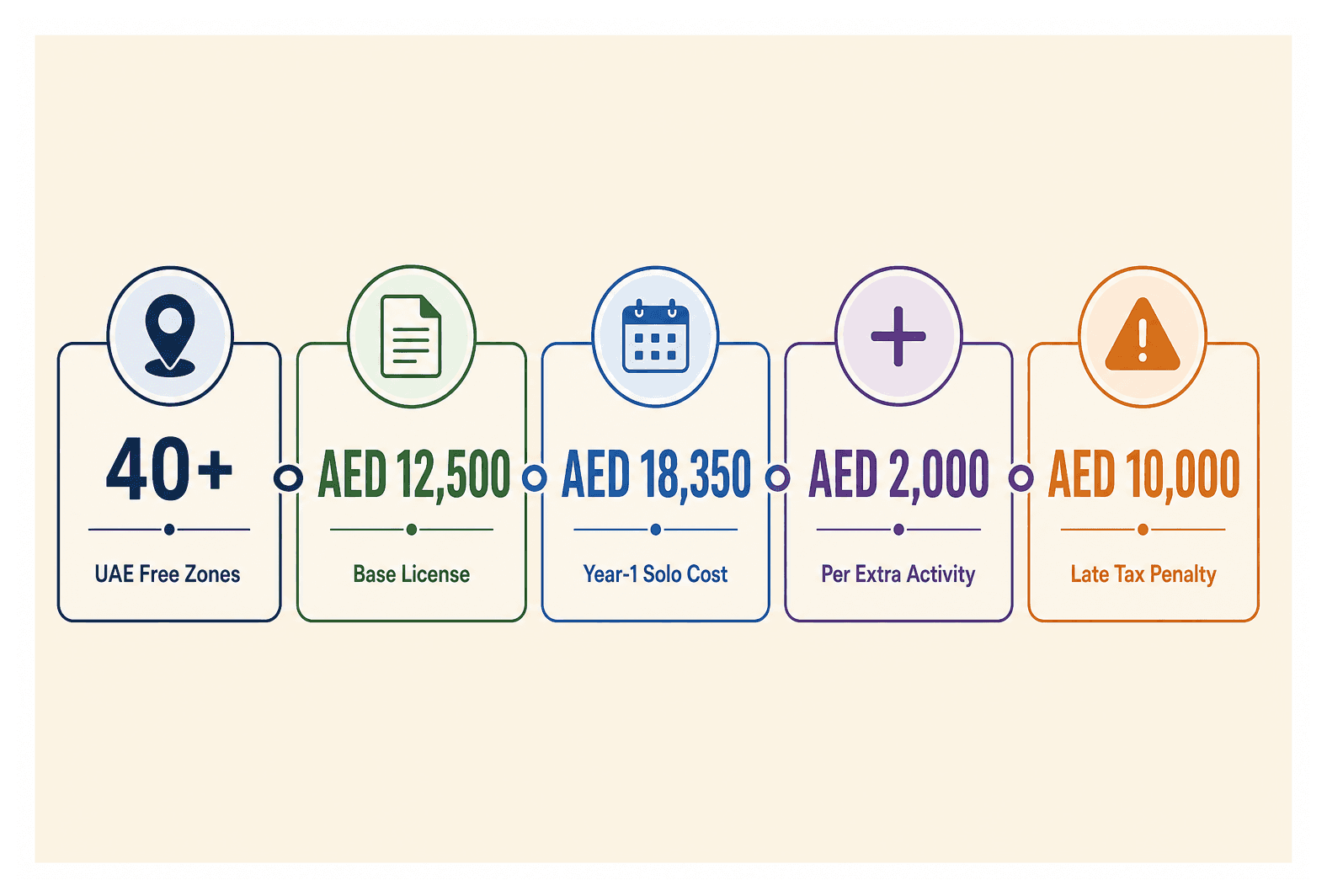
If one founder handles technology delivery and the other handles business development, both activities should appear on the license from day one. Adding an activity later costs AED 2,000 per activity beyond the first five included.
Understand the Real Baseline Cost
Dubai South Business Hub Free Zone licenses start from AED 12,500, but a sole founder with one visa starts from AED 18,350 in year one. A two-person startup must add the second founder's visa cost on top of that figure.
Register for Corporate Tax Without Delay
Late corporate tax registration carries a one-time AED 10,000 flat penalty from the Federal Tax Authority. Completing registration early is one of the simplest compliance steps a new startup can take to avoid an unnecessary cost.
Don't Confuse Duty Suspension With Duty Exemption
Free zone goods operate under duty suspension, meaning standard customs duties apply if products move onto the UAE mainland. Any startup planning to sell physical goods to mainland customers must factor this into its pricing model.
Verify That 100% Foreign Ownership Is Already Your Right
Full foreign ownership is available across UAE free zones and the mainland under Federal Decree-Law No. 26 of 2020, not a special free zone perk. Knowing this prevents founders from overpaying for packages that market ownership rights as a premium feature.
In 2026, more than 40 free zones operate across the UAE (u.ae, 2026). Licenses at Dubai South Business Hub Free Zone start from AED 12,500. First-year costs for a sole founder with one visa start from AED 18,350. Each activity beyond the first five costs AED 2,000. Late corporate tax registration carries a one-time AED 10,000 flat penalty (Federal Tax Authority, 2026). Yet first-time founders consistently overpay or under-plan because they select a package built for a solo operator rather than a two-person team. Choosing a free zone Dubai setup that accounts for two founders from day one saves you from costly visa amendments, additional share-transfer fees, and compliance gaps before your first invoice goes out.
This guide walks you through the exact requirements, realistic costs, and step-by-step process for choosing a free zone Dubai package that fits a two-person startup in 2026, using verified figures from Dubai South Business Hub Free Zone, which launched in September 2025.
What Is a Free Zone Package and Why It Matters for a Two-Person Startup
A free zone package is a bundled company formation product that includes a trade license, a legal entity structure, and optional visa allocations issued by a UAE free zone authority. For a two-person startup, the right package covers both founders under one license with separate visa entitlements and zero paid-up share capital requirements. Getting this right at incorporation is far cheaper than correcting it later.
How Free Zone Packages Are Structured
A standard free zone package bundles three core components: a license category (trading, service, or industrial), a legal entity type (typically an FZ-LLC or a branch of an existing company), and a visa quota. That quota tells you how many residency visas the license can sponsor. Worth flagging here: visa allocations are always priced separately from the base license fee. No free zone includes visas in its headline license price, and any quote that implies otherwise deserves a closer read.
Free zone goods also operate under duty suspension, not duty exemption. If you move goods from the free zone onto the UAE mainland, standard customs duties apply. That distinction matters for any startup planning to sell physical products to mainland customers.
Dubai South Business Hub Free Zone, which launched in September 2025, issues licenses from AED 12,500 with a one-day issuance turnaround. Two co-founders starting a digital marketing consultancy, for example, select a service license at AED 12,500, then each adds a two-year investor residency visa separately. The first-year baseline for a sole founder with one visa starts from AED 18,350; the second founder's visa is an additional cost on top of that figure.
Why Two Founders Change the Calculation
The moment you add a second founder, three things change. First, each founder requires a separate residency visa, so visa costs are additive from day one. Budget for both applications individually before you finalise your first-year cash plan.
Second, the share structure must reflect two shareholders at incorporation. Amending the shareholder register after the company is formed triggers additional government fees that are entirely avoidable with upfront planning.
Third, the activity scope at incorporation determines what both founders can legally invoice for. If co-founder A handles technology delivery and co-founder B handles business development, both activities should appear on the license at setup. Adding an activity later costs AED 2,000 per activity beyond the first five. Zero paid-up share capital is required, so there's no capital-deposit hurdle to clear. And 100% foreign ownership is available both in free zones and on the UAE mainland; it's a UAE-wide right under Federal Decree-Law No. 26 of 2020 and is unrelated to free zone or designated-zone status.
Key Requirements for Choosing a Free Zone Dubai Package
To set up a company in Dubai as a two-person free zone entity, you need valid passports for both founders, a chosen legal activity list, a registered trade name, and individual visa applications for each shareholder. No paid-up share capital is required at Dubai South Business Hub Free Zone, and regulated activities need approval from the named regulator in addition to the free zone license itself.
Document Requirements for Both Founders
Each founder submits their documents independently. The core checklist is:
Valid passport with a minimum of six months' remaining validity; copies of the bio-data page required at application
Passport-size photographs meeting UAE biometric standards for each applicant
No-objection letter or salary certificate if either founder currently holds a UAE employment visa
Business plan or activity description for certain regulated sectors, where requested
A British and an Indian co-founder setting up a tech startup both submit passport copies and photographs. Neither needs a no-objection letter if they're currently on visit visas. Both founders submit independently, and the Immigration and Citizenship Authority (ICP) manages entry permits and Emirates ID issuance (icp.gov.ae, 2026).
Activity and Name Registration Requirements
You can select up to five business activities in Dubai under one license at no extra cost. Each activity beyond five costs AED 2,000. Choose carefully at setup; it's the most cost-effective moment to get the list right.
Trade names must comply with UAE naming rules: no offensive terms, no reference to external political entities, and no names identical to existing registrations (UAE Ministry of Economy, 2026). Run a trade name availability search before paying any government fees to avoid rejection delays.
Regulated activity callout: Regulated activities such as healthcare, education, or financial services require the free zone to license the activity AND the named regulator to grant a separate operational approval. For example, a two-person e-learning startup lists "online education" as an activity; Dubai South Business Hub Free Zone licenses the activity, and KHDA (Knowledge and Human Development Authority) approval is required separately before the platform can operate. The same principle applies to healthcare (DHA) and financial services (CBUAE).
Tax and Compliance Registration Thresholds
VAT registration is mandatory once taxable supplies exceed AED 375,000 in any 12-month period. Late registration carries an AED 10,000 penalty (Federal Tax Authority, 2026). Corporate tax registration is required for all UAE legal entities regardless of profit level; the late registration penalty is a one-time flat AED 10,000, not a monthly charge.
Free zone companies may qualify as Qualifying Free Zone Persons (QFZP) for a 0% corporate tax rate on qualifying income, but only if they meet all four conditions: adequate substance in the UAE, qualifying income as defined by the Federal Tax Authority, no mainland permanent establishment, and compliance with transfer-pricing rules. Two founders earning AED 200,000 combined in year one are below the VAT threshold but must still complete corporate tax registration before the statutory deadline. Never describe a free zone as tax-free; obligations exist and deadlines are enforced.
Two-Person Startup Free Zone Cost Summary: Dubai South Business Hub Free Zone
Cost Item | Amount (AED) |
|---|---|
Base trade license (standard rate) | From AED 12,500 |
Base trade license (B2C rate) | AED 12,500 |
First-year cost: sole founder + one visa (baseline) | From AED 18,350 |
Second founder visa (additional cost) | Additional, priced separately on top of baseline |
Each activity beyond first five | AED 2,000 per activity |
Paid-up share capital required | AED 0 (zero required) |
Late VAT or corporate tax registration penalty | AED 10,000 each (corporate tax: one-time flat) |
Cost Breakdown for a Two-Person Startup Free Zone Setup
At Dubai South Business Hub Free Zone, a base license starts from AED 12,500. A sole founder with one visa costs from AED 18,350 in year one. A two-person startup adds a second visa on top of that baseline. Each activity beyond the first five adds AED 2,000, and zero paid-up share capital is required. Understanding the additive structure upfront prevents budget surprises.
License and Entity Formation Fees
Dubai South Business Hub Free Zone licenses start from AED 12,500. This base fee covers the legal entity formation and up to five business activities. Zero paid-up share capital is required; no funds need to be deposited or blocked at incorporation. The license is issued in one business day once documents are verified.
Two co-founders incorporating a consulting firm pay the AED 12,500 license fee and receive their trade license the next working day with no capital deposit required. That one-day turnaround is a genuine operational advantage when you're trying to open a bank account and start trading quickly. The free zone license cost in Dubai calculator at Dubai South Business Hub Free Zone lets you model your specific activity and visa combination before committing.
Visa Costs for Two Founders
The first-year cost for a sole founder with one investor residency visa starts from AED 18,350. That's the published baseline. The second founder's visa is always an additional cost on top; visas are never described as included in any license package.
Visa fees cover four distinct government-fee stages: the entry permit, the medical fitness test, Emirates ID biometrics, and the residency stamp. Each stage carries a separate charge. Startup co-founders Ahmed and Sara each require their own investor visa; Ahmed's visa brings the first-year total to AED 18,350 from the license baseline, and Sara's visa is costed separately on top. Check current ICP entry permit and Emirates ID fee schedules at icp.gov.ae before finalising your budget, as government fee schedules are updated periodically. You can also review UAE residency visa options through Dubai South Business Hub Free Zone's residency services channel.
Step-by-Step Guide to Setting Up Your Two-Person Free Zone Company
Setting up a two-person free zone company in Dubai involves six ordered steps: confirm your activity list, check your trade name, submit incorporation documents for both founders, receive your license, apply for each founder's residency visa separately, and complete tax registration. Each step has a defined document requirement and government fee. Here's how each one works in practice.
Step 1: Confirm Activities and Select Your License Type
List every revenue-generating activity both founders will perform. Cross-reference the approved activity list to confirm availability before you proceed.
Choose your license type: a professional license in Dubai covers consultancy and professional services; a trading license covers buying and selling goods; combinations are available depending on your model.
If any activity is regulated, identify the relevant regulator at this stage. Map the dual-approval timeline before you commit to a launch date.
Keep the list to five activities or fewer at launch. This keeps you within the base license fee. Add activities later at AED 2,000 each if the business evolves.
A two-person SaaS startup, for example, selects "software development" and "IT consultancy" under an ICT license in Dubai. Both activities fit within the first five at no extra cost, and neither triggers a secondary regulator requirement.
Step 2: Reserve Your Trade Name and Submit Incorporation Documents
Run a trade name availability search before paying any fees. A rejected name costs you time, not just money.
Submit passport copies, photographs, and any required supporting documents for both founders simultaneously. Sequential submission delays the process unnecessarily.
Dubai South Business Hub Free Zone issues the license in one business day once the document set is complete and verified.
The Memorandum of Association reflects both founders' shareholding at this stage. Agree the equity split before submission; amending it post-incorporation costs additional government fees.
Co-founders who submit their full document packs together on a Monday morning typically receive their license by Tuesday, with both names on the Memorandum of Association and the company ready to open a bank account.
Step 3: Apply for Residency Visas and Complete Tax Registration
After the license is issued, each founder applies for their investor residency visa independently through the free zone's residency service channel.
Each visa process covers four stages: entry permit, medical fitness test, Emirates ID biometrics, and residency stamp. Budget time for each stage separately.
Register for corporate tax with the Federal Tax Authority before the statutory deadline. The one-time late registration penalty is AED 10,000 (Federal Tax Authority, 2026).
Register for VAT if projected taxable supplies will exceed AED 375,000 within 12 months. Late VAT registration also carries an AED 10,000 penalty.
Open a UAE business bank account once the license and Emirates IDs are in hand. Most banks require both documents before they'll proceed.
Both founders typically complete their Emirates ID biometrics within two weeks of license issuance. They then use the trade license and their individual Emirates IDs to open a business account. Dubai South Business Hub Free Zone's bank account opening in Dubai support service can help coordinate this step.
Five Common Mistakes Founders Make When Choosing a Free Zone Dubai Package
The five most common mistakes when choosing a free zone Dubai package are: budgeting only the license fee and forgetting visa costs, listing too few activities at incorporation, assuming designated-zone customs benefits apply, missing corporate tax registration deadlines, and not confirming regulated-activity dual-approval requirements before launch. Each mistake is avoidable with the right preparation.
Underestimating Total First-Year Costs
Mistake 1: Treating the license fee as the total cost. Visas are always additional. Each founder requires a separate application. Fix: budget for both investor visas before you sign anything.
Mistake 2: Selecting too few activities at incorporation. Adding each activity later costs AED 2,000. Fix: list every revenue-generating activity both founders plan to invoice for, up to five, at setup.
Mistake 3: Assuming free zone status means designated-zone customs or VAT benefits. Dubai South Business Hub Free Zone is not a designated zone; no such benefit applies. Fix: confirm the free zone's designation status before factoring customs treatment into your pricing model.
Mistake 4: Missing corporate tax registration deadlines. The one-time AED 10,000 flat penalty applies regardless of whether you owe any tax. Fix: register immediately after license issuance, not at year-end.
Mistake 5: Starting a regulated activity without confirming the secondary regulator's timeline. DHA, KHDA, and CBUAE approvals can take weeks beyond the license issuance date. Fix: contact the relevant regulator before launch to map their approval process.
A two-person health-tech startup receives its free zone license in one day but cannot operate until DHA grants a separate approval. Founders who planned for this gap avoided a costly launch delay and kept their client commitments intact.
What happens if you miss the corporate tax registration deadline?
Missing the Federal Tax Authority's corporate tax registration deadline triggers a one-time flat penalty of AED 10,000, regardless of your company's profit level or turnover. This applies to all UAE legal entities, including free zone companies. Register as soon as your trade license is issued to avoid the charge entirely (Federal Tax Authority, 2026).
Ongoing Obligations After Choosing a Free Zone Dubai Package
After choosing a free zone Dubai package, a two-person startup must renew the trade license annually, renew each founder's residency visa before expiry, maintain corporate tax filings, and update the activity list whenever the business model changes. Failure to renew on time generates government fines and can block visa renewals entirely.
Annual License and Visa Renewal
Trade licenses renew annually. Set a calendar reminder 60 days before expiry; late renewal generates penalties and can freeze the company's ability to issue invoices, open bank accounts, or sponsor new visas.
Each founder's residency visa renews on its own cycle, typically every two or three years depending on the visa type granted
Emirates ID renewal is linked to visa renewal and must be completed through ICP before the ID expiry date (icp.gov.ae, 2026)
A lapsed license creates
References
Frequently Asked Questions