
Topic Summary
Regulatory Fines Stack Up Fast
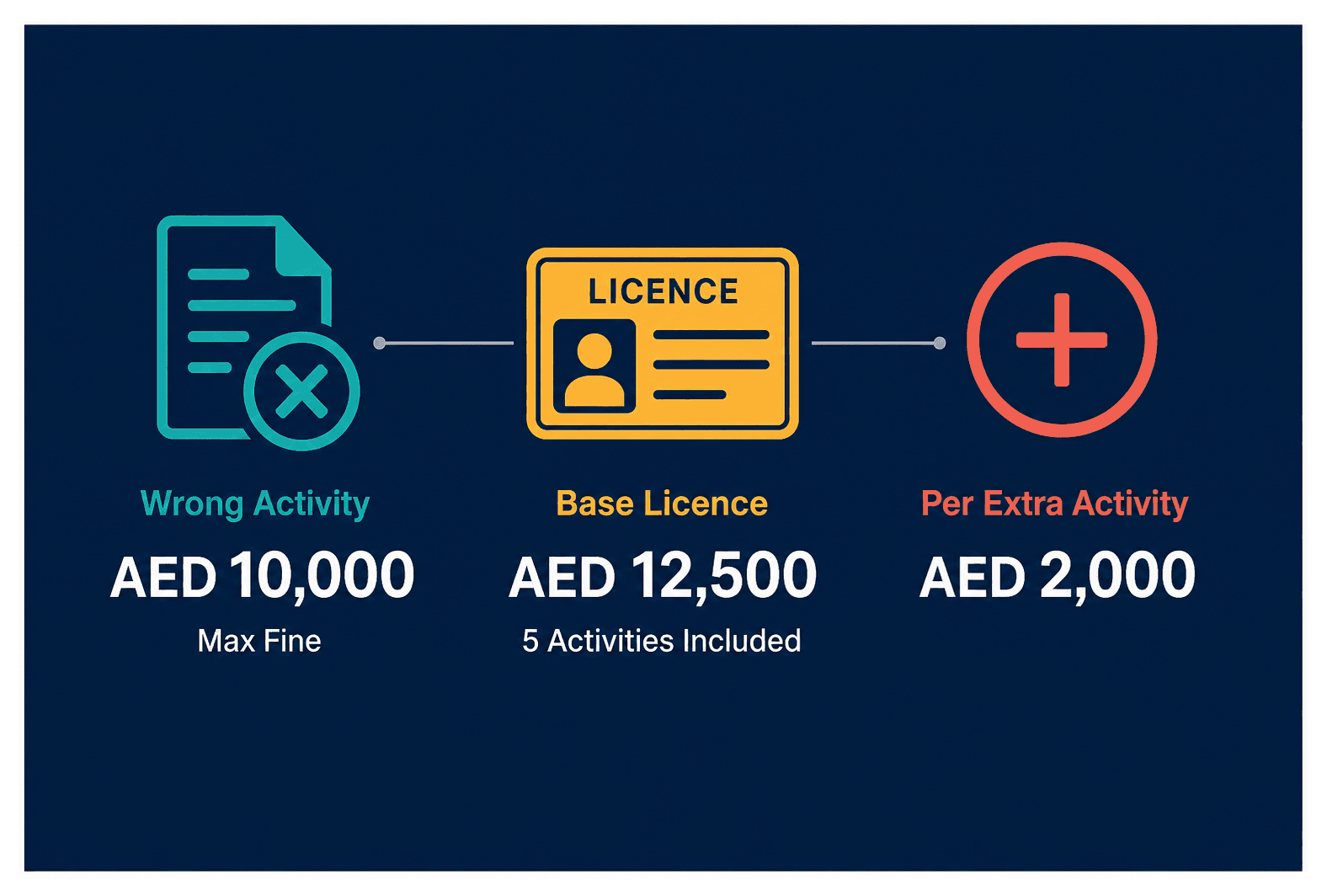
The Federal Tax Authority can impose fines of up to AED 10,000 per late registration triggered by misclassification. These penalties compound the longer the error goes uncorrected.
Banks Flag Out-of-Scope Invoices
If your licensed activity doesn't match what you're invoicing for, banks will freeze or query fund releases until you provide license clarification. This can halt cash flow at the worst possible moment.
Re-Licensing Costs More Than Getting It Right
Correcting a misclassified activity after setup involves re-licensing fees on top of your original costs. At DSBH, adding each activity beyond the first five costs AED 2,000, a fee that's avoidable with proper planning upfront.
Confusing Secondary and Ancillary Activities Is Common
Many founders mistakenly treat revenue-generating secondary activities as ancillary, leaving that income stream unlicensed. For example, a healthcare consultancy that also sells wellness products must license both activities separately.
Copying a Competitor's License Is Risky
One of the most frequent causes of misclassification is founders replicating a competitor's license without verifying it matches their own business model. What works for another entity may not cover your specific services or products.
Pivoting Without Updating Your License Creates Exposure
Founders who shift their service offering after incorporation often forget to update their trade license to reflect the new activity. This leaves the evolved business operating outside its licensed scope, attracting regulatory scrutiny.
Choosing Activities Upfront Costs Nothing Extra
At DSBH, the first five business activities are included in the base license fee starting from AED 12,500, with zero paid-up share capital required. Selecting the right activities before applying eliminates correction costs entirely.
In 2026, a significant share of first-time founders in Dubai discover their business activity is misclassified only after their first invoice is queried by a bank, a client, or a regulator. At that point, the correction process costs more than getting it right from day one. Choosing the wrong business activity in Dubai can trigger re-licensing fees, regulatory fines up to AED 10,000 per late registration (Federal Tax Authority, 2023), delayed bank account opening, and lost revenue during the correction window. A license at Dubai South Business Hub Free Zone (DSBH, launched September 2025) starts from AED 12,500, with the first five activities included and zero paid-up share capital required. Each activity you add beyond five costs AED 2,000. Getting the activity right at setup costs nothing extra within those five slots. Getting it wrong later always costs more.
This article explains exactly what a business activity is in Dubai's licensing framework, how misclassification happens, what it costs in one-off and recurring terms, and the precise steps to correct it before the damage compounds.
What Is a Business Activity in Dubai and Why Getting It Right Matters
A business activity in Dubai is the licensed description of what your company is legally permitted to do. It is recorded on your trade license and determines which clients you can invoice, which regulators oversee you, and which visa categories you can sponsor. Choosing the wrong one invalidates transactions and exposes you to fines.
How Dubai Classifies Business Activities on a Trade License
Each licensed entity in Dubai must declare one or more approved activities drawn from a standardised list maintained by the licensing authority. For free zone entities, that authority is the zone itself; for mainland entities, it is DET. Activities align broadly with the UN ISIC Rev.4 hierarchy (sections A through U), grouping commercial, professional, industrial, and service activities into discrete codes (UN Statistics Division, 2008).
The activity code on your license is not cosmetic. Banks, government portals, and client procurement teams all verify it against what you invoice for. A founder who sets up under "Management Consulting" but begins delivering software implementation projects will find the bank flags those invoices as outside scope and requests license clarification before releasing funds.
At DSBH, the pricing structure is straightforward:
License from AED 12,500
First five activities included in the license fee
Each activity beyond the first five: AED 2,000
Zero paid-up share capital required
Check the full list of business activities in Dubai on the DSBH activities page before you apply, not after.
The Difference Between Principal, Secondary, and Ancillary Activities
Your principal activity is the one generating the largest share of your revenue. Regulators and auditors use this to determine which rules apply to your entity. Under ISIC Rev.4, the top-down method identifies the principal activity by finding the category that accounts for the largest share of value added.
Secondary activities also produce output sold to third parties and must be separately licensed if they fall outside your declared scope. Ancillary activities, internal accounting, transport, IT support, are absorbed into the principal activity and do not need separate licensing.
Misidentifying a secondary activity as ancillary is one of the most common errors first-time founders make. A healthcare consultancy that also sells wellness products must list both "Healthcare Management Consulting" and the relevant trading activity. Treating product sales as ancillary leaves that trading revenue unlicensed.
How Choosing the Wrong Business Activity in Dubai Happens
Most activity mismatches in Dubai happen because founders copy a competitor's license, choose the broadest-sounding activity to stay flexible, or pivot their service offering after incorporation without updating their license. Each of these paths creates a gap between what the license permits and what the business actually does.
The Three Most Common Misclassification Triggers
Copying a competitor's license without checking whether their activity list matches your actual service mix.
Selecting a generic activity such as "General Trading" when your business is a specialist operation. This triggers regulator scrutiny if your invoices reference services not covered by a trading activity.
Post-incorporation pivot: launching with one service model and expanding into a different category, consulting into software development, for example, without adding the relevant activity codes.
A founder who licenses a technology consultancy but begins building and selling a SaaS product faces a real problem. Software sales require a distinct activity code; without it, the company cannot legally invoice for that product revenue. At DSBH, adding that code at setup costs nothing within the first five slots. Adding it after the fact costs AED 2,000 plus the amendment process.
Why 'General Trading' Is Not Always a Safe Default
General trading covers the buying and selling of physical goods. It does not cover service delivery, consulting, or professional activities. Founders who invoice for services under a trading license in Dubai are operating outside their licensed scope, a fact that banks, auditors, and corporate tax assessors will identify.
Regulated activities require both the DSBH license and a separate approval from the named regulator. An EdTech founder who registers under General Trading expecting to sell online courses will find that the Knowledge and Human Development Authority (KHDA) requires an education-specific activity on the license before granting its own approval. The trading activity does not qualify.
Regulated activities and their primary regulators:
Healthcare: Dubai Health Authority (DHA) or Ministry of Health and Prevention (MOHAP)
Financial services: Central Bank of the UAE or Securities and Commodities Authority (SCA)
Education: Knowledge and Human Development Authority (KHDA)
ICT and technology: Ministry of Economy (moet.gov.ae)
Cost of Getting It Wrong vs. Getting It Right: One-Off and Recurring Breakdown
Cost Item | Cost at Setup (Correct Activity from Day One) | Cost of Correction (Wrong Activity Amended Later) |
|---|---|---|
License fee | From AED 12,500; first five activities included | License fee PLUS amendment fee (UNVERIFIED: confirm amendment fee before publishing) |
Activity additions beyond five | AED 2,000 per activity, paid once at setup | AED 2,000 per activity PLUS amendment processing costs and time delay |
VAT / corporate tax late-registration penalty | No penalty; correct activity supports timely registration | Up to AED 10,000 flat penalty per late registration |
Bank account opening | Opened on first application; activity matches business model | Delayed or rejected; re-submission costs time and compliance resource |
Contract execution | Contracts executable from day one | Revenue loss during correction window; duration varies by case |
Visa costs | Always an additional cost, not included in any license figure | Always an additional cost, not included in any license figure |
The Hidden Financial Cost of Choosing the Wrong Business Activity in Dubai
The direct cost of correcting a wrong business activity in Dubai includes license amendment fees, potential regulatory fines of AED 10,000 for late tax registration, delayed bank account opening, and lost revenue during the correction window. Indirect costs include contract delays and reputational exposure with enterprise clients who audit supplier licenses.
One-Off vs. Recurring Costs: A Breakdown
One-off costs include the license amendment fee to add or change activities (UNVERIFIED: confirm amendment fee before publishing), an AED 10,000 one-time flat penalty for late corporate tax registration with the Federal Tax Authority, and an AED 10,000 penalty for late VAT registration if taxable supplies were made under the wrong activity (Federal Tax Authority, 2023).
Recurring costs include annual license renewal at the corrected activity scope and any ongoing compliance costs if the correction triggers mandatory audit or regulatory supervision.
Not included in any of these figures: visa fees (always an additional cost), third-party legal or PRO fees for managing the amendment, or lost revenue from contracts that could not be executed while the license was under correction. At DSBH, catching an activity gap at setup, rather than amending post-issue, is materially cheaper every time.
Consider a founder who begins invoicing for financial advisory services before adding the correct activity and crosses the VAT registration threshold during that period. They face both the AED 10,000 VAT late-registration penalty and a license amendment process before the Central Bank of the UAE will consider any regulated finance approval.
Bank Account Delays and Contract Voids
UAE banks perform activity verification during account opening. A license activity that does not match the company's described business model is one of the leading reasons for account rejection or prolonged KYC review. A logistics company licensed under "Management Consulting" will have its corporate bank account application rejected because the declared activity does not correspond to the freight invoices submitted as supporting documents.
Enterprise clients, particularly multinationals and government-linked entities, check supplier license activities against purchase orders. A mismatch can void a contract or delay payment. This is a real commercial risk, not a theoretical one.
For corporate tax purposes, Qualifying Free Zone Person (QFZP) status, which allows a 0% rate on qualifying income, requires all four of the following conditions to be met simultaneously:
Adequate substance in the free zone
Qualifying income derived from qualifying activities
No mainland branch election for the QFZP
Compliance with transfer pricing rules
A misclassified activity can disqualify qualifying income from the 0% treatment. The 9% corporate tax rate applies to taxable income above AED 375,000 and is the standard rate. Never describe corporate tax in Dubai as tax-free.
Five Steps to Correct a Wrong Business Activity in Dubai
To correct a wrong business activity in Dubai, you must identify the gap between your license and actual operations, select the correct activity codes, submit an amendment application to your licensing authority, obtain any required secondary regulator approval, and update your bank and corporate documents to reflect the amended license.
Step 1: Audit Your Current License Against Real Operations
Pull every invoice issued in the last 12 months and map each service or product category against the activities listed on your current license. A consulting firm that audits 24 months of invoices and finds that 30% of revenue comes from IT project delivery has identified a clear regulatory exposure, that activity is not on its consulting license.
Identify any revenue stream without a corresponding licensed activity. Check whether any of those unlicensed activities are regulated and note the secondary regulator involved. This audit takes one to two business days and is the foundation for everything that follows.
Quick audit checklist:
Download all invoices issued in the last 12 months
Group invoices by service or product type
Match each group to an activity on your current license
Flag any group with no matching activity
Note whether flagged activities are regulated
Step 2: Submit the Amendment and Obtain Regulator Sign-Off
Submit the activity amendment application to DSBH with the updated activity list. At DSBH, license amendments are processed efficiently given the one-day license issuance standard, but the application must be complete and accurate before that clock starts.
For regulated activities, the amendment to the free zone license must be accompanied by a parallel application to the named regulator. DSBH licenses the activity; the named regulator approves it separately. After adding a healthcare consultancy activity, for example, the founder submits a parallel notification to the Dubai Health Authority (DHA) and receives DHA approval before invoicing any health-sector clients.
Once the amended license is issued, update your bank's KYC records, your VAT registration activity description with the Federal Tax Authority, and any active contracts that reference your license details. Visas are always an additional cost and are not affected by an activity amendment unless the amendment changes the license category in a way that alters visa quota entitlements.
How to Choose the Right Business Activity in Dubai from the Start
To choose the right business activity in Dubai from the start, define your revenue model before you apply, match each income stream to an approved activity code, confirm whether any activity is regulated and requires secondary approval, and build in activities for planned pivots at AED 2,000 each rather than amending later.
Map Your Revenue Model to Activity Codes Before You Apply
Write out every service or product you plan to sell in the first 24 months, including services you are 70% confident you will offer. It is cheaper to add an activity at setup than to amend later. A founder planning a digital marketing agency that also intends to offer web development within 12 months should license both "Digital Marketing Services" and "Web Development" from day one, consuming two of the five included activity slots at no extra cost.
At DSBH, the first five activities are included in the license from AED 12,500. For a sole founder with one visa, the first-year all-in cost starts from AED 18,350. Zero paid-up share capital is required. Use the DSBH business activities in Dubai list to match your intended services to approved codes, that list is the authoritative reference, not a competitor's license.
Planning tip: Reserve at least one of your five included activity slots for a service you expect to add within 18 months. Changing your mind at setup costs nothing. Amending after issue costs AED 2,000 per activity plus processing time.
When to Get Professional Guidance on Activity Selection
If your business model spans two or more ISIC sections, manufacturing and retail, or financial services and technology, professional guidance reduces the risk of choosing wrong business activities in Dubai. Regulated activities always warrant a consultation. The secondary regulator's requirements can determine which base activity is acceptable on the license, and getting this wrong delays both the DSBH license and the regulator's own approval.
A fintech founder wanting to offer payment processing services needs both a technology activity on the DSBH license and a separate approval from the Central Bank of the UAE. Professional guidance at the activity-selection stage prevents a license that cannot support the regulated approval. DSBH's business support services can assist with activity mapping as part of the setup process.
Activity categories that always require dual approval:
Healthcare and medical services (DHA or MOHAP)
Financial services and payment processing (Central Bank of the UAE or SCA)
Education and training (KHDA or emirate-level authority)
Insurance activities (the Central Bank of the UAE)
Choosing the Wrong Business Activity in Dubai: Regulated Sectors Carry Extra Risk
In regulated sectors such as healthcare, financial services, and education, choosing the wrong business activity in Dubai creates a double exposure: the free zone license may be issued but the named regulator will reject or delay its own approval, leaving the company licensed but unable to legally operate in its intended field.
Healthcare, Financial Services, and Education: The Dual-Approval Requirement
The principle is consistent across all regulated sectors: DSBH licenses the activity, and the named regulator approves it separately. These are two distinct steps.
Healthcare: DSBH issues the healthcare license in Dubai; DHA or MOHAP approves the operation. A wrong base activity blocks the DHA application entirely.
Financial services: DSBH licenses the activity; the Central Bank of the UAE or SCA approves the regulated function. The activity code must match the regulated function applied for.
Education: DSBH licenses the activity; KHDA or the relevant emirate-level authority approves the institution or programme. An education license in Dubai with a misaligned activity code delays KHDA registration.
A medical equipment distributor who applies to DSBH under a general trading activity will find that DHA requires a specific medical devices trading activity on the license before processing its own import and distribution approval. The general trading code is insufficient. The founder must amend before DHA will progress the application.
VAT and Corporate Tax Implications of a Misclassified Activity
VAT registration in the UAE requires declaration of the nature of supplies made. If the declared business activity on the license does not match the supplies described in the VAT registration, the References
Frequently Asked Questions