
Topic Summary
Shareholders From High-Risk Jurisdictions Face Extra Scrutiny
FATF's grey list covers 21 jurisdictions as of 2024, and banks apply enhanced due diligence to any shareholder from those countries. Providing a notarised source-of-funds declaration upfront can prevent an immediate rejection.
Missing or Incomplete Source-of-Funds Documentation
Banks require clear evidence of where capital originates, and a gap here is one of the fastest triggers for a decline. Submitting a notarised source-of-funds letter alongside supporting documents like invoices or bank statements resolves this in most cases.
No UAE-Based Transactions or Business Activity Shown
Some banks decline companies that cannot demonstrate local economic activity or a credible pipeline of UAE transactions. Including supplier contracts, pro-forma invoices, or client agreements in your application package addresses this concern directly.
Operating in a Sector the Bank Considers High-Risk
Each UAE bank sets its own internal risk appetite, and certain industries face blanket avoidance regardless of license validity. Researching a bank's sector preferences before applying saves four to twelve weeks of delay per rejection.
Weak or Generic Business Plan Submitted
Compliance teams review your business plan as part of KYC, and a vague document raises red flags about the legitimacy of projected transactions. A detailed plan that explains your revenue model, customer base, and transaction flows significantly improves approval odds.
Reapplying Too Soon After a Formal Rejection
Submitting a new application to the same bank too quickly often triggers an automatic second rejection, compounding your record. The standard cooling-off period is three to six months, and multiple rejections across banks can itself become a compliance flag.
License Alone Does Not Satisfy Bank KYC Requirements
A valid free zone or mainland license proves legal existence but does not pass a bank's independent compliance review. Banks separately assess your full document set, including passports, memorandum of association, and source-of-funds declarations, under Central Bank of UAE AML rules.
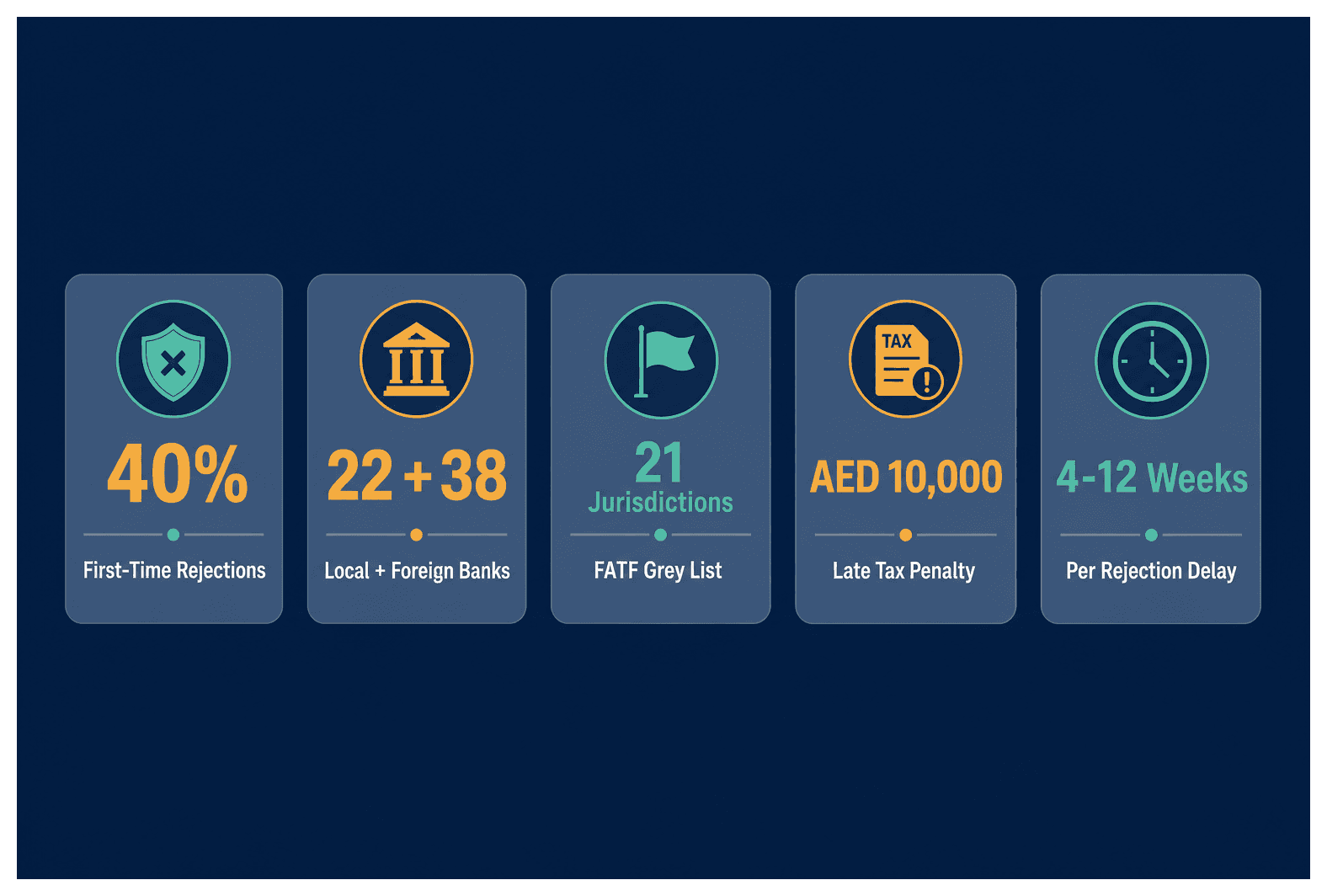
Roughly 40% of first-time founders who open a company in Dubai report that their corporate bank account UAE application is delayed or declined at least once before approval, according to business setup consultants active in the market. The Central Bank of UAE has tightened its anti-money-laundering framework every year since 2021. The UAE has 22 locally incorporated banks and 38 foreign bank branches as of 2024 (Central Bank of UAE, 2024). FATF's grey list as of 2024 covers 21 jurisdictions, and shareholders from those countries face enhanced scrutiny. Corporate tax late registration carries a flat AED 10,000 penalty (Federal Tax Authority, 2023). Each rejection adds four to twelve weeks to your timeline. These numbers matter because they define the compliance bar you need to clear.
This article ranks the most common reasons a corporate bank account UAE application gets rejected, explains exactly what documents or structural changes fix each one, and gives you the realistic cost of each remedy so you can walk into your bank appointment prepared.
What a Corporate Bank Account UAE Rejection Actually Means
A corporate bank account UAE rejection means the bank's compliance team has declined your application under Central Bank of UAE AML and KYC rules. The bank is not required to state the exact reason. Rejections are not permanent, but each one delays operations by four to twelve weeks and may require structural or documentary changes before reapplication.
How UAE Banks Evaluate New Company Applications
UAE banks operate under Central Bank of UAE AML/CFT regulations updated in 2021, and they conduct independent KYC reviews regardless of whether your company holds a valid free zone or mainland license. Your license proves legal existence. It does not pass the bank's compliance check for you.
Each bank sets its own internal risk appetite. Some avoid shareholders from specific nationalities. Others decline companies with no UAE-based transactions or those operating in sectors they consider high-risk. Compliance teams review the license, memorandum of association, shareholder passports, source-of-funds declarations, and a business plan. A gap in any one of these documents triggers a hold or outright rejection.
Banks are not obligated to disclose the specific reason for a rejection. A sole founder from a high-risk jurisdiction who submitted a trading license but no supplier contracts or source-of-funds letter received a rejection within 48 hours with no stated reason. Adding a notarised source-of-funds declaration and three pro-forma invoices resolved the issue on reapplication. That's the pattern: the problem is almost always identifiable in hindsight, but you need to know what to look for before you apply.
The Difference Between a Rejection and a Request for More Information
A request for more information (RFI) means the application is still live. Responding quickly and completely can still lead to approval. A formal rejection is different. It closes the application entirely, and reapplying too soon to the same bank often triggers a second rejection. The standard cooling-off period between reapplications at the same bank is typically three to six months.
Some banks issue informal verbal declines before issuing a formal rejection. Founders who catch these early can withdraw the application, fix the issue, and reapply without a formal rejection on record. That matters because multiple rejections across different banks can itself become a flag in the UAE financial system. Keeping your rejection record clean is a practical priority, not just a formality.
Free zone companies face the same bank KYC requirements as mainland companies. A Dubai South Business Hub Free Zone license, issued from AED 12,500 in 1 business day, gives you a clean, current document set. But the banking relationship is established separately with your chosen bank, on the bank's own terms.
How Your License Structure Affects Corporate Bank Account UAE Approval
A corporate bank account UAE application is more likely to succeed when the license activities precisely match the described business model. Mismatches between the license activity list and the stated revenue streams are one of the top three triggers for bank compliance holds. Correcting a license activity list typically costs AED 2,000 per additional activity added at Dubai South Business Hub Free Zone.
Corporate Bank Account UAE Rejection Causes: Fix and Cost at a Glance
Rejection Cause | Fix and Estimated Cost |
|---|---|
Incomplete KYC documents | Prepare a full KYC pack before applying. Notarisation and attestation: AED 200–500 |
Activity-to-business-model mismatch | Amend the license activity list before applying. AED 2,000 per additional activity at Dubai South Business Hub Free Zone |
High-risk shareholder nationality | Enhanced due diligence documents, source-of-funds declaration, reference letters. AED 500–8,000 depending on complexity |
No UAE economic substance | Active license address (included in most free zone licenses); visa is always an additional cost |
Unclear source of funds | Six months of bank statements plus a signed declaration. Professional drafting: AED 300–800 |
Missing corporate tax TRN | Register on the Federal Tax Authority portal before applying. Late registration penalty: AED 10,000 (one-time flat fee) |
Low projected turnover | No direct cost. Revise financial projections to reflect realistic, credible revenue for your sector |
Activity-to-Business-Model Mismatches
Banks cross-check the license activity list against the business plan you submit. If your plan describes services not covered by your licensed activities, the compliance team flags the inconsistency and places the account on hold.
A founder setting up a digital marketing agency listed only "advertising services" on the license but described SEO, web development, and software-as-a-service in the business plan. The bank placed the account on hold immediately. Adding "information technology services" and "software development" to the license for AED 4,000 (two additional activities at AED 2,000 each) resolved the conflict. The updated license was reissued in 1 business day at Dubai South Business Hub Free Zone, and the reapplication was approved.
The fix steps are straightforward:
Review every revenue stream described in your business plan
Cross-reference each stream against the list of business activities in Dubai on your license
Add any missing activities before submitting the bank application
Anchor business plan language to the ISIC-aligned activity descriptions on the license to eliminate ambiguity
Using a General Trading License When a Specific License Is Needed
Some founders choose a broad general trading license to avoid specifying activities. Banks often treat overly broad licenses as a risk signal because they cannot map the license to a clear revenue model. If your business is focused on a specific product category, a targeted trading license with defined activities gives the bank a cleaner picture of what you actually do.
Changing a license activity list after issuance is possible but adds time and cost. Getting it right at formation is the cheaper path. At Dubai South Business Hub Free Zone, the first five activities are included in the license fee starting from AED 12,500, which gives you room to be specific without paying extra for each activity up front.
The Seven Most Common Corporate Bank Dubai Reasons for Rejection, Ranked
The seven most common corporate bank Dubai rejection reasons, ranked by frequency, are: incomplete KYC documents, activity-to-business-model mismatch, high-risk shareholder nationality, no UAE economic substance, unclear source of funds, missing corporate tax registration, and low projected turnover. Most are fixable before reapplication with targeted document preparation or structural changes.
Ranked List of Rejection Causes With Fixes and Costs
Incomplete KYC documents (most frequent): Missing certified passport copies, no proof of residential address, or unsigned source-of-funds declarations. Fix: prepare a full KYC pack before applying. Cost: AED 200 to AED 500 for notarisation and attestation of personal documents.
Activity-to-business-model mismatch (second most frequent): License activities do not match the business plan. Fix: amend the license activity list before submitting the bank application. Cost: AED 2,000 per additional activity at Dubai South Business Hub Free Zone.
High-risk shareholder nationality or residence: Some nationalities appear on internal bank risk lists tied to FATF country classifications. The FATF grey list as of 2024 includes 21 jurisdictions. Fix: provide enhanced due diligence documents, a detailed source-of-funds declaration, and reference letters. Cost: AED 500 to AED 1,500 for professional preparation; complex cases require a compliance consultant at AED 3,000 to AED 8,000.
No demonstrable UAE economic substance: A company with no UAE address, no employees, and no UAE-based transactions is a red flag for any bank's compliance team. Fix: confirm the license address is active, document UAE-based client or supplier relationships, and register employees if applicable. The license address is included with every Dubai South Business Hub Free Zone license; visa costs are always an additional line item.
Unclear or undocumented source of funds: Banks require founders to show where the initial capital is coming from. Fix: provide six months of personal bank statements, a signed and notarised declaration, and any supporting contracts or investment records. Cost: no direct government fee, but professional drafting of the declaration runs AED 300 to AED 800.
Missing corporate tax registration: Since June 2023, UAE corporate tax at 9% applies to taxable income above AED 375,000, and banks increasingly request a Tax Registration Number (TRN) as part of KYC. Fix: register on the Federal Tax Authority portal and include the TRN in the application pack. The late registration penalty is AED 10,000, a one-time flat fee, not a monthly charge.
Low projected turnover: Some banks set minimum projected revenue thresholds for international wire facilities. Fix: revise financial projections to reflect realistic, credible numbers for your sector and market. No direct cost, but the projections must align with your license activities and the business plan narrative.
A founder from a FATF grey-listed country who applied without a source-of-funds letter and had no UAE supplier contracts was rejected by two banks. After engaging a compliance consultant for AED 5,000, preparing a full KYC pack, and registering for corporate tax, the third application was approved in six weeks. The total remediation cost was AED 5,800, which is far less than the six months of lost operating time the two rejections caused. Use the business setup cost in Dubai calculator to model these costs before you start.
Dubai South Business Hub Free Zone, launched September 2025, provides a physical registered address with every license, which satisfies the UAE economic substance address requirement. The first-year cost for a sole founder with one visa starts from AED 18,350, with visa costs itemised separately from the license fee.
Compliance Gaps That Trigger Corporate Bank Account UAE Rejections
The most common compliance gaps triggering a corporate bank account UAE rejection are missing Ultimate Beneficial Owner declarations, unregistered corporate tax status, and incomplete AML source-of-funds documentation. These are administrative oversights that are fully correctable, but each adds four to eight weeks to the account-opening timeline if addressed after the first rejection.
Ultimate Beneficial Owner Declarations
UAE Cabinet Resolution No. 58 of 2020 requires all UAE companies to register their Ultimate Beneficial Owners (UBOs) with the relevant authority (UAE Cabinet, 2020). UBO filing is mandatory for every UAE legal entity, without exception.
Banks verify UBO registration as part of KYC. A company that has not filed its UBO register will be held or rejected at the compliance stage, often before the relationship manager even reviews the business plan. At most free zones, UBO filing is completed during formation. At Dubai South Business Hub Free Zone, the formation process includes UBO document preparation as part of its business support services. Late filing can attract penalties from the relevant authority, so completing this step at formation is always the right call.
Corporate Tax Registration and VAT Status
Since June 2023, UAE corporate tax at 9% applies to taxable income above AED 375,000. Banks increasingly request a TRN as part of KYC, even for companies that have not yet reached the tax threshold. VAT registration is mandatory once annual taxable supplies exceed AED 375,000, with voluntary registration available from AED 187,500.
The penalty facts are worth knowing precisely:
Corporate tax late registration penalty: AED 10,000, one-time flat fee
VAT late registration penalty: AED 10,000
Corporate tax rate: 9% on taxable income above AED 375,000
Register for both before the bank application if your business has or expects turnover above the thresholds. Include the TRN in the account application pack as a standard document, not an afterthought. Tax registration is handled directly with the Federal Tax Authority and is not included in the license fee at any free zone.
Does registering for corporate tax before reaching the threshold cause problems?
No. Voluntary early registration for UAE corporate tax does not create a tax liability if your taxable income stays below AED 375,000. It does, however, give you a TRN to include in your bank application, which removes one common hold trigger from the compliance review. Register early and avoid the AED 10,000 late penalty.
How to Prepare a Bank-Ready Application Pack
A bank-ready corporate bank account UAE application pack includes a valid trade license, memorandum of association, certified passport copies for all shareholders, a signed source-of-funds declaration, six months of personal bank statements, a business plan with projected financials, UBO registration confirmation, a corporate tax TRN, and at least two reference letters from existing banking relationships.
Step 1: Assemble Your Core Corporate Documents
Gather the trade license, certificate of incorporation, and memorandum of association. All must be current and not expired. Most banks require the license expiry date to be at least six months away at the time of application.
Include the UBO register confirmation and, if applicable, the board resolution authorising the signatory to open the bank account.
Confirm the company address on all documents matches the registered address on the license exactly. Discrepancies between documents are a common hold trigger that is easy to prevent.
All documents must be in English or accompanied by a certified Arabic translation. If you're using bank account opening in Dubai support services, request a pre-check of your document set before formal submission.
Step 2: Prepare the Business Plan and Financial Projections
The business plan must describe the company's activities in language that aligns directly with the license activity list. Use the same terminology.
Include a 12-month projected profit and loss statement and a projected cash flow. Banks want to see realistic but credible numbers consistent with your activity type and market size.
Attach any signed contracts, letters of intent, or supplier agreements that demonstrate real commercial activity is already underway or planned.
Keep the plan to four to six pages. Compliance officers review many submissions and may deprioritise dense, lengthy documents.
Step 3: Choose the Right Bank for Your Risk Profile
Not all UAE banks share the same risk appetite. A bank that declines a trading company with cross-border transactions may readily approve a services company with local clients. Research sector and nationality fit before applying.
Apply to one bank at a time. Simultaneous applications to multiple banks can itself appear as a risk signal to compliance teams.
Use a business setup consultant or a banking introduction service to pre-qualify your profile with the bank's relationship manager before formal submission. The UAE has 22 locally incorporated banks and 38 foreign bank branches as of 2024 (Central Bank of UAE, 2024), and some have dedicated free zone business banking desks.
What Happens After a Corporate Bank Dubai Rejection and What It Costs to Fix
After a corporate bank Dubai rejection, founders must identify the root cause, correct the underlying issue, wait the bank's required cooling-off period (typically three to six months), and reapply with an updated pack. Total remediation costs range from AED 500 for a document correction to AED 15,000 or more if structural company changes or compliance consultants are required.
Diagnosing the Real Reason for the Rejection
Banks rarely state the precise reason for a rejection. Founders must work backward from the application to identify likely compliance triggers. Start by comparing the submitted document pack against the bank's publicly stated KYC requirements and the Central Bank of UAE AML guidelines, which are publicly available at centralbank.ae.
A business setup consultant with active banking relationships can often obtain informal feedback from the bank's relationship manager. That feedback is not guaranteed, but it's often available and worth pursuing. Run through these diagnostic questions before reapplying: Was the source-of-funds declaration signed and notarised? Did the business plan match the license activities precisely? Was the corporate tax TRN included? Was the UBO register confirmed in writing?
Realistic Cost Ranges for Common Fixes
Document correction (missing signatures, wrong format): AED 200 to AED 500
Adding license activities to resolve an activity mismatch: AED 2,000 per activity at Dubai South Business Hub Free Zone, with the license reissued in 1 business day
Corporate tax registration (if not yet done): No government fee; professional support AED 500 to AED 1,500; late registration penalty AED 10,000 if overdue (Federal Tax Authority,
References
Frequently Asked Questions