
Topic Summary
Why Core Activities Determine Your 0% Rate
Core income-generating activities are the operations your company actually performs to earn income. They decide whether that income can qualify for the 0% UAE corporate tax rate for free zone companies.
Licence Wording Is Not Enough
Your trade licence lists what you are permitted to do, but regulators look at what you actually do. Operations, staff and decisions carry more weight than the wording on the licence.
Substance Means Real People and Premises
Qualifying income depends on real staff, real premises and real decisions inside the free zone. Activities outsourced abroad make it much harder to show the core activity happens in the UAE.
Matching Core Activities to Your Business Type
Trading firms centre on sourcing, storing and selling goods, service firms on the expertise their people deliver, and holding structures on managing ownership. Confirm how your mix maps to official definitions before relying on it.
Evidence Trails for Each Activity
Keep purchase orders, sales invoices and stock records for trading, and client contracts, timesheets and project files for services. Holding income needs separate proof, since dividends follow specific rules.
Core income generating activities are the operations a company actually performs to earn its income. For a free zone company, they decide whether that income can qualify for the 0% rate under UAE corporate tax (Federal Tax Authority, 2023). This guide explains the idea in plain language, gives examples by business type and shows you how to evidence each activity.
What Are Core Income Generating Activities and Why Do They Matter?
Core income generating activities (CIGA) are the main things your company does to earn money, such as selling goods, delivering services or managing investments. The question is practical. Who does that work, and where? If the answer points to people and premises inside the free zone, your income has a much stronger claim to qualify.
How CIGA Differs From Your Trade License Activities
Your trade license lists what you're permitted to do. CIGA describes what you actually do to earn income. Those two things overlap, but they aren't the same. A license covering both advisory and trading doesn't make every trading dirham qualifying income.
Consider a consultancy licensed for advisory and trading that earns most of its fees from advisory projects delivered by its own team in Dubai South. Its core activity is advisory work, and the evidence sits in its staff and client files. Regulators look at operations, staff and decisions, not only the wording on the license.
Why Substance Matters for Qualifying Income
Your 0% rate applies only to qualifying income, and only if the company meets every condition of the Qualifying Free Zone Person test (Federal Tax Authority, 2023). Substance means real people, real premises and real decisions behind the activity. You can read more in our guide to the qualifying free zone person test.
Take a logistics firm that signs contracts from a registered address but outsources all warehousing and handling abroad. Its paperwork looks neat, yet it will struggle to show that its core activity happens in the UAE.
Which Activities Count as Core Income Generating Activities by Business Type?
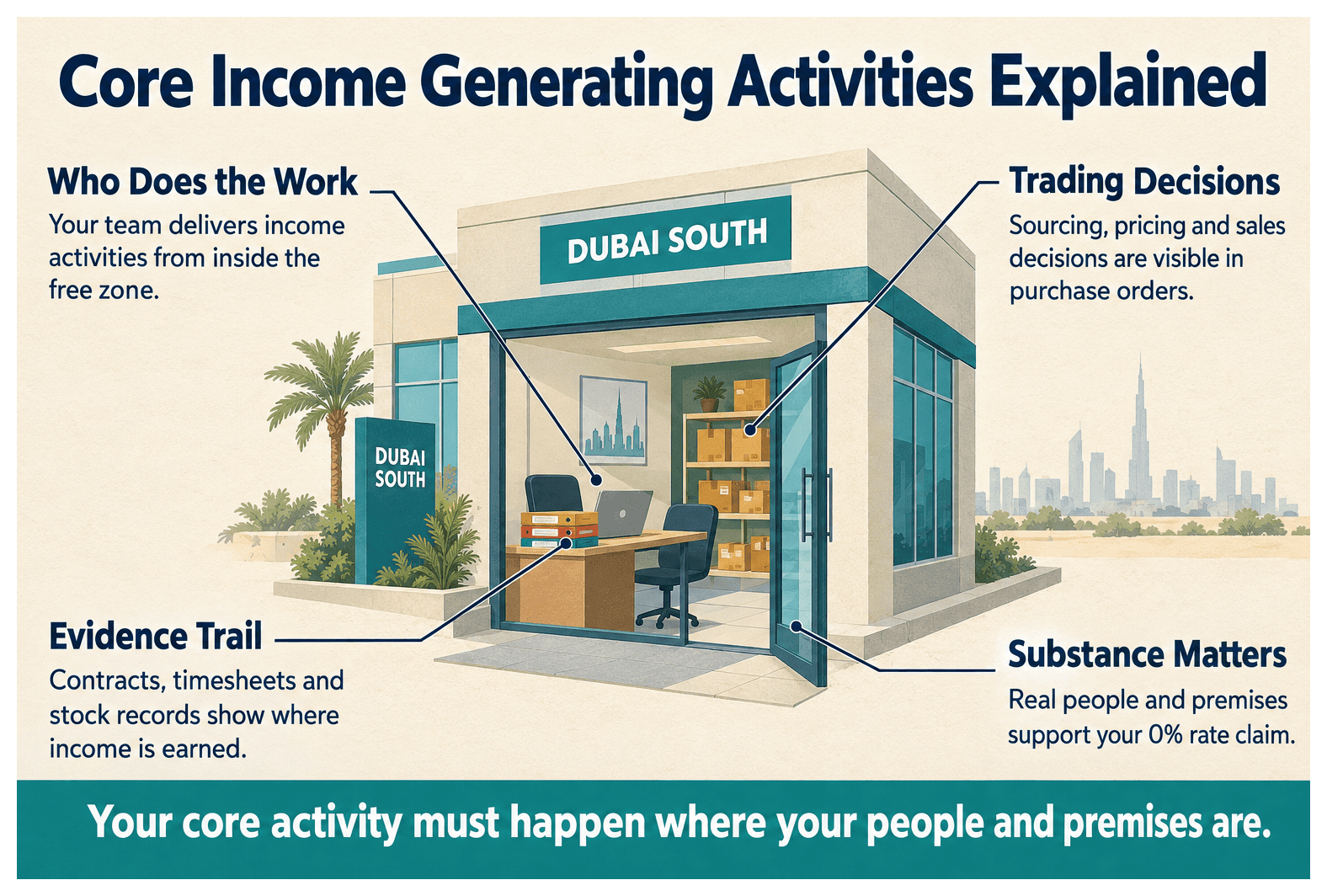
Your core activity depends on how your company earns its money. Trading firms usually centre on buying and selling goods, service providers centre on delivering expertise, and holding structures centre on managing ownership. Confirm with the Dubai South Business Hub team how your activity mix maps to official definitions before you rely on it.
Trading Companies and Goods Sales
For a trader, the core question is who sources, stores, prices and sells the goods. Picture a company importing office furniture through Dubai South warehouses, with its own sales team negotiating supply and client terms. Those decisions are visible in purchase orders, stock records and staff roles, which is exactly the trail you want.
Consultancy and Professional Service Firms
Service income is tied to the people doing the work. An advisory firm whose consultants deliver projects from its Dubai South office can show client contracts, timesheets and project files. The trick is keeping group work separate. If a parent company's staff deliver the project, the income story gets harder to defend.
Holding and Investment Structures
Holding income such as dividends follows specific rules, so don't assume it qualifies. Managing subsidiaries may count as an activity, but only if your company performs that management itself. Read our note on free zone company as shareholder structures before you treat this income as qualifying.
Business type | Evidence to keep |
|---|---|
Trading | Purchase orders, sales invoices, stock records |
Consultancy | Client contracts, project files, staff rosters |
E-commerce | Platform records, fulfilment contracts, staff roles |
Logistics | Freight contracts, warehouse lease, operations logs |
Holding | Board minutes, shareholding records, management evidence |
Can One Company Have More Than One Core Activity?
Yes, and many companies do. A firm can sell products and provide a small consulting service at the same time. Each stream should trace back to the activity that produces it. Keep separate records for each one, so you can show how income links to work performed in the UAE.
How Do You Evidence Core Income Generating Activities With Records?
You evidence core income generating activities by keeping records that show who does the work, where it happens and how income links to it. Contracts, payroll, premises documents and board minutes together form a clear trail. That trail supports your position if the Federal Tax Authority asks questions.
Documents That Show Who Does the Work
Employment contracts and job descriptions for staff in core roles.
Client contracts signed by the free zone entity itself.
Invoices linked to the activity that produced them.
Roster showing who works on each project.
Keep these documents for the same period as the income they support. A roster from last year doesn't help much if this year's contracts are missing.
Staffing, Premises and Decision Records
Premises and decisions matter as much as payroll. Keep your lease or office documents for every location where activity happens. Board minutes approving a supplier contract, with directors attending from Dubai, support evidence of decision-making in the UAE. Note where your staff actually work day to day.
Matching Income to the Activity Performed
Build a simple matrix that links each revenue stream to the activity behind it. Flag any income that comes from work done outside the company. If you add a product line or change your model, update the matrix the same month. For branch scenarios, see our guide on branch qualifying free zone person rules.
Is a Simple Spreadsheet Enough to Prove CIGA?
A spreadsheet is a good start, but it's only a map. It proves nothing on its own. Attach the contracts, payroll extracts and minutes that back up each line, and keep them in one place. Reviewers trust a matrix that points to real documents far more than a tidy table alone.
How Do You Test Your Core Income Generating Activities Step by Step?
To test your core income generating activities, you map income, check who performs the work, gather evidence and review the results each year. This four-step check shows whether your activities and income still line up with your substance position.
Step 1: Map Every Revenue Stream
List each income source for the last financial year.
Label each stream with the activity that produces it.
Note any income from group companies or mainland clients separately.
Step 2: Identify Who Performs Each Activity
Confirm which entity and which staff member carry out each activity.
Flag work outsourced to third parties or other group entities.
Check that the people involved are based in the UAE where required.
Step 3: Gather and Check Your Evidence
Collect contracts, payroll, premises and board records for each activity.
Confirm the evidence covers the same period as the income.
Fix gaps before you file anything.
Step 4: Review Annually and Update for Changes
Repeat the mapping whenever you add a product or change staffing.
Keep a dated record of each review.
Confirm deadlines and rules with the Federal Tax Authority or a licensed tax adviser.
What Mistakes Do Free Zone Companies Make With Mainland Clients?
Free zone companies often weaken their position in three ways. They assume a license covers all income, they outsource core work without oversight, or they overlook VAT and mainland rules. A license does not guarantee that every income type qualifies, so review each client type before you set prices.
Assuming a Free Zone License Covers All Income
A company selling to mainland customers once assumed all its income was qualifying. Those mainland sales needed separate review. Check each income type against the rules rather than relying on the license wording.
Outsourcing Core Work Without Oversight
Keep a named internal manager for every outsourced activity.
Document the scope of work in each contract.
Require monthly reports that the manager signs off.
A trading company that outsourced warehousing kept a manager in Dubai South who approved stock movements. That single step gave the company a clear internal link to its core activity.
Overlooking VAT and Mainland Sales Rules
VAT and corporate tax are separate questions with separate checks. Confirm how sales to mainland customers are treated before you issue invoices. Our article on VAT on sales to mainland UAE explains the questions to ask.
When Should You Confirm Your Tax Position With Experts?
Confirm your position with the Federal Tax Authority and a licensed tax adviser whenever your activities change, your income types shift or you plan a restructuring. Rates, thresholds and deadlines can change, so treat this article as general information, not tax advice.
What to Confirm With the Federal Tax Authority
Current corporate tax rates, thresholds and filing deadlines.
Official guidance on qualifying activities and qualifying income.
Any rule changes that affect your activity mix.
Working With a Licensed Tax Adviser
Share your CIGA matrix and key contracts before you file. Ask how dividends and profit distributions are treated, since the answer affects your planning. If you're weighing dividends from a free zone LLC, bring that question to the adviser early.
Planning Changes to Your Activity Mix
Before you change your structure, check the impact on your activities and income. A company considering a move to the mainland should review its options first. You can read about the steps in our guide to convert a free zone company to a mainland LLC, then confirm details with the Dubai South Business Hub team.
Conclusion: Keeping Core Income Generating Activities Clear and Documented
Core income generating activities decide whether your free zone company's income can qualify, so map each revenue stream to the activity behind it. Keep matching evidence and review the results every year. Confirm current rules with the Federal Tax Authority or a licensed tax adviser.
Ready to set up or review your free zone structure? Contact Dubai South Business Hub Free Zone to discuss company formation, a free zone trade license or a residency visa package tied to your company license, and to confirm the current details for your activities.
References
Frequently Asked Questions


