Topic Summary
What Is Free Zone Companies Charge VAT on Sales to Mainland UAE and Why It Matters
Yes, in most cases. A free zone license does not exempt a company from UAE VAT. A registered free zone company selling taxable goods or services to mainland customers generally charges 5% VAT. The exception is certain goods moved from a designated zone.
Designated vs Non-Designated Free Zone: Why Your Location Changes the VAT Answer
Designated vs Non-Designated Free Zone: Why Your Location Changes the VAT Answer
When a Free Zone Company Must Register for VAT
You must register when taxable supplies and imports exceed AED 375,000 over 12 months, or are expected to in the next 30 days. Voluntary registration starts at AED 187,500. Late registration carries a fixed AED 10,000 penalty ( FTA, 2026).
Practical Process to Register, Invoice, and File VAT on Mainland Sales
Confirm your zone status, check the threshold, register on EmaraTax, issue invoices showing 5% VAT, and file the VAT201 within 28 days of period end. Keep records for five years.
Real-World Scenarios: How Free Zone Companies Charge VAT on Sales to Mainland UAE
A consultancy charges 5% on mainland invoices once registered. A designated zone goods trader treats movement as an import. An unregistered company below the threshold charges nothing but should track turnover monthly.
Deadlines, Penalties, and Records Every Free Zone Finance Manager Should Track
Register within 30 days of crossing the threshold, file and pay within 28 days of period end, and keep records five years. Late filing costs AED 1,000, rising to AED 2,000 for a repeat within 24 months.
Common Mistakes When Free Zone Companies Charge VAT on Sales to Mainland UAE
The big ones: assuming a license removes VAT, ignoring the threshold, misclassifying goods and services, invoicing without a TRN, and missing deadlines.
More than 350,000 UAE businesses are VAT-registered [1], yet many owners still think a license switches VAT off. It doesn't. Free zone companies charge VAT on sales to mainland UAE at 5% [2] once registered. Registration is mandatory above AED 375,000, voluntary from AED 187,500, and late registration costs AED 10,000 [1]. This guide is for free zone owners and finance managers who need to apply those rules correctly.
What Is Free Zone Companies Charge VAT on Sales to Mainland UAE and Why It Matters
Yes, in most cases. A free zone license does not exempt a company from UAE VAT. A registered free zone company selling taxable goods or services to mainland customers generally charges 5% VAT. The exception is certain goods moved from a designated zone.
The Short Answer Under UAE VAT Law
Federal Decree-Law No. 8 of 2017 applies VAT across the UAE. Free zone status alone isn't an exemption. Say a Dubai South Business Hub consultancy invoices a Deira retailer AED 40,000 for advisory work. It adds AED 2,000 VAT. Corporate tax relief for Qualifying Free Zone Persons is a separate regime and doesn't remove VAT duties. See our guide on corporate tax for free zone companies with mainland clients.
VAT Treatment of Free Zone Sales to Mainland UAE Customers
Feature | Services Supplied to Mainland | Goods Moved to Mainland From a Designated Zone |
|---|---|---|
Standard VAT rate | 5% on most services | 5% treated as import VAT |
Designated zone status relevance | None; place of supply rules decide | Decisive; only listed zones qualify |
Who accounts for the VAT | Free zone supplier charges and pays | Importer, via customs or recipient's return |
Key documents | Tax invoice with TRN, contract | Customs declaration, delivery note, invoice |
Return reporting | Standard-rated sales in VAT201 | Import VAT reported by the accounting party |
Why Free Zone Owners Get This Wrong
They mix up corporate tax and VAT.
They treat customs duty relief as VAT relief.
They assume every free zone is a designated zone.
One trader assumed zero customs duty meant zero VAT. He shipped goods to a mainland buyer with no VAT treatment at all. Don't repeat that.
Designated vs Non-Designated Free Zone: Why Your Location Changes the VAT Answer
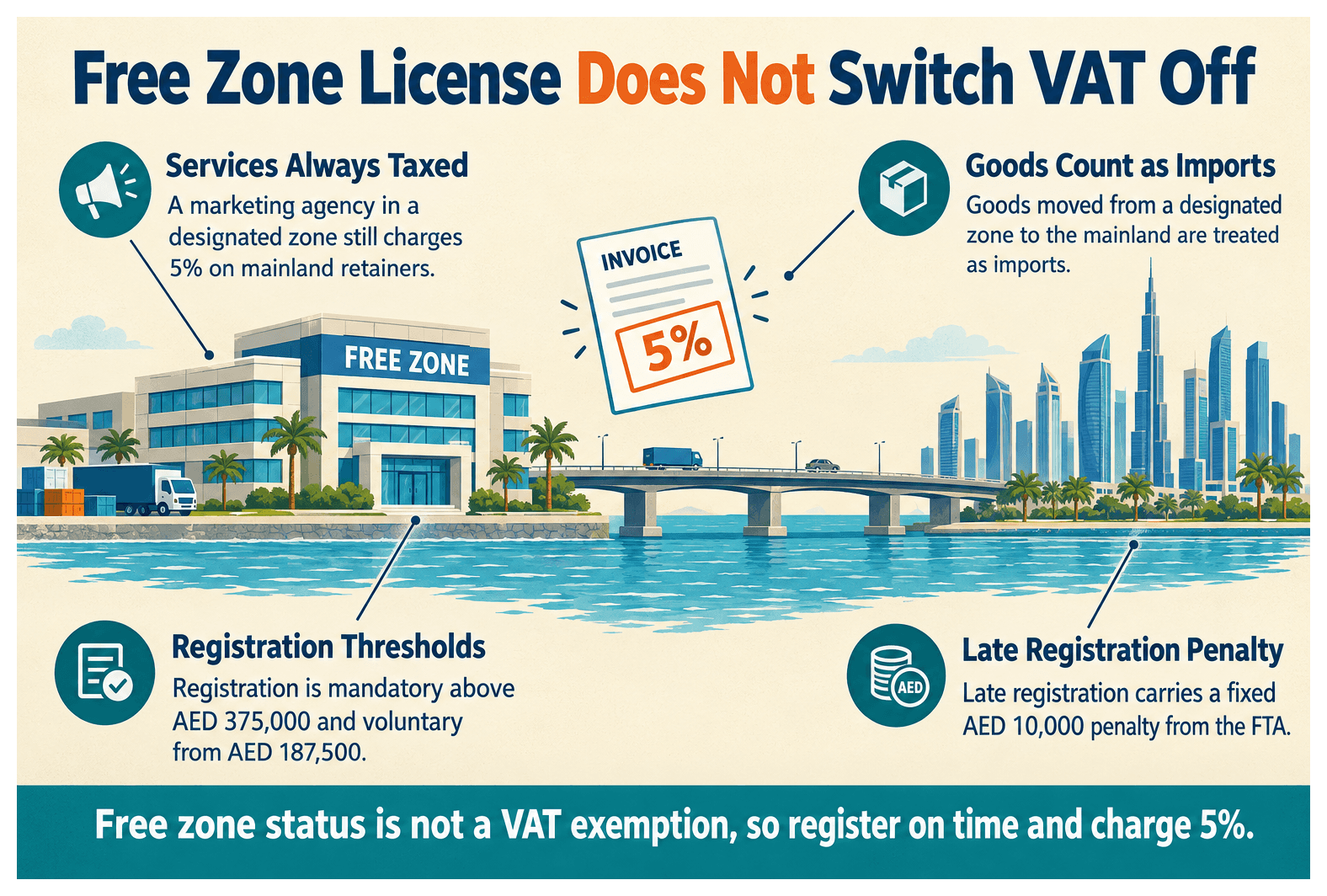
A designated zone is listed in Cabinet Decision No. 59 of 2017 and is treated as outside the UAE for VAT on certain goods. Goods moved to the mainland count as imports, so mainland VAT is due. Check the current list on the Ministry of Finance and FTA sites before relying on it.
What Changes When Goods Cross Into the Mainland
The movement is treated as an import of goods.
5% VAT is accounted for via customs or the recipient's return.
Both parties keep the movement paperwork.
Why Services Are Always Treated Differently
Designated zone rules don't extend to services. A marketing agency inside a designated zone still charges 5% on a retainer to a mainland client. In practice, this is where invoicing mainland clients trips people up.
When a Free Zone Company Must Register for VAT
You must register when taxable supplies and imports exceed AED 375,000 over 12 months, or are expected to in the next 30 days. Voluntary registration starts at AED 187,500. Late registration carries a fixed AED 10,000 penalty (FTA, 2026).
Registration runs through the EmaraTax portal.
Standard-rated and zero-rated supplies count, including exports.
Exempt supplies are treated differently.
A company with AED 250,000 in mainland sales and AED 200,000 in exports crosses the line on combined turnover. Our VAT return filing guide covers what comes next.
Practical Process to Register, Invoice, and File VAT on Mainland Sales
Confirm your zone status, check the threshold, register on EmaraTax, issue invoices showing 5% VAT, and file the VAT201 within 28 days of period end. Keep records for five years.
Step 1: Confirm zone status. Build a sales matrix: goods vs services, designated vs non-designated, mainland vs export.
Step 2: Register and invoice. Submit your license and financial data. Each invoice needs "Tax Invoice", both parties' details, your TRN (Tax Registration Number), date, description, and VAT in AED.
Step 3: File the VAT201. A quarter ending 31 March means filing and payment by 28 April.
Real-World Scenarios: How Free Zone Companies Charge VAT on Sales to Mainland UAE
A consultancy charges 5% on mainland invoices once registered. A designated zone goods trader treats movement as an import. An unregistered company below the threshold charges nothing but should track turnover monthly.
Scenario one: a consultancy invoices AED 100,000, adds AED 5,000 VAT, and reclaims AED 800 input VAT on office costs. Scenario two: a building materials trader ships AED 200,000 of goods to a mainland contractor. Import VAT is AED 10,000, and the delivery notes and customs papers are filed.
Deadlines, Penalties, and Records Every Free Zone Finance Manager Should Track
Register within 30 days of crossing the threshold, file and pay within 28 days of period end, and keep records five years. Late filing costs AED 1,000, rising to AED 2,000 for a repeat within 24 months.
Schedule an internal review on day 15 after each quarter.
File three days late and you still pay AED 1,000, even with no VAT due.
VAT is separate from Qualifying Free Zone Person status. Mainland revenue can also push profits into the 9% corporate tax rate.
Common Mistakes When Free Zone Companies Charge VAT on Sales to Mainland UAE
The big ones: assuming a license removes VAT, ignoring the threshold, misclassifying goods and services, invoicing without a TRN, and missing deadlines.
Testing the threshold at year-end instead of monthly.
Charging VAT before your TRN arrives, which forces credit notes.
Failing to produce delivery and customs documents in an audit.
Not correcting filed errors through voluntary disclosure.
Next Steps
Free zone companies charge VAT on sales to mainland UAE in most situations. Services are taxable at 5%, and goods depend on designated zone status. Review your sales against AED 375,000 this month, confirm your zone's status, and talk to the Dubai South Business Hub team about licensing and compliance.
References
Frequently Asked Questions