
Topic Summary
Account Opening Fees Vary Widely
One-off account opening fees in Dubai range from AED 0 to AED 2,000 depending on the bank and account tier. Free zone companies often qualify for fee-free opening at several local banks.
Minimum Balance Requirements Can Be Steep
Banks require ongoing minimum balances ranging from AED 10,000 to AED 500,000, which must be maintained continuously rather than just at opening. Falling below the threshold typically triggers penalty fees or account restrictions.
Monthly Maintenance Fees Add Up Over Time
Recurring maintenance charges run between AED 200 and AED 1,000 per month, making them a significant annual cost to budget for. Many banks waive these fees entirely if the required minimum balance is consistently maintained.
Late Tax Registration Carries a Flat Penalty
Both VAT and corporate tax late registration each carry a flat AED 10,000 penalty from the Federal Tax Authority. Delaying your corporate bank account opening can directly cause you to miss registration deadlines and trigger these avoidable costs.
A Corporate Account Is a Legal Requirement
UAE commercial law requires businesses to keep company funds completely separate from personal funds, and VAT payments must be made through a UAE bank account linked to your tax registration. Personal accounts cannot legally substitute for a corporate account under any circumstances.
Wage Payments Require a WPS-Registered Account
Salary payments for sponsored employees must be processed through a bank account registered with the UAE Wages Protection System, as mandated by the Ministry of Human Resources. This makes a corporate bank account operationally essential from the moment you hire your first employee.
Free Zone Licensing Can Accelerate the Process
At some free zones like Dubai South Business Hub, a trade license can be issued in as little as one business day starting from AED 12,500. Having your license in hand quickly is a key step toward faster bank account approval.
In 2026, opening a corporate bank account in Dubai carries one-off fees ranging from AED 0 to AED 2,000 at most mainstream banks. The UAE has over 50 licensed banks (Central Bank of the UAE, 2026). Minimum balance requirements range from AED 10,000 to AED 500,000. A VAT late registration penalty costs AED 10,000 (Federal Tax Authority, 2026). Corporate tax late registration carries the same AED 10,000 flat penalty. Monthly maintenance fees run AED 200 to AED 1,000, often waived if the balance is maintained. At Dubai South Business Hub Free Zone (DSBH), a trade license starts from AED 12,500, issued in one business day.
This guide breaks down every cost line for a corporate bank account in Dubai, separates one-off charges from recurring ones, explains what is not included, and shows how your company structure affects approval speed and fees.
What Is a Corporate Bank Account in Dubai and Why Every Business Needs One
A corporate bank account in Dubai is a business-only account held with a UAE-licensed bank, used to receive client payments, pay suppliers, run payroll, and meet VAT filing obligations. Without one, your company cannot legally transact in UAE dirhams or receive international wire transfers into a UAE entity.
Definition and Legal Basis
A corporate bank account is distinct from a personal account. It is registered in the company's trade name and linked directly to the trade license number. The Central Bank of the UAE licenses and supervises all retail and commercial banks permitted to offer business accounts in the country, and UAE commercial law requires businesses to keep company funds entirely separate from personal funds. Commingling is a compliance risk that can trigger regulatory scrutiny.
Both free zone companies and mainland companies are eligible to open a corporate bank account in Dubai. The document requirements differ slightly, but the underlying legal obligation is the same. A sole-founder consultancy licensed at a Dubai free zone, for example, needs a corporate account before it can invoice its first client in AED or USD. That's not a formality; it's a legal and commercial necessity from day one.
Why the Account Is Not Optional
VAT compliance: VAT-registered businesses must file returns and make payments through a UAE bank account linked to their tax registration number.
Corporate tax: Payments to the Federal Tax Authority require a verifiable UAE bank record; no personal account substitutes.
Client and investor expectations: Regional clients and investors expect local bank transfers, not payments from a personal account.
Wages Protection System (WPS): Salary payments for sponsored employees must run through a WPS-registered bank account, mandatory under UAE labour regulations (MoHRE, 2026).
A tech startup that delays opening its corporate bank account risks missing its VAT return deadline, triggering an AED 10,000 late registration penalty. That's a painful and entirely avoidable cost. Learn more about bank account opening in Dubai and what the process involves from a free zone perspective.
Corporate Bank Account Dubai Cost: One-Off vs. Recurring Charges
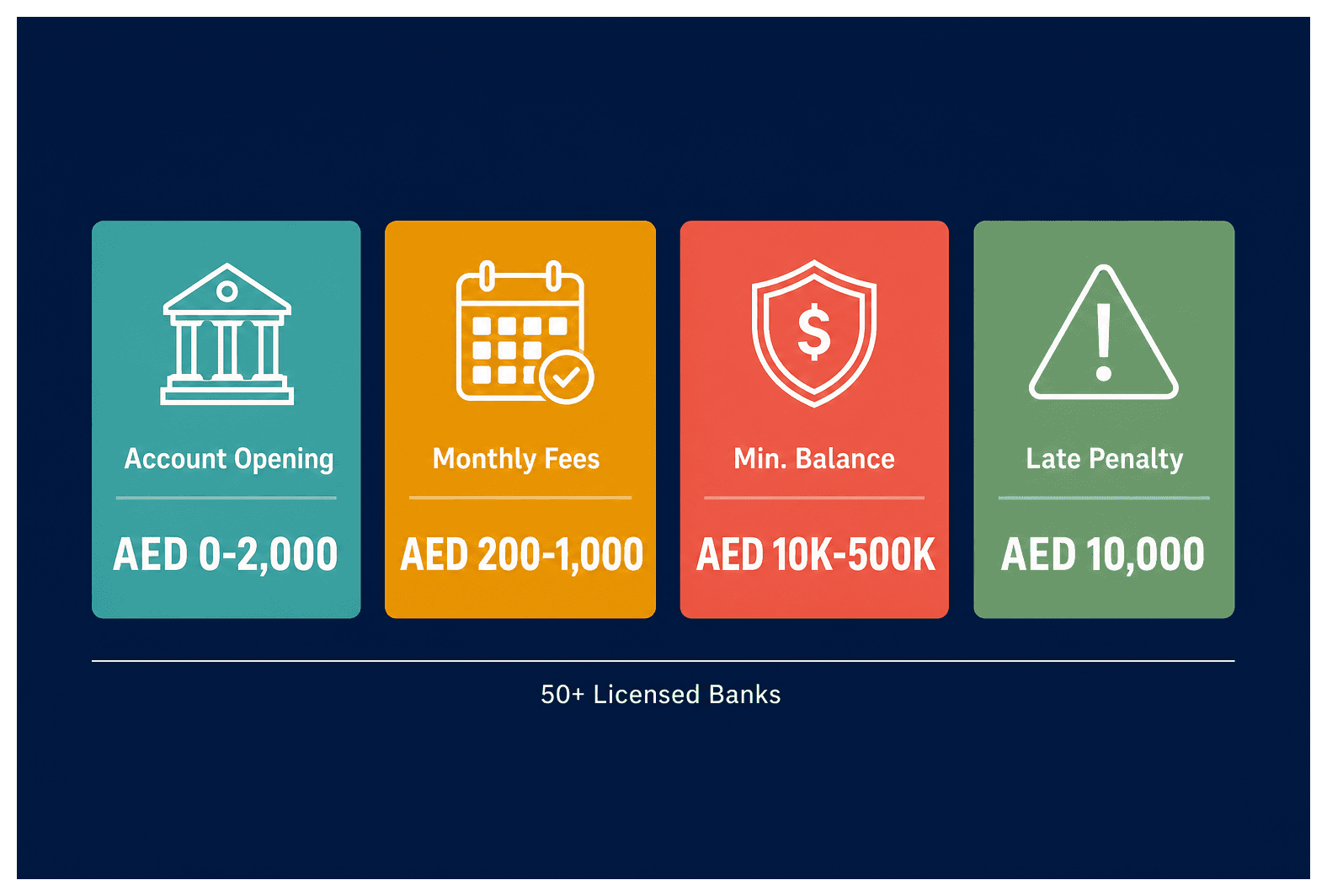
Corporate bank account costs in Dubai split into one-off charges (account opening fee of AED 0 to AED 2,000, initial deposit) and recurring charges (monthly or annual maintenance of AED 200 to AED 1,000, plus minimum balance requirements of AED 10,000 to AED 500,000 that must be maintained continuously). Understanding which bucket each cost falls into is what separates a realistic budget from an unpleasant surprise.
One-Off Costs at Account Opening
Account opening fee: AED 0 at several local banks for free zone companies, up to AED 2,000 at premium business banking tiers.
Initial deposit: Typically AED 10,000 to AED 50,000 depending on the bank and account tier. This is not a fee; it counts toward your minimum balance requirement.
Document notarisation: If your memorandum of association, passport copies, and Emirates ID attestation aren't already completed, add AED 500 to AED 1,500.
Card issuance: Some banks charge a one-time fee of AED 50 to AED 200 per debit or corporate card.
A founder setting up at Dubai South Business Hub Free Zone who already has attested incorporation documents from the formation process saves on notarisation costs when presenting documents to the bank. That's a real advantage of completing your document pack properly at the company formation stage.
Corporate Bank Account Dubai: One-Off vs. Recurring Costs
Cost Category | One-Off Costs | Recurring Costs |
|---|---|---|
Account fee | AED 0 to AED 2,000 at opening | Monthly maintenance: AED 200 to AED 1,000 (waived if minimum balance met) |
Deposit / balance | Initial deposit: AED 10,000 to AED 50,000 (counts toward minimum balance) | Below-balance penalty: AED 100 to AED 500/month if threshold is breached |
Documents | Notarisation/attestation: AED 500 to AED 1,500 (if not already completed) | International wire fee: AED 25 to AED 100 per outgoing transfer |
Cards | Card issuance: AED 50 to AED 200 per card | Annual card fee: AED 200 to AED 500 for premium tiers |
Not included | Trade license, visa packages, accounting, tax registration | VAT filing, corporate tax registration or filing |
Recurring Monthly and Annual Charges
Monthly maintenance fee: AED 200 to AED 1,000, often fully waived if you maintain the minimum balance throughout the month.
Below-balance penalty: The largest hidden cost. Falling below the threshold triggers AED 100 to AED 500 per month, every month, until you top up.
International wire transfers: AED 25 to AED 100 per outgoing transfer, varying by currency and bank.
Currency conversion: Receiving foreign currency typically attracts a spread of 0.5% to 2.5% above the mid-market rate.
Annual card fee: AED 200 to AED 500 per corporate card at premium account tiers.
A trading company maintaining a minimum balance of AED 50,000 at a local bank avoids the monthly maintenance fee entirely, saving AED 600 to AED 1,000 per year. That's money better directed at growth.
What Is Not Included in Bank Fees
Trade license: At DSBH, the license starts from AED 12,500. This is entirely separate from any bank charge.
Visa packages: Always an additional cost. A first-year setup for a sole founder with one visa at DSBH starts from AED 18,350.
Accounting and VAT filing: Banks don't provide bookkeeping or VAT return services; these must be contracted separately.
Corporate tax registration: The Federal Tax Authority manages this independently of your bank.
A first-time founder budgeting AED 18,350 for their DSBH license and visa package must add the bank's minimum balance requirement on top before they can start trading. Use the business setup cost calculator to map these figures together before committing.
Steps to Open a Corporate Bank Account in Dubai
To open a corporate bank account in Dubai, you need a valid trade license, incorporation documents, passport copies of all shareholders, Emirates ID or visa copy, a business plan summary, and proof of address. Most banks complete their review in five to fifteen business days after receiving a complete document set.
Step 1: Obtain Your Trade License First
No UAE bank will open a corporate account without a valid, current trade license. At Dubai South Business Hub Free Zone, the license is issued in one business day, which means banking can start almost immediately after company formation. A sole founder who completes DSBH formation on a Monday can present a valid trade license to their chosen bank by Tuesday morning.
Make sure the business activities listed on your license match the nature of transactions you plan to run through the account. Mismatches raise compliance queries and can delay or block account activation. DSBH requires zero paid-up share capital, so no share capital certificate is needed at this stage, which simplifies the document pack considerably.
Step 2: Prepare Your Document Pack
Core documents: Trade license, certificate of incorporation, memorandum and articles of association, passport copies of all shareholders and directors, UAE visa and Emirates ID copies, proof of residential address (utility bill or tenancy contract).
Supplementary documents: Banks may also request a business plan, projected turnover figures, and a list of expected counterparties or clients.
Interview format: Some banks require a physical branch visit for the initial compliance interview; digital-first banks licensed by the Central Bank of the UAE may allow video KYC.
Activity coverage: Each activity beyond the first five on your DSBH license costs AED 2,000. A consulting firm with six activities should present all six to the bank to avoid future account restrictions.
Step 3: Pass the Compliance Review
UAE banks conduct Know Your Customer (KYC) and Anti-Money Laundering (AML) checks on all new business accounts. This is mandatory under Central Bank of the UAE regulations, and there are no shortcuts. Free zone companies are generally viewed favourably because the free zone authority has already conducted entity verification, which reduces the bank's due diligence burden.
Common reasons for rejection include mismatched business activities, incomplete Ultimate Beneficial Owner (UBO) disclosure, and high-risk jurisdictions in the shareholder chain. If rejected, you can apply to a different bank. There is no central blacklist, but repeated rejections usually signal a documentation gap worth resolving before reapplying. A free zone company with a clear shareholder structure and a sole UAE-resident founder typically passes KYC faster than a multi-shareholder structure with overseas holding companies.
How Your Company License Affects Corporate Bank Account Dubai Approval
The type and issuing authority of your UAE trade license directly affects which banks will accept your application, how long KYC takes, and what minimum balance tier the bank assigns. Free zone licenses from regulated authorities like Dubai South Business Hub Free Zone tend to accelerate the compliance review because entity verification is already documented.
Free Zone vs. Mainland: How Banks See the Difference
Free zone companies operate under a free zone authority's regulatory umbrella, which banks treat as an additional layer of due diligence already completed. A founder who sets up at DSBH (launched September 2025) and presents a complete DSBH-issued license and incorporation pack typically satisfies the bank's entity verification requirement without additional legal opinions.
Mainland companies licensed by DET (Dubai Economy and Tourism) are also fully eligible. The document pack is similar but includes a local office tenancy contract. Worth flagging: 100% foreign ownership is available on both the mainland and in free zones. This has no bearing on bank account eligibility. One nuance that does matter for trade finance: free zone goods trade operates under duty-suspension, not duty-exemption. Banks offering letters of credit or trade finance facilities will treat this distinction carefully.
Regulated Activities and Dual Approval
Regulated activities: If your business activity falls under financial services or healthcare, DSBH licenses the activity and the named regulator approves it separately. Both approvals must be in place before the bank will activate a full account.
Financial services: The Central Bank of the UAE or another relevant authority issues the sector approval. Banks will request this document alongside the trade license.
Incomplete approval chains: Presenting the license only, without the sector approval, delays account opening and triggers additional compliance queries.
Professional activities: For consultancy and similar professional license activities, no dual approval is typically needed. The trade license alone satisfies the bank's requirements.
A payments technology company holding a DSBH license for a financial services activity must also present its Central Bank of the UAE approval before the account can be fully activated for client receipts. Skipping this step is one of the most common causes of delayed account opening for fintech founders.
Regulatory Requirements for a Corporate Bank Account in Dubai
Every corporate bank account in Dubai must comply with Central Bank of the UAE AML and KYC regulations, full UBO disclosure, and Economic Substance requirements where applicable. VAT-registered companies must also ensure the account is linked to their Federal Tax Authority tax registration number for return payments.
AML, KYC, and UBO Disclosure
AML and CFT framework: All UAE banks comply with the Central Bank of the UAE's AML and Combating the Financing of Terrorism (CFT) regulations.
UBO disclosure: Any individual owning 25% or more of the company must be named and their identity fully verified. A two-shareholder company where each partner holds 50% must provide full KYC documents for both individuals, not just the nominated director.
Sanctions screening: Banks run screening against international watchlists during onboarding. Clean results are required before account activation.
Ongoing monitoring: The bank may request updated documents annually or whenever ownership changes.
Tax Registration and the Bank Account Link
Companies that exceed the AED 375,000 VAT registration threshold must register with the Federal Tax Authority. The corporate bank account becomes the payment vehicle for quarterly VAT settlements. A DSBH-licensed consultancy that crosses that threshold must register for VAT and use its corporate account to settle the bills. Late VAT registration carries an AED 10,000 penalty.
Corporate tax applies to taxable income above AED 375,000. Qualifying Free Zone Person (QFZP) status may attract a 0% rate, but only if four conditions are all met: the entity is a free zone person, derives qualifying income, has adequate substance in the UAE, and has not elected to be subject to standard corporate tax rates. Late corporate tax registration carries a one-time AED 10,000 flat penalty. Tax obligations exist for all UAE businesses and must be actively managed.
What triggers a bank compliance query?
A bank compliance query is typically triggered by mismatched business activities between the trade license and actual transactions, incomplete UBO disclosure, or shareholders from high-risk jurisdictions. Resolving these before submission, rather than after, avoids delays of several weeks in account activation.
Choosing the Right Bank for Your Corporate Bank Account in Dubai
Choose a UAE corporate bank based on minimum balance requirements, monthly fee structure, multi-currency capability, digital banking features, and the bank's experience with free zone companies. Local banks tend to have lower minimum balances for SMEs, while international banks offer stronger cross-border payment rails but higher account maintenance fees.
Local Banks vs. International Banks: Cost Comparison
Local UAE banks: SME-focused corporate accounts with minimum balances of AED 10,000 to AED 50,000. Maintenance fees are often waived when the balance is maintained.
International banks: Higher minimum balances, typically AED 100,000 to AED 500,000, but stronger international payment networks and multi-currency account options.
Digital-first providers: Emerging in the UAE but must hold a Central Bank of the UAE license. Confirm licensing status before applying.
Best fit by transaction profile: High-volume local AED transactions favour local banks. Frequent USD or EUR cross-border payments may justify an international bank's higher fees.
A marketing consultancy billing regional clients in AED will likely find a local bank's SME account with an AED 25,000 minimum balance far more cost-effective than an international bank requiring AED 250,000. Match the bank to your actual transaction profile, not to brand recognition.
Features to Prioritise for a Dubai Free Zone Company
Multi-currency account support if you invoice in USD, EUR, or GBP.
Online banking with bulk payment capability for payroll via the Wages Protection System (WPS), mandatory for sponsored employees.
Trade finance facilities (letters of credit, bank guarantees) if your business involves import or export; these require separate credit approval.
Dedicated relationship manager for free zone entities, which speeds up compliance queries and account amendments.
References
Frequently Asked Questions