Topic Summary
What Is UAE Corporate Tax for Education Companies and Why It Matters
UAE corporate tax for education companies is a federal tax on profits. Education businesses should separate core tuition from ancillary services such as transport, uniforms, events and software, because each stream can be treated differently. That split drives your education company tax UAE position.
How Exempt Tuition and Taxable Ancillary Services Are Treated
How Exempt Tuition and Taxable Ancillary Services Are Treated
Free Zone Corporate Tax 2026 for Education Companies
Free zone corporate tax 2026 rules let a Qualifying Free Zone Person pay 0% on qualifying income and 9% on non-qualifying income. Non-qualifying revenue must stay at or below the lower of 5% of total revenue or AED 5 million. Cross that line and the 0% treatment goes.
Step-by-Step Registration and Filing
Create an EmaraTax account with the Federal Tax Authority, submit your company and license details, receive your Tax Registration Number (TRN), keep records, and file within nine months of year-end. Free zone entities add qualifying-income disclosures.
How Much Does It Cost and How Long Does It Take
Corporate tax registration carries no government fee, and approval often takes a few working days. Your real costs are license fees, accounting, audit and advisory support. Fees change, so check dates on every figure.
Regulations in the UAE That Shape Education Company Tax
Federal Decree-Law No. 47 of 2022, Ministry of Finance decisions and Cabinet decisions set the framework, including free zone qualifying income. Sector licensing rules and VAT on educational supplies sit alongside them. Verify current texts with the Ministry of Finance and the Federal Tax Authority.
Common Mistakes and What Should You Do Next to Stay Compliant
The most common Mistakes are skipping registration because of low profit, mixing tuition and ancillary income in one ledger, ignoring the de minimis limit, and missing the nine-month deadline. Separate revenue streams, watch non-qualifying income monthly, and diarise deadlines.
UAE corporate tax for education companies is 0% on taxable income up to AED 375,000 and 9% above it [2]. Qualifying Free Zone Persons follow a separate regime that keeps 0% on qualifying income only while non-qualifying revenue stays inside the de minimis limit.
More than 350,000 businesses are now registered with the Federal Tax Authority [1], and a missed registration costs AED 10,000 [3]. This guide is for owners and finance leads who need to know how tuition, ancillary income, free zone status, filing and costs fit together. Use the cost calculator to estimate setup costs and the name check tool before you file.
What Is UAE Corporate Tax for Education Companies and Why It Matters
UAE corporate tax for education companies is a federal tax on profits. Education businesses should separate core tuition from ancillary services such as transport, uniforms, events and software, because each stream can be treated differently. That split drives your education company tax UAE position.
The 9% Rate and the AED 375,000 Threshold Explained
The 0% band covers taxable income up to AED 375,000, and 9% applies to the excess. It applies to financial years starting on or after 1 June 2023. Take a tutoring company with AED 1,000,000 of taxable income. It pays 9% on AED 625,000, which is AED 56,250.
Who Counts as an Education Company for Tax Purposes
Classification follows the activity you perform, not your sales channel. That mirrors ISIC Rev.4 logic, where Section P covers education.
Schools, training centers and tutoring firms.
Edtech providers and educational publishers.
Support services such as consultancy and quality assurance.
An online language academy is classified by its teaching, not its website.
Exempt Tuition Versus Taxable Ancillary Education Revenue (Figures as of Publication Date, in AED)
Feature | Core Tuition and Teaching | Ancillary Services |
|---|---|---|
Typical examples | Course fees, term tuition, lesson packages | Bus subscriptions, uniforms, events, software licenses |
VAT treatment | Commonly exempt or zero-rated if qualifying (5% standard rate otherwise) | Usually 5% VAT |
Corporate tax treatment | Part of taxable profit: 0% to AED 375,000, then 9% | Part of taxable profit at the same rates |
Ledger tracking | Dedicated tuition revenue code | Separate code per stream |
Free zone qualifying income risk | Depends on who the client is and where it sits | Higher: mainland sales can count as non-qualifying |
Why Education Owners Should Plan Early
Registration is mandatory even when no tax is due. A start-up training center that skips it because it expects a loss still faces the AED 10,000 penalty. Read our overview of UAE corporate tax changes to see what shifted for 2026.
How Exempt Tuition and Taxable Ancillary Services Are Treated
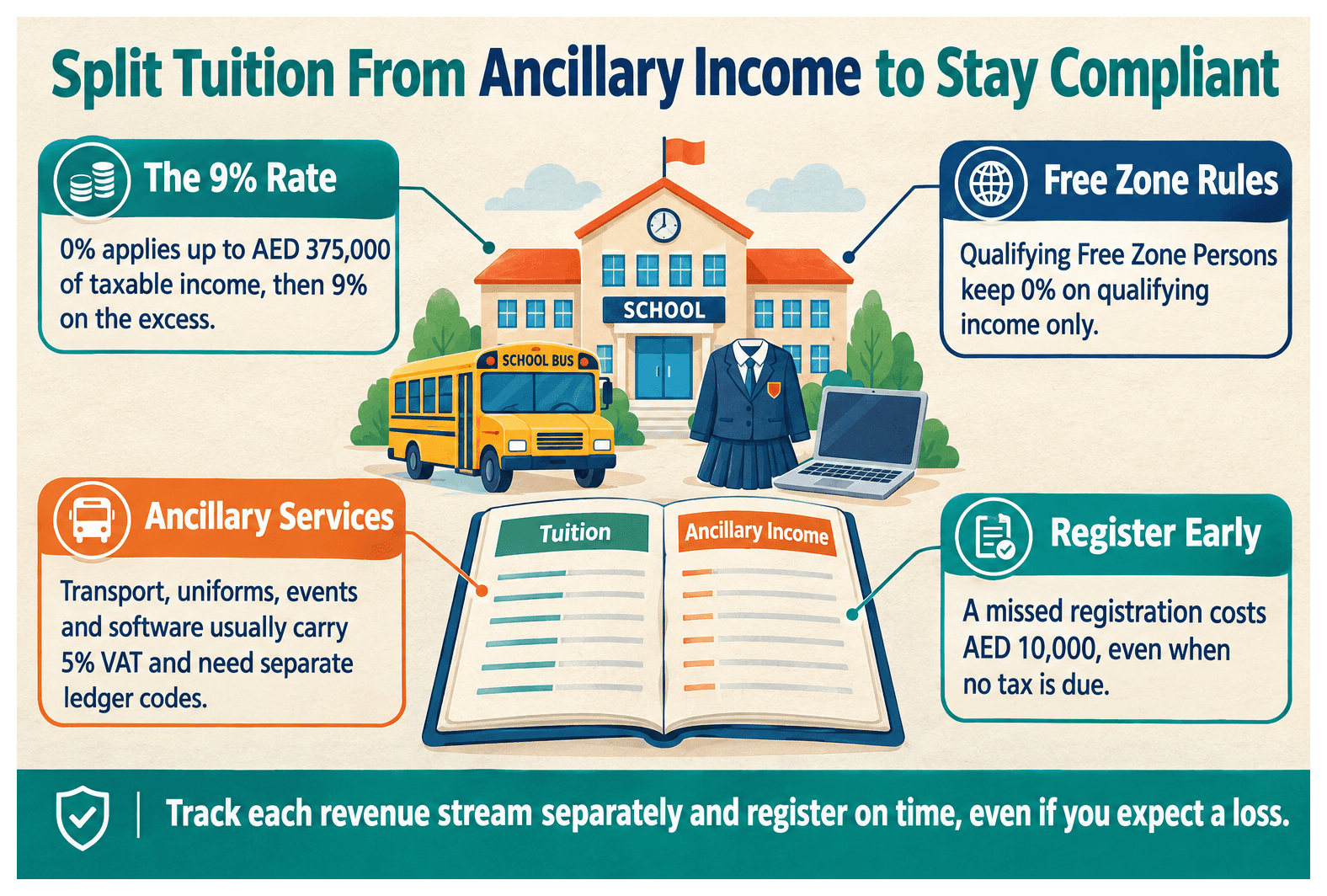
Core tuition is commonly treated as an exempt or zero-rated education supply for VAT. Corporate tax, though, applies to your overall taxable profit. Ancillary income is usually taxable commercial revenue and belongs in its own ledger.
Exempt Tuition Supplies and What Qualifies
Don't confuse the two taxes. VAT relief on tuition does not remove tuition profit from corporate tax. Keep license copies and invoices that label course fees as education services. A licensed training center that does this can evidence its VAT position quickly if the Federal Tax Authority asks.
Taxable Ancillary Services Education Companies Often Miss
Transport and uniform sales.
Books and merchandise (see educational supplies trading license in Dubai).
Paid events and software subscriptions.
Consultancy fees.
Separate ledgers reduce audit risk. A school-support business selling uniforms and bus subscriptions on top of tuition should code each line monthly.
Free Zone Corporate Tax 2026 for Education Companies
Free zone corporate tax 2026 rules let a Qualifying Free Zone Person pay 0% on qualifying income and 9% on non-qualifying income. Non-qualifying revenue must stay at or below the lower of 5% of total revenue or AED 5 million. Cross that line and the 0% treatment goes.
Qualifying Free Zone Person Conditions
Adequate substance in the free zone.
Qualifying activities and qualifying income.
Transfer pricing compliance.
Audited financial statements.
It's not a blanket exemption. A Dubai South Business Hub Free Zone training company earning from other free zone businesses can fit, but conditions apply every year.
The De Minimis Rule in Practice
A company with AED 10 million of revenue has a 5% limit of AED 500,000 for non-qualifying income. Breach it and you lose QFZP status for that year and the following four. Monitor mainland-client revenue monthly, not at year-end.
When Free Zone Status Suits an Education Business
It typically fits edtech, content, consultancy and corporate training with international clients. An education consultancy serving overseas institutions through a Dubai South license is a good example. Mainland student-facing teaching may need a different license. Dubai South Business Hub Free Zone offers trade licenses with residency visa packages tied to the license. See what a free zone company must file and the Dubai South education setup guide.
Step-by-Step Registration and Filing
Create an EmaraTax account with the Federal Tax Authority, submit your company and license details, receive your Tax Registration Number (TRN), keep records, and file within nine months of year-end. Free zone entities add qualifying-income disclosures.
Step 1: Confirm Your License and Company Name
Match your license activity to your education services, and align license details with tax records. A founder should verify the name with the name check tool first.
Step 2: Register on EmaraTax and Get Your TRN
Prepare your license, Emirates ID, passport and shareholder details. The registration fee is AED 0 as of January 2026.
Step 3: Keep Records and Prepare Financial Statements
Retain records for seven years. Run a monthly close that separates tuition from transport income. QFZP entities need audited accounts.
Step 4: File and Pay Within Nine Months
A 31 December year-end means a 30 September deadline. Consider corporate tax filing services if your books are complex.
How Much Does It Cost and How Long Does It Take
Corporate tax registration carries no government fee, and approval often takes a few working days. Your real costs are license fees, accounting, audit and advisory support. Fees change, so check dates on every figure.
Government Fees Versus Professional Costs
Registration: AED 0 (January 2026).
Late registration penalty: AED 10,000.
Bookkeeping and audit: varies by size.
Timeline From License to First Return
A company licensed in March can register within weeks and file after its first year-end, within the nine-month window. If you're a QFZP, book the audit early.
Estimate Your Setup and Compliance Budget
Model three scenarios before choosing a license, with license, visa and compliance lines in each. The cost calculator gives a current estimate.
Regulations in the UAE That Shape Education Company Tax
Federal Decree-Law No. 47 of 2022, Ministry of Finance decisions and Cabinet decisions set the framework, including free zone qualifying income. Sector licensing rules and VAT on educational supplies sit alongside them. Verify current texts with the Ministry of Finance and the Federal Tax Authority.
Corporate Tax Law and Ministerial Decisions
Check for updates every January. A finance lead should review Ministry of Finance decisions before the year-end close.
Tax Groups, Transfer Pricing and Related Parties
Multi-entity school groups may consider a tax group.
Management or licensing charges between related parties must follow the arm's length principle.
A holding company with two training subsidiaries is a typical case.
Common Mistakes and What Should You Do Next to Stay Compliant
The most common Mistakes are skipping registration because of low profit, mixing tuition and ancillary income in one ledger, ignoring the de minimis limit, and missing the nine-month deadline. Separate revenue streams, watch non-qualifying income monthly, and diarise deadlines.
Mistakes That Trigger Penalties
Late registration: AED 10,000.
Treating transport fees as exempt and underreporting taxable income.
Breaching the de minimis limit unnoticed.
Your Next Steps Checklist
Check your company name.
Register for corporate tax.
Split tuition and ancillary ledgers.
Review your position each January.
New founders can start with our Dubai South education guide and apply this 30-day plan.
Final Thoughts on UAE Corporate Tax for Education Companies
The 0% and 9% structure around AED 375,000, the exempt tuition versus taxable ancillary split, and the de minimis rule define your tax position. Clean ledgers and early registration keep you compliant. It's never a "tax-free" outcome, just a well-managed one.
Use the cost calculator, check your company name, and speak to the Dubai South Business Hub team about a free zone trade license with residency visa packages.
References
[1] Federal Tax Authority, 2026
[2] Ministry of Finance, 2025
[4] UAE Cabinet, 2023
Frequently Asked Questions