Topic Summary
What Is UAE Corporate Tax for Logistics Companies and Why It Matters
UAE corporate tax for logistics companies is a federal tax on net profit from freight forwarding, warehousing and transport. It charges 0% up to AED 375,000 and 9% above. Every licensed logistics business must register with the Federal Tax Authority, even if its bill is nil.
How the 9% Rate and AED 375,000 Threshold Apply to Freight, Warehousing and Transport Services
How the 9% Rate and AED 375,000 Threshold Apply to Freight, Warehousing and Transport Services
Free Zone Corporate Tax 2026 and the De Minimis Rule for Logistics Companies
Free zone corporate tax 2026 gives 0% only on qualifying income, and only to a Qualifying Free Zone Person. Non-qualifying revenue must stay at or below the lower of 5% of total revenue or AED 5 million. Breach it and you lose the 0% rate for that year and the next four.
Step-by-Step Registration and Filing for UAE Corporate Tax for Logistics Companies
Create an EmaraTax account, submit license and ownership details, and receive your tax registration number. Then keep records, prepare accounts and file within nine months of year end. Free zone companies add audited statements and a Qualifying Free Zone Person assessment.
How Much Does It Cost and How Long Does It Take
Registration on EmaraTax is free, and approval typically takes a few working days. Real costs come from accounting, audit and advisory support, plus penalties. Verify current fees on the Federal Tax Authority site before budgeting. Logistics company tax in the UAE rewards early planning.
Regulations in the UAE That Shape Logistics Company Tax
Federal Decree-Law No. 47 of 2022 sets the corporate tax framework. Cabinet and Ministry of Finance decisions cover free zones, qualifying activities and the de minimis rule. Transfer pricing, VAT, substance and record-keeping rules also affect taxable profit.
Common Mistakes and What Should You Do Next to Stay Compliant
Typical logistics company tax mistakes in the UAE are missed registration, mixed revenue streams, ignoring the de minimis limit, weak related-party pricing and poor records. Fix them by separating ledgers, documenting transactions and booking a review before your deadline.
In 2026, logistics contributes roughly 7% of UAE GDP (Dubai Chamber, 2024) [1]. UAE corporate tax for logistics companies is 0% on taxable profit up to AED 375,000 and 9% on the portion above it [2]. Free zone operators get 0% only on qualifying income, and non-qualifying revenue must stay within the lower of 5% of revenue or AED 5 million [3]. Returns are due nine months after year end, and a late registration costs AED 10,000 [2].
This guide is for owners and finance leads who want to know what they owe, when, and how to avoid penalties.
What Is UAE Corporate Tax for Logistics Companies and Why It Matters
UAE corporate tax for logistics companies is a federal tax on net profit from freight forwarding, warehousing and transport. It charges 0% up to AED 375,000 and 9% above. Every licensed logistics business must register with the Federal Tax Authority, even if its bill is nil.
Who Falls Inside the Tax Net
Freight forwarders, 3PL operators, warehouse owners, hauliers and last-mile couriers are all taxable persons. Mainland and free zone entities both register, though the rate depends on income type. Financial years starting on or after 1 June 2023 are in scope.
Take a Dubai South freight forwarder with AED 2.1 million net profit. At the standard rate, it pays 9% on AED 1,725,000, which is AED 155,250.
Why Logistics Margins Make Tax Planning Matter
Freight margins are thin, so a 9% charge on profit is material. Picture a 3PL with a 4% net margin next to a customs consultancy earning 25%. The same rate bites far harder on the first. Fuel, fleet depreciation and lease costs are where deduction planning pays off. If you're still at the formation stage, read about setting up a logistics company in Dubai.
How the 9% Rate and AED 375,000 Threshold Apply to Freight, Warehousing and Transport Services
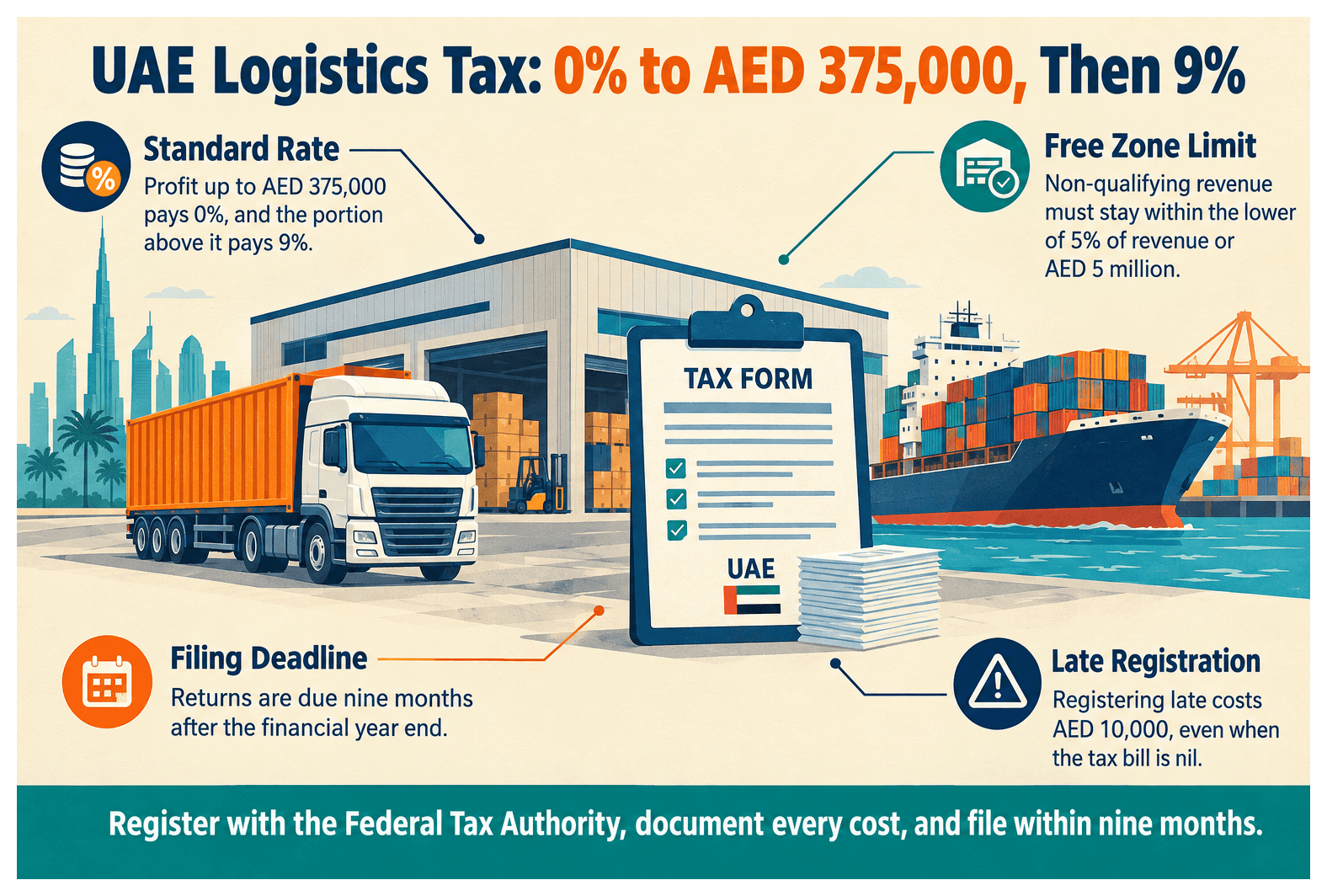
Logistics companies pay 0% on taxable income up to AED 375,000 and 9% above it. The rate applies to net profit after deductible costs, not revenue. Freight, warehousing and transport income are treated alike, unless a free zone company qualifies for 0%.
Freight Forwarding Income
Commission and handling fees are taxed on net profit. Say a forwarder bills AED 8 million, pays AED 6.9 million to carriers and spends AED 0.7 million on operating costs. Profit is AED 400,000, so tax is 9% of AED 25,000, or AED 2,250. Keep disbursements documented so pass-through costs don't inflate revenue. VAT zero-rating on international freight is a separate matter. If you're building this business, see the freight forwarding business setup in Dubai guide.
Warehousing and Storage Income
Rent, pick-and-pack and value-added services all count as business income.
Lease costs, racking depreciation and utilities are deductible if wholly for business.
Owner-traders must follow inventory valuation rules for UAE companies.
Split storage revenue from e-commerce fulfilment fees in your ledger.
Transport and Haulage Income
Fleet depreciation, fuel, driver costs and permits are deductible. Related-party transport charges must be at arm's length. Consider a 40-truck firm funding vehicles through a shareholder loan. Interest above the 30% of EBITDA cap may be disallowed for large borrowers.
Mainland vs Qualifying Free Zone vs Non-Qualifying Free Zone Logistics Company
Feature | Qualifying Free Zone Person | Mainland or Non-Qualifying Entity |
|---|---|---|
Rate on income up to AED 375,000 | 0% on qualifying income | 0% on the first AED 375,000 |
Rate on income above AED 375,000 | 0% qualifying, 9% non-qualifying | 9%, so AED 236,250 on AED 3 million profit |
De minimis limit (lower of 5% of revenue or AED 5 million) | Non-qualifying revenue must stay within it | Not applicable |
Audited financial statements | Mandatory every year | Required only above set revenue thresholds |
Substance and transfer pricing requirements | Local staff, premises and arm's length pricing | Transfer pricing applies to related parties |
Free Zone Corporate Tax 2026 and the De Minimis Rule for Logistics Companies
Free zone corporate tax 2026 gives 0% only on qualifying income, and only to a Qualifying Free Zone Person. Non-qualifying revenue must stay at or below the lower of 5% of total revenue or AED 5 million. Breach it and you lose the 0% rate for that year and the next four.
Conditions Must You Meet to Keep the Exemption
Keep real substance: staff, premises and core activity.
Maintain audited financial statements.
Follow transfer pricing rules.
Stay within the de minimis limit.
Don't elect standard-rate taxation.
What Counts as Qualifying Logistics Income
Qualifying activities include logistics services and warehousing or distribution in or from a designated zone, subject to Cabinet decisions. Dealings with other free zone persons can qualify. Mainland-sourced services generally don't, and they're taxed at 9%. Imagine a free zone 3PL storing goods for a mainland customer: that revenue counts toward the de minimis limit. Check the activity lists on the Federal Tax Authority and Ministry of Finance sites, plus your warehouse's designated zone status. Our guide on what a free zone company must file covers the paperwork.
Dubai South Business Hub Free Zone offers company formation, trade licenses and residency visa packages tied to a license. The 0% rate is never automatic, so it's not "tax free" on all income.
Step-by-Step Registration and Filing for UAE Corporate Tax for Logistics Companies
Create an EmaraTax account, submit license and ownership details, and receive your tax registration number. Then keep records, prepare accounts and file within nine months of year end. Free zone companies add audited statements and a Qualifying Free Zone Person assessment.
Step 1: Confirm Your License Activity and Company Name
Match license activity to freight, warehousing or transport.
Run a company name check before formation.
License activity drives tax classification.
Step 2: Register on EmaraTax
Upload your trade license, Emirates ID, passports and shareholder details.
Receive your registration number and certificate.
Late registration costs AED 10,000 (January 2026).
Step 3: Keep Records and Prepare Accounts
Retain records for 7 years.
Tag each invoice as qualifying or non-qualifying.
Maintain fleet, warehouse asset and related-party registers.
Step 4: File the Return and Pay Within Nine Months
A 31 December 2025 year end means a 30 September 2026 deadline.
Pay the tax by the same date.
Consider corporate tax filing services in Dubai.
How Much Does It Cost and How Long Does It Take
Registration on EmaraTax is free, and approval typically takes a few working days. Real costs come from accounting, audit and advisory support, plus penalties. Verify current fees on the Federal Tax Authority site before budgeting. Logistics company tax in the UAE rewards early planning.
Government Fees and Penalties
Registration: no government fee.
Late registration: AED 10,000 (January 2026).
Late filing: AED 500 monthly for 12 months, then AED 1,000 (January 2026).
Six months late adds AED 3,000.
Advisory, Audit and Setup Budget
Qualifying free zone persons must budget for annual audits. Use the cost calculator to compare license and visa package totals in AED. For wider figures, see business setup cost in Dubai for logistics.
Regulations in the UAE That Shape Logistics Company Tax
Federal Decree-Law No. 47 of 2022 sets the corporate tax framework. Cabinet and Ministry of Finance decisions cover free zones, qualifying activities and the de minimis rule. Transfer pricing, VAT, substance and record-keeping rules also affect taxable profit.
Corporate Tax Law, Cabinet Decisions and Ministerial Rulings
Rules get updated, so review them every January alongside your license renewal. Our summary of UAE corporate tax changes helps you track them.
Transfer Pricing, VAT and Substance Interactions
Related-party freight and warehouse charges must be at arm's length.
A group company undercharging a sister haulier invites adjustment.
VAT zero-rating on international transport is separate from corporate tax.
Free zone entities need genuine substance.
Common Mistakes and What Should You Do Next to Stay Compliant
Typical logistics company tax mistakes in the UAE are missed registration, mixed revenue streams, ignoring the de minimis limit, weak related-party pricing and poor records. Fix them by separating ledgers, documenting transactions and booking a review before your deadline.
Five Mistakes That Trigger Penalties
Assuming a free zone license means automatic 0%.
Breaching the de minimis limit through mainland billing.
Recording gross pass-through freight costs incorrectly.
Keeping weak asset and fuel records.
Missing the nine-month deadline.
A free zone warehouse operator whose mainland revenue passed AED 5 million would lose status for the period plus four years.
Your Next Steps
Check your qualifying status and ledger split now. Book a pre-year-end review in December, and revisit rules each January.
Final Thoughts on UAE Corporate Tax for Logistics Companies
UAE corporate tax for logistics companies rewards clean structure: 0% to AED 375,000, 9% above, and a 0% free zone rate only for qualifying income inside the de minimis limit. Separate your revenue streams and keep strong records. Use the cost calculator to estimate your Dubai South Business Hub free zone setup, run a name check, and speak with the team about license and residency visa packages.
References
Dubai Chamber, logistics sector contribution to GDP, 2024.
Federal Tax Authority, corporate tax registration, filing and penalties, 2026.
Ministry of Finance, corporate tax and Qualifying Free Zone Person decisions, 2026.
Frequently Asked Questions