Topic Summary
What Is UAE Corporate Tax for Trading Companies and Why It Matters
UAE corporate tax for trading companies is a 9% federal tax on taxable profit above AED 375,000, with 0% on profit up to that threshold. Qualifying free zone traders can access 0% on qualifying income if they meet the conditions set by the Federal Tax Authority .
Free Zone Corporate Tax 2026 for Trading Companies
Free Zone Corporate Tax 2026 for Trading Companies
How Goods Movement and Designated Zone Treatment Affect Trading Company Tax in the UAE
Goods movement affects tax because qualifying status depends on who buys the goods and where they are held. Transactions involving goods in a Designated Zone can be treated as qualifying, while sales into the mainland are generally non-qualifying. Re-exports and transit trade need clear contracts and customs records.
Step-by-Step Registration and Filing for UAE Corporate Tax for Trading Companies
To comply, register with the Federal Tax Authority, keep accounts, classify revenue, test the de minimis rule, prepare audited statements if required, and file within nine months of year-end. Free zone traders should confirm Qualifying Free Zone Person status before filing.
How Much Does It Cost and How Long Does It Take
Costs depend on license, visa quota and accounting scope. Corporate tax registration itself is free through the Federal Tax Authority, while licensing, audit and filing support are paid services. Confirm current figures, and note the date, with the Dubai South cost calculator .
Regulations in the UAE That Shape Trading Company Tax
Trading companies are shaped by the Federal Corporate Tax Law, Ministry of Finance decisions on qualifying activities, VAT at 5%, customs rules and economic substance expectations. Together they decide your rate, your filing duties and how goods move.
Common Mistakes and What Should You Do Next to Start Re-Exporting From Dubai South
The most common mistakes are skipping registration at 0%, breaching the de minimis limit, weak substance and untracked mainland sales. To start re-exporting from Dubai South, confirm your activity, check your name, estimate costs, license the company, then register for corporate tax.
UAE corporate tax for trading companies is 9% on taxable profit above AED 375,000 and 0% below it. Qualifying free zone traders can reach 0% on qualifying income only if they meet substance, de minimis and compliance conditions.
More than 350,000 businesses are registered with the Federal Tax Authority [1]. Returns are due within 9 months of year-end, and records must be kept for 7 years [1]. Free zone traders must also keep non-qualifying revenue under the lower of 5% of revenue or AED 5,000,000 [2]. This guide helps owners and finance leads work out their rate, their filing duties and their risks.
What Is UAE Corporate Tax for Trading Companies and Why It Matters
UAE corporate tax for trading companies is a 9% federal tax on taxable profit above AED 375,000, with 0% on profit up to that threshold. Qualifying free zone traders can access 0% on qualifying income if they meet the conditions set by the Federal Tax Authority.
The 9% Rate and the AED 375,000 Threshold Explained
Tax applies to net profit, not turnover. A trader with AED 1,000,000 taxable profit pays 9% on AED 625,000, which is AED 56,250. The same logic applies to mainland and free zone entities unless a special regime says otherwise.
Who Counts as a Trading Company for Tax Purposes
Buying and selling goods, including import, export and re-export, makes you a trader. Classification follows the activity performed, in line with ISIC Rev.4 wholesale and retail trade logic. E-commerce sellers are classed by the goods they sell, not the channel. A Dubai South electronics distributor selling to East Africa is taxed as a goods trader. If you stock several lines, see free zone vs mainland for a trading company before choosing a structure.
Why Recent Rule Changes Matter to Your Margins
Registration is mandatory, even at 0%.
Late registration triggers administrative penalties.
Late filing triggers separate penalties.
A trader that skips registration because profit is under AED 375,000 still faces a penalty.
Free Zone Corporate Tax 2026 for Trading Companies
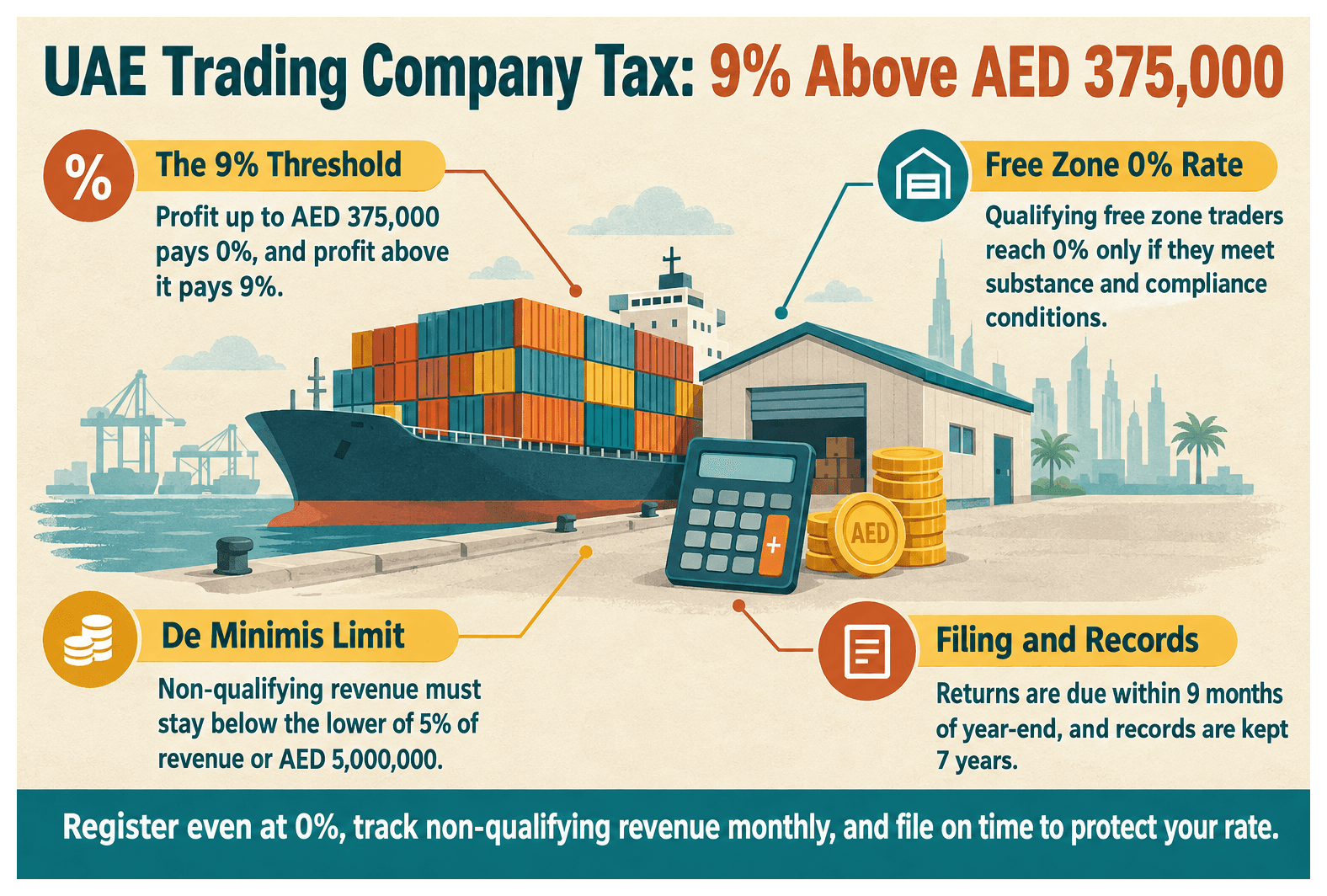
Free zone corporate tax 2026 gives Qualifying Free Zone Persons a 0% rate on qualifying income and 9% on non-qualifying income. Fail substance, de minimis, audit or filing rules, and you lose the regime and face 9% on all profit.
What Qualifying Income Means for a Trader
Sales to other free zone persons generally qualify, as does trading in qualifying commodities. A sale to a mainland retailer is generally non-qualifying. Read what qualifying income means for a Dubai trading company before you sign local contracts.
The De Minimis Rule and the AED 5 Million Limit
Non-qualifying revenue must stay below the lower of 5% of total revenue or AED 5,000,000. With AED 60 million revenue, your cap is AED 3 million, because 5% is lower. Breach either limit and you lose the regime for that year and the next four tax periods (Ministry of Finance, 2023). Track it monthly, not at year-end.
Substance and Audited Accounts Requirements
Real staff, premises and spending in the free zone.
Audited financial statements every year.
Transfer pricing files for related-party deals.
A trader with a flexi-desk and no operating staff may fail the substance test.
How Goods Movement and Designated Zone Treatment Affect Trading Company Tax in the UAE
Goods movement affects tax because qualifying status depends on who buys the goods and where they are held. Transactions involving goods in a Designated Zone can be treated as qualifying, while sales into the mainland are generally non-qualifying. Re-exports and transit trade need clear contracts and customs records.
What a Designated Zone Is and Why It Matters
Designated Zones are listed free zones treated as outside the UAE for VAT on certain goods movements. Goods moved between two Designated Zones under customs suspension keep that treatment. Release into the mainland triggers import treatment, with 5% VAT. Here's the catch: Designated Zone status is a VAT concept. Corporate tax status is separate, so confirm each zone with the Federal Tax Authority.
Import, Export and Re-Export Flows
Re-exports are typically cross-border sales.
Keep bills of lading, customs declarations and supplier contracts.
Log every movement against an invoice.
Take a Dubai South trader who buys machinery parts from China and re-exports to Kenya without releasing them into the mainland. UAE-China trade exceeds USD 95 billion annually (Dubai Chamber, 2024), so the corridor is busy, and the paperwork is your protection.
Warehousing and Storage Evidence
Stock location supports both substance and zone treatment. A trader leasing bonded space near Al Maktoum airport documents stock movements monthly. Start with this warehouse lease for a Dubai trading company guide.
Step-by-Step Registration and Filing for UAE Corporate Tax for Trading Companies
To comply, register with the Federal Tax Authority, keep accounts, classify revenue, test the de minimis rule, prepare audited statements if required, and file within nine months of year-end. Free zone traders should confirm Qualifying Free Zone Person status before filing.
Step 1: Register for Corporate Tax and Obtain Your Tax Registration Number
Register on the EmaraTax portal with your trade license and ownership documents ready. Do it soon after licensing, even if profit will sit below AED 375,000.
Step 2: Set Up Accounting and Revenue Classification
Tag every invoice as qualifying or non-qualifying, and flag related-party deals. A simple spreadsheet by customer type works. Keep records for 7 years.
Mainland vs Qualifying Free Zone Trading Company Tax Treatment (AED, as of January 2026)
Feature | Mainland Trading Company | Qualifying Free Zone Trading Company |
|---|---|---|
Tax on profit up to AED 375,000 | 0% | 0% on qualifying income; 9% on non-qualifying income |
Tax on profit above AED 375,000 | 9% (AED 146,250 on AED 2,000,000 profit) | 0% on qualifying income (AED 0 if all AED 2,000,000 qualifies) |
Qualifying income route | None; standard 9% applies | Available for qualifying activities and free zone customers |
Audited accounts requirement | Generally when revenue exceeds AED 50 million | Required every year |
De minimis exposure | Not applicable | Lower of 5% of revenue or AED 5,000,000 |
Step 3: Test De Minimis, Prepare Accounts and File
Run the 5% / AED 5 million test each quarter. A 31 December year-end means a 30 September deadline. If you want help, compare Dubai corporate tax filing services.
Step 4: Keep Substance and Transfer Pricing Evidence
Collect payroll, lease and expenditure records, and related-party disclosures. Build the evidence file annually, before the auditor asks.
How Much Does It Cost and How Long Does It Take
Costs depend on license, visa quota and accounting scope. Corporate tax registration itself is free through the Federal Tax Authority, while licensing, audit and filing support are paid services. Confirm current figures, and note the date, with the Dubai South cost calculator.
Timeline From License to First Filing
Setup typically takes days to weeks, depending on activity. Tax registration follows, then your first financial year. A trader licensed in March with a December year-end files by the following September, roughly 18 months after setup.
Estimating Your Setup Budget With the Cost Calculator
Price your license and visa package.
Size visa quota to your partners.
Run your company name check first.
Ask providers for dated audit and filing quotes.
Regulations in the UAE That Shape Trading Company Tax
Trading companies are shaped by the Federal Corporate Tax Law, Ministry of Finance decisions on qualifying activities, VAT at 5%, customs rules and economic substance expectations. Together they decide your rate, your filing duties and how goods move.
Corporate Tax Law and Ministerial Decisions
The base law is Federal Decree-Law No. 47 of 2022. Cabinet Decision No. 100 of 2023 and Ministerial Decision No. 265 of 2023 cover qualifying activities. Check the Ministry of Finance each January for updates.
VAT at 5% Alongside Corporate Tax
VAT is separate from corporate tax.
A mainland sale carries 5% VAT.
You still classify that income for corporate tax.
See what VAT a Dubai trading company actually pays.
Free Zone vs Mainland Trading Treatment
Mainland companies sell locally without qualifying-income worries, but get no 0% route. A free zone trader with 30% local sales is far above the 5% cap, so it should weigh a mainland branch.
Common Mistakes and What Should You Do Next to Start Re-Exporting From Dubai South
The most common mistakes are skipping registration at 0%, breaching the de minimis limit, weak substance and untracked mainland sales. To start re-exporting from Dubai South, confirm your activity, check your name, estimate costs, license the company, then register for corporate tax.
Mistakes That Cost Traders Their 0% Rate
Not tracking non-qualifying revenue.
Skipping audited accounts.
Treating Designated Zone VAT status as corporate tax status.
Missing filing deadlines.
One trader crosses the 5% cap in Q4 and loses the regime for five periods. That's an expensive quarter.
Your Next Steps to Start Re-Exporting From Dubai South
Check your name and run the cost calculator.
Choose your trade license and visa quota.
Plan your warehouse and supplier contracts.
Register for corporate tax.
Final Thoughts on UAE Corporate Tax for Trading Companies
UAE corporate tax for trading companies is manageable when you track qualifying income, respect the de minimis rule, keep real substance and file on time. No free zone outcome is automatic or tax free.
9% above AED 375,000.
Qualifying income and de minimis discipline.
Goods movement evidence on file.
Run the cost calculator, check your company name, and speak with the Dubai South Business Hub team about a free zone trade license and residency visa package.
References
Frequently Asked Questions