
Topic Summary
Match Your License to Contracted Goods
Dubai Customs verifies that imported goods match your licensed business activities at the point of clearance. A mismatch can result in shipment holds, fines, or license suspension, so confirm every product category is covered before signing any supplier contract.
Always Specify Governing Law and Forum
Omitting a governing law clause can allow an overseas supplier to invoke their home country's courts, adding months and significant legal costs to any dispute. Name the governing law and dispute resolution forum explicitly in every supplier agreement.
Sign Contracts Only After License Issuance
A significant share of first-time trading company founders sign supplier contracts before their UAE license is issued, creating payment, liability, and customs compliance gaps. Waiting until your license is active prevents costly operational halts from day one.
Register Commercial Agency Agreements Early
If a supplier appoints your Dubai company as their exclusive UAE agent or distributor, registration under the Commercial Agency Law is required before the first shipment. This registration is not automatic and must be applied for through the Ministry of Economy.
Budget for VAT and Corporate Tax Obligations
VAT at 5% applies to most imported goods at UAE customs entry, and corporate tax at 9% applies to taxable income above AED 375,000. Late registration for either carries a flat AED 10,000 penalty, so factor these obligations into your cost planning from the outset.
Plan Your Licensed Activities Before Signing
At free zones like Dubai South Business Hub, each activity beyond the first five costs an additional AED 2,000. Mapping out every product category you intend to trade before finalizing your license avoids expensive amendments after supplier contracts are already in place.
Supplier contracts for a Dubai trading company are legally binding purchase or supply agreements between your UAE-licensed entity and an overseas or local vendor. They define payment terms, delivery obligations, title transfer, dispute resolution, and governing law. In 2026, the UAE's non-oil trade is projected to exceed AED 2.5 trillion (UAE Government Portal, 2026) [1], with Dubai accounting for the majority of import and re-export volumes [2]. Yet a significant share of first-time trading company founders sign supplier contracts before their license is issued [3], creating payment, liability, and customs compliance gaps that can halt operations on day one. VAT at 5% applies to most imported goods at UAE customs entry [4]. Corporate tax at 9% applies to taxable income above AED 375,000 [5]. And late registration for either carries a flat AED 10,000 penalty each [6]. This guide walks you through what supplier contracts for a Dubai trading company actually require, the essential clauses you cannot omit, the costs involved, and the step-by-step process for getting everything in order, starting with the right trading license in Dubai.
What Are Supplier Contracts for a Dubai Trading Company
Supplier contracts for a Dubai trading company are legally binding purchase or supply agreements between your UAE-licensed entity and an overseas or local vendor. They define payment terms, delivery obligations, title transfer, dispute resolution, and governing law, and must align with your trade license activities to be enforceable under UAE commercial law. Getting this alignment right from the start isn't optional; it's the difference between a shipment clearing customs and one sitting in a hold at Jebel Ali.
The Legal Framework Governing Supplier Agreements in Dubai
The primary statute covering commercial contracts between trading entities in the UAE is Federal Law No. 18 of 1993 (UAE Commercial Transactions Law). This law governs payment obligations, delivery conditions, and remedies for breach, so any supplier contract your Dubai trading company signs operates within its framework by default, unless you specify otherwise.
Two alternative dispute resolution forums are worth knowing. The DIFC Courts and ADGM Courts both operate under common-law principles and are frequently chosen when contracting with international suppliers who want a familiar legal environment. A Dubai trading company importing electronics from South Korea that omits a governing law clause may find its supplier invoking Korean courts, adding months and significant legal costs to any dispute resolution process. Always name the governing law and the forum for dispute resolution explicitly.
If your supplier appoints you as their exclusive agent or distributor in the UAE, a separate registration obligation arises under Federal Law No. 18 of 1981 (Commercial Agency Law), administered by the Ministry of Economy. That registration is not automatic, you must apply before the first shipment.
Why Your Trade License Activity Must Match the Contracted Goods
Dubai Customs verifies that imported goods correspond to your licensed activities at the point of customs clearance.
A mismatch between your license activity and the goods in your supplier contract can result in shipment holds, fines, or license suspension.
General trading licenses cover a broader range of goods categories, reducing activity mismatch risk compared to single-activity licenses.
Always confirm your licensed business activities in Dubai cover every product category in your supplier contract before signing.
A founder who licenses "food products trading" but signs a supplier contract for industrial tools will face customs clearance refusal because the goods fall outside the licensed activity scope. At Dubai South Business Hub Free Zone (DSBH), trading licenses start from AED 12,500 with activities listed on the license. Each activity beyond the first five costs AED 2,000, so plan your product categories carefully before submitting your application.
Key Clauses Every Supplier Contract for a Dubai Trading Company Must Include
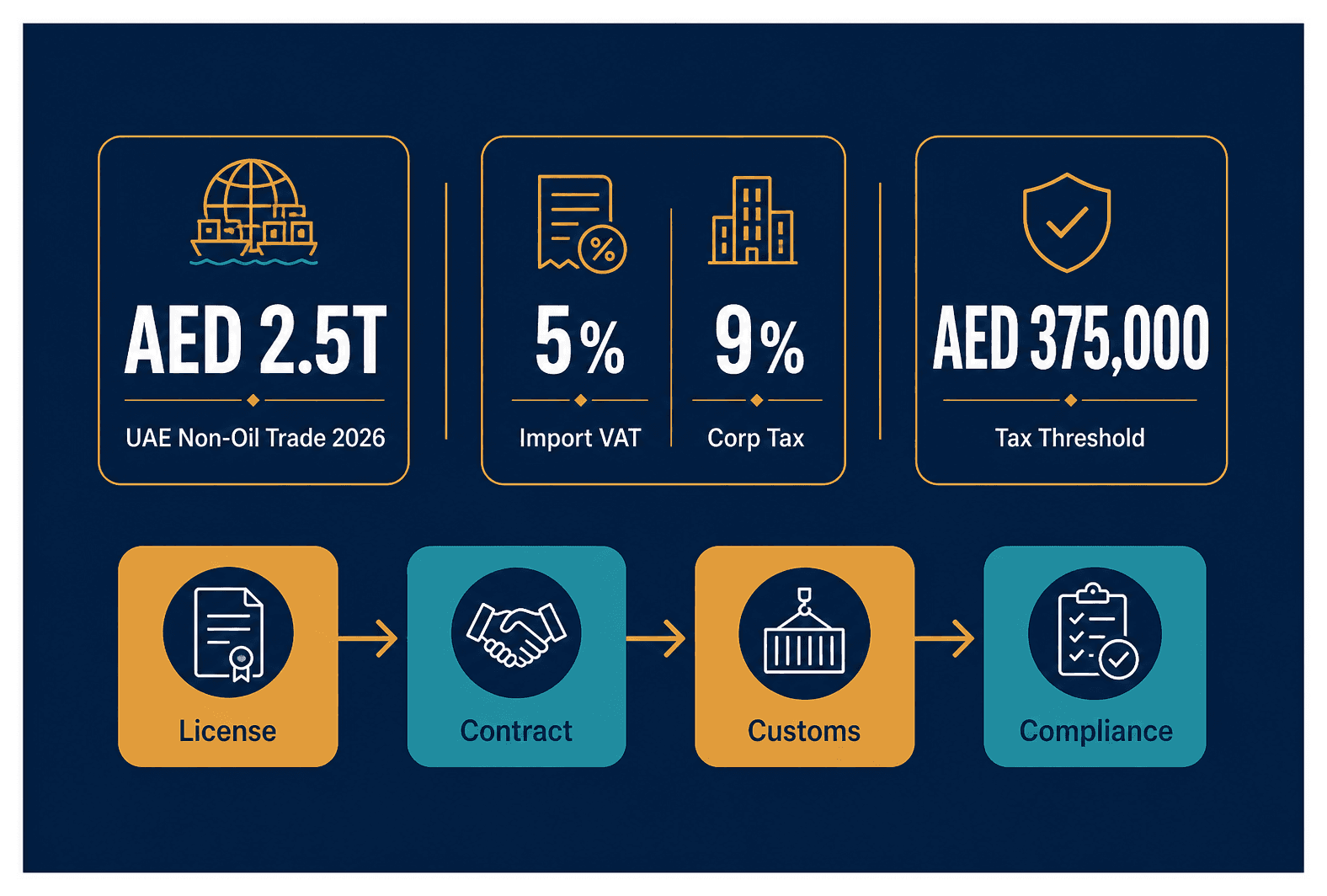
Every supplier contract for a Dubai trading company must include payment terms, Incoterms specifying where title and risk transfer, inspection and rejection rights, force majeure provisions, a governing law and dispute resolution clause, and VAT treatment of the supply. Omitting any of these exposes your company to unrecoverable losses on cross-border shipments.
Payment Terms and Currency Risk
State the currency, payment method (letter of credit, TT wire, or open account), and the due date relative to bill of lading or delivery.
The AED is pegged to the USD at 3.6725 (Central Bank of the UAE), eliminating exchange risk on USD-denominated supplier invoices for UAE entities.
A letter of credit (LC) issued through your UAE corporate bank provides payment security for both parties and is commonly required by Asian and European manufacturers.
Late payment penalty clauses must comply with UAE Commercial Transactions Law, interest rates above commercial norms can be challenged in UAE courts.
A Dubai trading company sourcing textiles from Turkey on open-account 60-day terms with no late payment clause has no contractual remedy if the shipment is delayed and the invoice falls due before goods arrive. Spell out the payment mechanics precisely, including what triggers the payment clock.
Incoterms, Title Transfer, and Customs Responsibility
Incoterms 2020 (ICC) define exactly where risk and cost transfer from supplier to buyer, CIF, FOB, DDP, and DAP are the most common in Dubai import contracts.
Under DDP (Delivered Duty Paid), the supplier handles UAE import duties and clearance, useful for small orders but rare at volume.
Under FOB or CIF, your trading company assumes risk and customs responsibility from the named port, your contract must name a Dubai port or free zone entry point explicitly.
Free zone goods are duty-suspended, not duty-exempt, customs duty becomes payable when goods are released into the UAE mainland market.
A founder importing consumer goods CIF Jebel Ali who signs a contract without specifying the free zone warehouse as the delivery point may receive a goods release notification with an unexpected customs duty bill before they have a mainland distribution arrangement in place. Name the exact delivery point in the contract, not just the port.
Inspection, Rejection, and Quality Warranties
Include a pre-shipment inspection right and specify which international standard applies, SGS, Bureau Veritas, or an equivalent accredited body.
Define the rejection window: how many days after delivery your company can raise a non-conformance claim.
State whether rejected goods are returned at the supplier's cost or destroyed locally, and who bears the associated UAE customs and logistics costs.
Product liability warranty clauses are essential if your trading company on-sells to UAE retailers or end-consumers, as Federal Law No. 15 of 2020 (UAE Consumer Protection Law) may hold you liable as the importer of record.
Is a force majeure clause required in UAE supplier contracts?
Yes. UAE Commercial Transactions Law (Federal Law No. 18 of 1993) recognises force majeure as a ground for suspending contractual obligations, but only if the clause is expressly included and the triggering events are defined. Without it, a party claiming force majeure faces a higher evidentiary burden in UAE courts. Always draft the clause to cover port closures, regulatory changes, and pandemic-level disruptions.
VAT and Corporate Tax Obligations Tied to Supplier Contracts Trading Dubai
Supplier contracts for a Dubai trading company trigger VAT at 5% on most imported goods at the point of UAE customs entry. Your company must be VAT-registered if taxable supplies exceed AED 375,000 annually. Corporate tax at 9% applies to taxable income above AED 375,000 unless your company qualifies as a Qualifying Free Zone Person (QFZP) under all four QFZP conditions.
VAT Registration and Import VAT on Supplier Invoices
Import VAT at 5% is levied at UAE customs clearance and is recoverable as input tax if your company is VAT-registered and the goods are used for taxable supplies (Federal Tax Authority, 2024).
Mandatory VAT registration threshold: AED 375,000 in annual taxable turnover.
Late VAT registration carries a penalty of AED 10,000, register before your first commercial shipment clears customs, not after.
Your supplier contract should state whether the quoted price is exclusive or inclusive of UAE VAT, most cross-border supply contracts price exclusive of destination country taxes.
Corporate Tax Considerations for Free Zone Trading Companies
UAE corporate tax at 9% applies to taxable income above AED 375,000 for financial years starting on or after 1 June 2023. A free zone company can qualify for 0% corporate tax on qualifying income only if it meets all four QFZP conditions: it maintains adequate substance in the free zone, earns qualifying income, does not elect to be subject to the standard regime, and complies with transfer pricing rules. All four conditions must be met simultaneously, failing one disqualifies the company from the 0% rate.
Worth flagging: trading income from sales to UAE mainland customers generally does not qualify as qualifying income under QFZP rules. If your supplier contracts are structured around selling into the mainland market, seek qualified tax advice before finalising your contract and sales structure. Late corporate tax registration carries a one-time flat penalty of AED 10,000, not a monthly charge, but a single fixed hit you'll want to avoid entirely.
Step-by-Step Guide to Formalising Supplier Contracts for a Dubai Trading Company
To formalise supplier contracts for a Dubai trading company, you need to: obtain your trade license, open a UAE corporate bank account, negotiate and draft the contract with all required clauses, have it reviewed under UAE law, and register any exclusive commercial agency arrangement with the Ministry of Economy before shipments begin.
Supplier Contract Setup Costs for a Dubai Trading Company
Cost Item | Estimated Cost (AED) |
|---|---|
DSBH trading license (standard) | From AED 12,500 |
DSBH trading license (B2C) | From AED 12,500 |
First-year cost, sole founder, one visa | From AED 18,350 (visa is additional to license fee) |
Additional license activity (beyond first five) | AED 2,000 per activity |
Legal contract drafting (estimated range) | AED 3,000 to AED 15,000 |
VAT late registration penalty | AED 10,000 |
Corporate tax late registration penalty (one-time flat) | AED 10,000 one-time flat |
Step 1: Obtain Your Trade License and Confirm Licensed Activities
Your trade license must be issued and active before you sign any supplier contract in the company's name, a pre-license agreement has no legal standing as a UAE company obligation.
DSBH (launched September 2025) issues trading licenses from AED 12,500 with a one-day issuance timeline and zero paid-up share capital required.
First-year total cost for a sole founder with one visa starts from AED 18,350, the visa is an additional cost and is not included in the license fee.
Confirm every product category in your intended supplier contract is covered by your listed license activities; each activity beyond the first five costs AED 2,000.
A founder planning to import both consumer electronics and personal care products should list both activity categories on their DSBH license before approaching suppliers, avoiding a later amendment fee and customs clearance delays. Use the business activities list to cross-check your intended goods before submitting your application.
Step 2: Open a UAE Corporate Bank Account
Supplier contracts require payment from a UAE corporate account, personal accounts cannot be used for commercial import payments and will be flagged by compliance teams at both UAE and international banks.
Your trade license, Memorandum of Association, and Emirates ID (or passport for new visa applicants) are the core documents banks require.
Average account opening timeline for a free zone company is 2 to 6 weeks depending on the bank and KYC complexity, the UAE has 49 nationally licensed banks (Central Bank of the UAE, 2025).
Having your supplier contract draft ready at account opening demonstrates genuine business purpose and can accelerate compliance review.
The AED-USD peg at 3.6725 removes exchange risk on USD-denominated supplier invoices. For guidance on bank account opening in the UAE, DSBH's banking and taxation support services can point you toward the right institutions for your trading activity.
Step 3: Draft, Review, and Execute the Supplier Contract
Use a bilingual contract (English and the supplier's language) with English as the governing language if disputes are to be resolved in UAE courts or international arbitration.
Engage a UAE-licensed legal adviser to review the draft, standard international templates often omit UAE-specific requirements such as commercial agency registration triggers.
Both parties should sign and stamp the contract; UAE courts give weight to company stamps alongside signatures for commercial documents.
Register any exclusive distribution or agency arrangement with the Ministry of Economy under Federal Law No. 18 of 1981 (Commercial Agency Law) before the first shipment, failure to register means the agreement is unenforceable as a registered agency.
Step 4: Arrange Logistics, Insurance, and Customs Documentation
Your supplier contract's Incoterms clause determines whether you or the supplier arranges freight and marine insurance, confirm this before booking cargo.
Prepare your import documentation set: commercial invoice, packing list, certificate of origin, bill of lading or airway bill, and any product conformity certificates required by UAE standards bodies.
Dubai Trade is the UAE's single-window platform for submitting customs declarations, your freight forwarder will need your trade license number and activity codes (Dubai Trade).
DSBH does not provide bonded warehousing or customs integration, arrange third-party logistics and customs clearance agents separately.
Costs Involved in Setting Up Supplier Contracts for a Dubai Trading Company
The core costs for supplier contracts in a Dubai trading company include the trade license (from AED 12,500 at DSBH), corporate bank account setup, legal contract drafting (typically AED 3,000 to AED 15,000 depending on complexity), Ministry of Economy commercial agency registration fees, and any product testing or conformity certification required for your goods category.
License and Company Formation Costs at Dubai South Business Hub Free Zone
Trading license from AED 12,500 at DSBH; launched September 2025.
First-year all-in cost for a sole founder with one residency visa starts from AED 18,350, the visa cost is additional to the license fee and is not bundled.
Zero paid-up share capital required, no capital is locked in a bank account to activate the license.
Each activity beyond the first five listed on the license costs AED 2,000; plan your product categories before submitting your application to minimise amendment costs.
100% foreign ownership is available at DSBH and also on the UAE mainland, it is not exclusive to free zones or linked to designated-zone status.
Use the business setup cost calculator to model your first-year total before committing to a license package.
Legal, Registration, and Compliance Costs
Commercial contract drafting by a UAE-licensed law firm: typically AED 3,000 to AED 15,000 depending on contract complexity and number of schedules.
Ministry of Economy commercial agency registration fee: UNVERIFIED: <figure>. Confirm before publishing.
Product conformity certification through the Ministry of Industry and Advanced Technology (MoIAT) fees vary by product category and testing laboratory.
VAT registration is free through the Federal Tax Authority's EmaraTax portal, the cost risk is the AED 10,000 late registration penalty if you delay.
Corporate tax registration is also free through EmaraTax, late registration carries a one-time flat AED 10,000 penalty, not a recurring monthly charge.
Common Mistakes Founders Make With Supplier Contracts in Dubai
The most common mistakes with supplier contracts in Dubai include signing agreements before the trade license is issued, failing to register exclusive commercial agency arrangements with the Ministry of Economy, omitting a UAE-compatible dispute resolution clause, and not aligning the contracted goods with licensed activities, all of which can result in unenforceable contracts or customs clearance failures.
Signing Before Your License Is Issued
Frequently Asked Questions