
Topic Summary
FTA Registration Fee Is Completely Free
The Federal Tax Authority charges AED 0 to submit a corporate tax registration application in the UAE. The only direct government cost is nothing — what costs money is failing to register on time.
Late Registration Triggers a AED 10,000 Penalty
Missing your registration deadline results in a one-time flat penalty of AED 10,000 with no monthly grace period attached. Deadlines are tied to your license issuance month, so founders must check the FTA's rolling deadline calendar immediately after incorporation.
Registration and Tax Liability Are Separate Obligations
Every UAE-incorporated juridical person must register regardless of whether they ultimately owe any tax. A company can register, qualify for small business relief or QFZP status, and still carry a nil tax liability.
The 9% Rate Only Applies Above AED 375,000
The standard corporate tax rate of 9% applies only to taxable income exceeding AED 375,000. Qualifying Free Zone Persons who meet all four QFZP conditions under Ministerial Decision No. 139 of 2023 pay 0% on qualifying income.
Free Zone Companies Must Still Register
Free zone entities, including those at Dubai South Business Hub Free Zone, are not exempt from the registration obligation. Even a company that qualifies for the 0% QFZP rate must obtain a Tax Registration Number from the FTA.
Indirect Costs Are Where Budgets Get Surprised
While the government fee is AED 0, founders who appoint a registered tax agent will pay professional service fees that vary by firm. Recurring costs such as compliance software and annual filing support sit entirely outside the one-off registration figure.
License Costs and Tax Registration Are Separate Budgets
At Dubai South Business Hub Free Zone, a first-year setup starts from AED 18,350 for a sole founder with one visa — but corporate tax registration costs sit entirely outside that figure. Founders should treat them as two distinct budget line items from day one.
In 2026, the Federal Tax Authority charges AED 0 to submit a corporate tax registration application in the UAE. The registration itself is free. What costs money is missing the deadline: a one-time AED 10,000 flat penalty with no monthly grace period attached (Federal Tax Authority, 2026). The standard corporate tax rate sits at 9% on taxable income above AED 375,000, while a 0% rate applies to qualifying income for entities that meet all four Qualifying Free Zone Person (QFZP) conditions under Ministerial Decision No. 139 of 2023. At Dubai South Business Hub Free Zone, a license starts from AED 12,500, with a first-year total from AED 18,350 for a sole founder with one visa. Corporate tax registration costs sit entirely outside that figure.
This guide breaks down the full corporate tax registration cost in the UAE, separates one-off fees from recurring obligations, flags what the quoted figures do not include, and shows first-time founders at Dubai South Business Hub Free Zone exactly what to budget before they open their doors. For more detail, see our guide on EmaraTax corporate tax registration guide. For more detail, see our guide on EmaraTax account setup and penalties guide.
What Is Corporate Tax Registration in the UAE and Why It Matters
Corporate tax registration in the UAE is the mandatory process by which a business entity obtains a Tax Registration Number (TRN) from the Federal Tax Authority under Federal Decree-Law No. 47 of 2022. It applies to all juridical persons incorporated in the UAE, regardless of whether they ultimately owe tax. You register first; you calculate your liability later.
Who Must Register and When
The scope is wide. Every UAE-incorporated juridical person must complete corporate tax registration in the UAE, including:
Free zone companies (including those at Dubai South Business Hub Free Zone)
Mainland limited liability companies (LLCs)
Branches of foreign companies operating in the UAE
Natural persons (sole traders) with annual business revenue above AED 1 million
Registration deadlines are tied to your license issuance month. The Federal Tax Authority publishes a rolling deadline schedule, so the month your license is issued determines your specific cutoff. A sole founder who starts a company at Dubai South Business Hub Free Zone in September 2025, for example, must check the FTA deadline calendar for that specific license month to avoid the AED 10,000 penalty.
Worth flagging: the AED 10,000 is a one-time flat charge, not a recurring monthly fee. But it's still a cost you want to avoid entirely.
The Difference Between Registration and Paying Tax
Registration is an administrative obligation. It does not automatically mean you owe corporate tax. A registered entity may still carry nil liability if it qualifies for small business relief or meets all QFZP conditions.
Think of it this way: a free zone trading company that registers on time but later qualifies as a QFZP pays AED 0 on qualifying income. It still needed to register. The 9% standard rate only applies on taxable income above AED 375,000, and the 0% rate on qualifying income requires all four QFZP conditions to be satisfied simultaneously. Conflating the registration obligation with the tax liability is one of the most common planning mistakes first-time founders make.
What the Corporate Tax Registration Cost in the UAE Actually Covers
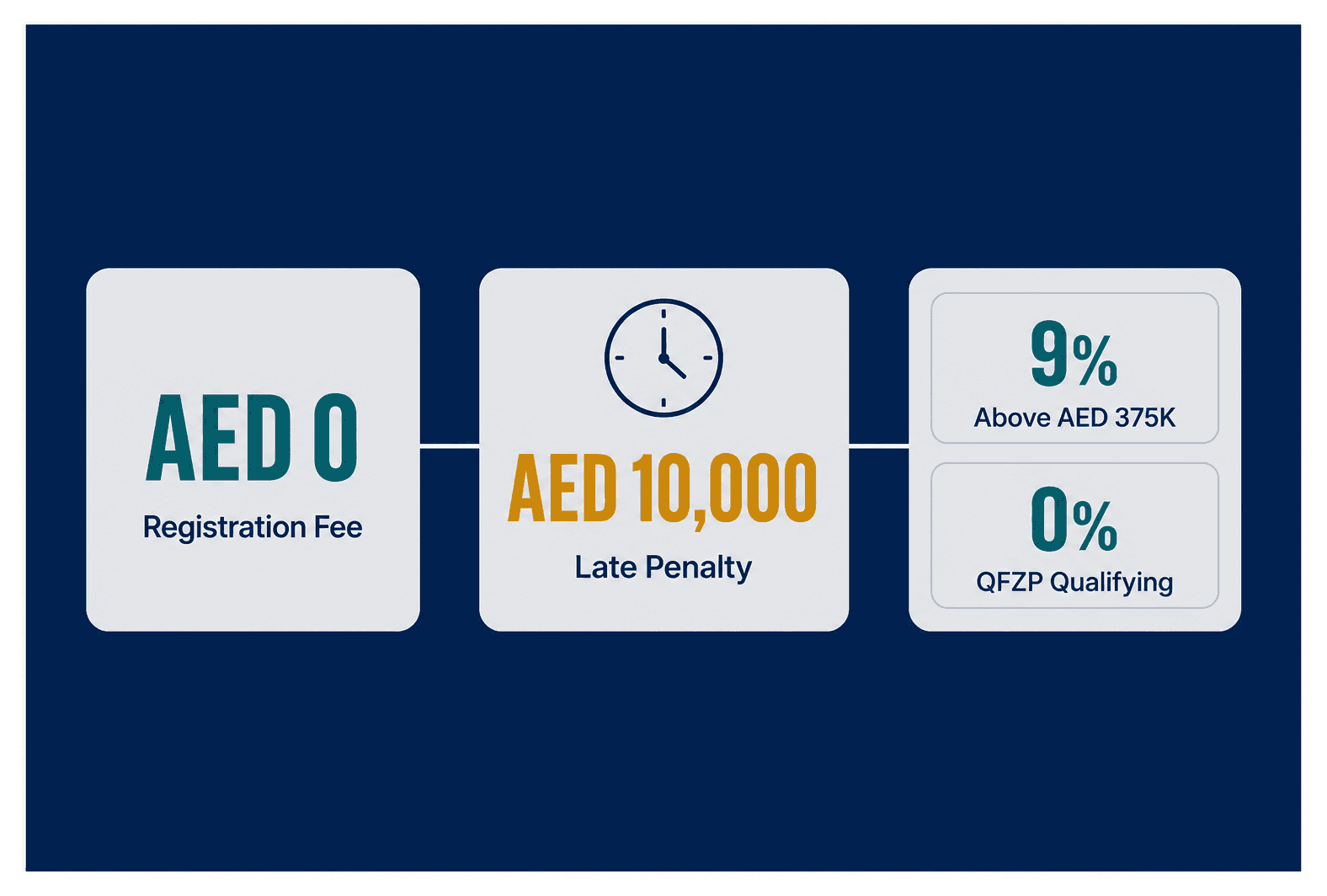
The Federal Tax Authority charges no government fee to submit a corporate tax registration application in the UAE. The direct cost is AED 0 for the registration itself. The real costs are indirect: professional service fees, compliance software, and the AED 10,000 penalty for late filing if a deadline is missed (Ministry of Finance UAE, 2023).
One-Off Costs vs. Recurring Costs: A Clear Breakdown
A founder who self-registers via EmaraTax pays AED 0 in government fees. One who appoints a registered tax agent pays the agent's professional fee, which varies by firm. Here is how the cost categories split:
Corporate Tax Registration Cost in the UAE: One-Off vs. Recurring
Cost Item | One-Off Costs | Recurring Annual Costs |
|---|---|---|
FTA registration government fee | AED 0, paid once at registration, never again | Not applicable, registration is a one-time event |
Tax agent registration filing fee (if appointed) | Paid at point of registration if you use an agent; UNVERIFIED: <figure>, confirm before publishing | Not applicable for registration itself; separate annual return fee applies |
Notarised power of attorney (if agent used) | One-off notarisation cost if appointing a tax agent; UNVERIFIED: <figure>, confirm before publishing | May need renewal if agent relationship continues |
Annual corporate tax return filing fee | Not applicable, this is a recurring obligation | Professional fee if using a tax agent; UNVERIFIED: <figure>, confirm before publishing |
Bookkeeping and accounting | Not applicable, this is a recurring obligation | Varies by transaction volume; required to support annual return filing |
Audit report (if required by free zone authority) | Not applicable, this is a recurring obligation | Required annually if your free zone authority mandates it; UNVERIFIED: <figure>, confirm before publishing |
What Is Not Included in the Registration Cost
Several costs sit completely outside the corporate tax registration process. Founders often bundle these incorrectly:
VAT registration is a separate obligation with its own AED 10,000 late penalty, a distinct process from corporate tax registration
Visa costs are never part of any tax registration figure; they are always an additional line item
Accounting software subscriptions, audit reports, and transfer pricing documentation are separate ongoing costs
Free zone license renewal fees are entirely unrelated to FTA registration fees
A founder budgeting AED 18,350 for their first year at Dubai South Business Hub Free Zone (license plus one visa) must add corporate tax compliance costs on top. They are not part of that figure. Use the business setup cost calculator to map the full picture before you commit.
How Free Zone Companies Fit Into Corporate Tax Registration in the UAE
Free zone companies in the UAE must register for corporate tax like any other juridical person. A free zone entity may qualify for a 0% rate on qualifying income as a Qualifying Free Zone Person, but only if it meets all four QFZP conditions set by the Ministry of Finance UAE. Registration is still mandatory regardless of which rate ultimately applies.
The Four QFZP Conditions You Must Meet
All four conditions must be satisfied simultaneously. Failing any single one disqualifies the entity from the 0% rate on qualifying income for that entire tax period:
The entity must be a Qualifying Free Zone Person maintaining adequate substance in the UAE
It must derive qualifying income as defined in Ministerial Decision No. 139 of 2023
It must not have elected to be subject to the standard 9% corporate tax regime
It must comply with transfer pricing rules and maintain audited financial statements
A technology consultancy licensed at Dubai South Business Hub Free Zone that maintains real operations, employs staff locally, and derives income from qualifying business activities in Dubai can pursue QFZP status. But it must still register and file annually regardless of its rate outcome.
What DSBH's Free Zone Status Does and Does Not Give You
Dubai South Business Hub Free Zone enables 100% foreign ownership, this is also available on the mainland and is unrelated to designated-zone status
DSBH is not a designated zone; it does not carry designated-zone customs or VAT benefits
Free zone goods are duty-suspended, not duty-exempt, a meaningful distinction for import and export planning
DSBH does not provide bonded warehousing or customs integration services
Corporate tax registration obligations at DSBH are identical to those at any other UAE free zone
A founder importing goods through Dubai South Business Hub Free Zone should plan for duty-suspended treatment in their landed-cost calculations. DSBH licenses from AED 12,500, with zero paid-up share capital required to activate the license.
Step-by-Step Guide to Corporate Tax Registration in the UAE
To complete corporate tax registration in the UAE, a business must create an EmaraTax account, prepare its trade license and incorporation documents, submit the registration form online, and receive its Tax Registration Number from the Federal Tax Authority. The process is fully digital and carries no government fee.
Step 1: Gather Your Documents Before You Log In
Having everything ready before you open EmaraTax prevents a half-completed application. You will need:
Trade license copy (your DSBH license issues in one business day, have it ready before starting)
Memorandum of association or equivalent constitutional document
Passport copy and Emirates ID of the authorised signatory
Corporate structure chart if the entity has parent companies or subsidiaries
Your chosen financial year-end date, you must declare this during registration
A sole founder at DSBH who receives their license on day one can start gathering these documents immediately and submit the EmaraTax registration well before their FTA deadline.
Step 2: Submit via EmaraTax and Receive Your TRN
Create or log in to your EmaraTax account at the Federal Tax Authority portal, the portal is free to use
Select "Corporate Tax" and complete the registration form; the system validates fields in real time
Upload the documents gathered in Step 1
The FTA issues a Tax Registration Number (TRN) upon approval, keep this number, as it is required on returns and official correspondence
If you appoint a registered tax agent, they complete this step on your behalf under a notarised power of attorney
Most straightforward free zone registrations are processed within a few working days of a complete submission on EmaraTax. Once your TRN is issued, you can also open your bank account in the UAE with the full compliance picture in place.
Penalties That Add to Your Corporate Tax Cost in the UAE
The Federal Tax Authority imposes a one-time AED 10,000 flat penalty for late corporate tax registration. A separate AED 10,000 penalty applies for late VAT registration. Neither penalty is monthly. Late filing of a corporate tax return and late payment of tax due carry additional penalties calculated as a percentage of unpaid tax (Federal Tax Authority, 2026).
Registration Penalty vs. Filing Penalty: Know the Difference
Late registration penalty: AED 10,000, one-time flat charge, triggered by missing the registration deadline
Late return filing penalty: a separate percentage-based penalty on unpaid tax, distinct from the registration penalty
Late payment penalty: accrues on unpaid corporate tax after the due date
VAT late registration: also AED 10,000, but an entirely separate obligation and a separate penalty event
A founder who registers late and then also files their return late faces two distinct penalty categories: the flat AED 10,000 registration penalty plus a separate filing and payment penalty on any tax owed. These are not the same charge applied twice.
How to Avoid These Costs Entirely
Register before your FTA-published deadline for your specific license issuance month
Set a calendar reminder the day your license is issued, at DSBH that can be day one of operations, since the license issues in one business day
Use an FTA-registered tax agent if you are unfamiliar with EmaraTax, to ensure a complete, on-time submission
Keep your trade license and constitutional documents current, an outdated document is the most common cause of a rejected submission
Founders who complete corporate tax registration in the same week their DSBH license is issued eliminate penalty risk before their first invoice is raised.
Total First-Year Cost Picture for a DSBH Founder
A sole founder with one visa setting up at Dubai South Business Hub Free Zone starts from AED 18,350 in the first year, covering the license and visa. Corporate tax registration with the FTA adds no government fee. Ongoing compliance costs, bookkeeping, return filing, and any agent fees, sit on top of this figure and must be budgeted separately.
Breaking Down the AED 18,350 Starting Figure
DSBH license from AED 12,500
First-year total from AED 18,350 for a sole founder with one visa, the visa is an additional cost, never described as included in the license fee
Zero paid-up share capital required, no capital must be deposited into a bank account to activate the license
Each business activity beyond the first five costs an additional AED 2,000, audit your activity list before applying
DSBH launched in September 2025, and pricing reflects the current schedule
A B2C service founder with four activities and one visa starts from AED 12,500 (license) plus visa cost, staying well under the AED 18,350 ceiling for the first year. Check the company setup cost in Dubai calculator for a personalised figure.
Compliance Costs to Budget Alongside Your License
Bookkeeping: required to maintain records for corporate tax return filing; cost varies by transaction volume
Annual corporate tax return filing: professional fee if using a tax agent; UNVERIFIED: <figure>, confirm before publishing
Audit: may be required by the DSBH authority depending on entity size, confirm directly with DSBH
Bank account opening: a separate process; DSBH's banking and taxation support services can assist
UAE residency visa renewal: a recurring cost in year two and beyond, not a one-off expense
A founder who maps out license cost, visa cost, bookkeeping, and corporate tax return filing in a single spreadsheet before launch avoids the common mistake of under-budgeting year-one operations. Your UAE residency visa renewal timeline should sit in that same planning document.
Regulated Activities and Corporate Tax Registration in the UAE
For regulated business activities, a UAE company must hold both a valid free zone license for that activity and a separate approval from the named sector regulator. Corporate tax registration is an additional, parallel obligation with the Federal Tax Authority. No regulated license exempts a company from the corporate tax registration requirement (Ministry of Finance UAE, 2023).
Financial and Professional Services: Two Approval Layers
A financial services company at DSBH holds a DSBH license for the activity and must obtain separate approval from the relevant financial regulator
A healthcare company at DSBH holds a DSBH license and must obtain DHA approval separately
Corporate tax registration with the FTA is a third, parallel obligation, it does not substitute for either the license or the regulatory approval
Founders should map all three obligations (license, regulatory approval, FTA registration) before launch to sequence deadlines correctly
A financial advisory firm licensed at DSBH must: (1) hold its DSBH license,
References
Frequently Asked Questions