
Topic Summary
Base License Fee Starts at AED 12,500
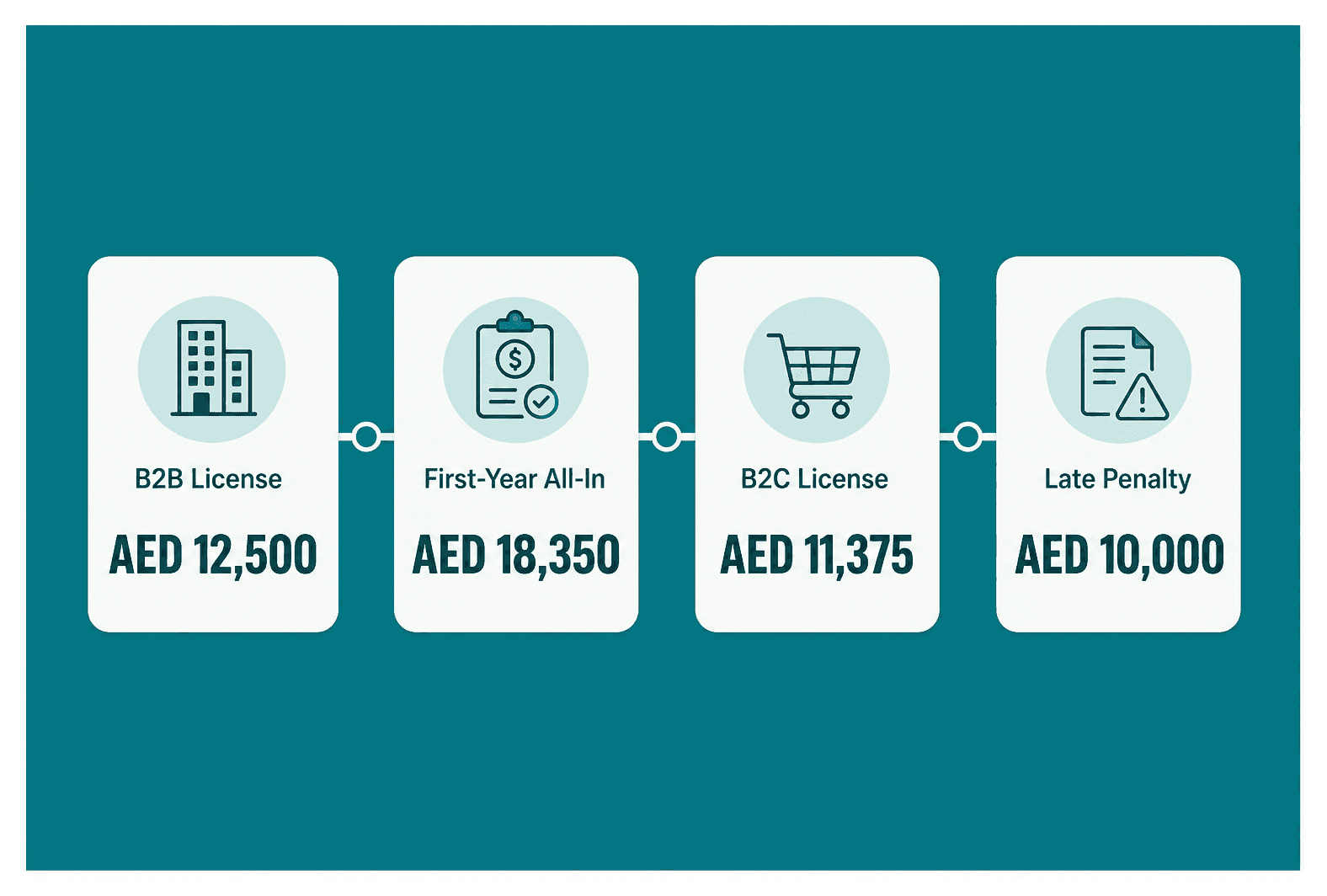
Dubai South Business Hub Free Zone issues trade licenses from AED 12,500, with one activity included at no extra charge. Zero paid-up share capital is required, and the license is issued within one business day.
All-In First-Year Cost: AED 18,350
A sole founder requiring one visa should budget AED 18,350 for the complete first-year cost, which stacks the license fee, establishment card, and one visa package. Each additional visa needed beyond the first must be budgeted as a separate line item on top of this figure.
Adding Activities Costs AED 2,000 Each
The first five business activities are included in the base license fee with no per-activity surcharge. Any activity added beyond the fifth costs AED 2,000 per activity, paid at the point of addition.
Corporate Tax Late Registration Carries a Flat Penalty
Failing to register for corporate tax on time results in a one-time AED 10,000 flat penalty from the Federal Tax Authority. Registering on time is free, making timely compliance a straightforward way to avoid a significant avoidable cost.
VAT Becomes Mandatory Above AED 375,000 Revenue
Businesses with annual taxable supplies exceeding AED 375,000 must register for VAT, with a AED 10,000 penalty for late registration. VAT registration itself is free when completed on time.
Recurring Costs Extend Well Beyond the License Fee
Annual recurring expenses include license renewal, visa renewals per holder covering medical fitness and Emirates ID, and any contracted office or flexi-desk lease. Accounting and audit fees are not provided by DSBH and must be budgeted separately.
Regulated Activities Carry Additional Approval Fees
Sectors requiring regulatory oversight, such as healthcare or education, involve a one-time regulator approval fee paid per approval cycle from bodies like DHA, DET, or KHDA. These fees are sector-specific and sit outside the standard license cost structure.
In 2026, the cost of a Dubai license with one activity starts from AED 12,500 at Dubai South Business Hub Free Zone (DSBH), launched September 2025, with a sole founder's all-in first-year total from AED 18,350 including one visa. Zero paid-up share capital is required. The license is issued in one business day. Corporate tax late registration carries a one-time AED 10,000 flat penalty (Federal Tax Authority, 2026). VAT registration is mandatory above AED 375,000 in annual taxable supplies, also with a AED 10,000 late penalty. B2C licenses start from AED 12,500.
This guide breaks down every component of that figure: one-off costs, annual recurring costs, what is explicitly not included, and the compliance obligations that catch first-time founders off guard. By the end, you'll know exactly what to budget before you commit a single dirham.
What Is the Cost of a Dubai License With One Activity
The cost of a Dubai license with one activity at DSBH starts from AED 12,500 for the license fee alone. A sole founder's all-in first-year cost, including one visa, starts from AED 18,350. Zero paid-up share capital is required. The license is issued in one business day.
The License Fee: What AED 12,500 Covers
DSBH issues free zone trade licenses from AED 12,500 for standard B2B activities. Dubai South Business Hub Free Zone licenses start from AED 12,500. Both figures cover one legal entity registration with one activity included at no extra charge. That's the full cost of a Dubai license with one activity at the base level.
Here's what the license fee covers:
One legal entity registration
One business activity (no per-activity surcharge for the first five)
Zero paid-up share capital requirement
One business day issuance
Each activity beyond the first five: AED 2,000 per activity, paid at the point of addition
A solo IT consultant setting up at DSBH pays AED 12,500 for the license. If they later add software reselling as a second activity, the additional cost is AED 2,000. That's the structure: predictable, flat, and transparent.
What the AED 18,350 First-Year Figure Includes
AED 18,350 is the all-in first-year cost for a sole founder with one visa. This figure stacks the license fee, establishment card, and one visa package. Visas are always an additional cost, they're never described as included in the license fee itself.
Founders needing more than one visa must budget each as a separate line item beyond the AED 18,350 base. A single founder launching a general trading company and sponsoring one employee would use AED 18,350 as the baseline, then add the second visa cost directly on top. That's the correct budgeting approach for the cost of a Dubai license with one activity.
Dubai License Cost Breakdown: One-Off vs. Annual Recurring Costs
Cost Item | One-Off Costs (Paid at Setup) | Annual Recurring Costs |
|---|---|---|
License fee | From AED 12,500, paid once at incorporation | Annual renewal fee applies (UNVERIFIED: confirm renewal amount before publishing) |
Establishment card | Paid once at setup; included in the AED 18,350 sole-founder package | Visa renewals per holder: entry permit, medical fitness, Emirates ID, stamping |
Memorandum of Association / corporate tax registration | MoA notarisation paid once where applicable | Corporate tax registration: free if on time; AED 10,000 one-time penalty if late |
Activity additions / VAT registration | Each activity beyond the first five: AED 2,000, paid at the point of addition | VAT registration: free if on time; AED 10,000 penalty if late, mandatory above AED 375,000 annual taxable supplies |
Share capital / office lease | Zero paid-up share capital required at setup | Office or flexi-desk lease renewal if physical space is contracted |
Regulated-activity approval / accounting | Regulator approval fee (sector-specific, paid once per approval cycle, e.g., DHA, DET, KHDA) | Accounting and audit fees, not provided by DSBH; budget separately |
One-Off vs. Recurring Costs: A Full Cost Breakdown Table
Dubai license costs split into one-off charges paid at setup and recurring charges due on annual renewal. One-off costs include registration and establishment card fees. Recurring costs include the annual license renewal, visa renewals, and compliance registrations. Knowing which is which protects your cash flow in year two.
One-Off Costs Paid at Setup
The license registration fee from AED 12,500 is paid once at incorporation. A founder registering a professional services company with one activity pays this fee at setup, no share capital deposit is required. The establishment card fee and any MoA notarisation costs are also one-off charges.
Activity additions are not recurring unless you add them. Each activity beyond the first five costs AED 2,000, paid at the point of addition. These charges only recur if you trigger them through a structural change such as adding a shareholder or amending your activity list.
Annual Recurring Costs to Plan For
Annual recurring costs include the license renewal fee (UNVERIFIED: confirm renewal amount before publishing), visa renewals per holder, and any compliance registrations that fall due. A founder who misses the corporate tax registration deadline faces a one-time AED 10,000 flat penalty from the Federal Tax Authority, not a monthly charge, but still a significant hit in year one.
VAT registration is mandatory once taxable supplies exceed AED 375,000 per annum, with the same AED 10,000 late registration penalty. Trade name renewal may be separately billed depending on your license structure.
What Is Explicitly Not Included
The cost of a Dubai license with one activity does not cover:
Visas beyond the first (each is always an additional cost)
Office or flexi-desk lease fees if physical space is required
Regulated-activity approvals from external regulators, DSBH licenses the activity; the named regulator approves it separately
Bonded warehousing or customs integration, DSBH does not provide these
Designated-zone customs or VAT benefits, DSBH is not a designated zone; free zone goods are duty-suspended, not duty-exempt
A healthcare startup using a DSBH license still needs DHA approval as a separate process before it can operate clinically. DSBH issues the license; DHA approves the practice. That's two processes, two potential fee lines. Explore the full list of business activities in Dubai to confirm your classification before applying.
Visa and Residency Costs Attached to Your License
Visas are always an additional cost on top of the license fee. A sole founder's first-year package including one visa starts from AED 18,350. Each additional visa adds cost covering medical fitness, Emirates ID, and entry permit components. The number of visas a license supports depends on the office space contracted.
What One Visa Actually Costs in Year One
The AED 18,350 first-year figure is the practical all-in benchmark for a sole founder with one visa. Individual visa cost components include:
Entry permit
Status change or medical fitness
Emirates ID (processed by ICP)
Visa stamping
ICP processes Emirates ID and residency stamping, these are government fees, not free zone fees. A founder sponsoring a spouse on the company visa adds the full visa cost stack on top of the AED 18,350 base. That's one of the most common budgeting oversights for first-time founders. Budget a separate line for each additional visa holder from day one. You can review UAE residency visa options at DSBH to plan your visa count accurately.
Investor vs. Employee Visa: Cost Implications
The founder typically holds an investor or partner visa. Employees hold sponsored work visas, which carry MoHRE (Ministry of Human Resources and Emiratisation) work permit fees on top of the ICP residency components. MoHRE fees are a government charge outside the free zone's control.
A founder hiring their first full-time employee must budget MoHRE work permit fees plus ICP residency fees, both separate from the DSBH license cost. Each visa renewal, typically every two to three years, incurs the same component fees again. Factor that into your year-two and year-three cash flow projections from the start.
How to Calculate Your Total First-Year Cost: A Step-by-Step Guide
Calculate your total first-year Dubai license cost by adding five line items in order: license fee, visa costs, regulated-activity approval fees if applicable, compliance registrations, and any office or flexi-desk fees. Starting from AED 18,350 for a sole founder with one activity and one visa is the correct baseline.
Step 1: Confirm Your Activity and License Type
Identify whether your activity is B2B (license from AED 12,500) or B2C. An e-commerce founder selling direct to consumers selects the B2C license. Count your activities: the first five are included; each beyond five adds AED 2,000.
Check whether your activity requires a separate regulator approval, DET for travel, DHA for health, KHDA for education. Cost that approval separately before you apply. Use the business activities in Dubai list at DSBH to confirm your classification.
Step 2: Add Visa and Residency Line Items
Start with one visa if you're a sole founder: AED 18,350 is the all-in base. A two-founder startup needs two investor visas; the second visa cost is added directly on top of the AED 18,350 base figure. Emirates ID is a mandatory government fee, it's not optional and it's not free.
Note the renewal date from day one so your year-two budget accounts for visa renewals. These costs repeat every two to three years per visa holder.
Step 3: Add Compliance Registrations and Penalties to Avoid
Corporate tax registration is mandatory for all UAE-resident businesses. Late registration incurs a one-time AED 10,000 flat penalty. VAT registration is mandatory once taxable supplies exceed AED 375,000 annually, late registration also carries a AED 10,000 penalty (Federal Tax Authority, 2026).
A trading company hitting AED 375,000 in sales within its first eight months must register for VAT immediately. Neither penalty is monthly, both are one-time flat charges. And both are entirely avoidable with timely registration. Budget zero for compliance registrations if you act on time, but flag the deadlines in your calendar from day one. For banking setup alongside compliance, review the banking and taxation services available through DSBH.
Corporate Tax and VAT: What the Cost of a Dubai License With One Activity Does Not Cover
Your license fee does not cover corporate tax or VAT obligations. Corporate tax at 9% applies to taxable income above AED 375,000 unless Qualifying Free Zone Person conditions are met. VAT at 5% applies once taxable supplies exceed AED 375,000 annually. Both require separate registrations with the Federal Tax Authority.
Corporate Tax: The Four QFZP Conditions
The UAE corporate tax rate is 9% on taxable income above AED 375,000. A Qualifying Free Zone Person (QFZP) may access a 0% rate on qualifying income, but all four conditions must be satisfied simultaneously:
Adequate substance in the UAE
Qualifying income only (as defined by the relevant ministerial decision)
No election to be subject to standard corporate tax
Full compliance with transfer pricing rules
Partial eligibility is not eligibility. A DSBH-licensed software company earning only from qualifying free zone transactions may meet QFZP criteria, but only after satisfying all four conditions, confirmed with a qualified UAE tax adviser. Register for corporate tax on time to avoid the one-time AED 10,000 flat penalty.
VAT Registration: When It Kicks In and What It Costs to Miss It
VAT at 5% is mandatory once taxable supplies exceed AED 375,000 per annum. Voluntary registration is available from AED 187,500. The late registration penalty is a one-time AED 10,000 charge from the Federal Tax Authority, and VAT registration is entirely separate from your DSBH license. DSBH does not manage VAT filings on your behalf.
A general trading company importing and reselling goods worth AED 40,000 per month hits the AED 375,000 threshold in fewer than ten months. Registration can't wait until year-end. Many first-time founders underestimate how quickly trading businesses reach this threshold.
Is corporate tax registration the same as VAT registration?
No. Corporate tax registration and VAT registration are two separate processes with the Federal Tax Authority. Corporate tax applies to taxable income above AED 375,000. VAT applies to taxable supplies above AED 375,000 annually. Both carry a one-time AED 10,000 late registration penalty and both must be handled independently of your free zone license.
Regulated Activities: Extra Approval Costs Beyond the License Fee
For regulated activities, DSBH issues the commercial license and the named government regulator approves the activity separately. This means two distinct processes and two potential fee lines. Examples include DHA for healthcare, DET for travel and tourism, and the Central Bank of the UAE for financial services. Budget regulator fees as a separate line item.
How Dual Licensing Works in Practice
DSBH licenses the activity commercially. The sectoral regulator grants operational approval. Both are required before the business can operate in a regulated sector. A travel agency founder receives the DSBH license in one business day but must also obtain DET approval before selling travel packages, DET approval has its own application, fee, and timeline that DSBH cannot control or accelerate.
Always contact the relevant regulator early. Their approval timeline may be significantly longer than the one-day DSBH license issuance.
Common Regulated Sectors and Their Approval Bodies
Here's which regulator you'll need to approach based on your sector:
Healthcare:DHA (Dubai Health Authority) approval required
Travel and tourism: DET (Dubai's Department of Economy and Tourism) approval required
Financial services:Central Bank of the UAE or relevant authority approval required
Education and training: KHDA approval required before delivering accredited courses to UAE residents
An EdTech founder licensing an e-learning activity at DSBH must seek KHDA approval separately. Sector oversight can shift, always confirm the current regulator for your specific activity before applying. For sector-specific guidance, see the healthcare license and education license pages at DSBH.
Key Cost Factors That Change Your Final Number
Four variables move the cost of a Dubai license with one activity above the AED 18,350 baseline: the number of visa holders, additional activities beyond five, regulated-activity approval fees, and whether you need physical office space. Each is predictable if you plan before you apply.
References
Frequently Asked Questions