Topic Summary
Start With the Right Trading License Type
A trading license covering wholesale or retail distribution activities is the core document required to operate legally in Dubai. Without it, you cannot clear customs, sign supplier contracts, or open a business bank account for trade.
Match Your Activity Codes to Your Goods
Dubai regulators cross-reference ISIC Revision 4 classifications when approving license activity lists, and mismatched codes are a leading cause of rejection. Specify the exact goods category you intend to trade, such as wholesale of electronics under Division 46, rather than using broad descriptions.
Choose Free Zone or Mainland Based on Customers
Both free zone and mainland licenses now allow 100% foreign ownership, so your jurisdiction decision should hinge on your supply chain model instead. Free zone setups like DSBH suit GCC re-export and B2B wholesale, while a mainland DET license better serves businesses selling directly to UAE retailers or consumers.
Know the Real First-Year Cost Upfront
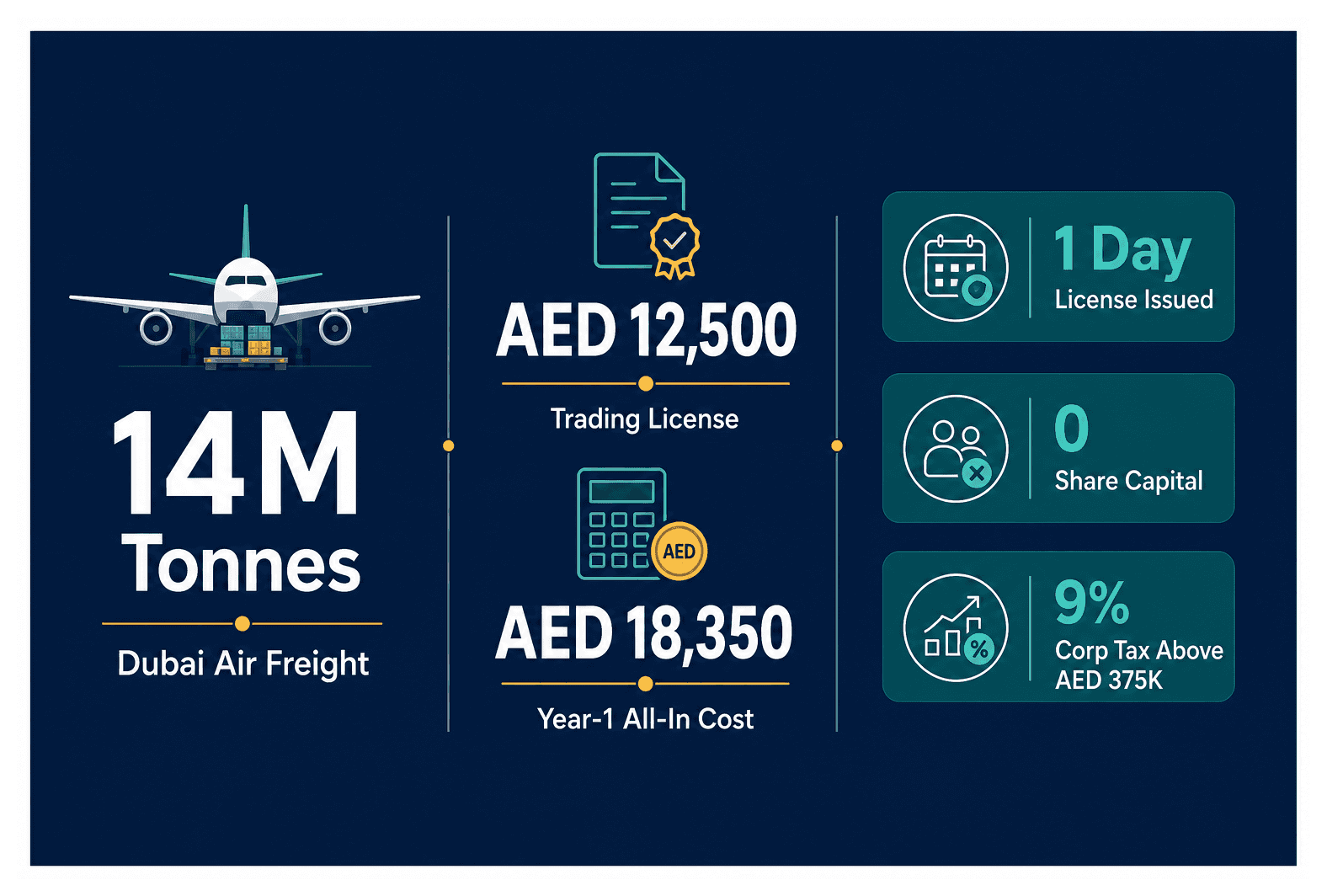
A standard trading license at Dubai South Business Hub Free Zone starts from AED 12,500, with a first-year all-in cost from AED 18,350 for a sole founder with one visa. Zero paid-up share capital is required, and the license can be issued in as little as one business day.
Plan for Corporate Tax From Day One
The UAE applies a 9% corporate tax on taxable income above AED 375,000, meaning distribution companies are not operating in a tax-free environment. Factoring this into your pricing and margin models before launch prevents costly surprises as revenue scales.
Understand Duty Status in Free Zone Storage
Goods stored in a free zone like DSBH are duty-suspended, not duty-exempt, which is an important distinction for cost planning. Any goods moved from the free zone into the UAE mainland require customs clearance and applicable import duties to be paid at that point.
Dubai's Logistics Scale Creates Real Market Opportunity
Dubai alone handles over 14 million tonnes of air freight annually, and the UAE ranked 13th globally on the World Bank's Logistics Performance Index. This infrastructure makes Dubai one of the highest-return entry points for founders looking to distribute goods across the GCC region.
In 2026, the UAE handles over 14 million tonnes of air freight annually through Dubai alone (Dubai Airports, 2024). The UAE ranked 13th globally in the World Bank's Logistics Performance Index (World Bank, 2023). A standard trading license at Dubai South Business Hub (DSBH) Free Zone starts from AED 12,500 [1]. First-year all-in cost for a sole founder with one visa starts from AED 18,350 [2]. Zero paid-up share capital is required [3]. The license is issued in one business day [4]. Corporate tax applies at 9% on taxable income above AED 375,000 (Federal Tax Authority, 2023) [5].
Founders looking to move goods across the GCC consistently rank distribution company setup in Dubai as one of the highest-return entry points into the regional market. This article covers the core requirements for a distribution company in Dubai, the realistic cost of a first-year license, and the exact steps to get your company operational, including what to expect from warehouse sourcing, visa processing, and tax registration.
What Is a Distribution Company in Dubai and What License Does It Need
A distribution company in Dubai buys goods from producers and resells them to retailers, wholesalers, or end customers. It requires a trading license covering wholesale or retail distribution activities. The license is issued by a free zone authority or the mainland Department of Economy and Tourism (DET), depending on the chosen jurisdiction.
The trading license in Dubai is the core document that authorizes your company to buy and sell goods commercially. Without it, no customs clearance, no supplier contracts, and no bank account for trade purposes. Getting the right license type, with the right activity list, is the single most important decision in your distribution company setup in Dubai.
The ISIC Classification Behind Distribution Activities
Distribution falls under ISIC Revision 4 Section G, which covers all Wholesale and Retail Trade globally. The relevant divisions are:
Division 45: Wholesale and retail trade and repair of motor vehicles
Division 46: Wholesale trade, except motor vehicles (the most common for B2B distributors)
Division 47: Retail trade, except motor vehicles
The activity you list on your license must match the goods category you intend to trade. A founder importing consumer electronics and selling to retail chains would list "Wholesale of computers, computer peripheral equipment and software" under Division 46 of ISIC Rev.4. Regulators cross-reference this framework when approving activity lists. Mismatched activity codes are a leading cause of license rejection, so specificity matters far more than brevity here.
You can review the full list of business activities in Dubai available under the DSBH framework before you submit.
Free Zone vs. Mainland: Which Jurisdiction Fits Distribution
Both free zone and mainland licenses now allow 100% foreign ownership, following the 2021 amendment to the UAE Commercial Companies Law. Ownership structure alone should not drive your jurisdiction decision.
The real distinction comes down to your customer base and supply chain model:
DSBH Free Zone license: Best suited for B2B wholesale, regional re-export, and GCC distribution models where goods move through Dubai rather than being sold directly to UAE end consumers
Mainland DET license: Better suited when the majority of your customers are UAE-based retailers or end consumers requiring direct supply
Duty status: Free zone storage is duty-suspended pending clearance, not duty-exempt. Goods entering the UAE mainland from a free zone require customs clearance and applicable import duties
DSBH designated-zone status: DSBH Free Zone does not hold designated-zone status, so no designated-zone VAT or customs benefits apply
A distributor supplying GCC wholesale buyers through Dubai re-export routes fits the free zone model well. One supplying Dubai supermarket chains directly may prefer a mainland DET license. Neither jurisdiction is tax-efficient.
Distribution Company Dubai Requirements: Structure, Activities, and Warehouse
A Dubai distribution company requires a valid trading license, a registered office address or warehouse, at least one shareholder, and a UAE-resident manager or authorized signatory. Regulated goods categories, including food, pharmaceuticals, and chemicals, require additional approvals from named sector regulators before trade can begin.
Shareholder, Manager, and Capital Requirements
Ownership: A sole founder can hold 100% of shares. No minimum paid-up share capital is required at DSBH Free Zone
Manager or signatory: A UAE-resident manager or authorized signatory is required for bank account opening and most regulatory interactions
Physical presence: Not required at incorporation. A registered address at the free zone suffices at the license stage
Individual shareholders: Passport copy plus a recent utility bill or bank statement (dated within three months)
Corporate shareholders: Company incorporation documents, a certificate of good standing, and a board resolution authorizing the UAE entity
A German founder, for example, can incorporate a single-shareholder distribution company at DSBH with zero paid-up capital and appoint a UAE-based manager without relocating personally at the outset. That's a genuinely low barrier to entry for an international trade operation.
Activity List: What You Can and Cannot Bundle
Your license lists the specific goods categories you're permitted to distribute. Vague descriptions like "general trading" cover a broad range but carry higher scrutiny from approving authorities. Specific activity descriptions aligned to ISIC codes process faster and with fewer queries.
At DSBH, the first five activities are included in the base license fee. Each additional activity beyond five costs AED 2,000. So if you're distributing across multiple product categories, plan your activity list carefully before submission.
Regulated goods require a second layer of approval that sits entirely outside the DSBH license process:
Pharmaceuticals and medical devices: Ministry of Health and Prevention (MOHAP) product registration
Food products and supplements: Dubai Municipality food import approval
Chemicals: Ministry of Climate Change and Environment or Dubai Civil Defence, depending on the substance
A distributor of health supplements, for instance, would obtain a DSBH trading license listing "Wholesale of pharmaceutical and medical goods" and separately seek MOHAP product registration. DSBH licenses the activity; the named regulator approves the specific goods. Both steps are mandatory, and neither replaces the other.
Warehouse Requirements for a Distribution Operation
A registered address (flexi-desk or shared office) is sufficient at the license stage. A physical warehouse is required before goods can be stored or dispatched commercially. Here's what to know:
Warehouse space in the Dubai South logistics district is leased independently from third-party operators. DSBH does not provide warehousing
DSBH does not offer bonded warehousing or customs integration services. These are arranged through Dubai Trade-registered logistics providers
Minimum warehouse size, racking standards, and fire safety compliance are governed by Dubai Civil Defence and relevant municipality requirements
Cold-chain or hazardous goods storage requires additional authority approvals before operations begin
A consumer goods distributor leasing 500 sq m of warehouse space within the Dubai South logistics zone benefits directly from proximity to Al Maktoum International Airport for inbound air freight, and road access to Jebel Ali Port for sea freight. That dual-mode access is a genuine operational advantage.
DSBH Free Zone Distribution License: First-Year Cost Summary
Cost Item | Amount (AED) |
|---|---|
Base license fee (B2B) | From 12,500 |
Base license fee (B2C) | From 11,375 |
Each activity beyond first five | 2,000 per activity |
First-year total (sole founder, one visa) | From 18,350 |
Paid-up share capital required | Zero |
License issuance time | 1 business day |
Cost of a Distribution Company Setup in Dubai
A sole founder setting up a distribution company at Dubai South Business Hub Free Zone pays from AED 18,350 in year one, covering a license from AED 12,500 and one visa package. Zero paid-up share capital is required. Each activity beyond the first five costs AED 2,000. Visas are an additional cost, not included in the license fee.
DSBH Free Zone License Fees Broken Down
DSBH launched in September 2025 as a free zone authority under Dubai South. Its fee structure is straightforward:
B2B trading license from AED 12,500
B2C trading license from AED 12,500
First five activities included in the base license fee
Each activity beyond five: AED 2,000
First-year all-in cost for a sole founder with one visa: from AED 18,350
Zero paid-up share capital required
License issued in one business day after document approval
To put it concretely: a founder listing six distribution activities (one beyond the base five) would pay AED 12,500 + AED 2,000 = AED 14,500 for the license component alone, before visa costs. Use the business setup cost calculator to model your specific configuration before committing.
Additional Costs to Budget Before You Start Trading
Visas: Always an additional cost. Never included in the license fee
Warehouse lease: Costs vary by size, location, and fit-out. Get quotes directly from Dubai South logistics park operators
VAT registration: Mandatory once taxable supplies exceed AED 375,000 annually. Late registration carries an AED 10,000 penalty (Federal Tax Authority, 2023)
Corporate tax registration: Required for all UAE entities. Late registration carries a one-time flat AED 10,000 penalty, not a monthly charge (Federal Tax Authority, 2023)
Sector-regulator fees: Food safety, pharmaceutical registration, and similar approvals are paid separately to the relevant authority
A distributor projecting AED 500,000 in first-year turnover should budget for VAT registration from day one to avoid the AED 10,000 late-registration penalty. That's a straightforward cost to plan around.
How to Complete Your Distribution Company Setup in Dubai: A Step-by-Step Process
Setting up a distribution company in Dubai takes five core steps: choose your jurisdiction, reserve your trade name, submit incorporation documents, obtain your license, then register for tax and open a bank account. At DSBH Free Zone, the license is issued in one business day once documents are approved.
Step 1: Choose Your Jurisdiction and Activity List
Decide between a DSBH Free Zone license (B2B wholesale, re-export, regional distribution) and a mainland DET license (direct UAE retail supply)
Confirm the specific goods categories you'll distribute and map them to ISIC-aligned activity codes
Check whether any goods are regulated. If so, identify the named regulator and their approval timeline before committing to a launch date
Confirm your activities are available under the DSBH framework before proceeding
A founder planning to distribute industrial tools B2B across the GCC would select DSBH Free Zone and list "Wholesale of other machinery and equipment" as a primary activity. The first five activities are included in the base fee; each additional activity costs AED 2,000.
Step 2: Reserve Your Trade Name and Submit Documents
Check company name availability before committing. Names must not duplicate existing registrations or include prohibited terms
Individual shareholders: passport copy plus proof of address (utility bill or bank statement, within three months)
Corporate shareholders: incorporation documents, certificate of good standing, and board resolution authorizing the UAE entity
Regulated goods applications: include a business plan or activity description for the relevant sector regulator
A sole founder submitting a passport copy and proof of address for a non-regulated goods distribution company can realistically receive their DSBH license in one working day for eligible activities of approval. That's one of the fastest incorporation timelines available in Dubai.
Step 3: Secure Your Visa, Warehouse, and Bank Account
Apply for your investor or employee UAE residency visa through DSBH's residency services. Visa packages are always an additional cost, separate from the license fee
Source warehouse space independently from Dubai South logistics park operators or third-party commercial landlords. DSBH does not provide warehousing
Open a Dubai bank account with your UAE corporate license, shareholder documents, a business plan, and evidence of anticipated transaction flows
Register for VAT with the Federal Tax Authority once you're at or approaching the AED 375,000 taxable supply threshold
Complete corporate tax registration with the Federal Tax Authority. All UAE entities must register, regardless of taxable income level
A founder who completes incorporation in week one can typically have their residency visa stamped and a bank account opened within three to five weeks, assuming clean compliance documentation.
Tax and Compliance Obligations for a Dubai Distribution Company
A Dubai distribution company must register for corporate tax with the Federal Tax Authority and for VAT once taxable supplies exceed AED 375,000 annually. Corporate tax applies at 9% on taxable income above AED 375,000. Qualifying Free Zone Person status requires meeting four conditions and is not automatic.
Corporate Tax: What Distribution Companies Need to Know
All UAE-registered entities must register for corporate tax with the Federal Tax Authority. There are no exemptions based on size or structure at the registration stage. Corporate tax applies at 9% on taxable income exceeding AED 375,000 per financial year.
A 0% rate applies only to Qualifying Free Zone Persons (QFZP), and all four conditions must be satisfied simultaneously:
Adequate substance in the UAE
Qualifying income only (no disqualifying mainland revenue)
Transfer pricing compliance
No mainland permanent establishment
DSBH Free Zone is not a designated zone, so no designated-zone corporate tax treatment applies. A DSBH-licensed distributor earning AED 600,000 in taxable income would pay 9% corporate tax on AED 225,000 (the amount above the AED 375,000 threshold) unless all four QFZP conditions are fully met. Late corporate tax registration carries a one-time flat AED 10,000 penalty.
VAT, Import Duties, and Customs Registration
VAT registration is mandatory once taxable supplies reach AED 375,000 annually. Voluntary registration is available from AED 187,500
Late VAT registration: AED 10,000 penalty from the Federal Tax Authority
Distribution companies importing goods must register with Dubai Trade and obtain an importer code before customs clearance
Import duties of 5% apply to most goods entering the UAE mainland. Free zone storage is duty-suspended, not duty-exempt
Alcohol, tobacco, and energy drinks attract excise tax in addition to import duty and VAT
A distributor importing AED 2 million of electronics into the UAE mainland would pay 5% import duty at clearance and charge 5% VAT on onward UAE sales, requiring both a Dubai Trade importer code and FTA VAT registration.
Is VAT registration required from day one for a distribution company?
VAT registration is mandatory once your taxable supplies reach AED 375,000 in any 12-month period. If you expect to exceed this threshold in your first year of trading, register before you begin selling. Voluntary registration is available from AED 187,500, and the late-registration penalty is a flat AED 10,000.
Key Considerations Before You Launch Your Dubai Distribution Business
Before launching a Dubai distribution company, confirm your goods category is not subject to sector-regulator approval, secure warehouse space independently of your license, register for corporate tax and VAT with the Federal Tax Authority, and open a UAE corporate bank account. Getting
References
Frequently Asked Questions