
Topic Summary
Know What Payment Plans Actually Cover
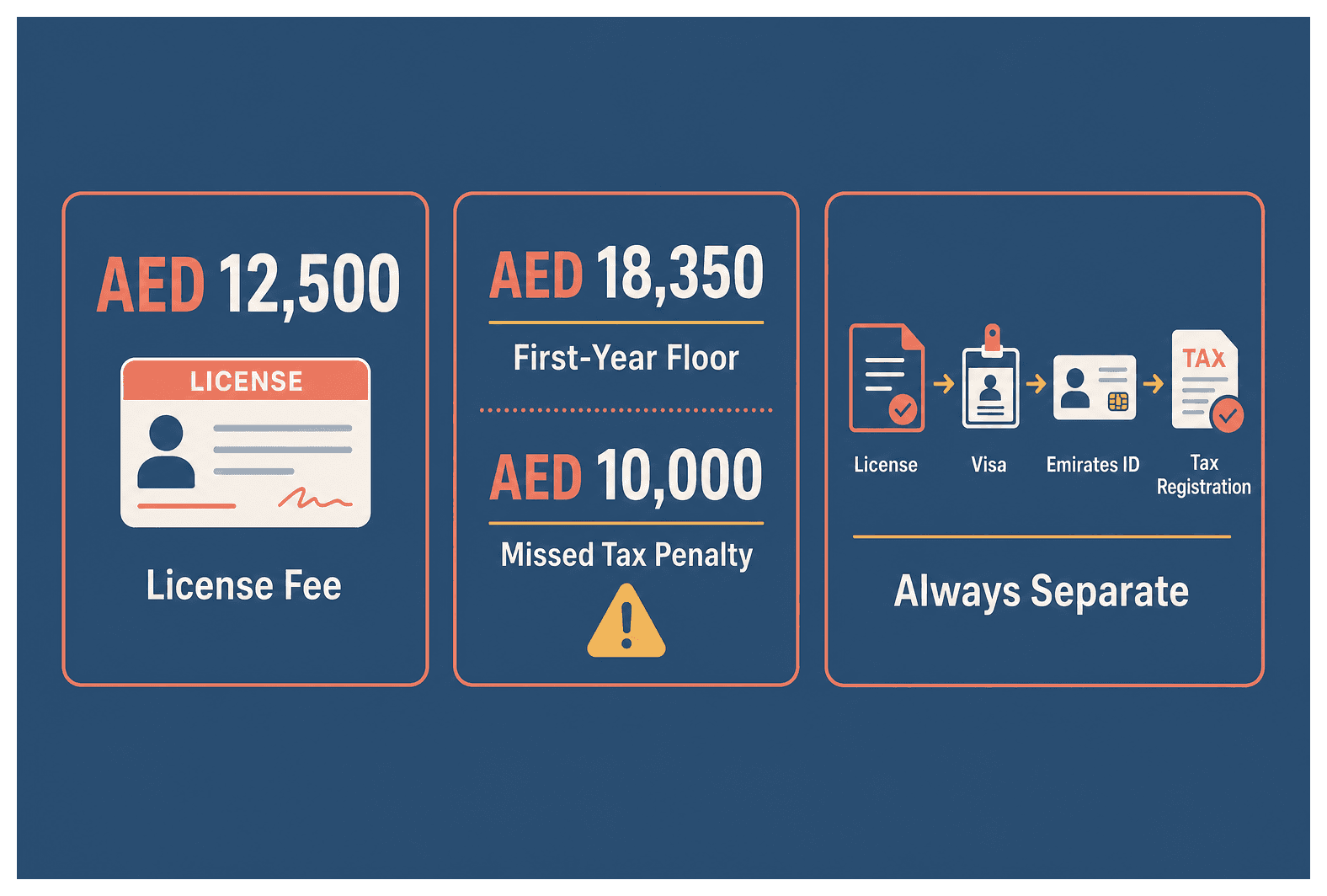
A Dubai business setup payment plan typically spreads the license fee, establishment card, and sometimes MoA notarisation across instalments. It does not cover visa fees, Emirates ID, medical tests, or regulatory approvals, which are always billed separately.
Budget Beyond the License Fee Alone
At DSBH, the license starts from AED 12,500, but the true first-year all-in cost for a sole founder begins at AED 18,350. Founders who price only the license fee routinely underestimate their total first-year outlay by 20 to 30 percent.
Plan Your Business Activities Before Signing
DSBH includes up to five activities in the base license fee, and each additional activity costs AED 2,000. Finalising your full activities list before signing avoids a costly amendment later.
Track VAT and Corporate Tax Deadlines Yourself
Missing VAT registration triggers an AED 10,000 penalty from the Federal Tax Authority, and a missed corporate tax registration carries a separate AED 10,000 flat penalty. Your free zone will not track these deadlines for you.
Confirm Instalment Dates and Triggers in Writing
Before signing any payment agreement, verify the exact instalment dates, what event triggers each invoice, and whether renewal is auto-billed. Ambiguity on these points is a leading cause of unexpected cash-flow disruption for new founders.
Verify Zero Paid-Up Share Capital Requirement
DSBH requires no paid-up share capital, meaning no capital deposit appears on your payment schedule. This is a meaningful cash-flow advantage for early-stage founders that not all free zones offer.
Use Official UAE Channels to Check License Status
Always verify your license and payment status through official UAE government portals rather than relying solely on free zone communications. Knowing what each status code means helps you confirm your application is progressing correctly.
In 2026, first-time founders in Dubai routinely underestimate their total first-year outlay by 20 to 30% because they price only the license fee and ignore the downstream costs that payment plans do not cover. A missed VAT registration triggers an AED 10,000 penalty from the Federal Tax Authority; a missed corporate tax registration triggers a separate AED 10,000 flat penalty. The DSBH (Dubai South Business Hub Free Zone) license starts from AED 12,500, with a first-year all-in cost for a sole founder from AED 18,350. Visa fees are always additional. And licenses can be issued in one business day. Getting the business setup payment Dubai picture right before you sign anything is the single most effective way to protect your cash flow.
This guide walks you through every component a payment plan does and does not include, the exact steps to verify your license and payment status through official UAE channels, what each status code means, and the DSBH figures you need to sanity-check any quote you receive.
What a Business Setup Payment Plan in Dubai Actually Covers
A business setup payment plan in Dubai spreads the upfront license fee, establishment card, and sometimes the Memorandum of Association notarisation across two or three instalments. It does not cover visa fees, medical tests, Emirates ID, office rent, or regulatory approvals, which are always billed separately and due on their own schedules.
Core Costs Typically Bundled into a Payment Plan
The license fee is the anchor figure in any business setup payment Dubai arrangement. At DSBH, that fee starts from AED 12,500 for most activities. Zero paid-up share capital is required, so no capital deposit sits inside the payment schedule, a meaningful cash-flow advantage for early-stage founders.
License fee: from AED 12,500 at DSBH; this is the figure most payment plans are built around
Establishment card and MoA notarisation: sometimes bundled, sometimes invoiced separately, always confirm in writing before signing
Zero paid-up share capital: no capital deposit required at DSBH, so it does not appear on the payment schedule
First-year all-in floor: AED 18,350 for a sole founder with one visa, treat this as the minimum, not the expected total
A founder setting up a single-activity consulting company at DSBH pays AED 12,500 for the license. Adding a second activity beyond the first five included costs AED 2,000 per activity. Plan your business activities list before signing to avoid that amendment cost later.
Costs That Are Always Additional, Never Bundled
Visa fees are never described as included in a DSBH package. Medical fitness tests, Emirates ID biometrics, and ICP (Identity and Citizenship Authority) application fees are paid directly to the relevant government entity on that entity's schedule, not DSBH's.
Visa fees: always additional; invoiced separately from the license payment plan
Medical fitness test, Emirates ID, ICP fees: paid directly to government entities; not part of any free zone invoice
Regulatory approvals:DHA for healthcare, the relevant UAE financial regulator for financial services, separate payments, separate timelines
VAT and corporate tax registration: free to complete on tax.gov.ae, but each carries an AED 10,000 penalty if missed
A founder who budgets only AED 12,500 and then receives a visa invoice plus an ICP fee invoice is not facing hidden charges. Those costs were always outside the license payment plan scope. The AED 375,000 VAT threshold and the AED 10,000 late-registration penalties are your responsibility to track, not your free zone's.
Key Payment Plan Terms Founders Must Clarify Before Signing
Before signing any business setup payment agreement in Dubai, confirm the instalment dates, what triggers each invoice, whether renewal is auto-billed, and which reference number tracks your application. Ambiguity on any of these four points is the most common reason founders face unexpected charges or license suspension in year two.
Instalment Triggers and Due Dates
Not all payment plans work the same way. Some use time-based triggers (50% on signing, 50% at 90 days); others are milestone-based (second payment released on visa stamping). Knowing which structure you are on determines how you manage cash flow in the first quarter.
Trigger type: confirm whether instalments are time-based or milestone-based before signing
Grace period: ask how many days before a missed instalment suspends your license application
Currency: ensure the schedule is denominated in AED to avoid exchange-rate exposure
Total in writing: partial-payment arrangements sometimes carry an administrative surcharge not shown in the headline price
A founder paying in two instalments who misses the second due date by 15 days may find their establishment card issuance paused. That delay pushes the visa application back, which in turn pushes the Emirates ID timeline back by weeks. One missed payment cascades quickly. Get the grace period clause in writing.
Renewal Billing and Year-Two Costs
License renewal at most free zones falls due 30 to 60 days before the expiry date. If you assume renewal is on the anniversary of your license issue date, you may already be inside the renewal window without realising it. Renewal fees can also differ from the first-year fee, so ask for a written renewal-fee schedule at the point of sign-up.
Renewal window: typically 30 to 60 days before expiry; confirm the exact date with DSBH at application
Renewal fee: may differ from year-one fee; get a written schedule upfront
Visa renewal cycle: every two to three years; invoiced independently of the license renewal
Consequence of late renewal: license suspension can trigger bank account freezes and disrupt active transactions
A founder who sets up a company in October and assumes renewal falls in October the following year may miss a September renewal window if the free zone counts from the Memorandum of Association date, not the license issue date. That one-month gap can suspend an otherwise compliant business.
Five Steps to Verify Your Business Setup Payment and License Status in Dubai
To verify your business setup payment and license status in Dubai, check the Ministry of Economy's online portal using your trade license number, then cross-check with your free zone authority's client portal using your application reference number. Each channel returns a different status field, and you need both to confirm your company is fully active.
Step 1: Locate Your Reference Numbers Before You Start
You need three reference numbers before attempting any business setup Dubai check. First, your free zone application reference, issued at the point of submission. Second, your trade license number, issued on approval. Third, your establishment card number, issued after license activation.
If you applied through DSBH, your application reference appears in the confirmation email sent within one business day of submission. A founder who applied on a Monday and received a license by Tuesday morning should have all three numbers before proceeding. Without the trade license number, the Ministry of Economy portal search returns no result. Do not move to Step 2 until you have it.
Step 2: Check License Status on the Ministry of Economy Portal
Go to moet.gov.ae and navigate to the Business Services or License Verification section
Enter your trade license number; the portal returns one of four statuses: Active, Suspended, Expired, or Under Renewal
Active means all fees are cleared and the license is valid; Suspended means a payment or document is outstanding; Expired means the renewal window has passed
Screenshot and date-stamp every result, banks may request a status certificate dated within 30 days
A founder whose bank requests proof of an active license can use a dated screenshot from moet.gov.ae as interim evidence while the formal certificate is being printed.
Dubai Business Setup Payment: Key Status Codes and What to Do
Status Code | What It Means | Next Action |
|---|---|---|
Active | License valid; all fees cleared; company can trade, sponsor visas, and open bank accounts | Download a dated certificate; proceed with bank account opening and visa sponsorship |
Suspended | Fee or document outstanding; trading technically restricted; visa sponsorship paused | Identify the outstanding item in your free zone portal; clear it within the grace period to avoid escalation to Expired |
Expired | Renewal window has passed; reactivation required; bank may freeze corporate account | Contact DSBH immediately; pay any reactivation fees; resolve to Active before approaching a bank |
Under Renewal | Renewal application submitted and in progress; most authorities accept as temporarily valid | Confirm with your specific bank whether they accept this status for KYC purposes before submitting applications |
Paid (payment portal) | Invoice settled; receipt generated in the free zone client portal | Download the PDF receipt immediately; store it for bank KYC and auditor requests |
Overdue (payment portal) | Payment missed beyond the due date; may trigger a late fee or license suspension | Pay immediately; request written confirmation that the Overdue flag has been cleared before submitting any government applications |
Step 3: Cross-Check with Your Free Zone Client Portal
Log into the DSBH client portal with the credentials issued at application; navigate to Payment History and confirm all instalments show as Paid
Any invoice in Overdue status must be cleared before approaching a bank for bank account opening in the UAE
Download all payment receipts as PDFs, your auditor and bank compliance team will request these during KYC
If a payment shows as Pending for more than 48 hours after transfer, contact DSBH with your bank transfer reference number
A founder who paid by bank transfer on a Thursday may see Pending status until Monday if the transfer cleared over a weekend. That is a processing delay, not a failed payment. The 48-hour rule is the practical threshold before escalating.
Step 4: Verify Tax Registration Status with the Federal Tax Authority
Go to tax.gov.ae and use the TRN Verification tool; enter your Tax Registration Number to confirm VAT registration is Active
If turnover exceeds AED 375,000 and you are not yet VAT-registered, register immediately, the late-registration penalty is AED 10,000
Corporate tax registration is separate; navigate to the corporate tax section of tax.gov.ae and confirm registration is complete, the penalty is a one-time flat AED 10,000
Both registrations are free; the only cost of delay is the penalty
A founder who hits AED 375,000 in revenue in month eight and registers for VAT in month ten faces an AED 10,000 penalty for the two-month gap. A calendar reminder set at incorporation costs nothing. The penalty does.
Is a business setup Dubai check different for free zone versus mainland companies?
The Ministry of Economy portal at moet.gov.ae covers both free zone and mainland licenses. Free zone companies also have a secondary check in their free zone client portal, which mainland companies do not. Both channels must show Active status for a company to be fully operational and bank-ready.
What Each License and Payment Status Code Means
Dubai license and payment status codes signal the current state of your company file. Active means fully compliant and tradeable. Suspended means a fee or document is outstanding. Expired means the renewal deadline has passed. Under Renewal means a renewal application is in progress. Each status has a different impact on your ability to open a bank account or sponsor visas.
License Status Codes and Their Practical Consequences
Active: license valid; all fees cleared; company can trade, sponsor visas, and open bank accounts
Suspended: fees or documents outstanding; trading restricted; visa sponsorship paused; resolve within the grace period to avoid escalation
Expired: renewal window passed; reactivation may require penalty payment and a fresh establishment card; bank may freeze the corporate account
Under Renewal: renewal in progress; most banks and government entities accept this status as temporarily valid, confirm with your specific bank before relying on it
A founder whose license moves to Expired during a bank KYC review will likely have their account opening application rejected. Resolving to Active first is the only reliable path forward. Do the business setup Dubai check before booking a bank appointment, not after.
Payment Status Codes in Your Free Zone Portal
Paid: invoice settled and receipt generated; download the PDF immediately
Pending: payment received but not yet reconciled; typical resolution within one to two business days
Overdue: payment missed beyond the due date; may trigger a late fee or license suspension depending on policy
Cancelled: invoice voided, usually after an application amendment; confirm a replacement invoice has been issued if the service was not dropped
A founder who sees an Overdue invoice should pay it and then request written confirmation that the flag has been cleared, before submitting any government applications that depend on clean payment status.
How Business Setup Payment Plans Interact with Tax and Regulatory Obligations
Your free zone payment plan covers the license, not your tax obligations. VAT registration, corporate tax registration, and any sector-specific regulatory approvals run on their own timelines and carry their own penalties. Treating them as separate tasks with separate deadlines is essential to avoiding an AED 10,000 penalty that no business setup payment Dubai plan will absorb.
VAT and Corporate Tax Registration Timelines
VAT registration is mandatory once taxable supplies exceed AED 375,000 in any 12-month period. Voluntary registration is available from AED 187,500, useful if you want to reclaim input VAT before hitting the mandatory threshold. Both registrations are completed on tax.gov.ae at no cost.
Corporate tax registration is required for all UAE-incorporated entities regardless of revenue level. The Federal Tax Authority sets the deadline based on your financial year end, not your incorporation date. The penalty for missing it is a one-time flat AED 10,000, not a monthly accumulating charge. But it is still AED 10,000 you do not need to spend.
A tech startup incorporated in January 2026 that hits AED 375,000 revenue by August must register for VAT by the end of September. Missing that window costs AED 10,000 regardless of how small the company is. Set the calendar reminder on day one.
Regulated Activity Approvals and Their Separate Fee Structures
Dual-approval rule: DSBH licenses the activity; the named regulator approves it separately, both steps are required before you can legally operate
Healthcare: requires DHA approval in addition to the DSBH license; the DHA fee is paid directly to DHA on DHA's schedule
Financial services: requires approval from the relevant UAE financial regulator in addition to the DSBH license
Education: requires KHDA approval in addition to the DSBH license; do not factor KHDA fees into your DSBH payment plan budget
A founder setting up a health and wellness consultancy at DSBH pays the DSBH license fee to DSBH and the DHA approval fee directly to DHA. Two separate payments, two separate timelines, one compliant business. Check the full healthcare license requirements before budgeting.
Building a Realistic Budget Around Your Business Setup Payment in Dubai
A realistic business setup payment budget in Dubai adds the license fee, visa costs, government fees, regulatory approvals, and a 15% contingency to the free zone's headline figure. For a sole founder with one visa at DSBH, the verified first-year floor is AED 18,350 before any additional activities or regulated-sector approvals.
The DSBH Cost Baseline and What Sits on Top of It
License: from AED 12,500; issued in one business day; zero paid-up share capital required
First-year all-in floor: AED 18,350 for a sole founder with one visa, this is the verified minimum, not the expected total
Additional activities: each activity beyond the first five costs AED 2,000; front-load your activity list to avoid amendment fees
Separately billed: visa fees, medical tests, Emirates ID, and ICP charges sit on top of AED 18,350 and are not absorbed into it
A founder who needs three Federal Tax Authority
Frequently Asked Questions