Topic Summary
Choose Between Free Zone and Mainland
Free zone entities suit founders serving international clients, while mainland licenses let you trade directly in the UAE local market. Both structures now allow 100% foreign ownership under UAE law amended in 2020.
Know the Real First-Year Cost
The all-in first-year cost at Dubai South Business Hub Free Zone starts from AED 18,350, covering the license and one visa. The base license alone starts from AED 12,500, with no paid-up share capital required.
Pick the Right Legal Structure for Liability
A Free Zone Establishment gives a solo founder limited liability with a straightforward setup, while a sole proprietorship on the mainland leaves personal assets exposed to business debts. Choosing the wrong structure can create significant financial risk from day one.
Expect a One-Business-Day License Turnaround
DSBH issues the trade license in one business day once documents and payment are submitted. This compresses the gap between application and being ready to trade considerably.
Register for VAT and Corporate Tax on Time
Late VAT registration and late corporate tax registration each carry a flat AED 10,000 penalty. Building these deadlines into your setup timeline from the start avoids an easily preventable cost.
Don't Confuse Free Zone with Designated Zone
Free zone status and designated zone status are separate legal classifications with different VAT and customs consequences. DSBH is not a designated zone, so goods crossing into the UAE mainland are subject to customs duty.
Sponsor Your Own Residency Visa as a Solo Founder
A single-shareholder free zone entity allows the founder to sponsor their own UAE residency visa without a local partner. A UK-based consultant, for example, can secure a two-year UAE residency visa through their DSBH company.
In 2026, Dubai issues more than 40,000 new business licenses each year (Dubai Chamber, 2024), and a rising proportion go to solo founders who want full ownership, no partners, and no local sponsor. The first-year all-in cost for a company setup one-person Dubai at Dubai South Business Hub Free Zone (DSBH) starts from AED 18,350 [1], covering the license and one visa. The base license alone starts from AED 12,500 [2], with zero paid-up share capital required [3]. DSBH issues the license in one business day [4]. Late VAT registration carries an AED 10,000 flat penalty [5]; so does late corporate tax registration [6]. This guide covers every structural choice and cost line a first-time founder needs before committing: license type, one-off versus recurring fees, visa costs, tax obligations, and exactly what that AED 18,350 figure includes and excludes.
What a One-Person Company Setup in Dubai Actually Means
A one-person company setup in Dubai is a single-shareholder legal entity where one founder owns 100% of the shares, holds the trade license, and can sponsor their own residency visa. It is distinct from a partnership or multi-shareholder structure and is available in free zones and on the mainland.
The phrase "one-person company" covers a specific legal reality: you are the sole director, sole shareholder, and sole signatory. There is no silent partner, no local sponsor requirement for most activities, and no obligation to share equity. That structure is exactly what a company setup one-person Dubai is designed to deliver.
Free Zone versus Mainland: Which Structure Fits a Solo Founder
Free zone entities are incorporated under a specific free zone authority and operate under that authority's regulations. Mainland entities are licensed by DET and can trade directly in the UAE local market without a local agent for most activities. The practical difference comes down to your customer base, not your ownership rights.
Worth flagging: 100% foreign ownership is available in both free zones and on the mainland under the UAE Commercial Companies Law amendments introduced in 2020 (Federal Decree-Law No. 26 of 2020, UAE Government Portal, 2020). It is not exclusive to free zones. A UK-based marketing consultant setting up a company as a sole founder at DSBH can own 100% of shares, operate internationally, and sponsor a two-year UAE residency visa, all without a local partner.
One distinction that trips up many first-time founders: free zone goods moving into the UAE mainland are duty-suspended, not duty-exempt. Customs duty applies the moment goods cross into the mainland market. DSBH is not a designated zone and does not carry designated-zone VAT or customs benefits. Don't conflate free zone status with designated-zone status; they are separate classifications with different regulatory consequences.
Legal Structures Available to a Single Shareholder
Your structure choice shapes your liability exposure from day one. Here are the main options:
Free Zone Establishment (FZE): One shareholder, limited liability, incorporated under the free zone authority. The standard vehicle for a company setup one-person Dubai in a free zone.
Sole Establishment (Sole Proprietorship): Mainland structure; the founder has unlimited personal liability for business debts.
Single-Member LLC: Mainland structure; limited liability, but more complex to incorporate than an FZE.
At DSBH, zero paid-up share capital is required, removing a common barrier for first-time founders. An e-commerce founder incorporating as an FZE at DSBH has limited liability protection from day one without needing to deposit share capital in a bank before receiving the license. The license issues in one business day once documents and payment are complete, which compresses the gap between application and trading readiness considerably.
Company Setup Dubai Cost: One-Off versus Recurring Fees
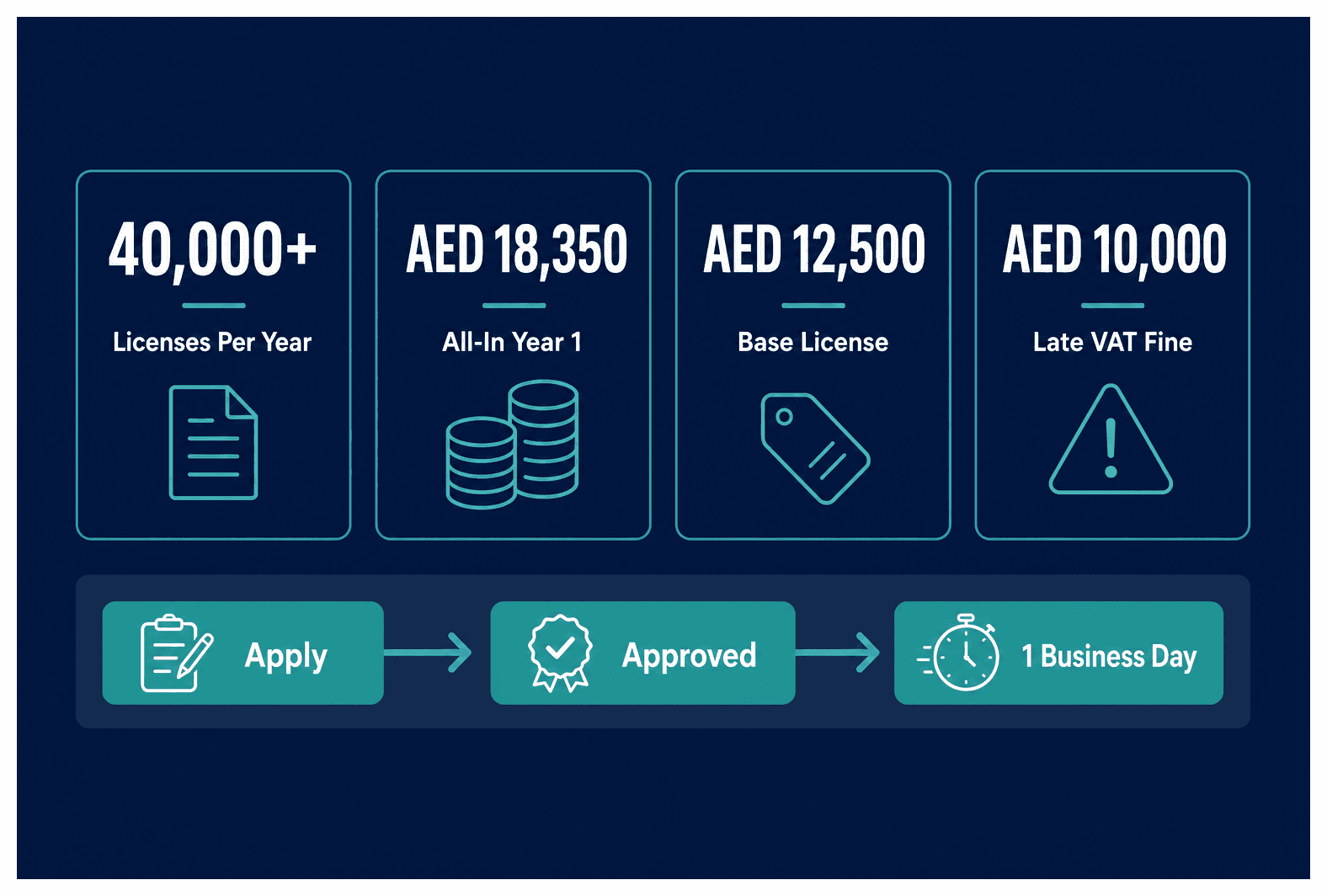
The first-year all-in cost for a sole founder with one visa at Dubai South Business Hub Free Zone starts from AED 18,350. This covers the license and one visa; it excludes medical insurance, Emirates ID fees, attestation, accounting, and any activity beyond the first five included in the base license.
Understanding which costs are one-off and which recur annually is the single most useful thing you can do before budgeting. Many founders underestimate year-two costs because they only model year one.
One-Person Company Setup Cost at DSBH: One-Off vs Recurring Fees
Cost Item | One-Off Costs (Year 1 Only) | Recurring Annual Costs |
|---|---|---|
License issuance fee | From AED 12,500 | License renewal due annually; renewal fee applies each year |
Initial visa application and entry permit | Paid once at first application; included in the AED 18,350 first-year all-in figure | Visa renewal required every 2-3 years; treated as a recurring cost |
Establishment card (initial issuance) | Issued once after license; required before visa applications can proceed | Renewal applies when the establishment card expires |
Medical fitness test (visa applicant) | Paid once at initial visa application; conducted at an approved health centre | Required again at each visa renewal cycle |
Emirates ID (initial application via ICP) | Paid to ICP at first application; fee depends on visa duration (UNVERIFIED: confirm exact amount with ICP before publishing) | Renewed in line with visa renewal cycle |
License renewal fee | Not applicable in year one, this is a recurring charge only | Due annually; amount mirrors the initial license fee structure |
Visa renewal fee | Not applicable at initial setup, renewal comes at the end of the visa term | Due every 2-3 years; always an additional cost, never bundled into the license |
Costs that are never included in the DSBH base package and must be budgeted separately:
Medical insurance (mandatory for all UAE visa holders)
Emirates ID fee (paid to ICP)
Medical fitness test fee
Typing and processing fees at approved centres
Bank account opening fees
Accounting and bookkeeping
VAT registration agent fees
Additional activities beyond the first five (AED 2,000 each)
A solo tech consultant taking the base license plus one visa at DSBH budgets AED 18,350 for year one, then separately sources medical insurance and books an Emirates ID appointment through ICP.
What 'All-In' Does and Does Not Cover
The AED 18,350 starting point is exactly that: a starting point. No physical office or warehouse is bundled into the base license cost. Flexi-desk or dedicated office packages are separate line items, priced according to the space and duration you need.
DSBH does not provide bonded warehousing or customs integration services. Founders in physical goods businesses must arrange third-party logistics and customs clearance independently. Bank account opening is also a separate process; DSBH does not guarantee account approval, which depends entirely on the bank's own KYC requirements.
Use the DSBH cost calculator to model your specific combination of activities, visas, and add-ons before committing to a budget.
Step-by-Step Guide to Company Setup for a One-Person Business in Dubai
To set up a one-person company in Dubai, you choose a free zone or mainland structure, reserve a trade name, select your business activities, submit incorporation documents, receive your license, then apply for your residency visa and Emirates ID. At DSBH, the license issues in one business day.
Step 1: Choose Your Jurisdiction and Activity
Decide on free zone or mainland. Free zones suit international clients and B2B work. Mainland is the better fit if you need to contract directly with UAE government entities or retail consumers without a distributor.
Select your business activities. Each activity must match what you actually do. DSBH includes up to five activities in the base license; anything beyond that costs AED 2,000 per activity.
Check your trade name. Use the company name availability search before filing. Trade names must comply with UAE naming regulations and cannot include offensive terms or references to political or religious bodies.
Identify regulated activities early.Healthcare, financial services, and education each require both a DSBH license and separate approval from the named regulator. A solo financial advisor planning to offer investment advisory services needs a DSBH license and a separate Securities and Commodities Authority registration; the license alone is not sufficient to operate.
Step 2: Submit Documents and Receive Your License
The standard document set for a sole founder is straightforward: passport copy, passport-size photograph, completed application form, and proposed trade name. No attested educational certificates are required for most commercial activities, though regulated activities may require professional qualification verification from the relevant UAE authority.
Once documentation is complete and payment is made, DSBH issues the license in one business day. After license issuance, the establishment card is the next document you need before visa applications can proceed. Don't skip this step; banks and government portals frequently ask for it.
Step 3: Apply for Your Residency Visa and Emirates ID
A free zone license holder can sponsor their own investor visa. The application goes through the General Directorate of Residency and Foreigners Affairs (GDRFA Dubai, 2026). The process runs in this order:
Entry permit issuance
Status adjustment or change of status (if already in the UAE)
Medical fitness test at an approved health centre
Emirates ID biometrics at ICP
Visa stamping in the passport
Medical insurance must be active before the visa is finalised; this is a mandatory requirement under UAE law. The UAE residency visa is always an additional cost on top of the license, never bundled into it.
Visa and Residency Costs for a Solo Founder
A UAE residency visa for a solo founder is always an additional cost on top of the license fee. The AED 18,350 first-year figure at DSBH includes one visa. Mandatory add-ons include medical insurance, a medical fitness test, and an Emirates ID application fee paid separately to ICP.
What the Investor Visa Process Involves
The investor visa is the standard route for a free zone sole founder. It grants a two- or three-year UAE residency tied to the company license. MoHRE is not involved in investor visa applications for free zone entities; the relevant authority is GDRFA Dubai.
Dependant visas for a spouse or children are separate applications with separate costs. They are not included in any base package and should be budgeted as additional line items from the outset.
Mandatory Costs Beyond the Visa Stamp
Medical insurance: Mandatory for all UAE visa holders. Cost varies by provider, age, and coverage level. Budget this separately; it is not optional.
Emirates ID fee: Paid to ICP. Amount depends on visa duration. (UNVERIFIED: confirm exact current fee with ICP before publishing.)
Medical fitness test fee: Paid at an approved health centre during the visa process.
Typing and processing fees: Charged by approved typing centres for form submission.
Verify current amounts directly with GDRFA Dubai and ICP before finalising your budget, as government fees are updated periodically.
Tax and Compliance Obligations Every Solo Founder Must Know
UAE corporate tax applies to businesses earning above AED 375,000 in net profit. Free zone entities may qualify for a 0% rate as a Qualifying Free Zone Person if they meet four specific conditions. VAT registration is mandatory above AED 375,000 in taxable turnover. Late registration penalties are AED 10,000 each.
Corporate Tax: The Four QFZP Conditions That Determine Your Rate
The 0% corporate tax rate for free zone entities is not automatic. It applies only to Qualifying Free Zone Persons (QFZP). The four conditions, as set out by the Ministry of Finance (2023), are:
Maintain adequate substance in the UAE
Derive qualifying income as defined by the Ministry of Finance
Have not elected to be subject to standard corporate tax
Meet transfer pricing and other compliance requirements
Income from UAE mainland customers may constitute non-qualifying income, taxed at the standard 9% rate above AED 375,000 net profit. A solo digital marketing consultant at DSBH serving only overseas clients and maintaining substance in the UAE may qualify as a QFZP, but must confirm this with a UAE tax adviser before filing. Never describe DSBH or any free zone as "tax-free"; that framing is both inaccurate and misleading without the four conditions attached.
VAT Registration and the AED 10,000 Late-Registration Penalty
VAT registration is mandatory when taxable supplies and imports exceed AED 375,000 in any 12-month period. Voluntary registration is available above AED 187,500. The Federal Tax Authority imposes an AED 10,000 penalty for late VAT registration. This is a one-time flat penalty, not a monthly charge.
Corporate tax late registration carries a separate AED 10,000 one-time flat penalty. The two are independent of each other. Free zone entities are not automatically VAT-exempt; supplies to UAE mainland customers are standard-rated at 5% unless a specific zero-rating or exemption applies. Register before you cross the threshold, not after.
Is DSBH a designated zone for VAT purposes?
No. DSBH is a free zone but not a designated zone under UAE VAT law. Designated-zone VAT treatment, which can affect how supplies between businesses in those zones are treated, does not apply to DSBH. Founders should not assume any automatic VAT benefit beyond what applies to standard free zone entities.
Choosing the Right License Type for Your One-Person Business
A one-person business in Dubai typically needs a professional license for service-based or consultancy activities, or a trading license for buying and selling goods. The activity you list on the license must match what you actually do; mismatches can trigger FTA penalties and bank KYC rejections.
Professional License: Best Fit for Consultants, Creatives, and Advisors
A professional license covers service-based activities where the founder sells expertise rather than physical goods: consulting, design, marketing, IT services, training, and similar work. DSBH issues professional licenses from AED 12,500. Up to five activities are included in the base license, with additional activities costing AED 2,000 each beyond that threshold.
A one-person management consulting firm listing "Business Management Consultancy" and "Market Research" as two of its five included activities pays no additional activity fee for either. For regulated professional services such as legal advice, medical consultancy, or financial advisory, the relevant UAE regulator must separately approve the activity before you can offer it to clients.
Trading License: What a Solo Founder in Commerce Needs to Know
A trading license covers import, export, distribution, and resale of goods. The goods categories must be specified on the license at the time of application. Free zone trading licenses permit import and re-export without mainland customs duty while goods remain in the free zone; duty applies when goods enter the UAE mainland market.
DSBH does not provide bonded warehousing or customs integration. Solo trading founders must arrange third-party logistics and customs clearance independently. Worth noting: e-commerce is not a separate license category. A founder selling online is classified by the type of goods or services sold, consistent with how the same activity would be classified through any other sales channel (UN ISIC Rev.4, UN Statistics Division, 2008, still accurate as of 2026).
References
References
Frequently Asked Questions