
Topic Summary
One-Day Licensing at Dubai South Business Hub
Dubai South Business Hub Free Zone, launched in September 2025, issues a trade license within one business day once documents clear. This speed is a genuine advantage for remote founders who cannot afford weeks of administrative delays.
Realistic Year-One Costs to Budget
A sole founder seeking one visa should budget from AED 18,350 for their first year, with base licenses starting from AED 12,500. Each business activity added beyond the first five costs an additional AED 2,000.
Zero Paid-Up Share Capital Required
DSBH requires no paid-up share capital to incorporate, removing a common cash-flow barrier for early-stage founders. This makes the structure accessible without tying up significant funds at the point of registration.
Full Foreign Ownership Without a Local Sponsor
Free zones allow 100% foreign ownership, meaning remote founders retain complete control of their company. While mainland UAE now offers similar rights, free zone incorporation remains administratively simpler for a single founder with no UAE presence.
A Credible Jurisdiction for Global Clients
A UAE legal entity provides a stable, internationally recognised address for contracts, invoicing, and banking. Clients and payment processors respond positively to a UAE-registered business, making it easier to operate globally.
Understand the Duty-Suspended, Not Duty-Exempt, Rule
Goods held within a free zone are duty-suspended, but standard customs duties apply the moment they cross into the UAE domestic market. Founders selling physical products must plan their supply chain around this distinction from day one.
Bank Accounts May Still Require One Visit
While most of the setup process can be handled remotely through couriers and e-signatures, some banks require a video call or a single in-person visit to open a corporate account. Knowing this upfront prevents costly surprises mid-process.
In 2026, more than 60% of founders registering a UAE free zone company operate their business entirely outside the country at the point of incorporation, according to business setup consultants active in the market. Dubai South Business Hub Free Zone (DSBH), launched in September 2025, issues a trade license in one business day once documents clear. The base license starts from AED 12,500. Zero paid-up share capital is required. A sole founder with one visa should budget from AED 18,350 for year one. Each business activity beyond the first five costs AED 2,000. These are the numbers that matter for a company setup remote-first Dubai, and this guide covers the exact requirements, realistic costs, and a clear seven-step process so you can get fully operational without relocating.
What Is Company Setup for Remote-First Businesses in Dubai
A remote-first Dubai company setup means registering a UAE legal entity, typically a free zone LLC, without the founder physically relocating. The company holds a valid trade license, a UAE corporate bank account, and can issue residency visas, yet its day-to-day operations run entirely from anywhere in the world.
Why Remote Founders Choose a Dubai Free Zone Structure
Free zones have become the default choice for overseas founders, and the reasons are practical rather than theoretical. Here's what drives that decision:
100% foreign ownership. Free zones allow full foreign ownership without a local sponsor. The same right became available on the UAE mainland under Federal Decree-Law No. 26 of 2020, but free zone incorporation remains administratively simpler for a single remote founder with no UAE presence.
Credible international jurisdiction. A UAE legal entity gives your business a stable, widely recognised address for contracts, invoicing, and banking, something clients and payment processors respond to positively.
Duty-suspended, not duty-exempt. Free zone goods entering the UAE domestic market are duty-suspended while inside the free zone. Once goods cross into the UAE domestic market, standard customs duties apply. Plan your supply chain around this distinction from day one.
Speed at DSBH. Dubai South Business Hub Free Zone, launched in September 2025, issues a license in one business day once documents clear, a genuine operational advantage for founders who can't afford weeks of waiting.
Take a concrete example: a SaaS founder based in London sets up a company at Dubai South Business Hub Free Zone, invoices global clients through the UAE entity, and holds a UAE investor visa without maintaining a physical office in Dubai. The entire structure is legal, tax-compliant (with proper planning), and fully operational from the UK.
How a Remote-First Structure Differs from a Traditional Setup
Traditional setups assume the founder or a manager is physically present for banking, government transactions, and visa processing. Remote setups front-load document preparation and use PRO services instead of in-person visits.
A remote-first founder must plan for courier-based or e-signature document flows from day one. Some steps, notably bank account opening, may still require a video call or a single in-person visit depending on the bank. That's worth knowing before you start, not after.
Zero paid-up share capital at DSBH removes a common cash-flow barrier for early-stage founders.
Corporate structure choice (free zone LLC vs. branch) affects which markets the company can serve directly. Free zone entities sell to the UAE domestic market through a local distributor unless they obtain a dual license.
Company Setup Dubai Requirements for Remote-First Founders
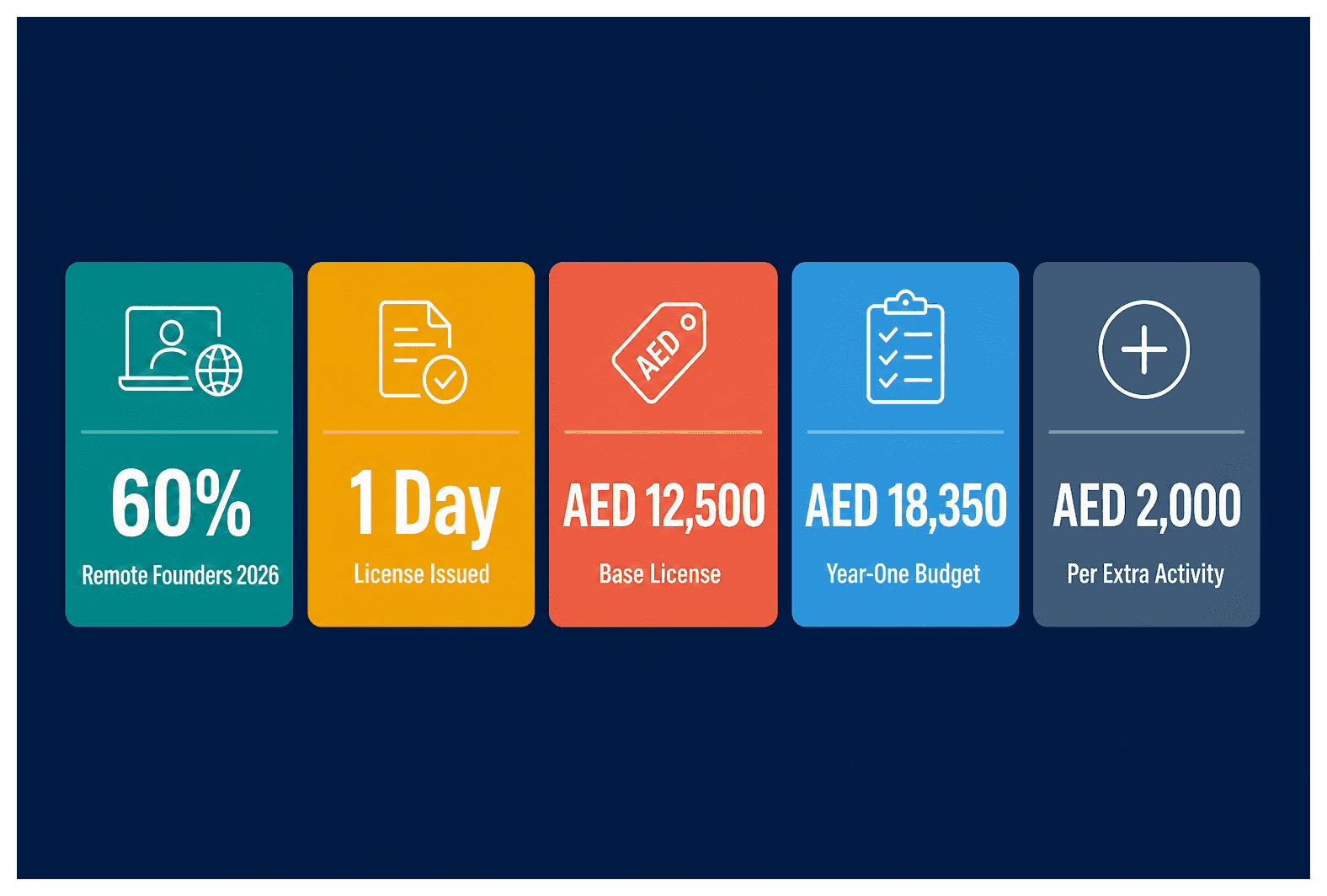
To complete a remote-first company setup in Dubai you need a valid passport, a chosen trade name, a defined list of business activities, a registered address (provided by the free zone), and compliance registrations for VAT and corporate tax once the relevant thresholds are met. No local sponsor or physical office lease is required in a free zone.
Documents You Must Prepare Before You Apply
Get these ready before you submit, missing a single item delays initial approval:
Passport copy for all shareholders and the appointed manager, valid for at least six months from the application date.
Passport-size photograph with a white background for each shareholder.
Proof of residential address, a utility bill or bank statement, typically no older than three months.
Completed application form and a signed business plan summary if the free zone authority requires one.
If a shareholder is a corporate entity: certificate of incorporation, memorandum of association, and a board resolution authorising the UAE investment, each attested appropriately for the UAE.
Activity Selection and Regulated-Activity Rules
Choosing the right business activities before you apply is one of the highest-leverage decisions you'll make. DSBH covers a wide range across ICT, professional services, trading, education, and more.
The first five activities are included in the base license fee. Each additional activity beyond five costs AED 2,000.
For regulated activities, healthcare, financial services, or education, for example, DSBH licenses the activity and the named sector regulator approves it separately. The Dubai Health Authority (DHA) covers health activities, the Central Bank of UAE covers financial services, and the Knowledge and Human Development Authority (KHDA) covers education. Both approvals are mandatory; neither alone is sufficient.
A digital marketing consultant adding e-commerce consultancy and social media management to a professional services license stays within five activities and pays no extra fee. Add a sixth, and the AED 2,000 charge applies.
Tax Registration Obligations Remote Founders Often Miss
VAT registration is mandatory once taxable turnover exceeds AED 375,000 in any 12-month period. Late registration carries a one-time AED 10,000 penalty (Federal Tax Authority, 2026).
Corporate tax registration is required for all UAE legal entities regardless of revenue. The late registration penalty is a one-time flat AED 10,000, not a monthly charge. Register immediately after incorporation, not when you start generating revenue.
Qualifying for 0% corporate tax as a Qualifying Free Zone Person (QFZP) requires meeting four conditions simultaneously: adequate substance in the UAE, qualifying income, no election to be subject to the standard rate, and compliance with transfer-pricing rules. Remote founders must actively plan for this, it doesn't apply automatically. Worth flagging: DSBH is not a designated zone under UAE VAT law, so it carries no designated-zone customs or VAT treatment.
Step-by-Step Process for Company Setup Remote-First Dubai
The remote-first Dubai company setup process runs across seven steps: choose a free zone and activities, check your trade name, submit documents, receive initial approval, pay license fees, collect your license and Memorandum of Association, then open a corporate bank account. At DSBH the license is issued in one business day once documents clear.
The Seven-Step Remote Incorporation Process
Select your free zone. Confirm it supports remote document submission. DSBH allows founders to complete incorporation without travelling to Dubai.
Check trade name availability. Use the trade name availability search and confirm the name meets UAE naming rules: no offensive terms, no names of ruling families, no abbreviations that misrepresent the activity.
Compile and submit your document pack. Passport copies, photographs, proof of address, completed application, and activity list, submitted via courier or the free zone's digital portal.
Receive initial approval. The free zone authority reviews your application and confirms the name and activities are cleared.
Pay the license fee. From AED 12,500 at DSBH. Visa package fees are always a separate, additional cost, never bundled.
Collect your license and Memorandum of Association. A founder in Singapore, for example, sends notarised documents via DHL to DSBH, completes the application online, pays by bank transfer, and receives a scanned license in one working day for eligible activities of payment. The physical license follows by courier.
Open your corporate bank account. This is the final step and often the most time-intensive. See the bank account opening in UAE section below for what banks require.
Year-One Cost Breakdown for a Remote-First Dubai Company at DSBH
Cost Item | Amount (AED) |
|---|---|
Base trade license (standard activities) | From 12,500 |
Base trade license (B2C activities) | From 11,375 |
Each activity beyond the first five | 2,000 per activity |
First-year total for sole founder with one visa | From 18,350 (visa cost additional) |
Paid-up share capital required | Zero |
VAT / corporate tax late registration penalty (each) | 10,000 (one-time flat) |
What Happens After the License Is Issued
Register for corporate tax with the Federal Tax Authority immediately, the AED 10,000 flat penalty applies regardless of revenue level.
Apply for your UAE residency visa through the free zone if you want UAE residence, this triggers Emirates ID processing and a medical fitness check.
Appoint a PRO service or use the free zone's business support services to handle ongoing government transactions, especially if you remain based outside the UAE.
Schedule VAT registration as soon as taxable turnover approaches the AED 375,000 threshold.
What Does a Remote-First Dubai Company Setup Cost in Year One
A sole remote founder with one visa should budget from AED 18,350 for year one at Dubai South Business Hub Free Zone. This covers the license fee from AED 12,500 plus visa costs as a separate line item. Each business activity beyond the first five adds AED 2,000. Zero paid-up share capital is required.
License and Activity Fees at DSBH
Base trade license starts from AED 12,500. Dubai South Business Hub Free Zone licenses start from AED 12,500.
A founder adding seven activities pays AED 4,000 on top of the base license fee (two activities beyond the first five, at AED 2,000 each).
Zero paid-up share capital means no capital is locked up at incorporation, your working capital stays liquid.
DSBH does not charge for a physical office lease as part of the base license. A flexi-desk or registered address arrangement is typically included; confirm the exact package at the time of application.
Build a Realistic First-Year Budget
Sole founder with one visa: from AED 18,350 total for year one. Visas are always an additional cost on top of the license fee, never described as included.
A two-founder remote SaaS company selecting six activities pays the base license fee plus AED 2,000 for the sixth activity, plus two separate visa packages, all itemised separately from the license cost.
Corporate bank account opening fees vary by bank. Most UAE banks charge zero account-opening fees but may require a minimum monthly balance, budget for this separately.
VAT and corporate tax registration carry no government fee for the registration itself. Professional support for returns adds to annual operating costs, so factor that into your year-two budget from the start.
Use the business setup cost calculator to build a personalised first-year budget based on your specific activity count and visa requirements.
How to Hire and Pay a Remote Team After Your Dubai Company Setup
After completing your company setup remote-first Dubai, you can sponsor employees for UAE residency visas or engage overseas contractors directly. UAE-based employees must be registered with MoHRE (Ministry of Human Resources and Emiratisation). Remote contractors outside the UAE are not subject to UAE labour law, but the company must maintain clear contracts to satisfy corporate tax substance requirements.
UAE Employee Visas and MoHRE Registration
Every UAE-based employee must be registered through MoHRE and issued a UAE residency visa. The free zone processes the visa; MoHRE governs the employment contract terms.
The number of visas a free zone license can support depends on the license category and office space. Confirm your visa quota with DSBH at application stage, don't assume a standard allowance.
WPS (Wages Protection System) compliance is mandatory for all UAE-based employees. Salaries must be paid through a WPS-registered bank account.
UAE Labour Law sets minimum notice periods, end-of-service gratuity, and annual leave entitlements. Remote founders managing UAE employees from abroad must comply fully, regardless of where the founder is based.
Engaging Overseas Contractors Without a UAE Presence
A UAE free zone company can legally pay overseas contractors via international bank transfer. No UAE visa or work permit is required for contractors working entirely outside the UAE.
Document all contractor agreements carefully. Corporate tax substance rules require that key management and decision-making functions have a genuine UAE nexus if you're claiming Qualifying Free Zone Person status. Running the company entirely through overseas contractors without any UAE-based decision-making weakens that claim significantly.
Payments to related parties overseas may attract transfer-pricing scrutiny under UAE corporate tax rules introduced under Federal Decree-Law No. 47 of 2022. Maintain arm's-length documentation from day one, retrofitting this documentation after an audit notice is far more expensive.
Is a UAE residency visa required to manage a UAE free zone company?
No. A founder can legally own and manage a UAE free zone company without holding UAE residency. However, a UAE residency visa strengthens your corporate bank account application profile and simplifies ongoing government transactions. Most remote founders apply for an investor visa alongside their license.
Corporate Bank Account Opening for Remote-First Companies
Opening a UAE corporate bank account for a remote-first company requires your trade license, Memorandum of Association, passport copies, and a clear explanation of your business model and expected transaction flows. Most UAE banks conduct enhanced due diligence on remote founders; a well-prepared application with source-of-funds documentation significantly reduces the risk of rejection.
Documents Banks Typically Request from Remote Founders
Trade license and certificate of incorporation from DSBH.
Memorandum of Association listing all shareholders and their ownership percentages.
Passport copies and Emirates ID (if the visa has been issued) for all shareholders and authorised signatories.
Six months of personal or business bank statements from your home-country bank to demonstrate source of funds.
A business plan or company profile describing your activities, clients, and expected monthly transaction volumes.
Why Remote Founders Face Additional Scrutiny
The Central Bank of UAE has continuously strengthened its AML framework since 2021. Banks apply enhanced due diligence to non-resident founders as standard practice, this isn't personal, it's regulatory.
Founders from FATF grey-listed jurisdictions face additional document requests and longer review timelines. Check the current FATF list before you apply, because the list changes and your jurisdiction's status affects your timeline directly.
A UAE residency visa in your passport significantly improves your bank application profile, even if you don't plan to be resident full-time. Working with a business support team that has established banking relationships can shorten the approval timeline materially, some founders report cutting weeks off the process this way.
Do UAE banks charge fees to open a corporate account?
Most UAE banks charge zero account-opening fees for corporate accounts. However, many require a minimum monthly average balance, typically ranging from AED 25,000 to AED 50,000 depending on the bank and account type. Factor this into your working capital plan before choosing a banking partner.
Final Checklist Before You Launch Your Remote-First Dubai Company
Before launching your remote-first Dubai company, confirm your trade license is issued, corporate tax registration is filed, your corporate bank account is active, all shareholders hold current KYC documents, and your business activities match your actual revenue streams. These five points prevent the most common post-incorporation compliance failures for remote founders.
Follow These Actions Immediately After License Issuance
Register for corporate tax with the Federal Tax Authority (tax.gov.ae) immediately
References
Frequently Asked Questions