Topic Summary
What a Dubai Customs Trader Code Actually Is
A Dubai Customs trader code is a unique registration number that identifies your business as a licensed importer or exporter. It is mandatory on every customs clearance declaration and is distinct from your HS code or trade license number.
Three Codes Every Dubai Trader Must Know
Dubai traders must manage three separate codes: the Customs Trader Code (company identifier), the HS Code (product tariff classification), and the Trade License Number (business activity authorisation). Confusing these is the most common compliance mistake UAE traders make.
Registration Costs and Processing Timeframes
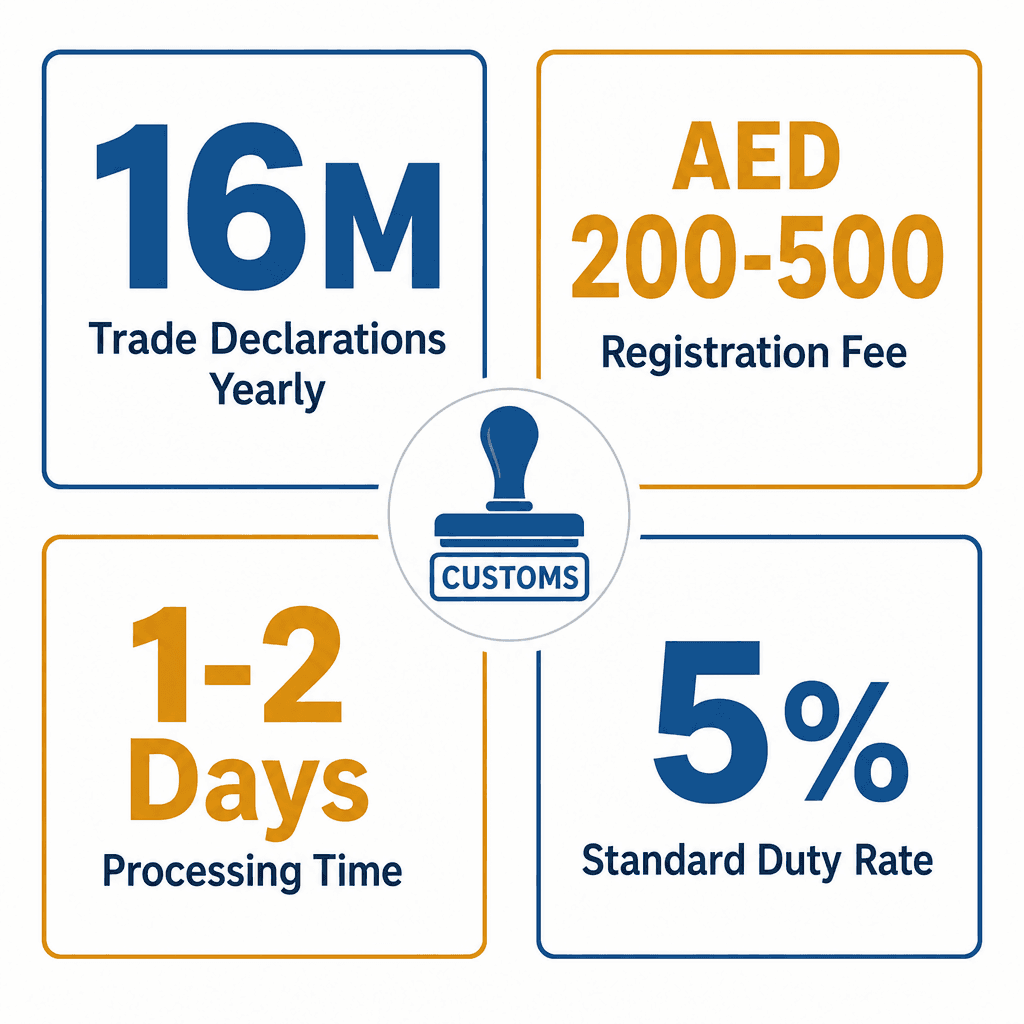
The registration fee ranges from AED 200 to AED 500 depending on company type, per the 2026 Dubai Customs fee schedule. Standard processing takes just one to two working days.
No Code Means No Customs Clearance
Without a valid trader code, no customs declaration can be filed and your goods will be held at the port of entry. There is no grace period, and even a lapsed trade license can trigger an immediate suspension of your customs code.
Which Businesses Are Required to Register
Any business importing or exporting physical goods through Dubai must hold a valid trader code, including general trading companies, e-commerce businesses, manufacturers, and distributors. Service-only businesses with no physical goods movement are exempt.
Scale of Dubai Customs Operations in 2026
Dubai Customs processes over 16 million trade declarations annually, and every single one requires a valid trader code linked to the business. Dubai International Airport alone handles over 2.5 million tonnes of air cargo each year.
Standard Duty Rate Applies Across Most Goods
The UAE applies a standard customs duty rate of 5% of CIF value to most imported goods. The applicable rate for each product line is determined by its HS code, which works alongside your trader code on every filing.
A Dubai Customs trader code (also known as a dubai customs import code, import code, or customs code) is mandatory for any business importing or exporting goods through Dubai. Without it, your goods cannot clear Dubai Customs. In 2026, Dubai Customs processes over 16 million trade declarations annually (Dubai Customs, 2025), and every single one requires a valid trader code linked to the importing or exporting business. The registration fee sits at AED 200 to 500 depending on company type (Dubai Customs fee schedule, 2026). Standard processing takes 1 to 2 working days. The UAE's standard customs duty rate is 5% of CIF value for most goods (Dubai Customs, 2026). Dubai International Airport handles over 2.5 million tonnes of air cargo annually (Dubai Airports, 2025).
This guide covers exactly what the dubai customs import code is, who needs one, how to register step by step, what it costs in AED, how to renew it, and what happens if yours lapses.
What Is a Dubai Customs Trader Code
A Dubai Customs trader code is a unique registration number issued by Dubai Customs that identifies your business as a licensed importer or exporter. It is mandatory for all customs clearance in Dubai, and it's distinct from your HS code (a product tariff code) and your trade license number (a business activity code). Think of it as your company's ID card at every Dubai port and airport, no code, no clearance. For more detail, see our guide on import and export license in Dubai. For more detail, see our guide on auto parts trading license in Dubai. Registering your Dubai Customs import code is a mandatory step for any trading business setup in the UAE.
The Three Codes Every Dubai Trader Must Know
Three separate codes govern every customs transaction in Dubai, and confusing them is the most common compliance mistake UAE traders make. Here's how they differ:
Three Codes Every Dubai Trader Must Understand
Code Type | What It Is | Who Issues It | Purpose |
|---|---|---|---|
Customs Trader Code | Company-level import/export identifier | Dubai Customs | Required on every customs clearance declaration |
HS Code | Product-level tariff classification | World Customs Organisation | Determines duty rate per product line |
Trade License Number | Business activity authorisation | Free zone authority or DET | Authorises your business activities in UAE |
A Dubai-based e-commerce business importing electronics, for example, holds a DET trade license (authorising the activity), uses HS code 8471.30 for laptops (determining the 5% duty rate), and must quote its Customs Trader Code on every declaration to release the shipment. All three codes travel together on every filing. For a deeper look at product classification, see our HS code Dubai customs guide. For more detail, see our guide on HS codes for Dubai customs.
Why the Dubai Customs Import Code Is Not Optional
No trader code means no customs declaration can be filed. Your goods are held at the port of entry until the code is active and valid. The code links each shipment to your licensed business entity, creating the audit trail Dubai Customs uses for compliance tracking.
This applies to both mainland DET companies and free zone entities. A free zone trading company at Dubai South whose trade license lapses by even one day will find its customs trader code suspended immediately, blocking all in-transit shipments until renewal is completed. There is no grace period. The issuing authority is always Dubai Customs, not your free zone authority (Dubai Customs, 2026).
Who Needs a Dubai Customs Trader Code
Any business importing or exporting physical goods through Dubai must hold a valid Dubai Customs trader code. This includes trading companies, e-commerce businesses with physical products, manufacturers, and distributors. Service-only businesses with no physical goods movement do not require one. For more detail, see our guide on importing food products in Dubai.
Businesses That Must Register
You need a dubai import code if your business falls into any of these categories:
General trading companies importing and re-exporting goods through Dubai ports and airports
E-commerce businesses receiving inventory into UAE warehouses or fulfilment centres
Manufacturers importing raw materials or components
Distributors clearing goods at Jebel Ali Port, Dubai International Airport, or any Dubai Customs point
Free zone entities moving goods between their free zone and the UAE mainland (treated as an import transaction)
A practical example: an e-commerce business operating from Dubai South importing consumer goods from China needs its import export code dubai sorted before its first container arrives at Jebel Ali. Without it, the container sits on demurrage at the importer's cost. Jebel Ali is the UAE's primary import gateway and the world's largest man-made harbour (DP World, 2025), delays there are expensive. Companies holding a trading business license in Dubai under a free zone authority are among the primary users of the customs code, making registration a standard first step post-incorporation.
Businesses That Do Not Need One
Pure service companies, consulting firms, IT service providers, marketing agencies, with no physical goods movement do not need a customs trader code. Professional license holders providing services only are also exempt.
That said, if a service business begins importing branded merchandise or product samples, registration becomes mandatory immediately. A Dubai-based management consulting firm with no inventory doesn't need the code today, but the moment it starts receiving physical stock, it does. For businesses using a licensed customs broker on a one-off basis, the broker's code covers that single shipment, but for regular importers, your own code is far more cost-effective. Read our general trading license in Dubai guide to understand which license activities trigger the registration requirement.
How to Register for a Dubai Customs Trader Code, Step by Step
Register for a customs import code dubai via the Dubai Trade portal at dubaitrade.ae. You need a valid UAE trade license, company MoA, passport copy, Emirates ID, and bank details. The registration fee is AED 200 to 500 and the code is typically issued within one to two working days.
The Complete Registration Process
A newly incorporated general trading company at Dubai South Business Hub Free Zone can realistically complete steps 1 to 7 in a single afternoon and receive its trader code the following business day, ready to file its first customs declaration before the initial shipment arrives. Free zone companies use the same Dubai Trade portal as mainland companies; your free zone trade license number is the primary identifier. See the Dubai South logistics district for trading businesses guide for more on how the location integrates with Jebel Ali Port operations.
Tips to Avoid Registration Delays
All documents must be in English or include a certified Arabic translation.
The company name on your trade license must exactly match the name on your MoA, even minor discrepancies trigger manual review and add days.
Use UAE Pass for login where possible; it cuts identity verification time significantly.
If your company has multiple authorised signatories, register all of them during initial setup to prevent clearance bottlenecks later.
Documents Required for Dubai Customs Trader Code Registration
To register for a dubai import code you need a valid UAE trade license, company Memorandum of Association, passport copy of the owner or authorised signatory, Emirates ID, and bank account details. All documents must be current and match the company name on the trade license exactly.
Full Document Checklist
Document Standards That Catch Traders Out
Passport scans must show all four corners of the document. Cropped images are rejected outright, and resubmitting adds at least one working day to your timeline.
Your MoA must be the most recently attested version. If your company has been amended since the original incorporation, new shareholders, name change, activity update, the older MoA won't be accepted. Sort this before you apply. Bank accounts must also be in the company's name, not a personal account. Sole traders should open a dedicated business account before starting the customs code registration. Free zone companies should use their free zone-issued MoA and trade license directly; these are accepted by Dubai Customs without additional attestation in most cases (Dubai Customs, 2026).
Dubai Customs Trader Code Fees and Timelines for 2026
The Dubai Customs trader code registration fee is AED 200 to 500 depending on company type, paid via the Dubai Trade portal. Annual renewal costs approximately the same amount. Always confirm the current fee at dubai.customs.gov.ae before payment, as fees are subject to change.
Fee Breakdown by Company Type
Dubai Customs Import Code vs HS Code vs Trade License Number
Code Type | What It Is | Who Issues It | Purpose |
|---|---|---|---|
Customs Trader Code | Company import/export ID | Dubai Customs | Required for all customs clearance declarations |
HS Code | Product tariff classification | World Customs Organisation | Determines duty rate per product line |
Trade License Number | Business activity license | Free zone authority or DET | Authorises business activities in UAE |
Initial registration fee: AED 200 to 500, varies by company classification (sole establishment, LLC, or free zone entity) (Dubai Customs, 2026)
Annual renewal fee: AED 200 to 500, same band as initial registration
Late renewal penalty: additional charges apply if renewal is not completed before trade license expiry, exact amount confirmed at point of renewal on the Dubai Trade portal
All fees paid online via dubaitrade.ae, no cash or cheque payment accepted
Free zone company fees fall within the same AED 200 to 500 band; no separate fee from your free zone authority
Processing Timelines to Plan Around
Standard registration: 1 to 2 working days from complete submission
On-time renewal (before expiry): same day or next working day via Dubai Trade portal
Renewal after expiry: additional verification steps apply, extending processing to 3 to 5 working days
Plan your customs code renewal at least two weeks before your trade license expiry to avoid any gap in clearance capability
How to Renew Your Dubai Customs Import Code
Renew your Dubai Customs import code annually via the Dubai Trade portal at dubaitrade.ae. Renewal is tied to your trade license renewal, complete both together before expiry. The dubai import code renewal fee is approximately AED 200 to 500. An expired customs code blocks all customs clearance until renewal is processed.
The Renewal Process via Dubai Trade Portal
A trading company at Dubai South Business Hub Free Zone that sets a calendar reminder 30 days before its trade license expiry each year can renew both the license and the customs code in the same week, maintaining uninterrupted clearance capability with zero disruption to incoming shipments. That's the standard approach I'd recommend to any active importer.
What Happens If You Miss the Renewal Deadline
The customs trader code is suspended immediately upon trade license expiry. No grace period. All pending customs declarations are placed on hold, and goods already at port start accumulating demurrage charges at AED 50 to 200+ per container per day depending on the port and carrier (shipping carrier tariff schedules, 2026).
Jebel Ali's free storage window is typically 5 to 7 days before demurrage kicks in (DP World, 2025). Miss your renewal and you could be paying demurrage fees before you've even resolved the compliance issue. Reinstatement requires completing the full renewal process plus potentially a late fee. Build the dubai customs import code renewal into your annual compliance calendar alongside your trade license payment, treat them as one task, not two.
Is there a grace period for Dubai Customs trader code renewal?
No. Dubai Customs suspends the trader code immediately when the linked trade license expires. There is no grace period. Any customs declarations submitted after expiry are rejected until the renewal is processed and the code is reactivated. Renew before expiry, not after.
Dubai Customs Import Code vs HS Code vs Trade License, Key Differences
The customs import code dubai identifies your business to customs authorities. The HS code classifies the specific product being traded and determines the duty rate. The trade license number authorises your business activity. All three are different codes with different purposes, active traders in Dubai need all three.
Side-by-Side Comparison of All Three Codes
Every Dubai customs declaration references all three codes simultaneously. Here's what each one does:
Customs Trader Code: company-level identifier, issued by Dubai Customs, required on every declaration regardless of product type
HS Code (Harmonised System Code): product-level tariff classification, maintained by the World Customs Organisation, determines the duty rate per product line. The WCO maintains over 5,000 HS codes used globally (World Customs Organisation, 2024)
Trade License Number: business activity authorisation, issued by your free zone authority or DET, confirms your company is legally permitted to conduct import/export activities in the UAE
A distributor importing medical devices into Dubai quotes its Customs
Citations
Dubai Economy and Tourism.. dubaidet.gov.ae. DET Dubai, 2024.
Federal Authority for Identity, Citizenship, Customs and Port Security.. icp.gov.ae. ICP UAE, 2024.
DP World.. dpworld.com. DP World, 2024.
Dubai Chamber of Commerce.. dubaichamber.com. Dubai Chamber, 2024.
UAE Ministry of Economy and Tourism.. moet.gov.ae. MOET UAE, 2024.
Frequently Asked Questions