Topic Summary
Non-Compliant Trade Name Blocks Approval
A trade name that violates DET naming rules is the single most frequent reason applications are returned or rejected in Dubai. The fix costs nothing and takes minutes — correct the name before submission using DET's name reservation tool.
Incomplete or Invalid Documentation Stalls Review
Missing, expired, or improperly attested documents are the second most common cause of rejection across both mainland and free zone applications. Audit every required document against the authority's checklist before submitting to avoid a return notice.
Regulated Activities Require Prior Approvals
Selecting a healthcare, financial, or other restricted activity without the required regulator approval will result in rejection under UAE Cabinet Resolution No. 55 of 2021. Securing the relevant approval before filing can prevent delays of several weeks.
Outstanding Compliance Flags From Prior Entities
An unpaid Federal Tax Authority penalty — for example, one of AED 10,000 — will block a new application entirely until it is cleared. Founders must resolve all outstanding compliance issues tied to previous entities before submitting.
Mismatched Ownership Structures Trigger Rejection
Shareholder or ownership details that conflict across submitted documents are a consistent source of formal refusals. Ensure all constitutional documents, passport copies, and application forms reflect identical ownership percentages and party names.
Returns and Rejections Are Not the Same Outcome
A return allows you to correct a named issue and resubmit without losing queue position or paying additional government fees, while a formal rejection may require a new application and waiting period. Always request the written reason code from the authority before taking any corrective action.
A significant share of trade license applications in Dubai are rejected or returned at first submission every year, and in most cases the cause is one of five preventable errors. The Department of Economy and Tourism (DET, 2025) processes applications across all mainland business categories, while free zone authorities run parallel review processes with their own timelines and fee structures. A non-compliant trade name takes minutes to fix and costs nothing before submission. An unpaid Federal Tax Authority penalty of AED 10,000 blocks a new application entirely until it's cleared. A missing regulator approval for a healthcare or financial activity can delay setup by weeks. This article ranks the most frequent causes of trade license application rejection in Dubai by how often they occur, gives the specific fix for each, and states the cost involved, so first-time founders can submit a clean application from day one.
What a Trade License Application Rejection in Dubai Actually Means
A trade license application rejection in Dubai means the relevant authority, either DET for mainland or the relevant free zone, has declined to issue a license due to non-compliant documentation, an unapproved trade name, a restricted activity, or an outstanding compliance flag. The applicant must correct the specific cause and resubmit.
The Difference Between a Rejection and a Return
Not every negative outcome is the same. A return means the authority has sent your file back for a specific, named correction. You can fix it and resubmit without losing your position in the queue, and in most cases without paying an additional government fee.
A rejection is a formal refusal. It may require a new application, new fees, and in some cases a waiting period before you can resubmit. DET and free zone authorities both use both outcomes, so the first thing you should do after any negative result is request the written reason code from the authority. Don't guess.
Consider this scenario: a founder applying for a general trading license receives a return notice citing "trade name not compliant" rather than a full rejection. She updates the name and resubmits within 24 hours at no additional government fee. That's a return, not a rejection, and it costs her only a few hours. The distinction matters enormously for your timeline and budget.
Free zone trade license applications, such as those at Dubai South Business Hub Free Zone (launched September 2025, licenses from AED 12,500), follow the free zone authority's own review process rather than DET's. The correction window and fee structure differ by authority, so always confirm which type of outcome you've received before taking any action.
Why the Cause Matters More Than the Outcome
The correction pathway and cost differ entirely depending on whether your trade license application in Dubai was declined for a name issue, a document problem, an activity restriction, or a compliance flag. Founders who refile without identifying the root cause almost always receive a second rejection.
UAE Cabinet Resolution No. 55 of 2021 governs restricted commercial activities on the mainland. If your activity falls under that resolution and you haven't obtained the required approval, refiling the same application produces the same result. Free zone and mainland review bodies are separate, so the same error can produce different outcomes depending on where you apply, which is why understanding the specific cause is the only productive starting point.
The Five Most Common Rejection Causes, Ranked by Frequency
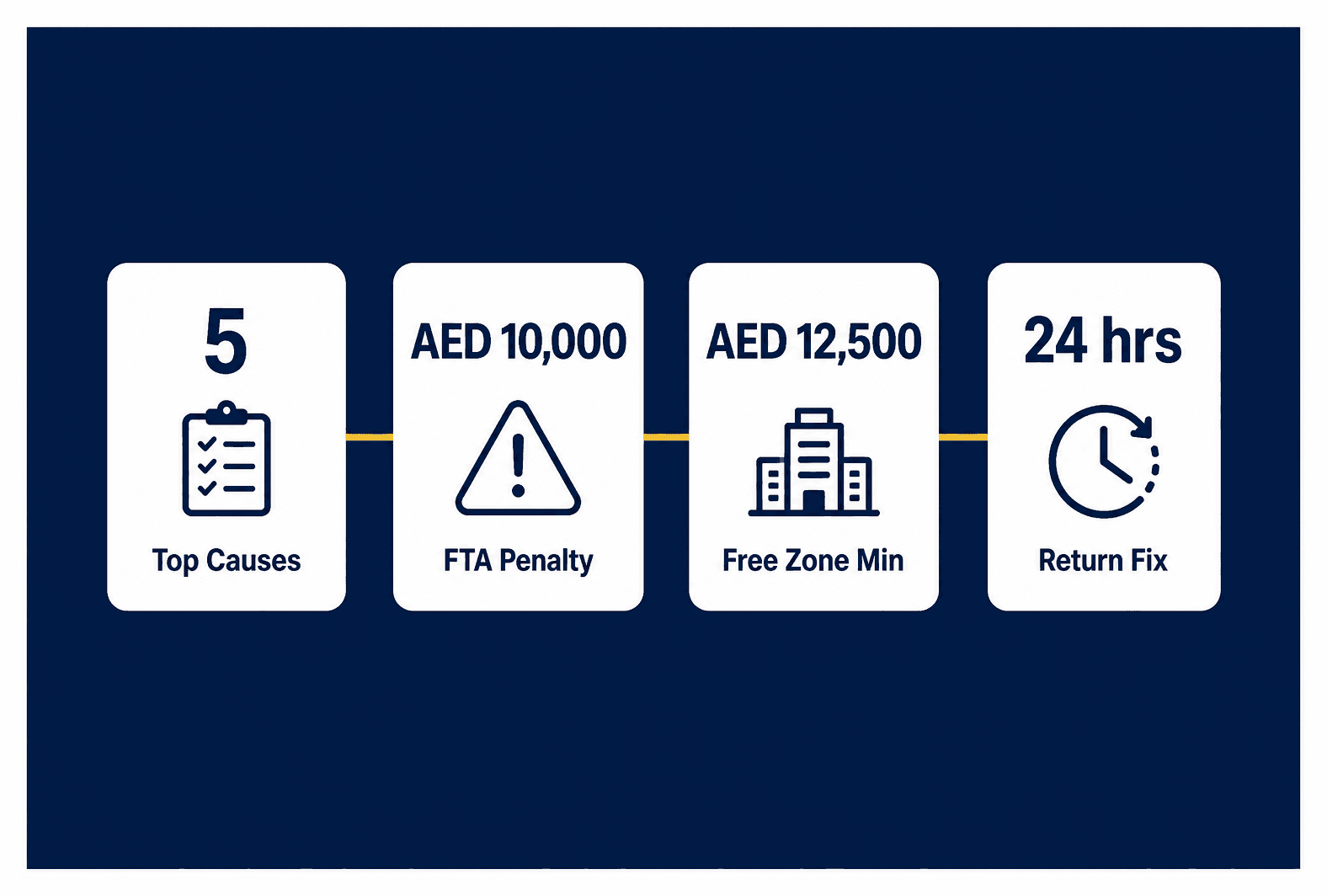
The most frequent causes of trade license application rejection in Dubai, ranked by occurrence, are: non-compliant trade name, incomplete or invalid documentation, selecting a restricted or regulated activity without the required approval, outstanding compliance flags from prior entities, and mismatched shareholder or ownership structures.
Why Ranking Matters for First-Time Founders
Addressing causes in order of likelihood saves real time. A trade name availability search takes minutes and costs nothing. Obtaining a regulator's approval for a financial services activity can take several weeks. Most first-time founders are rejected for name or document issues, not because their business idea is impermissible. So start with the quick checks, then move to the slower ones.
The sections below treat each cause in rank order, with its specific fix and the cost involved. Work through them in sequence before you file.
Trade License Rejection Causes: Fix and Cost at a Glance
Rejection Cause | Fix | Cost Before Submission |
|---|---|---|
Non-compliant trade name | Run a trade name availability search; remove restricted words; select a unique name | AED 0 |
Incomplete or invalid documentation | Replace expired passports; attest and counter-attest foreign corporate documents via UAE Ministry of Foreign Affairs | Attestation fees vary by country and document type |
Regulated activity without prior approval | Obtain named regulator approval (DHA, KHDA, Central Bank, or VARA) before submitting the license application | Regulator fee varies by sector |
Outstanding compliance flag (FTA/MoHRE/ICP) | Clear all penalties and violations via tax.gov.ae, mohre.gov.ae, and icp.gov.ae before filing | AED 10,000 per FTA penalty; MoHRE fines vary |
Ownership structure mismatch | Align all documents so every record states the same ownership percentages and shareholder names | AED 0 if corrected before submission; amendment fees apply post-issuance |
Ranked List: Each Cause, Its Fix, and What It Costs
The five ranked causes of trade license rejection in Dubai each have a distinct fix: correct the trade name via the name reservation portal, replace invalid documents, obtain regulator approval for restricted activities, clear outstanding compliance flags, and restructure the ownership record. Costs range from zero to several thousand AED depending on the cause.
Cause 1: Non-Compliant Trade Name (Most Frequent)
The trade name must not duplicate an existing registered name, must not include offensive or religious terms, must not use abbreviations without approval, and must not include a country name unless the activity specifically warrants it. DET trade name guidelines prohibit names identical or confusingly similar to existing entities, and free zone authorities apply their own name rules on top of federal guidelines.
Here's a real example: a founder names his consultancy "Emirates Strategic Advisors LLC" and receives an instant rejection because the word "Emirates" is restricted without specific government approval. He renames the entity, runs a trade name availability search to confirm the new name is clear, and resubmits the same day. Zero additional government fee. The entire delay is under 24 hours.
Fix: Run a name check before submission. Both DET's online portal and free zone authorities offer real-time checks. Cost: AED 0 to correct before submission. Name amendments after a license is already issued carry an authority amendment fee, so catching this early is always cheaper.
Cause 2: Incomplete or Invalid Documentation
Common document failures include:
Expired passport copies (UAE authorities require at least six months' validity from the date of application)
Missing attested memorandum of association
Unattested foreign corporate documents
Fix: For foreign corporate shareholders, all constitutional documents must be notarised in the country of origin, attested at the UAE embassy in that country, and then counter-attested by the UAE Ministry of Foreign Affairs. The ICP governs Emirates ID issuance and validity requirements for UAE-resident shareholders.
Cost: Attestation fees vary by country and document type. UAE Ministry of Foreign Affairs counter-attestation costs are published on the MoFA portal; confirm the current fee before budgeting. Expedited services cost more. Passport renewal or Emirates ID renewal costs depend on the individual's situation and are separate from the license application fee.
Cause 3: Restricted or Regulated Activity Without Prior Approval
Certain activities require a no-objection letter or formal approval from a named regulator before DET or a free zone authority will issue the license. These include financial services, healthcare, education, legal consultancy, and food trading. Submitting the license application before obtaining that approval is the third most common rejection cause, and it's entirely avoidable.
Fix: Check whether your chosen activity appears on the restricted or regulated list. If it does, obtain the relevant regulator's approval first. Only then submit the trade license application, with the approval document attached. At Dubai South Business Hub Free Zone, DSBH issues the free zone license while the named regulator approves the activity separately. Both are required before you can operate commercially. You can review the full list of business activities in Dubai available at DSBH to confirm your activity's status before filing.
Cost: Regulator approval fees vary by sector. Healthcare activities require Dubai Health Authority (DHA) approval with its own fee schedule. Education activities require KHDA approval. Financial activities require Central Bank or VARA approval depending on the product type. Each publishes its own fee schedule on its official portal.
Causes 4 and 5: Compliance Flags and Ownership Mismatches
Cause 4: Outstanding compliance flag. An existing entity linked to the same shareholder has outstanding violations, unpaid fines, or an expired license. This flags the new trade license application in Dubai for review or automatic hold.
VAT late registration penalty: AED 10,000 (Federal Tax Authority)
Corporate tax late registration penalty: AED 10,000, one-time flat penalty, not monthly (Federal Tax Authority)
MoHRE labour violations and quota bans are also tracked and can block a new application
A founder with a lapsed mainland trading entity attempts to open a new free zone company. The application is held because the old entity carries an unpaid AED 10,000 corporate tax late registration penalty. She settles it via the Federal Tax Authority portal and resubmits. The fix is straightforward, but the penalty must be paid, not appealed away, for the flag to clear.
Cause 5: Ownership structure mismatch. The ownership structure stated in the application doesn't match the documents supplied. A sole shareholder application accompanied by a partnership agreement, or a 51/49 split stated in the MOA but not reflected in the share certificate, will both trigger a rejection. Fix this by aligning all documents before submission. 100% foreign ownership is available on the mainland and in free zones, so there's no structural reason to misstate the split. Document correction before submission costs only your time. Post-submission amendments carry authority amendment fees.
Restricted and Regulated Activities: The Most Misunderstood Cause
Regulated activities in Dubai require a named regulator's approval before a trade license is issued. Financial services need Central Bank or VARA sign-off; healthcare needs DHA approval; education needs KHDA. Submitting the trade license application before securing regulator approval is the most misunderstood and most avoidable cause of rejection.
How to Identify Whether Your Activity Is Regulated
DET publishes a list of activities that require initial approval on its portal. Free zone authorities publish their own permitted activity lists. If your activity involves any of the following, assume it's regulated until you confirm otherwise:
Handling client money or providing investment advice
Providing health or wellness services to the public
Offering legal advice or representation
Operating an educational institution or training centre
Trading in food products for human consumption
The activity description matters. "Management consultancy" is typically unregulated. "Investment management" is regulated by the Central Bank. Check the exact wording of your activity code before filing. For technology-related activities, you can explore the ICT license in Dubai options to confirm whether your specific activity requires a separate regulatory sign-off.
The Correct Sequence: Approval First, License Second
Confirm the activity code and its regulatory status on the DET or free zone authority portal.
Apply to the named regulator for initial approval or a no-objection letter.
Submit the trade license application with the regulator's approval document attached.
Receive the license. The regulatory approval and the license together make the activity operational. Neither alone is sufficient.
Skipping step 2 and going directly to step 3 is the single most common sequencing error among first-time founders. At Dubai South Business Hub Free Zone, DSBH issues the free zone license while the named regulator approves the activity separately. Both must be in place before you conduct any commercial activity.
Outstanding Compliance Flags That Trigger Automatic Rejection
Outstanding compliance flags, including unpaid VAT or corporate tax penalties, expired trade licenses linked to the same owner, and unresolved labour violations, can trigger an automatic hold or rejection on a new trade license application in Dubai. Clearing these flags before submission is essential and must be done through the relevant authority's portal.
Tax and Financial Compliance Checks
The Federal Tax Authority's systems are linked to the business registration ecosystem. An outstanding VAT late registration penalty of AED 10,000 or a corporate tax late registration penalty of AED 10,000 (one-time flat, not monthly) will surface during the application review. There's no workaround: the penalty must be paid for the flag to clear.
Fix: Log in to the FTA portal at tax.gov.ae, check for any outstanding returns or penalties on all entities linked to your Emirates ID or passport number, and settle them before submitting a new trade license application in Dubai. Check every entity you've ever been connected to, not just the most recent one.
Labour and Immigration Compliance Checks
MoHRE maintains records of labour violations and quota bans linked to an employer's registration number. An active ban prevents a new license from being issued. Separately, ICP tracks immigration violations; an overstay or a cancelled visa with outstanding fines can block a new residency-linked license application.
Fix: Check your MoHRE status at mohre.gov.ae and your ICP status at icp.gov.ae before submitting. Pay any fines and obtain clearance letters where required. These checks take less than an hour and cost nothing if your record is clean.
Which portals to check before filing
Federal Tax Authority: tax.gov.ae, VAT and corporate tax penalties
MoHRE: mohre.gov.ae, labour violations and quota bans
ICP: icp.gov.ae, immigration violations and visa fines
How to Submit a Clean Trade License Application in Dubai
To submit a clean trade license application in Dubai, complete a trade name check, prepare all documents with valid dates and correct attestation, confirm your activity's regulatory status and obtain any required approvals, clear all compliance flags on linked entities, and verify that the ownership structure in every document matches exactly.
Pre-Submission Checklist for First-Time Founders
Trade name: Run a trade name availability search; avoid restricted words; confirm the name is unique across both mainland and free zone registers.
Documents: Passport copies valid for at least six months; Emirates ID if UAE-resident; attested and counter-attested corporate documents if a company is a shareholder; MOA drafted and signed with the correct ownership split.
Activity: Confirm the activity code; check if regulator approval is required; obtain it before submission, not after.
Compliance: Check FTA, MoHRE, and ICP portals for any outstanding flags on all entities linked to you personally.
Ownership: Ensure every document, the application form, the MOA, and the share certificate, states the same ownership percentages and shareholder names.
At Dubai South Business Hub Free Zone, the license starts from AED 12,500, zero paid-up share capital is required, and a complete application is processed in one business day. Each activity beyond the first five costs AED 2,000, so select only the activities you genuinely need. You can model your full business setup cost in Dubai before committing to any structure.
What Happens After a Clean Submission
A mainland DET application with no flags or missing documents is typically reviewed within a few working days; the exact timeline varies by activity type and any additional approvals required.
At Dubai South Business Hub Free Zone, a complete, compliant application results in license issuance in one business day. That timeline only applies if the submission is clean. A missing document or an unresolved compliance flag removes that advantage entirely.
Once the license is issued, the next steps are bank account opening and, if applicable, visa applications. Visas are always an additional cost at DSBH, never included in the license fee. A sole founder with one visa starts from AED 18,350 in year one.
Cost Summary: What Each Fix Actually Costs
Fixing a trade name error before submission costs nothing. Document attestation costs vary by country and type. Regulator approval fees depend on the sector. Outstanding tax penalties are AED 10,000 each for VAT and corporate tax late registration. Post-submission amendments carry additional authority fees.
Costs You Control Before Submission
Trade name check: AED 0 using online portals
Document preparation: AED 0 if documents are already valid; attestation fees apply for foreign documents (UAE Ministry of Foreign Affairs counter-attestation fees are published on the MoFA portal, confirm current rates before budgeting)
Compliance clearance: AED 10,000 per outstanding FTA penalty if applicable; MoHRE fines vary by violation type and are listed on the MoHRE portal
Regulator approval: Sector-dependent; DHA, KHDA, Central Bank, and VARA each publish their own fee schedules on their official portals
Costs That Apply After the License Is Issued
Activity amendments post-issuance carry an authority amendment fee; at DSBH, each activity beyond the first five costs AED 2,000
Trade name changes after license issuance require a formal amendment and a new fee
Visa applications are always an additional cost and are never included in the license fee at DSBH
At Dubai South Business Hub Free Zone, no paid-up share capital is required, which removes one common cost barrier. The license starts from AED 12,500. A sole founder with one visa starts from AED 18,350 in year one. Amendment fees apply if you change the license after issuance, so getting the submission right the first time is always cheaper than correcting it later.
What to Do Next
Most trade license application rejections in Dubai are preventable. A name check, a complete document pack, the correct regulatory sequence, and a clean compliance record are the four things that separate a first-time approval from a second submission and its delays.
Your Next Step
Run a trade name check and model your full cost before committing to any structure. Use the pre-submission checklist in this article as your single reference before you file. If you're ready to start a business in Dubai, Dubai South Business Hub Free Zone offers licenses from AED 12,500 with a one-business-day turnaround on clean applications.
The checklist in this article covers every cause of rejection in rank order. Work through it before you submit, and your trade license application in Dubai has every reason to be approved on the first attempt.
References
Frequently Asked Questions