
Topic Summary
License Costs Vary More Than You Think
Dubai free zones like Dubai South Business Hub start from AED 12,500, while some northern emirate free zones offer licenses below AED 10,000. However, lower entry costs often come with narrower permitted activity lists that may not cover your actual business.
Jurisdiction Locks In Your Regulatory Relationship
Your chosen emirate determines which licensing authority oversees your business, which visa categories you can sponsor, and what compliance obligations you carry. This is a structural decision, not just a cost comparison.
Free Zone Mainland Trading Restrictions Apply Everywhere
Free zone companies cannot trade directly on the UAE mainland without a local distributor or a separate mainland license, regardless of whether they are based in Dubai or Ras Al Khaimah. Many founders overlook this when choosing a cheaper northern emirate option.
Switching Jurisdictions Later Is Expensive
Restructuring after formation can cost AED 15,000 or more in cancellation and re-registration fees, plus potential visa re-sponsorship costs. A founder who saves AED 5,000 upfront by choosing a northern emirate may spend three times that within 18 months if their clients are Dubai-based.
Tax Penalties Hit Regardless of Emirate
Late VAT or corporate tax registration carries a one-time AED 10,000 penalty from the Federal Tax Authority, and this applies uniformly across all seven emirates. Federal compliance obligations do not shrink because your license fees are lower.
Your Activity Type Should Drive the Decision
A digital consultancy with remote staff has a very different jurisdiction calculus than an import-export firm relying on Jebel Ali Port. Matching your emirate choice to your actual business model, client base, and logistics needs matters far more than headline license pricing.
The Seven Emirates Are Not Interchangeable Options
Dubai, Abu Dhabi, Sharjah, Ajman, Ras Al Khaimah, Fujairah, and Umm Al Quwain each operate distinct licensing authorities and free zones with different activity scopes, visa quotas, and office requirements. Treating them as equivalent choices with only price differences is a common and costly mistake.
In 2026, over 40% of first-time founders registering a UAE company default to Dubai without comparing costs, visa allowances, or jurisdiction scope against other emirates, and many overpay or underestimate their compliance load as a result. The UAE has seven distinct emirates (UAE Government Portal, 2024), each with its own licensing authorities. Dubai South Business Hub Free Zone (DSBH) issues licenses from AED 12,500, with a first-year cost from AED 18,350 for a sole founder with one visa. Late VAT or corporate tax registration in any emirate carries a one-time AED 10,000 penalty (Federal Tax Authority, 2024). And switching jurisdictions after formation can cost AED 15,000 or more in restructuring fees alone.
This article gives you a direct, scenario-by-scenario comparison of the vs emirates business dubai decision, including a cost-and-scope table, a clear breakdown of what each jurisdiction actually delivers, and a recommendation you can act on, not a neutral summary that leaves you guessing.
What Is the Dubai vs Other Emirates Business Setup Decision and Why It Matters
The Dubai vs other emirates business setup decision is a choice between jurisdiction, cost structure, visa capacity, and market access. Dubai offers the broadest commercial infrastructure and free zone options. Other emirates offer lower license fees but narrower scope. The right answer depends on your activity, client base, and growth plan.
What the Comparison Actually Covers
The UAE comprises seven emirates: Dubai, Abu Dhabi, Sharjah, Ajman, Ras Al Khaimah, Fujairah, and Umm Al Quwain. Each operates its own licensing authorities and free zones. That means the vs emirates business dubai comparison is not a single data point, it's a multi-variable decision that touches licensing cost, activity scope, visa quota, physical office requirements, proximity to clients and logistics hubs, and regulatory oversight.
The key dimensions to compare:
License cost and annual renewal fees
Activity scope and permitted business categories
Visa quota per license and associated costs
Physical office requirements (flexi-desk, serviced office, or warehouse)
Proximity to international airports and ports
Depth of regulatory infrastructure
One thing worth flagging early: the free zone versus mainland decision is separate from the emirate choice. Both options exist in multiple emirates. Conflating them distorts the comparison. A digital consultancy with five remote staff needs a different jurisdiction calculus than an import-export firm moving physical goods through Jebel Ali Port.
Why Jurisdiction Choice Has Long-Term Consequences
Your license jurisdiction determines which regulator you answer to, which visa categories you can sponsor, and whether your staff can work on the mainland without a dual-license arrangement. Free zone companies in any emirate are generally restricted from direct mainland trading without a local distributor or a separate mainland license. That restriction applies in Dubai and in Ras Al Khaimah equally.
Switching jurisdictions after formation means cancellation, new registration fees, and potential visa re-sponsorship. Those costs dwarf the initial saving from a cheaper emirate. A founder who sets up in a lower-cost northern emirate free zone to save AED 5,000 on year-one fees may face AED 15,000 or more in restructuring costs within 18 months if their client base is overwhelmingly Dubai-based. The vs emirates business dubai decision is a long-term structural choice, not a one-year price comparison.
Dubai vs Other Emirates: Business Setup Comparison
Feature | Dubai Free Zone (DSBH) | Northern Emirates Free Zone |
|---|---|---|
License cost entry point | From AED 12,500 | Varies; some options below AED 10,000 but with narrower activity lists |
First-year cost (sole founder, one visa) | From AED 18,350 (visa always additional) | Can be lower upfront; visa costs vary by authority and package |
Paid-up share capital requirement | Zero paid-up share capital required | Varies by authority; some require nominal capital deposit |
License issuance speed | Typically 3–7 business days depending on authority | |
Activity scope breadth | Broad: professional, trading, ICT, financial services, healthcare, education, B2C | Narrower; activity lists vary significantly by authority |
Mainland trading access | Restricted without a separate mainland license or local distributor (applies to all free zones) | Same restriction; no advantage over Dubai free zones on this dimension |
Designated-zone VAT status | Not a designated zone; goods are duty-suspended, not duty-exempt | Most northern emirate free zones also not designated zones; confirm per authority |
Emirates vs Dubai Comparison: Cost, Scope, Visa Impact, and Best Fit
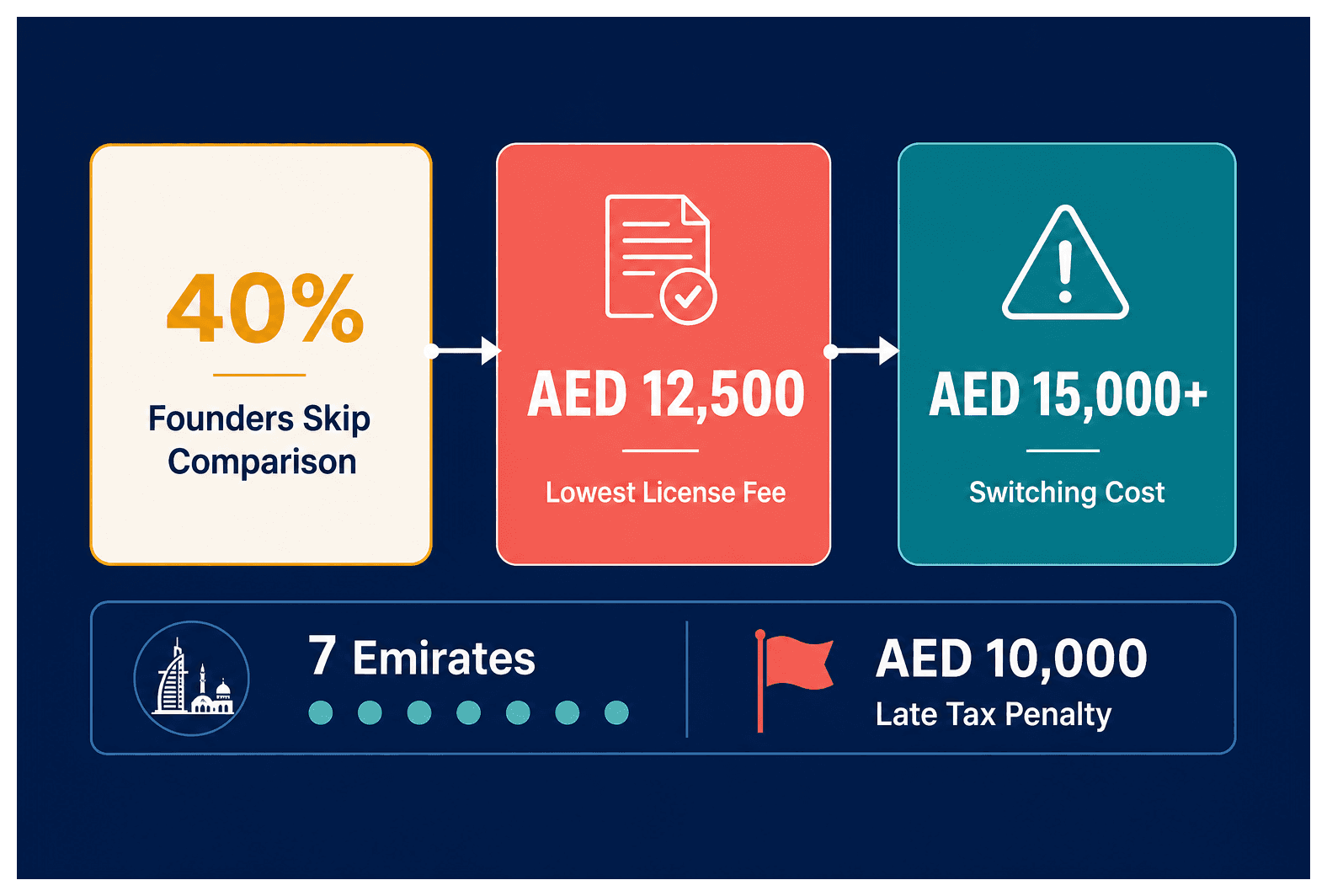
Dubai free zone licenses start from AED 12,500 at Dubai South Business Hub Free Zone, with a first-year cost from AED 18,350 for a sole founder with one visa. Other emirates can price lower but restrict activity scope and visa capacity. Dubai consistently wins on infrastructure, market access, and international credibility.
What the Table Does Not Show: Hidden Differentiators
The comparison table captures the headline numbers. But several factors don't appear in any fee schedule, and they matter just as much in the vs emirates business dubai decision.
Banking access: UAE banks tier their service offerings by emirate. Dubai-registered entities generally access a wider range of business accounts and credit facilities faster. You can explore bank account opening in Dubai options tied directly to your free zone license.
Talent pipeline: A tech startup hiring five software engineers will find the Dubai talent market three to four times larger than any northern emirate, reducing headhunting costs and time-to-hire materially.
Warehousing and logistics: DSBH does not provide bonded warehousing or customs integration. Founders who need these must plan a separate logistics arrangement, regardless of emirate.
VAT treatment: DSBH is not a designated zone under UAE VAT law. Free zone goods are duty-suspended, not duty-exempt. This applies equally in most northern emirate free zones.
Corporate tax: Qualifying for the 0% corporate tax rate as a Qualifying Free Zone Person (QFZP) requires four specific conditions, adequate substance in the free zone, qualifying income only, no mainland business nexus, and audited financial statements. This applies in any emirate's free zone, not just Dubai. Miss one condition and the standard 9% rate applies (Federal Tax Authority, 2024).
Worth flagging: the late VAT registration penalty is AED 10,000. The corporate tax late registration penalty is also AED 10,000, as a one-time flat fee. Neither penalty varies by emirate.
Visa Quotas, Residency Rights, and Workforce Rules by Emirate
Visa quotas in UAE free zones are tied to license type and office package, not to the emirate alone. Dubai free zones typically offer flexible quota scaling. Visas are always an additional cost to the license fee. UAE residency visas issued by any emirate's free zone are valid nationwide for living and banking.
How Visa Allowances Differ Across Emirates
Free zone visa quotas are determined by each authority's package structure, not by federal law. That means a Dubai free zone and a northern emirate free zone may offer the same base quota at different price points. At DSBH, visas are always an additional cost on top of the license fee. The first-year figure of AED 18,350 for a sole founder already incorporates one visa, but that visa cost is a separate line item, not a bundled inclusion.
A founder setting up a four-person consultancy should model total year-one cost including four visa fees, Emirates ID fees, and medical screening before comparing emirates on license price alone. The UAE residency visa issued by any free zone is valid across all seven emirates for residence, banking, and driving license purposes (ICP, 2024). So the residency benefit itself is not a Dubai-exclusive advantage, it's a federal benefit that applies wherever your license sits.
Mainland Workforce Rules and MoHRE Obligations
Free zone companies in any emirate that hire mainland-based staff must comply with MoHRE regulations regardless of where the license is issued. The Wages Protection System (WPS) applies to all employers sponsoring staff under UAE labour law, whether the license is in Dubai or Fujairah.
Emiratisation obligations under the Nafis programme (Nafis, 2024) apply primarily to mainland companies above certain headcount thresholds. Free zone companies have separate, generally lighter obligations. Founders comparing emirates should confirm the specific sponsorship and WPS requirements with the relevant authority before committing to a structure.
Is a UAE residency visa from a northern emirate free zone accepted in Dubai?
Yes. A UAE residency visa issued by any free zone authority, in any emirate, is valid across all seven emirates for residence, banking, and driving license purposes. The visa is a federal document processed through ICP (Federal Authority for Identity, Citizenship, Customs and Port Security). The issuing emirate does not restrict where you can live or bank.
Five Scenarios Where Dubai Wins the vs Emirates Business Dubai Decision
Dubai is the stronger choice when your clients are Dubai-based, your activity requires DET or sector-specific regulatory approval, you need fast banking access, your brand relies on a Dubai address, or you plan to scale headcount within 12 months. In these scenarios, a lower license fee elsewhere rarely offsets the structural advantages.
Step 1: Identify Your Client Geography
If 70% or more of your revenue comes from Dubai-based clients, a Dubai license eliminates friction in contract discussions, invoicing, and in-person meetings. A management consultant whose top five clients are all in DIFC or Downtown Dubai will close deals faster with a Dubai free zone address than with a Ras Al Khaimah or Fujairah equivalent. A Dubai address signals market presence to multinational procurement teams, particularly relevant for professional services, ICT, and financial advisory.
Northern emirate licenses can work well for fully remote or export-focused businesses where client geography is global rather than UAE-local. But if your pipeline is Dubai-heavy, start with Dubai.
Step 2: Map Your Activity to the Right Regulator
Regulated activities, healthcare, education, financial services, require both a free zone license and separate approval from the named sector regulator. DSBH licenses the activity; the named regulator approves it separately. For healthcare, that's the Dubai Health Authority (DHA). For education, it's the Knowledge and Human Development Authority (KHDA). For Dubai mainland trade, it's DET (DET, 2024).
A telehealth startup, for example, must obtain both a DSBH free zone license and a DHA facility approval, two separate processes. DSBH handles company formation; DHA handles clinical authorization. Dubai hosts these regulators. Not every northern emirate does. If your activity requires a Dubai-specific regulator's sign-off, there's no practical alternative to a Dubai license. You can review the full list of business activities available at DSBH to confirm your activity's classification before applying.
Step 3: Factor in Banking and Fintech Access
Major UAE banks and digital banking platforms are headquartered or have primary operations in Dubai. Dubai-registered entities often face shorter account-opening timelines and access a broader range of corporate banking products. For any business where fast cash-flow access matters, particularly in financial services or fintech, Dubai's banking ecosystem is a structural advantage over more peripheral emirates. DSBH licenses financial services activities, but the relevant financial regulator approves them separately.
Step 4: Consider Scenarios Where Another Emirate May Suit Better
The vs emirates business dubai comparison isn't always won by Dubai. A passive holding company owning international intellectual property with no UAE staff or clients may reasonably consider a lower-cost northern emirate free zone for pure cost efficiency. Manufacturing or heavy industry businesses may find purpose-built industrial zones in Abu Dhabi or Fujairah better suited to their physical infrastructure needs.
The goal is matching jurisdiction to business model, not defaulting to the cheapest or the most recognized name. If your business has no Dubai-specific regulatory requirement, no Dubai client base, and no near-term hiring plan, a northern emirate free zone may genuinely be the right fit.
Corporate Tax, VAT, and Regulatory Obligations Across the UAE
UAE corporate tax and VAT obligations are federal and apply uniformly across all seven emirates regardless of where you license. The 0% corporate tax rate for Qualifying Free Zone Persons requires four specific conditions. VAT and corporate tax late registration each carry a one-time AED 10,000 penalty. Emirate of registration does not change these rules.
Federal Tax Rules That Apply in Every Emirate
This is one of the most common misconceptions in the vs emirates business dubai comparison: the idea that Dubai free zones are "tax-free" while other emirates aren't, or vice versa. Neither is accurate. UAE corporate tax is a federal law. It does not vary by emirate. A northern emirate free zone company faces the same corporate tax framework as a Dubai free zone company.
The 0% QFZP rate requires all four of the following conditions to be met:
Adequate substance in the free zone (real operations, not a mailbox)
Qualifying income only (specific categories defined by federal regulation)
No mainland business nexus
Audited financial statements filed annually
VAT registration is mandatory once taxable supplies exceed AED 375,000 per year, regardless of emirate. Late VAT registration carries a one-time AED 10,000 penalty. Late corporate tax registration carries a separate one-time AED 10,000 flat penalty (Federal Tax Authority, 2024). A DSBH company and a northern emirate free zone company face identical filing deadlines and penalty structures.
Designated Zone Status and What It Does Not Cover
Designated zones under UAE VAT law have specific customs and VAT treatment for goods. Not all free zones qualify. DSBH is not a designated zone. Free zone goods at DSBH are duty-suspended, not duty-exempt, a meaningful distinction for import-heavy businesses. DSBH also does not offer bonded warehousing or customs integration.
An e-commerce retailer importing consumer electronics needs to confirm designated-zone status with any free zone they consider, in any emirate, before assuming duty-suspension benefits. The designated-zone question is relevant in Dubai and in other emirates alike. It's a classification, not a Dubai-specific advantage. Check with the Ministry of Finance for the current list of designated zones if your business involves physical goods movement.
Does registering in Dubai reduce my corporate tax rate?
No. UAE corporate tax is a federal law that applies uniformly across all seven emirates. The 0% rate for Qualifying Free Zone Persons requires four specific conditions regardless of which emirate's free zone you use. Emirate of registration has no bearing on your corporate tax rate or filing obligations.
How to Choose Between Dubai and Another Emirate for Your Business Setup
Choose Dubai when your clients, regulators, or talent pool are concentrated there. Choose another emirate when your activity is industrial, your cost sensitivity is high, and your business has no Dubai-specific regulatory or market requirement. Always model total first-year cost including visa fees, not license price alone.
The Decision Checklist for First-Time Founders
Confirm your primary client geography. If it's Dubai, start with Dubai.
Identify whether your activity requires a Dubai-specific regulator (DHA, KHDA, DET). If yes, Dubai is mandatory.
Model total year-one cost across at least two scenarios, Dubai free zone and a northern emirate free zone, including visa fees, Emirates ID, medical screening, and bank account charges in every scenario.
Assess your 12-month headcount plan. If you expect to hire more than two people, compare visa quota costs, not just license fees.
Confirm banking needs. If fast corporate account access matters, weight Dubai's ecosystem advantage in your decision.
A sole founder launching a B2C online retail brand with Dubai customers should model: DSBH B2C license from AED 12,500, plus visa, Emirates ID, and medical screening, arriving at a year-one figure from AED 18,350 before bank account fees. Zero paid-up share capital is required. You can run the exact numbers using the business setup cost calculator at DSBH.
When to Revisit the Decision After Setup
References
Frequently Asked Questions